
The music industry has a problem it rarely discusses without wrapping it in words like “innovation,” “engagement,” and “creativity”: once hundreds of millions of people are already paying every month to stream virtually every song ever recorded, where does the next pile of money come from? Raising subscription prices only gets you so far, advertising has its limits, and convincing people to buy music they effectively already rent has become rather difficult. Enter generative AI, which offers Spotify and the record labels something irresistible: an entirely new way to monetize the same catalog all over again.
Spotify users and musicians should therefore pay very close attention to what comes next. Spotify is preparing to let subscribers use generative AI to create covers and remixes of commercially released music, with Universal Music Group already onboard and Merlin joining the party on August 4. The feature is expected to become an additional paid option for Premium subscribers, which is a rather elegant way of saying that after charging you to hear the original recording, the music industry has discovered it might also be able to charge you to mess with it.
Somebody in a boardroom will undoubtedly call it “unlocking value” without being struck by lightning.
Related Reading:
- Suno Will Press Your AI Songs On “Vinyl” For $45. Who Exactly Asked For This?
- Streaming Is Booming But Universal Music Lost Nearly €9 Billion In One Day
What Exactly Is Spotify Building?
Spotify’s forthcoming tool will allow users to create AI-generated covers and remixes using music from participating artists and songwriters. The company first announced licensing agreements with Universal Music Group and Universal Music Publishing Group in May, followed by a separate agreement with Merlin in August. Pricing and a firm launch date have not been announced, but Spotify has made clear that the feature is intended to become another paid layer within its Premium ecosystem.

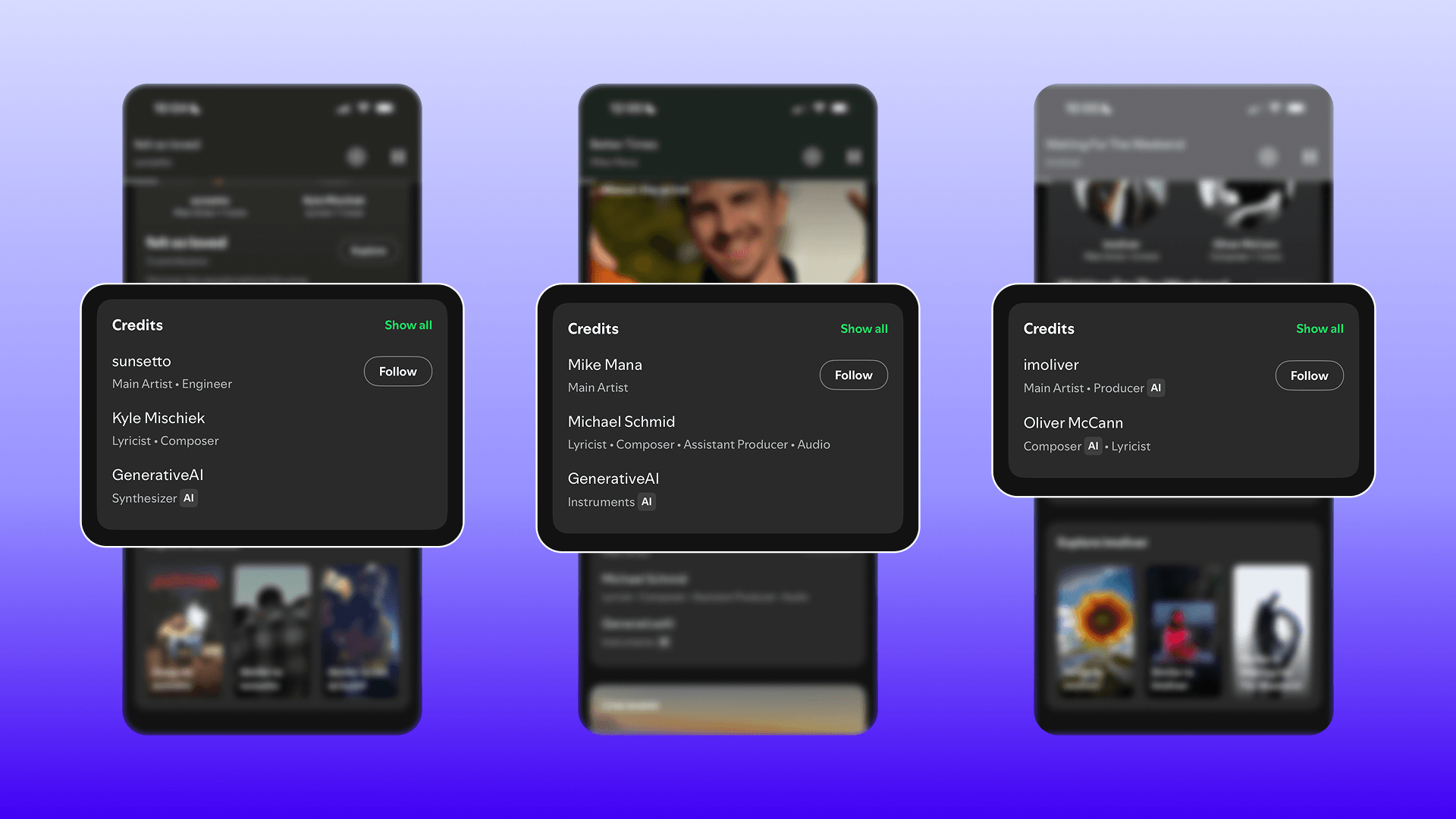
Spotify says participating artists and songwriters will receive credit and compensation, and that consent will be fundamental to the model. Merlin has been even more explicit, stating that artists represented through its participating labels will have the option to take part. That matters because this is not being presented as open season on every recording sitting inside Spotify’s servers.
So no, you should not assume that Spotify is about to hand you “Seven Nation Army” and let you turn it into Bavarian techno because you had three beers and discovered a BPM slider. Nor should we assume that The Cure’s “A Forest” will suddenly become available for someone to transform into a 160 BPM EDM anthem until Robert Smith’s head explodes. Those recordings would have to be part of the participating catalog, and Spotify has not announced either one.
Do Artists Actually Get a Say?
According to Spotify and Merlin, they do, and that distinction is important. Spotify repeatedly describes the system as involving participating artists and songwriters, while Merlin specifically says its artists will have a choice. That already puts the proposed service on firmer ethical ground than the Wild West model of generative AI, where a voice gets cloned, a composition gets mangled, and everyone starts asking questions after the streams have already accumulated.
The unanswered question is how that consent works once actual music-industry contracts enter the room. Recorded music involves separate rights in the sound recording and underlying composition, and those rights may be controlled or administered by artists, labels, songwriters, publishers, or some combination of all four. An artist may control one thing, a label another, and a publisher something else entirely.
That is where Spotify still owes listeners and musicians a much clearer explanation. Does the artist personally approve participation? Can a label authorize certain uses of a master under an existing recording agreement? Can a publisher approve uses of the composition without the songwriter making an individual decision each time? What happens when the performer, songwriter, label, and publisher are all different parties and one of them looks at your death-metal interpretation of “Dancing Queen” and sees nothing but incremental revenue?
Those are not insignificant contractual details. They determine whether “artist consent” means genuine creative control or merely that someone legally entitled to license the work has signed the correct piece of paper.
There Is Actually a Good Version of This
There is a legitimate argument for what Spotify is trying to build. AI covers and remixes are not going away, and a licensed system that identifies the original creators, compensates rights holders, and restricts participation to approved works is preferable to an unregulated platform where somebody clones a voice, copies a composition, uploads the result, and waits for a lawyer to notice.
There is also nothing inherently offensive about remix culture. Hip-hop, electronic music, dub, dance music, and countless other genres have spent decades sampling, reshaping, and reconstructing existing recordings. Some of the most influential music ever made emerged from artists taking existing sounds apart and putting them back together in ways nobody expected.
The difference is that doing it well traditionally required some degree of talent, judgment, taste, and technical ability. Generative AI is about to drop that barrier through the floor. That could produce genuinely fascinating creative work, but it will also produce a tidal wave of absolute rubbish because there is no technological breakthrough capable of curing bad taste.
And Here Comes the Money
This is where the warm feeling starts to disappear. Spotify is not building this purely because it wants listeners to discover their inner Quincy Jones. The remix capability is being positioned as another paid product, while the labels and rights holders involved are openly discussing new forms of monetization and compensation. Businesses are allowed to make money, obviously, but the music industry has become remarkably talented at turning every new technological shift into another opportunity to charge somebody for interacting with recordings that already generate revenue.
We have spent years watching streaming turn ownership into access, access into subscriptions, subscriptions into multiple tiers, and those tiers into increasingly elaborate packages. Now the industry has identified another product hiding inside the music it already licenses: your ability to modify it.
The original recording makes money. The AI remix can make money. The tool required to create the remix can make money. The labels and publishers can collect licensing revenue from the process. And if somebody eventually takes that AI remix and presses it onto a $45 PETG record, we will have achieved the perfect circle of modern music economics: take somebody else’s song, run it through artificial intelligence, charge the listener to alter it, monetize the derivative version, and then sell them a physical copy of the result.
Suno must be furious it didn’t invent the entire chain first.
From AI Sludge to AI Remixes
That is what makes Spotify’s announcement such a useful companion to the Suno vinyl story. Suno is attempting to give AI-generated music the physical legitimacy of a record, even if the “record” happens to be made from PETG and the music might have been generated while somebody waited for the microwave to finish.
Spotify is approaching the problem from the other end. It starts with legitimate, copyrighted, commercially released music and offers AI as the means to mutate it into something new. In both cases, the sales pitch wraps itself around creativity and access, but there is a very obvious commercial engine underneath.
Labels spent years fighting piracy because they were losing control over copying. They fought streaming until they figured out how to monetize it. They spent the early AI era warning about unauthorized training, cloning, and derivative works. Now that licensing structures are beginning to emerge, the language is changing very quickly from existential threat to exciting new revenue stream.
Funny how that happens.
The Real Test Is Artist Control
Spotify deserves some credit for attempting to build licensing, attribution, and compensation into this system before releasing it. That is considerably more responsible than dumping an unrestricted AI generator onto hundreds of millions of users and asking the legal department to hide under a conference table.
But the phrase that matters here is not AI-powered. It is artist-approved. If Robert Smith can say no and “A Forest” remains “A Forest,” fine. If Jack White decides that “Seven Nation Army” has already endured enough football stadiums without being transformed into yacht rock by someone named Chad in Scottsdale, even better.
The problem begins if “consent” ultimately means that somebody holding sufficient contractual rights inside a multinational music company can approve the use because another revenue stream looked attractive during an earnings call. At that point, we should stop calling it fan empowerment or participatory creativity.
It’s inventory.
Related Reading:
- Why Should AI Created Music Be Allowed On The Charts At All?
- Amazon Music Opens Alexa+ AI Playlists And Conversational Search To Every U.S. User
- Global Paid Music Subscriptions Hit 865 Million As Streaming Takes 86% Of Spending
- AI Music Labels Are Coming To Streaming, But Will They Actually Work?
- TIDAL Says AI Music Can Stay, But It Won’t Get Paid































Asa
August 10, 2026 at 7:50 pm
I suppose that’s what DJs do to a certain extent with their ‘mixes’ (all approved, right?), but I would think most Artists who have a spine(?) would not sign off on this, and yet most sign their entire lives away and give it to creatures that feign care.
I’m sure Metallica would love to hear ‘One’ shaken, not stired, with Swift’s ‘Shake it Off’…yes, that’s the ticket.
Thanks for caring and writing the lines and those in between.
What a world!
PS. AI/LLMs will be the end of civilization…it’s only getting started in every aspect of life/living. It doesn’t have to be this way, but it’s by design from the deep. Mimicry.