
Spotify spent most of its existence convincing listeners that music did not really require a screen. After building the largest paid audio-streaming service in the world, the company now appears rather interested in your eyeballs as well.
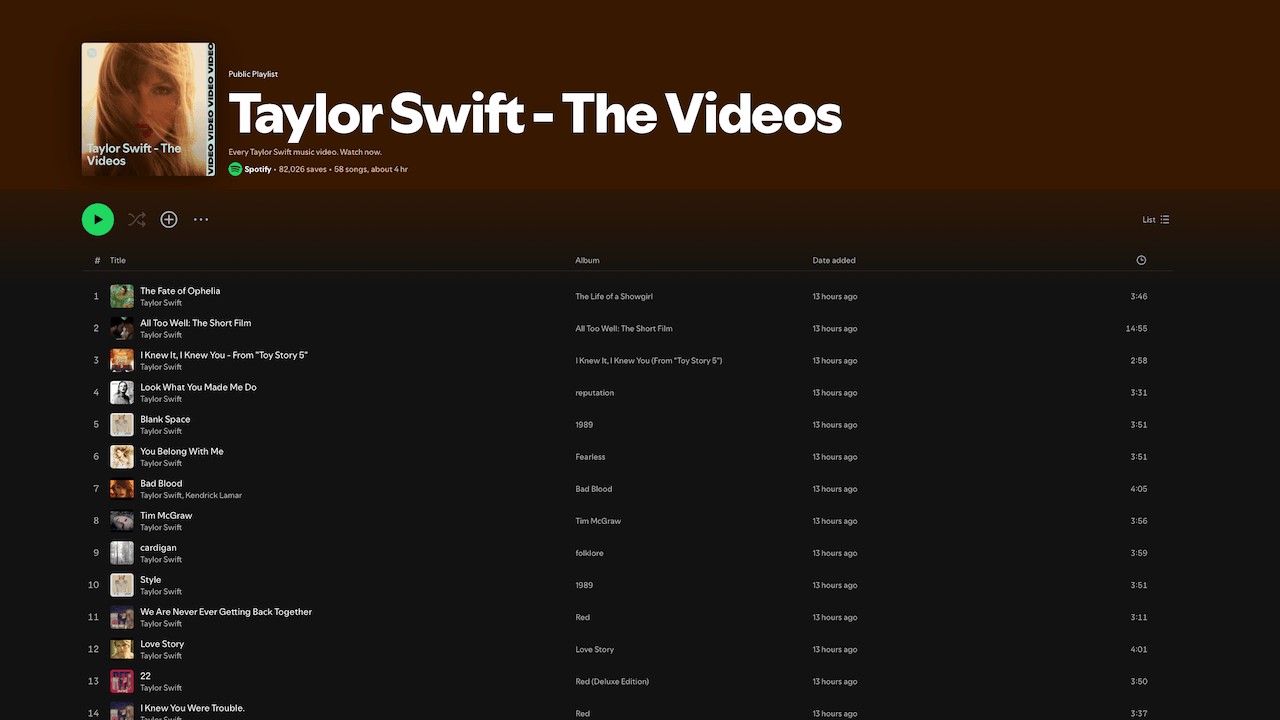
All 58 of Taylor Swift’s official music videos are now available to Spotify Premium subscribers in markets where its music-video beta is offered, stretching from “Tim McGraw” through 2026’s “Opalite.” Videos can be watched on Spotify’s TV, desktop, iOS and Android apps, giving one of the largest fanbases in popular music another reason to stay inside Spotify rather than opening YouTube.
The implementation is more important than simply dumping videos into another menu. Start playing a supported song, tap “Switch to video,” and the video begins at the same point; switch back to audio and the song continues without restarting. It is hardly revolutionary; YouTube Music introduced essentially the same concept seven years ago, but convenience has always been Spotify’s sharpest weapon.
Related Reading:
- Spotify Will Label AI Artists And Stop Recommending Them. So Why Is It Letting Fans Remix Real Music With AI?
- Spotify Finally Tries Hi-Fi: Lossless Listening Lounge In London Built Around Horn Speakers And Bryston Power
Spotify Did Not Invent Music Videos on a Streaming Service
Before anyone starts carving Daniel Ek’s face into Mount Rushmore, Spotify is rather late to this particular party.
Apple Music already offers music videos, curated video playlists, live performances and the 24-hour Apple Music TV channel. TIDAL says its video section includes more than 650,000 music videos and other visual programming including concerts, documentaries and original shows.
Then there is YouTube Music, which added seamless switching between songs and corresponding music videos back in 2019. At the time, Google said it had already time-matched more than five million official videos with their audio tracks.
Spotify’s advantage is therefore not invention. It is scale, personalization and the opportunity to make video feel like an extension of what hundreds of millions of people are already doing inside the app.
Why Taylor Swift Matters
Spotify began testing music videos in 2024 and expanded the beta to Premium subscribers in the U.S. and Canada in late 2025. It has since added Videos for You, a personalized playlist refreshed daily with music videos, live performances and covers tailored to the listener.
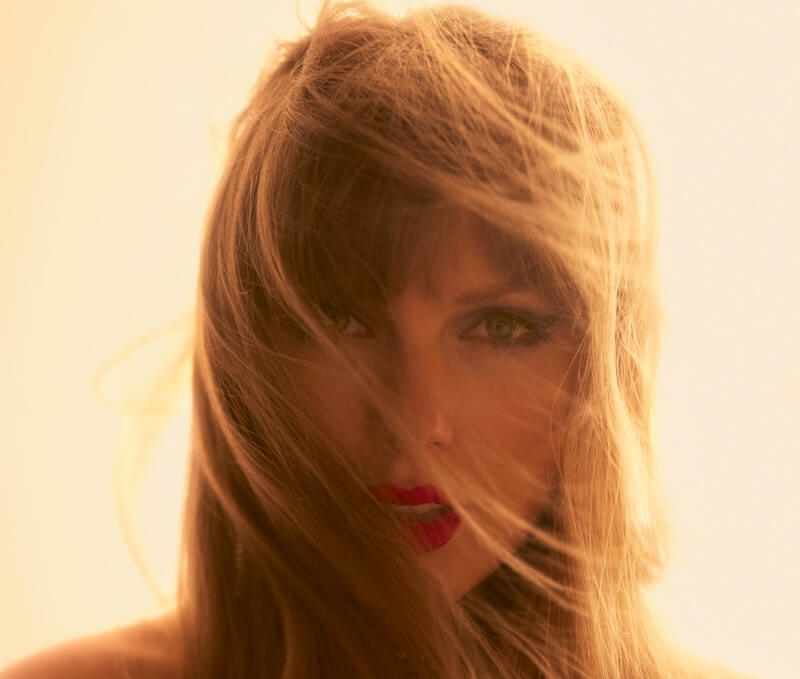
Taylor Swift gives Spotify a rather more visible demonstration than another obscure beta button. Her videos have long functioned as extensions of her albums and eras, and Spotify now has the complete official catalog available without forcing fans to leave the service. Or drop $9,000 on concert tickets.
The potential engagement is enormous. Spotify reported 300 million Premium subscribers and 777 million monthly active users for Q2 2026, and said at its May Investor Day that more than two-thirds of Premium subscribers had already watched music videos on Spotify.
That last number is probably the one YouTube should circle.
Spotify Is Becoming a Lot More Than a Music App
The Swift rollout makes considerably more sense when viewed alongside what Spotify has been doing elsewhere.
After years of dangling Spotify HiFi in front of audiophiles like a carrot attached to a fishing pole, the company finally rolled out Lossless playback at up to 24-bit/44.1kHz FLAC for Premium users in 2025. Spotify has also expanded audiobooks to more than 700,000 titles across 22 markets, turning books into a substantial part of the platform rather than an interesting tab most people forget exists.
The company is also becoming more interactive. Talk to Spotify, currently rolling out in beta to eligible Premium users, lets listeners speak or type conversational requests about music, podcasts, audiobooks and their own listening history. Spotify increasingly wants you asking it what to play rather than deciding that Google or ChatGPT should answer first.
Then there is Reserved by Spotify, launched with Live Nation and powered by Ticketmaster. Spotify identifies some of an artist’s most engaged Premium listeners using signals such as streams, saves and shares, and can hold two concert tickets for them to purchase before the general sale. Spotify is no longer satisfied with knowing that you listen to an artist; it would also like to participate in getting you through the venue door.
Video is following the same strategy. Spotify has already experimented with 48-hour music-video exclusives, allowing fans to watch certain new videos on Spotify before they appear elsewhere. Add personalized videos, video podcasts, lyrics, concert discovery, ticket access and artist pages, and the direction becomes rather difficult to miss.
Spotify wants the song, the video, the podcast interview, the audiobook, the concert ticket and as much of the relationship between fan and artist as it can reasonably fit inside one green application.
Why Should Listeners Care?
Convenience is the obvious answer. If you are already listening to Taylor Swift, Noah Kahan or another artist on Spotify, moving from the song to the video requires one button instead of leaving the app, finding the correct video on YouTube and starting again.
That becomes more interesting on a television. Spotify can move from being something playing invisibly through a streamer or smart speaker to an actual visual entertainment app, while still letting listeners return to background audio the moment they decide they have had enough choreography.
Spotify’s recommendations are another advantage. The company already knows what listeners play, save, skip, revisit and share, which gives it an enormous behavioral dataset for recommending video without requiring users to build another viewing history from scratch.
Should YouTube Actually Be Worried?
It should pay attention. Panic would be premature.
YouTube still owns an enormous music-video ecosystem Spotify cannot reproduce overnight, including official releases, live performances, fan uploads, interviews, archival footage, covers, reaction videos and almost every other piece of music-related video ever pointed at a camera.
Spotify does not need to replace all of that. It only needs to remove enough reasons for its existing users to leave.
That is where Taylor Swift matters. If somebody already pays Spotify, follows her there, receives recommendations there and can now watch all 58 official videos without opening another service, YouTube loses one small piece of engagement. Repeat that across enough major artists and Spotify starts reclaiming a meaningful amount of attention.
There is also some delicious irony in Spotify borrowing a concept YouTube Music introduced in 2019 and presenting it to an audience of 300 million paying subscribers. Timing has never prevented Spotify from eventually turning somebody else’s table stakes into a very large business.

The Bottom Line
Spotify’s real play here is retention. Taylor Swift is an almost absurdly effective test case because her fans already treat the visual side of her catalog as part of the music itself. If Spotify can make watching the official video as frictionless as hearing the song, one of the most obvious reasons to jump over to another app disappears.
The expanding catalog will inevitably include considerably less essential viewing. Macklemore remains available for anyone who feels their evening is incomplete without a political lecture followed by “Hind’s Hall.” His recent MetLife performance drew objections from the Israeli-American Council, Pink and Robert Kraft — owner of the New England Patriots and Gillette Stadium and founder of the Foundation to Combat Antisemitism, who said Macklemore’s recent actions and what Kraft described as a broader history of antisemitic rhetoric and imagery were deeply offensive to the Jewish community. Macklemore was subsequently dropped from Ed Sheeran’s tour after venues objected to his participation.
That is the bargain Spotify is making as it becomes a larger visual platform: more choice also means more material you may desperately wish had remained unavailable in either format. Fortunately, the skip button remains one of the finest inventions in streaming.
Related Reading:



































Bob Kraft
September 17, 2026 at 12:00 pm
That guy can’t sing for shit. And what a pathetic cuck Sheeran was for letting him perform.
Spotify has how many paying subscribers? How are Qobuz and Tidal still in business?
Strange times.
Ian White
September 17, 2026 at 2:00 pm
Bob,
Guess by the sarcasm that you are not a Pats fan. I would agree that the first idiot could never sing and that his anti-semitic imagery was highly offensive. Especially here in NJ at MetLife Stadium in a state with 520,000 Jewish American residents.
He has the right to spout that nonsense. We also have the right to pay money for a concert that doesn’t become a political rally filled with hate.
IW