
There remains a corner of high-end audio that sees the words “Made in China” and immediately reaches for the smelling salts.
That attitude is becoming increasingly difficult to defend.
There is also an important distinction between Chinese-owned companies designing and manufacturing their own products and American, Canadian or British audio brands having products manufactured in China. Both approaches can result in excellent hardware. What matters is whether manufacturers are transparent about where and how their products are made, whether the engineering is sound and whether buyers are getting what they were promised.
A misleading flag on the back panel does not improve sound quality.
Neither does a passport.
FiiO and Eversolo are two particularly good examples of how far Chinese hi-fi manufacturers have come. FiiO, founded in Guangzhou in 2007, has grown far beyond the portable players, DACs and headphone amplifiers that established its reputation. Eversolo, based in Shenzhen and backed by Zidoo Technology, has moved rapidly from network players and DACs into amplifiers, speakers and increasingly ambitious two-channel systems. FiiO says several of its products have achieved record sales within their categories; comparable audited sales figures from Eversolo are not public, but its expanding product range and international distribution make it rather difficult to dismiss as a niche curiosity.
Their latest amplifiers make the point rather nicely.
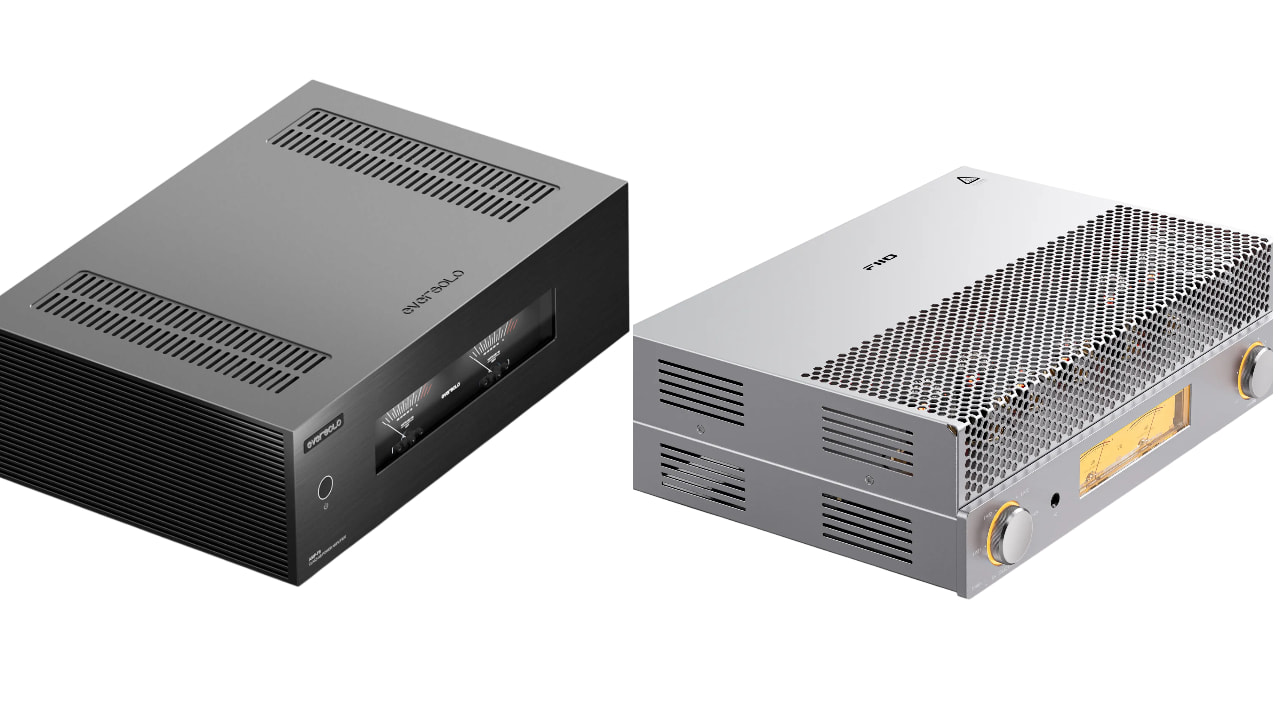
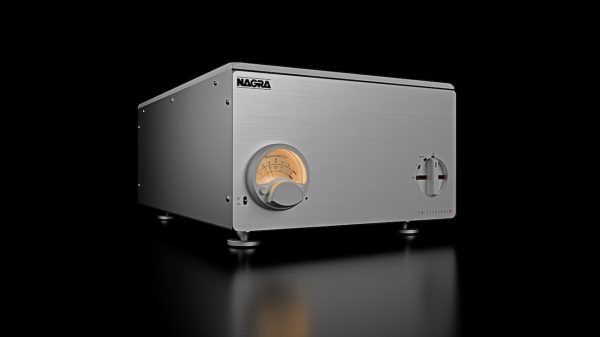
The $1,800 Eversolo AMP-F8 and $769.99 FiiO EA13 both come from Chinese manufacturers, both feature analog VU meters and both are aimed squarely at two-channel listeners.
That is roughly where the similarities end.
Related Reading:
- FiiO EA13 Is A $769.99 EL34 Class A Tube Amplifier That Should Cost A Lot More
- 11 New High End Vienna 2026 Products I Want To Review Most
Two Completely Different Ideas About Amplification
The Eversolo AMP-F8 is a conventional high-power Class AB stereo power amplifier. It delivers 180 watts per channel into 8 ohms and 280 watts into 4 ohms, and it can be bridged to produce 500 watts into an 8-ohm load. There is no volume control or source selection because that is not its job; you will need a preamplifier, DAC with variable output or one of Eversolo’s streaming components with preamp functionality.
The FiiO EA13 travels back several decades in the opposite direction.
It uses four JJ Electronic EL34 output tubes with two NOS Sylvania PCF80 tubes in a pure Class A push-pull circuit. FiiO calls it a power amplifier, but with four RCA inputs and an analog volume control, it operates more like a traditional integrated amplifier. It also includes a 6.35 mm headphone output.
And then there is the power discrepancy.
FiiO advertises up to 28 watts per channel into either 4 or 8 ohms, but that figure is specified at less than 5% THD+N. At less than 1% THD+N, FiiO specifies at least 18 watts per channel. That distinction is important when comparing it with the considerably more powerful Eversolo; treating 28 watts and 180 watts as directly equivalent specifications would be misleading.
One is designed to control a wide range of modern loudspeakers without breaking much of a sweat.
The other expects you to choose your loudspeakers rather more carefully.
Neither approach is wrong.
Eversolo AMP-F8: Power, Control and System Flexibility
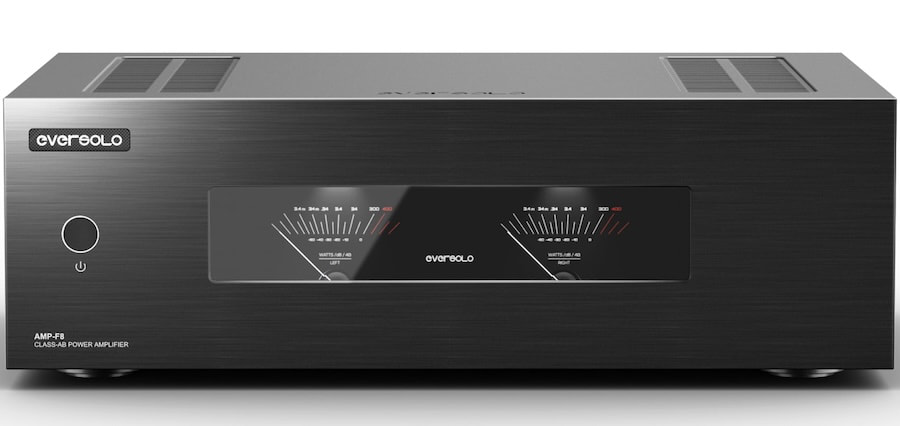
The AMP-F8 is the easier amplifier to recommend from a loudspeaker-matching perspective.
Its 180-watt output into 8 ohms rises to 280 watts into 4 ohms, while a damping factor greater than 400 suggests substantial electrical control over a loudspeaker’s drivers. Eversolo specifies THD+N at 0.003% and an A-weighted signal-to-noise ratio of at least 115 dB. Balanced XLR and unbalanced RCA inputs are provided, along with selectable 23 dB and 29 dB gain settings.
There is also an 800-watt toroidal linear power supply, DC blocking and 24 filter capacitors inside the chassis. At 35 pounds, the F8 might be compact compared with some traditional high-power amplifiers, but nobody is going to mistake it for a WiiM Amp when the delivery driver arrives.
The ability to bridge the F8 offers a useful upgrade path. Start with one in stereo and, should common sense eventually leave the building, add a second amplifier and run the pair as 500-watt monoblocks into compatible 8-ohm loudspeakers.
The limitation is important: Eversolo specifies bridged operation into 8 ohms, not 4 ohms.
The AMP-F8 also does absolutely nothing before the amplification stage. There is no DAC, streaming platform, phono preamp, headphone amplifier or input selector. That makes it ideal for someone who already owns a capable preamplifier or wants to assemble a system one component at a time.
It also means the $1,800 purchase price is not necessarily the end of the bill.
FiiO EA13: Less Power, More Personality
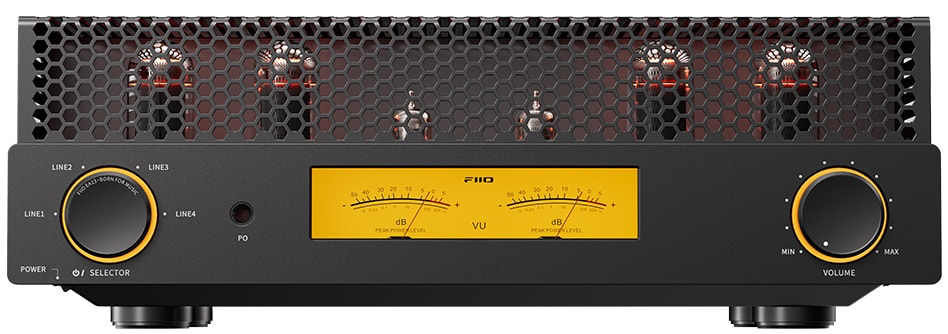
The EA13 asks an entirely different question: how much genuine tube amplifier can FiiO put on your rack for less than $800?
Quite a lot, apparently.
The amplifier weighs 39 pounds and uses six vacuum tubes, custom EI silicon-steel output transformers filled with epoxy resin and fine sand, dedicated 4-ohm and 8-ohm speaker taps, four line-level RCA inputs and an analog volume control. There is no DAC, Bluetooth, streamer or phono stage hiding inside.
Good.
Not every amplifier needs an app.
The EA13 is very much an old-school analog component dressed in considerably newer clothing, complete with mechanical VU meters and adjustable RGB illumination around the controls. Apparently EL34s were not visually interesting enough.
Its greatest strength is also its biggest limitation.
Eighteen clean watts per channel can be more than enough with efficient loudspeakers in a small or medium-sized room. Pair the FiiO with speakers presenting a benign impedance curve and sensitivity in the upper 80s or 90s, and there is no reason to assume that 18 watts will automatically be inadequate.
Try the same thing with inefficient planar speakers or a floorstander that drops toward 2 or 3 ohms and physics will eventually ask to speak with the manager.
The EA13 also brings the realities of tube ownership with it: substantial heat, eventual tube replacement and more attention to speaker matching. Buyers looking for appliance-like ownership should probably keep walking.
For someone curious about real EL34 amplification without spending several thousand dollars, however, $769.99 is an extremely aggressive price. Apos currently lists the amplifier at that price, although stock has been intermittent.
Specifications Compared
| Specification | Eversolo AMP-F8 | FiiO EA13 |
|---|---|---|
| MSRP | $1,800 | $769.99 |
| Type | Stereo power amplifier | Tube stereo integrated amplifier |
| Topology | Class AB | Pure Class A push-pull, pentode mode |
| Output | 180W/ch into 8 ohms; 280W/ch into 4 ohms | 28W/ch into 4 or 8 ohms |
| Bridged Output | 500W into 8 ohms | — |
| THD+N | 0.003% at 1 kHz | 1-5% |
| Signal-to-Noise Ratio | ≥115 dB, A-weighted | ≥97 dB, A-weighted |
| Damping Factor | >400 at 8 ohms/1 kHz | — |
| Frequency Response | 10 Hz to 30 kHz, ±0.5 dB | 20 Hz to 60 kHz, attenuation below 2.9 dB |
| Inputs | Balanced XLR and unbalanced RCA | 4 x stereo RCA |
| Gain | 23 dB or 29 dB | — |
| Power Supply | 800W toroidal linear supply | — |
| Input Tubes | — | 2 x Sylvania NOS PCF80 |
| Output Tubes | — | 4 x JJ Electronic EL34 |
| Speaker Outputs | — | Dedicated 4-ohm and 8-ohm taps |
| Headphone Output | — | 6.35 mm |
| Volume Control | — | 40-step analog control |
| Dimensions | 10.4 x 15.3 x 4.7 inches | 16.9 x 13.3 x 5.7 inches |
| Weight | 35 lbs | 39 lbs |
| U.S. Price | $1,800 | $769.99 |
Advantages & Disadvantages

The AMP-F8 offers vastly greater power, balanced connectivity, low measured noise and distortion, easier compatibility with demanding loudspeakers and the option of converting two amplifiers into high-power monoblocks. Solid-state operation also avoids tube replacement and warm-up rituals.
Its trade-off is that it is strictly a power amplifier. You need something upstream to control volume and select sources, and at $1,800 it costs more than twice as much as the FiiO.
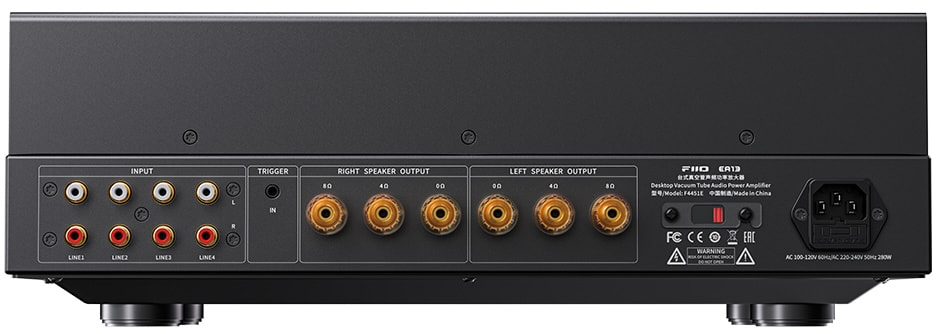
The EA13 provides volume control, four analog inputs, headphone listening and genuine EL34 tube amplification in one chassis for considerably less money. It is arguably the more complete amplifier for someone starting an analog-focused system from scratch.
Its modest clean output makes loudspeaker selection much more important, and there are no balanced inputs, remote control, digital inputs, phono stage or streaming features. Tubes generate heat and eventually wear out because thermodynamics remains stubbornly immune to firmware updates.
Who Should Buy the Eversolo AMP-F8?
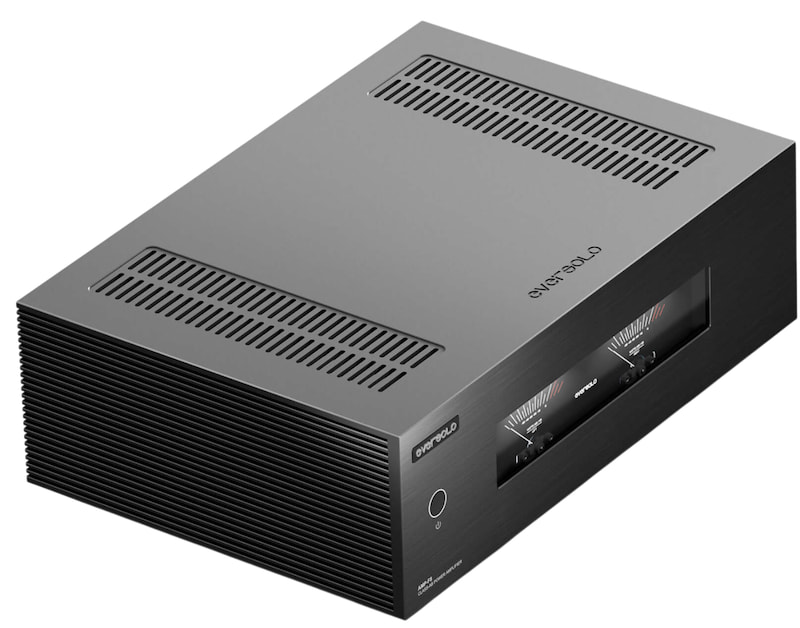
The F8 makes far more sense for listeners using moderately inefficient bookshelf speakers, larger floorstanders or loudspeakers with more demanding impedance characteristics. It also fits systems where the owner already has a streamer/DAC with variable output or a dedicated preamplifier.
It is the amplifier I would consider first if future loudspeaker changes are likely, because 180 watts into 8 ohms and 280 into 4 ohms provide considerably more breathing room.
Owners of Eversolo streamers are the obvious audience, but there is nothing proprietary about the relationship. Its XLR and RCA inputs allow the F8 to work with virtually any suitable preamplifier or variable-output source.
Who Should Buy the FiiO EA13?
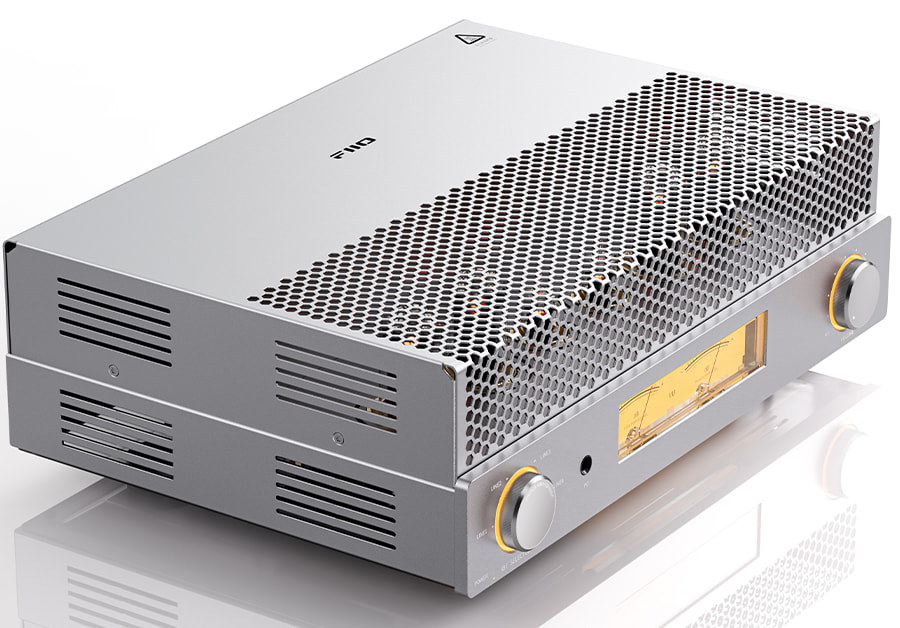
The FiiO is aimed at someone who wants to explore tube amplification and understands that loudspeaker efficiency matters.
It makes particular sense with sensitive standmounts, vintage-inspired loudspeakers, horns and easier-to-drive floorstanders. Someone building a vinyl or analog system around a separate phono stage could connect multiple sources directly and skip a standalone preamplifier altogether.
It is also considerably more interesting for headphone listeners because the Eversolo does not provide a headphone output.
And there is the appeal of the tubes themselves. Some listeners want an amplifier that disappears into the rack. Others want six glowing bottles and moving VU meters staring back at them.
There is room in this hobby for joy.
The Bottom Line
The Eversolo AMP-F8 and FiiO EA13 are not competitors in the conventional sense, which is precisely why comparing them is useful.
For less than $2,000, Eversolo offers a powerful Class AB amplifier designed to drive a broad selection of modern loudspeakers and slot into a serious separates system. For less than $800, FiiO offers a heavy, pure Class A EL34 integrated amplifier that would have seemed absurdly inexpensive from almost any established tube manufacturer only a few years ago.
Neither proves that every audio component manufactured in China is exceptional. That would be just as silly as assuming every amplifier built in North America or Europe deserves a standing ovation.
Quality is quality.
Transparency matters. Engineering matters. Reliability matters. Performance matters. Value matters. The nationality of the company logo?
Much less than some people in high-end audio would like to admit.
Where to Buy:
- Eversolo AMP-F8 – $1,800 at Amazon
- FiiO EA13 – $769.99 at Apos Audio
Related Reading:
















ORT
October 11, 2026 at 9:20 pm
“Shallow Hal needs a tube amp”…If I wanted an amp that doesn’t use tubes I would get an integrated amp. Oh…WAIT! I just did! I gots me a Marantz Model 60n in Silver & Gold!!!!
If I had wanted a tube amp with VU Meters(!!!!) that I could easily afford and didn’t give an airborne intercourse (think about that kiddies!) about having to use a phono pre-amp or a ‘table with a line out function, I definitely would buy the Fi Fy Fo Fum FiiO. In Silver and kinda gold with those two Big Beautiful VU Meters! Talk about having a Media Room with a VU?!
I may still get one!
ORTacles of Thebes
Ian White
October 12, 2026 at 9:45 am
ORT,
Forget about the kiddies. Think about me!
FiiO sold out the first batch. I believe there are more coming. I think the amp looks wonderful but we may have to wait until January 2027 to get a review sample.
IW