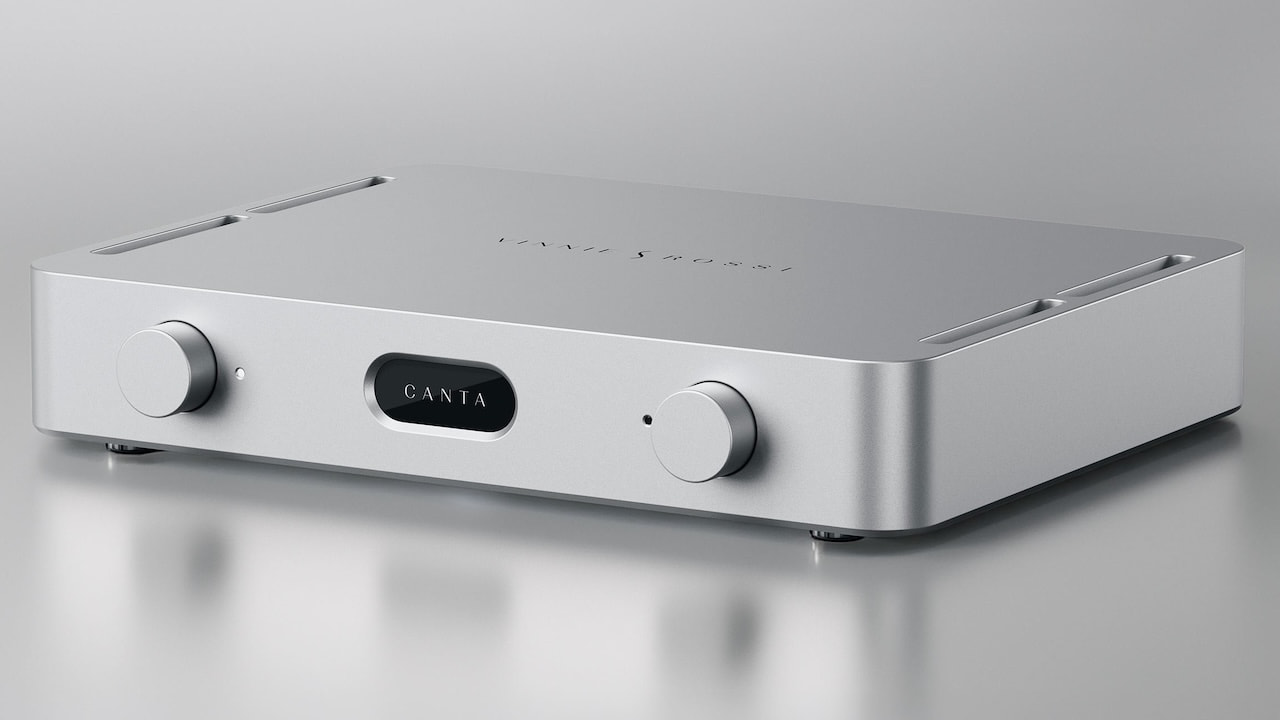
Not every high-end integrated amplifier needs a touchscreen, network connection, and enough software features to require its own IT department. Vinnie Rossi has taken a decidedly different approach with his new CANTA Integrated Amplifier ($23,995), focusing on analog amplification, carefully selected components, and a relatively compact design that doesn’t require reinforcing the furniture.
The American-made CANTA combines a Class A vacuum tube line stage with a Class AB MOSFET power amplifier, delivering 125 watts per channel into 8 ohms and 250 watts into 4 ohms. It follows the CANTA Phono Preamplifier we covered in August and expands a product family positioned below Rossi’s substantially more expensive BRAMA Series.
The new integrated is expected to begin shipping in late October, joining a growing category of premium integrated amplifiers that approach the same problem through very different engineering philosophies. Rossi’s solution is particularly interesting because of its circuit architecture, unusual power supply, and surprisingly modest physical dimensions.
Related Reading:
Why Is the Vinnie Rossi CANTA Integrated Different?
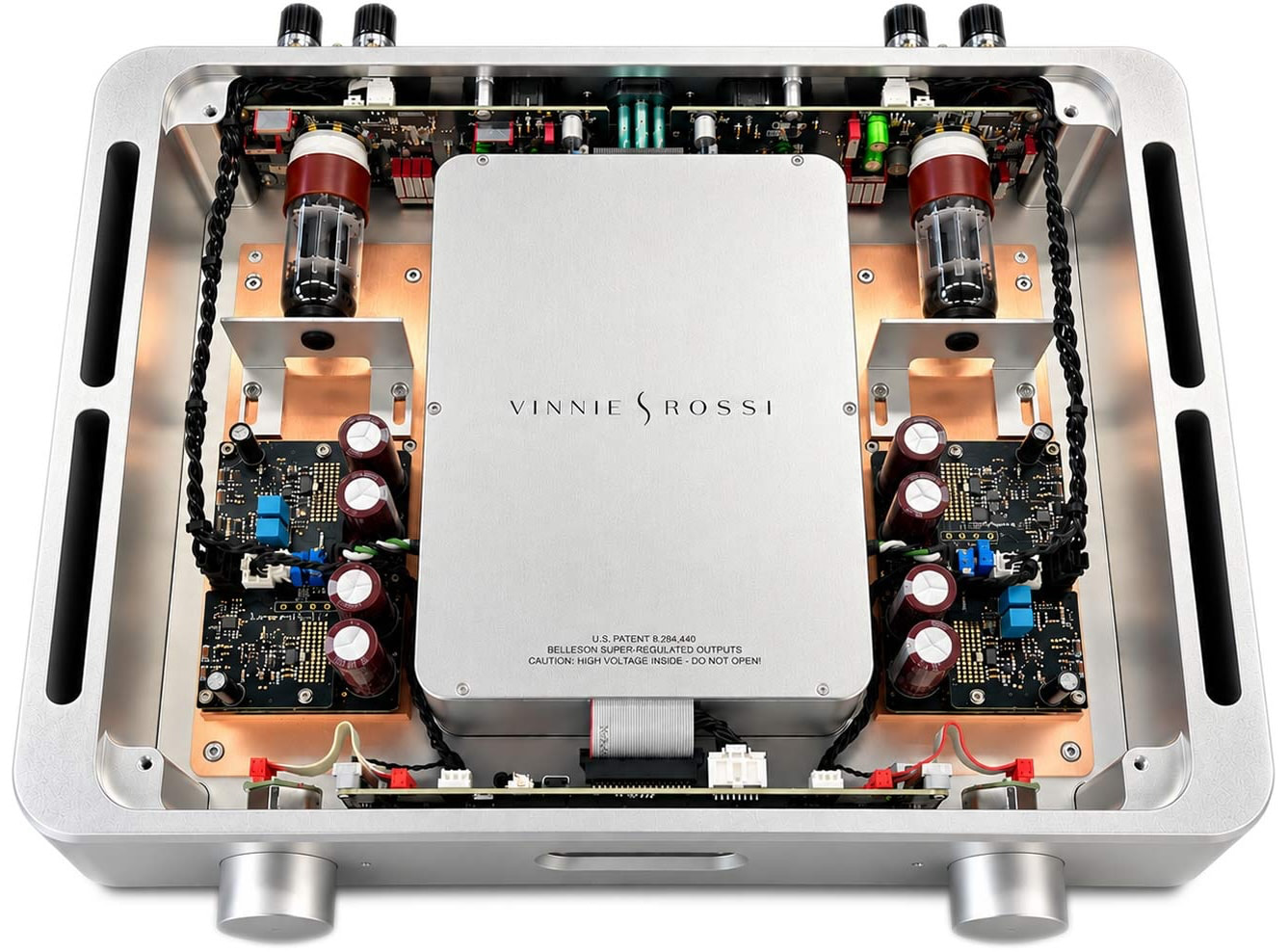
Hybrid amplifiers are hardly revolutionary, but their performance depends on how the designer combines vacuum tubes and solid-state circuitry. Rossi uses a dual-mono Class A line stage built around two 6SN7 triodes, one per channel, with the tubes responsible for voltage amplification rather than delivering current directly to the loudspeakers.
The output section employs precision-matched lateral MOSFETs operating in Class AB, using two devices per supply rail. This arrangement allows the designer to exploit the electrical characteristics of triodes in the input stage while relying on solid-state devices for the considerably more demanding task of driving loudspeakers.
Unlike conventional high-powered tube amplifiers, the CANTA doesn’t require large output transformers, which helps explain its comparatively slim enclosure. Rossi has also emphasized extremely short signal and power paths, reducing unnecessary internal connections and keeping the circuit topology relatively uncomplicated.
The manufacturer’s stated objective is to combine the tonal character and dimensional presentation associated with 6SN7 triodes with the control and current delivery of MOSFET amplification. Whether the resulting sound lives up to those claims is something we would need to evaluate through extended listening rather than accepting the marketing language as gospel.
A Switching Power Supply at This Price?
Perhaps the most interesting engineering decision involves the power supply, which avoids the enormous conventional transformers commonly found inside competing high-end integrated amplifiers. Rossi instead uses a custom switch-mode architecture incorporating power factor correction and Belleson super-regulation, designed to provide stable operating voltages while controlling electrical noise.
The company specifies more than 1,000 watts of peak output capability from the power supply, intended to accommodate dynamic demands without compromising regulation. That figure refers specifically to the supply’s capability, not the continuous power delivered to the loudspeakers.
Switching power supplies still make some audiophiles uncomfortable, largely because earlier implementations developed an unfortunate reputation for electrical noise and interference. Modern designs can achieve excellent performance when properly engineered, although the implementation and measurements matter considerably more than whether a power supply uses a conventional transformer.
Rossi’s willingness to challenge established conventions is consistent with his history of battery-powered amplification and unconventional power delivery. At this price, however, customers are entitled to expect more than an interesting circuit diagram, and the company’s claims about noise performance and stability deserve careful examination.
Build Quality and Everyday Operation
The CANTA’s chassis begins as a solid block of aluminum that is precision CNC machined, fine bead blasted, and anodized. The substantial enclosure is intended to provide mechanical rigidity, electromagnetic shielding, resonance control, and thermal management without the enormous external heatsinks found on some competing amplifiers.
Measuring 16.25 inches wide, 12.75 inches deep, and only 2.75 inches tall, the CANTA weighs 24 pounds, making it considerably easier to accommodate than many integrated amplifiers in this price category. Its low-profile design should also appeal to listeners who prefer their electronics to occupy less visual space, although adequate ventilation remains essential.
The front panel incorporates a high-resolution LCD and two Swiss rotary encoders, with 24-position and 48-position controls handling the amplifier’s operating functions. A 100-step resistor ladder provides volume adjustment, while three selectable gain settings of 22dB, 28dB, and 34dB allow users to accommodate sources with different output levels.
Channel balance can be adjusted across 12 steps, and the amplifier remembers individual gain and balance settings for each input. Home Theater Bypass is also provided, allowing the CANTA to operate with an external AV processor that handles volume control for the front loudspeakers.
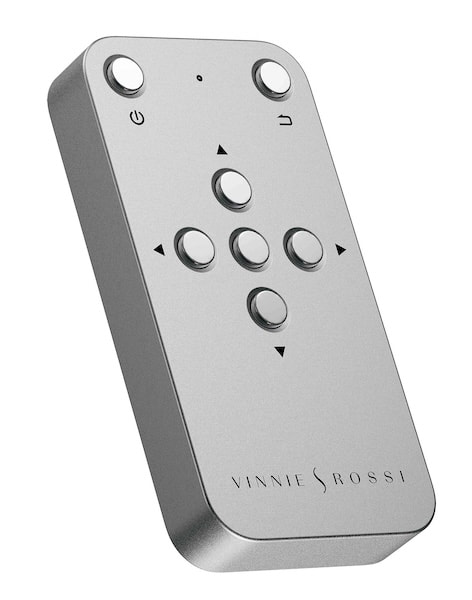
The supplied infrared remote is machined from solid aluminum, matching the attention to materials evident in the main component. Rossi also includes a rugged airtight transportation case with custom foam, heavy-duty latches, and a pressure-release valve, which seems rather sensible when the contents cost more than some used cars.
Connectivity Without the Digital Extras
The rear panel offers two pairs of balanced XLR inputs, two pairs of single-ended RCA inputs, and corresponding volume-controlled XLR and RCA outputs. Gold-plated five-way binding posts handle loudspeaker connections, while a USB-C port is provided exclusively for firmware updates.
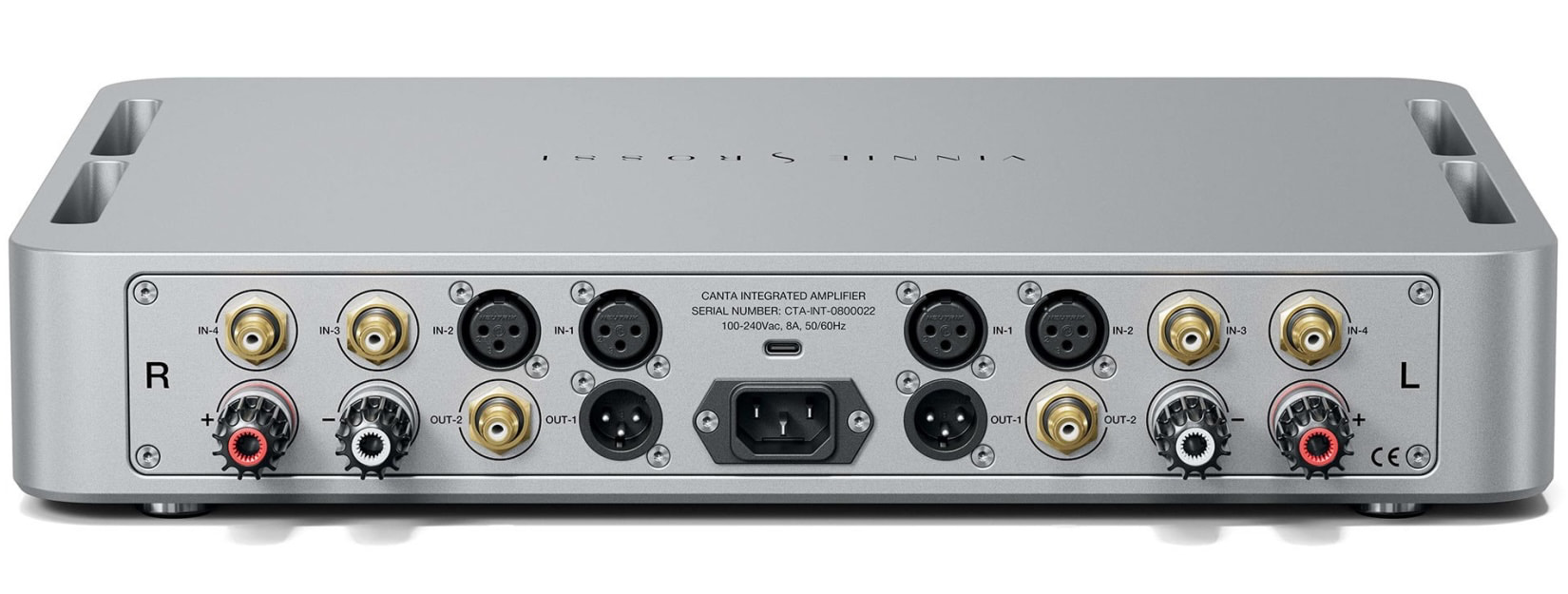
There is no built-in DAC, network streamer, or phono stage, reflecting Rossi’s decision to concentrate on the amplifier’s analog performance rather than offering a complete source and amplification platform. Customers considering the CANTA will therefore need external components for digital playback and vinyl reproduction, which may be entirely reasonable for listeners who have already invested heavily in dedicated source equipment.
The approach also creates an obvious connection to the wider CANTA Series, with dedicated preamplifier and stereo power amplifier models planned to complement the existing phono stage. That modular product strategy gives buyers a potential upgrade path, although the integrated itself is intended to provide the core amplification and control functions in a single chassis.
Vinnie Rossi CANTA Integrated Amplifier Specifications:
- Type: Hybrid stereo integrated amplifier
- Line Stage: Dual-mono Class A
- Vacuum Tubes: Two 6SN7 triodes, one per channel
- Power Amplifier: Dual-mono Class AB lateral MOSFET
- Output Power: 125 watts RMS per channel into 8 ohms
- Output Power: 250 watts RMS per channel into 4 ohms
- Power Supply: Custom switch-mode architecture with power factor correction and Belleson super-regulation
- Power Supply Capability: Greater than 1,000 watts peak
- Frequency Response: 5Hz – 100kHz, ±0.5dB
- THD+N: Less than 0.1%, 20Hz – 20kHz
- Signal-to-Noise Ratio: Greater than 100dB, 20Hz – 20kHz
- Input Impedance: 47k ohms
- Selectable Gain: 22dB, 28dB, 34dB
- Volume Control: 100-step resistor ladder
- Channel Balance: 12-step adjustment
- Analog Inputs: 2 pairs balanced XLR; 2 pairs RCA
- Analog Outputs: Volume-controlled balanced XLR and RCA
- Speaker Connections: Gold-plated five-way binding posts
- Line Output Impedance: Less than 100 ohms
- Speaker Output Impedance: Less than 0.05 ohms
- Home Theater Bypass: Yes
- USB Type-C: Firmware updates only
- Display: High-resolution LCD
- Front Controls: Two Swiss rotary encoders
- Remote Control: Machined aluminum infrared remote
- AC Power: 100-264V AC, 50-60Hz
- Dimensions (WxDxH): 16.25 x 12.75 x 2.75 inches
- Weight: 24 lbs (11kg)
- Chassis: CNC machined aluminum
- Manufacturing: United States
- Warranty: 10 years
- U.S. Price: $23,995
The Competition
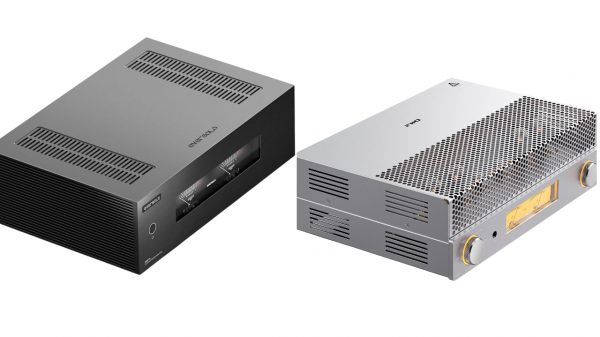
Spending almost $24,000 on an integrated amplifier opens the door to some formidable alternatives, particularly from manufacturers with extensive experience building high-current solid-state electronics. Two models stand out because they offer very different interpretations of what an integrated amplifier at this level should accomplish.
Gryphon Diablo 333 ($24,900)
Denmark’s Gryphon Diablo 333 is considerably more powerful, delivering 333 watts per channel into 8 ohms and 666 watts into 4 ohms through a fully solid-state Class AB design. Weighing 112 pounds, the Diablo relies on a substantial conventional power supply and large chassis, making the physical differences between these amplifiers almost as pronounced as their circuit architectures.
The Gryphon also offers optional DAC and phono modules, giving owners greater flexibility to consolidate their systems, although those upgrades add substantially to the purchase price. With its higher rated output and modular connectivity, the Diablo makes a compelling case for listeners with demanding loudspeakers who prefer a more traditional high-power integrated design.
Accuphase E-800S ($21,975)
Japan’s Accuphase E-800S makes an alternative case, delivering 50 watts per channel into 8 ohms and 100 watts into 4 ohms through a fully balanced Class A MOSFET architecture. Its Balanced AAVA volume control, substantial toroidal transformer, and six-fold parallel push-pull output configuration reflect the company’s emphasis on meticulous engineering and continuous Class A operation.
The E-800S also includes a dedicated headphone amplifier and expansion slots for optional digital and phono boards, giving it greater flexibility as a system centerpiece. At 78.7 pounds, however, it occupies considerably more physical space than Rossi’s new integrated, and its lower rated output may influence the decision for buyers using difficult loudspeaker loads.
The Bottom Line
The Vinnie Rossi CANTA Integrated is an intriguing alternative to the oversized integrated amplifiers that have come to dominate the upper end of the market. Its appeal isn’t simply the combination of tubes and transistors, but Rossi’s willingness to question whether a premium amplifier needs enormous dimensions, a conventional power supply, or an extensive collection of digital features to justify its position.
Of course, a clever design and attractive specifications don’t automatically translate into exceptional sound quality, particularly when the competition includes manufacturers such as Gryphon and Accuphase. At $23,995, prospective buyers should expect convincing performance across a wide range of loudspeakers, excellent long-term reliability, and enough transparency to justify choosing the CANTA over established alternatives.
What makes this amplifier worth investigating is the possibility that Rossi has found a more practical way to deliver the performance expected from expensive separates without demanding an entire equipment rack. That is a more meaningful ambition than simply building another amplifier with a bigger transformer, heavier chassis, and a price tag that requires a domestic negotiation worthy of the United Nations.
Price & Availability
The Vinnie Rossi CANTA Integrated Amplifier is priced at $23,995 in the United States, with shipments scheduled to begin in late October 2026 through authorized dealers. The amplifier is manufactured in the United States and includes a 10-year warranty.
For more information: vinnierossi.com
Related Reading: