An 85-inch television used to sound enormous. RayNeo apparently looked at that and decided we were thinking too small.
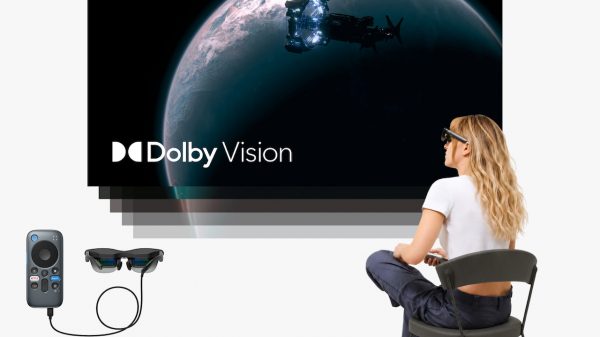
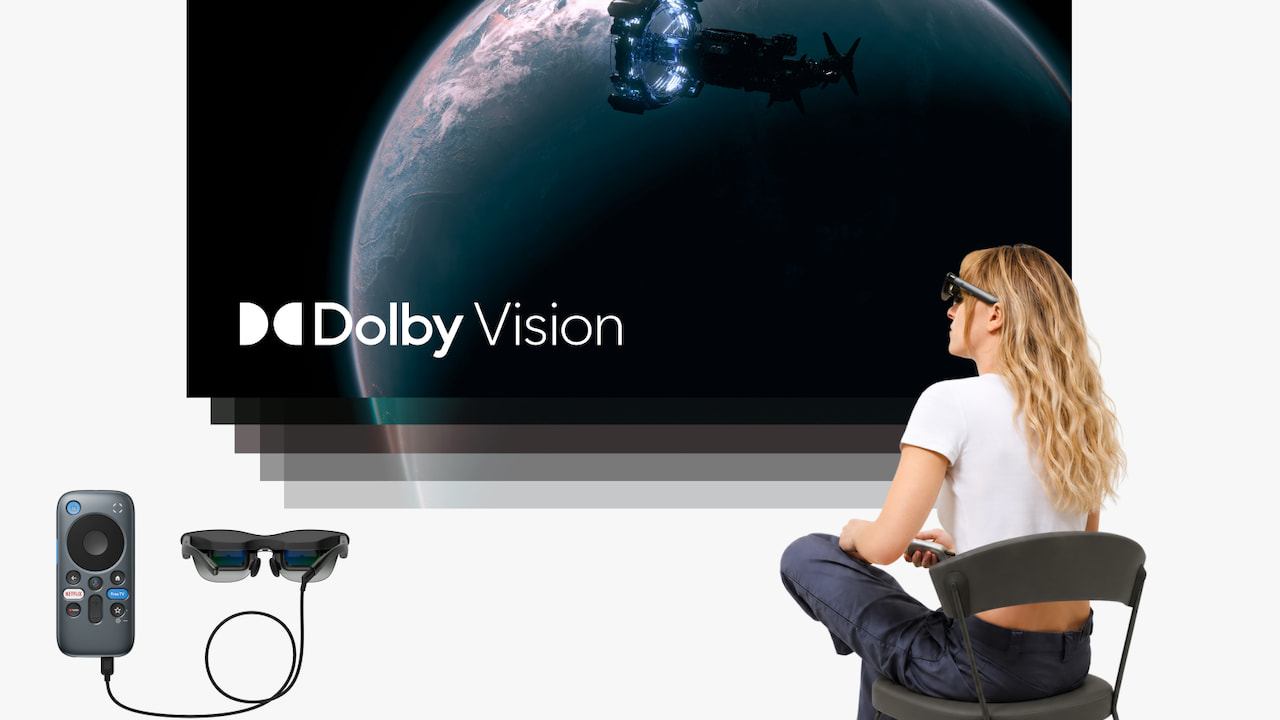
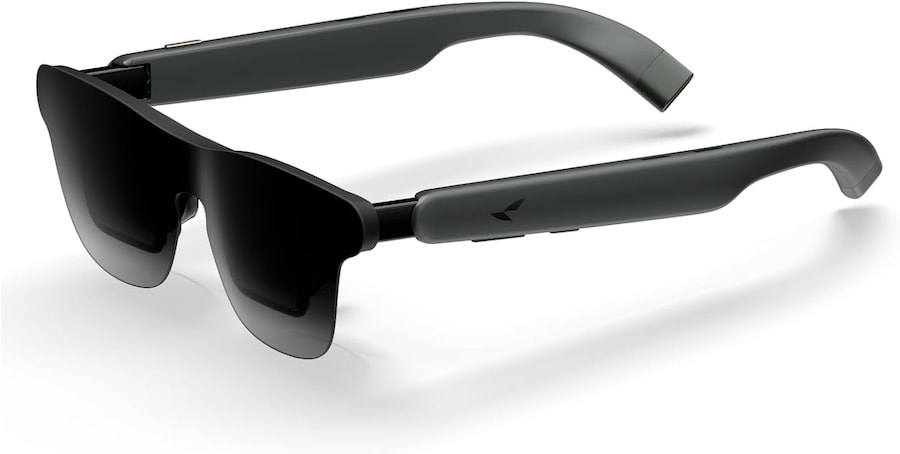
The new RayNeo GT Max AR glasses use dual Micro-OLED displays to create a virtual screen measuring up to 307 inches, with a 59-degree field of view, 120Hz support, native 3DoF spatial tracking and a four-speaker audio system tuned with Bang & Olufsen. There is also Dolby Vision, although with an important qualification: RayNeo says native Dolby Vision playback requires the GT or GT Max to be paired with its new Pocket TV Pro streaming device.
That makes the GT Max considerably more interesting for eCoustics readers than another pair of smart glasses designed primarily to photograph lunch and ask an AI assistant where you parked the car. This one wants to be a television — a very large television that happens to sit directly in front of your face.
Who Is RayNeo?
RayNeo was incubated by TCL Electronics and already offers multiple generations of AR and AI eyewear. Counterpoint Research says RayNeo held a 41% share of the Birdbath/Flat-Prism AR glasses segment in Q1 2026, ahead of VITURE and XREAL.
That category is also moving quickly. Counterpoint reports that global AR-glasses shipments increased 136% year over year during Q1 2026, even as traditional VR headset shipments declined 17%. Consumers appear increasingly interested in lighter, more specialized eyewear rather than heavier headsets built around fully immersive virtual reality.
RayNeo’s GT Series leans directly into that shift by concentrating on movies, streaming and gaming rather than trying to become an all-day spatial computer. That narrower focus may actually make the product easier for consumers to understand.
RayNeo GT Max: The Hardware
The GT Max uses RayNeo’s Peacock Optical Engine 3.0 Max with dual 0.6-inch Micro-OLED displays delivering 1080p resolution per eye. RayNeo provides three virtual-screen sizes — 227, 267 and 307 inches — and claims brightness up to 1,200 nits.
The glasses weigh 78 grams, putting them in a very different physical category from something like Apple Vision Pro. RayNeo will also offer the GT Max in three interpupillary-distance sizes: Small for users below 64mm, Medium for 64 to 67mm and Large for those above 67mm. Custom prescription-lens inserts will also be supported.
Those details matter because comfort and optical alignment are not small issues with display glasses. A product that looks spectacular for ten minutes but becomes uncomfortable during a two-hour movie is not much of a home theater replacement.
Keeping the Picture Where You Want It
A dedicated Zone 360 3DoF processor handles head tracking. Three-degree-of-freedom tracking follows rotational movement — pitch, yaw and roll — and RayNeo provides three viewing modes depending on how and where the glasses are being used.
Pinned Mode keeps the image fixed in one location, while Follow Mode allows the display to move naturally with your head. Steady Mode is intended specifically for moving environments such as trains and airplanes, where constant motion can make a virtual display far less enjoyable.
That last mode could prove more useful than some of the giant-screen marketing. Anyone who has tried to watch a movie on a laptop during turbulence knows that a huge virtual image becomes considerably less impressive if it appears to be attempting an emergency landing of its own.
Bang & Olufsen Handles the Audio
Both GT models use a quad-speaker system co-tuned with Bang & Olufsen, along with head-tracked spatial audio. RayNeo also includes a directional Whisper Mode designed to reduce how much sound reaches people sitting nearby.
How convincing any of that sounds will require an actual review. Open-ear speakers built into glasses are not going to replace a good pair of headphones when isolation, bass extension and maximum dynamic range matter, but integrated audio makes considerable sense for casual movie watching, gaming or streaming when wearing headphones is inconvenient.
The B&O involvement also suggests RayNeo understands that the audio cannot simply be treated as an accessory to the display. If you are going to sell the idea of a private movie theater, the soundtrack has to do more than politely emerge from two tiny speakers near your temples.
Dolby Vision and Pocket TV Pro
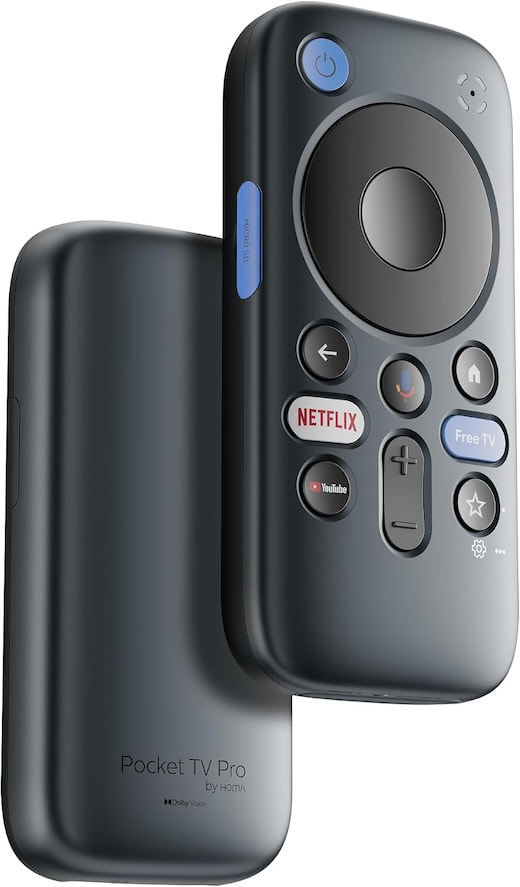
The Pocket TV Pro is a portable Google TV streaming device designed specifically for the RayNeo ecosystem. It uses an Amlogic S905X5M-J processor with 3GB of RAM, 64GB of storage and expansion support up to 2TB, while its 6,500mAh battery is rated for up to 5.5 hours of continuous streaming.
More importantly, this is the device RayNeo requires for native Dolby Vision playback through the GT and GT Max. The Pocket TV Pro also supports RayNeo’s real-time AI conversion of SDR content to HDR through its Vision 4000 display processor.
So if Dolby Vision is one of the primary reasons you are considering the glasses, the Pocket TV Pro is not merely an optional accessory. It is part of the specific playback chain required to get that feature, and RayNeo has not yet announced final U.S. pricing for the streamer.
Apple Vision Pro, Meta and a Different Idea
We recently looked at Apple’s effort to give Vision Pro a stronger reason to exist through live 8K immersive baseball. Vision Pro remains extraordinary technology, but it starts at $3,699 and asks consumers to buy into Apple’s much broader concept of spatial computing. Its appeal lies in creating immersive experiences that conventional televisions cannot reproduce.
At the other end of the market, Ray-Ban Meta emphasizes cameras, AI, communication, music and everyday wear rather than immersive video. Counterpoint says Meta held nearly 84% of the global display-less smart-glasses segment in Q1 2026, which demonstrates how much traction that lighter, everyday-wear approach has already gained.
RayNeo is pursuing a third path. The GT Max does not need to replace your laptop, photograph everything you see or become an AI assistant living beside your temple. Its primary job is considerably simpler: give you a very large private display that fits into a travel bag.
There may be something refreshingly sensible about that. Not every piece of wearable technology needs to reinvent computing, social interaction and human consciousness before lunch.
Who Is This For?
The most obvious customer is a frequent traveler. A 78-gram pair of glasses capable of creating a cinema-sized image has obvious appeal on an airplane, train or in a hotel room where carrying a television generally creates problems with the overhead compartment.
The GT Max also makes sense for portable gaming, particularly for people using handheld PCs or other compatible video sources who want something substantially larger than a seven or eight-inch display. There is another potential audience among people living in apartments, dorm rooms or other small spaces where installing a large television or projector is impractical.
Streaming is another obvious application. Paired with Pocket TV Pro, the system effectively becomes a wearable Google TV display, which could make it useful in situations where a conventional screen is either unavailable or undesirable.
What the GT Max does not replace is the social aspect of a television or home theater. Your spouse, kids or friends cannot share the same image unless everyone owns their own pair of glasses, and nobody is passing popcorn around a single headset. Large televisions and projection still win rather decisively when more than one person wants to watch.
Specifications Compared
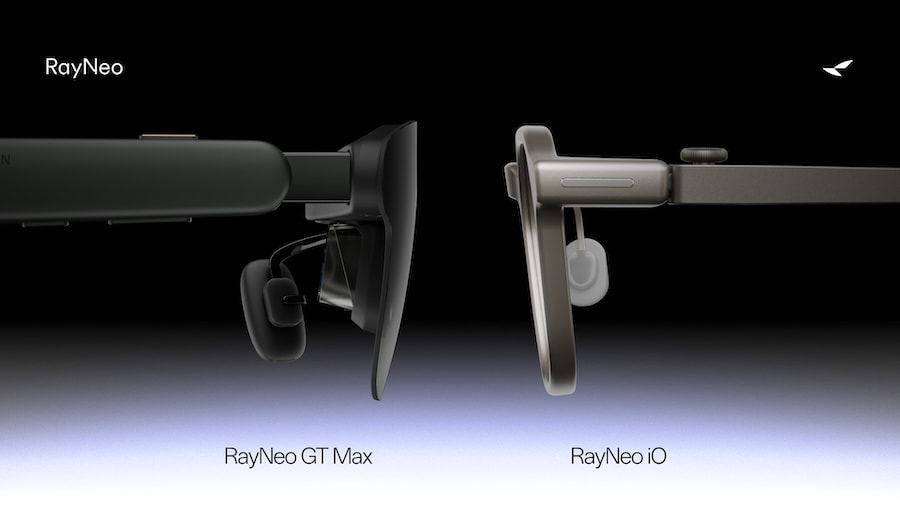
| RayNeo iO | RayNeo GT | RayNeo GT Max | |
| MSRP | $499 | $329 | $429 |
| Primary Function | Ambient Heads-Up Productivity & AI | Portable AR Media & Gaming | Cinema-Grade AR Display |
| Chassis Weight | 33g | 68g | 78g |
| Optical Engine | Firefly Nano (0.085cc MicroLED) | Birdbath (BB) | Peacock Optical Engine 3.0 Max |
| Field of View (FOV) | 23.5° | 46° | 59° |
| Display Sizing | Heads-Up Text Overlay | Up to 231-inch (136″/201″/231″) | Up to 307-inch (227″/267″/307″) |
| Audio Configuration | Visual-First (0 Speakers / Bone Conduction + 4-Mic) | Quad-Speakers (Co-Tuned by B&O) | Quad-Speakers (Co-Tuned by B&O) |
| Tracking & Controls | Smart Crown Dial & Head Gestures | Zone 360 Native 3DoF Chip | Zone 360 Native 3DoF Chip |
The Bottom Line
Apple wants Vision Pro to become a new computing platform, while Meta wants smart glasses to become something people wear all day. RayNeo is making a much narrower pitch with the GT Max: what if you just want a huge private screen?
That may be the product’s biggest advantage. There are still important questions about comfort, optical sharpness, sound leakage and how convincing the image feels after two hours of use, but the application is easy to understand and does not require consumers to buy into a completely new computing ecosystem.
Apple will put you inside Yankee Stadium for $3,699. RayNeo would rather put the movie theater in front of your eyes and let you finish the flight. For a lot of consumers, that might be the easier sales pitch.
Price & Availability
The RayNeo GT and GT Max are available as of September 4, 2026 for $329 or $429 at Amazon, respectively.
Related Reading: