When Rush opened their Fifty Something tour on June 7, 2026, with “Xanadu,” it was an emotional reminder of what had been missing from the stage since Neil Peart’s death in 2020. Six days later, Geddy Lee and Alex Lifeson performed the album’s title track for the first time in 47 years. Even by Rush standards, that’s a rather long intermission.
With Anika Nilles behind the drums, these ambitious compositions are getting another chance to shine. That makes Mobile Fidelity’s new UltraDisc One-Step edition of A Farewell to Kings particularly timely.
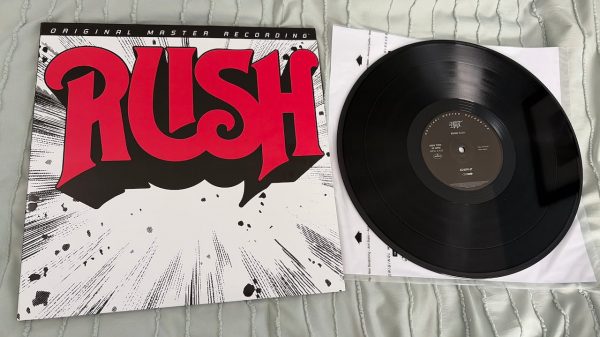
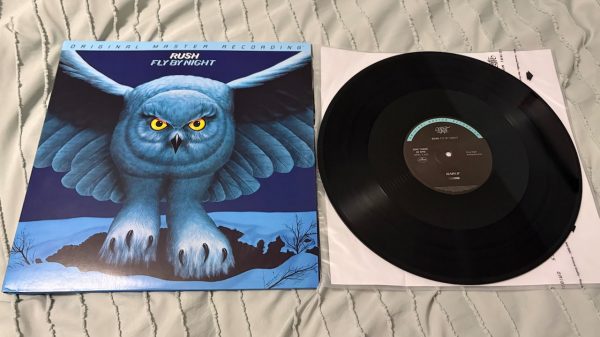
This is the third installment in our examination of Mobile Fidelity’s Rush reissue series, following my reviews of the 1974 debut and Fly By Night. Both $59.99 editions delivered meaningful sonic improvements, but A Farewell to Kings presents a different challenge. It was a more sophisticated recording to begin with, and MoFi is asking more than twice as much for its premium vinyl treatment.
2112 Changed Everything
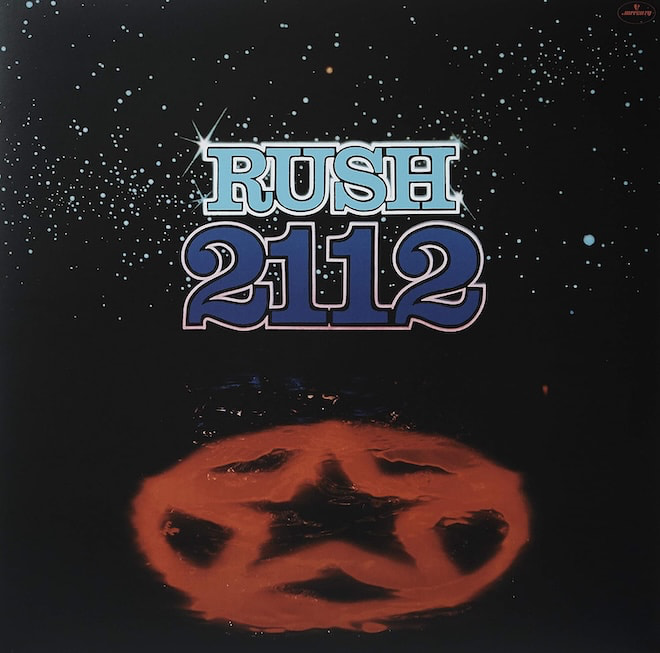
The chronology is important. Rush released their self-titled debut in 1974, followed by Fly By Night, Caress of Steel in 1975, and 2112 in April 1976. The live double album All the World’s a Stage arrived later that year, followed by the band’s fifth studio album, A Farewell to Kings, in September 1977.
Caress of Steel had been a commercial disappointment, and the supporting Down the Tubes Tour suggested that spending most of an album singing about necromancers and mythical fountains was not necessarily the quickest route to financial security.
Mercury wanted something more accessible.
Rush responded with 2112, opening the album with a twenty-minute science-fiction epic. Because nothing reassures nervous record executives quite like refusing to follow their advice.
The gamble worked. 2112 became the band’s commercial breakthrough and gave Geddy Lee, Alex Lifeson, and Neil Peart the freedom to pursue their own musical direction.
They took that freedom straight to Rockfield Studios in Wales, where they recorded A Farewell to Kings with producer Terry Brown in 1977.
The result was a more expansive album, with additional synthesizers, acoustic guitars, percussion instruments, and two compositions that were never going to make life easy for Toronto radio programmers.
Q107 had only launched in May 1977, while CHUM-FM had been playing progressive rock since 1968. The latter was certainly more adventurous, but I doubt either station’s advertising department was thrilled by the prospect of squeezing the full 11 minutes of “Xanadu” between Harry Rosen and Harvey’s commercials and another reminder that Molson Canadian was available at your local Beer Store.
“Closer to the Heart,” at just under three minutes, was considerably easier to accommodate. Fortunately, Rush weren’t building their career around radio programmers’ bathroom schedules.
Was This Rush’s First Concept Album?
No. Caress of Steel had already introduced extended conceptual narratives, and 2112 devoted an entire side to a connected science-fiction story.
A Farewell to Kings isn’t a complete concept album either. Its six songs explore power, ambition, morality, immortality, and science fiction, but they don’t tell one continuous story.
“Xanadu” draws inspiration from Samuel Taylor Coleridge’s “Kubla Khan,” while “Cinderella Man” takes its premise from Frank Capra’s Mr. Deeds Goes to Town. The closing “Cygnus X-1: Book One: The Voyage” sends its protagonist into a black hole, with the story continuing on 1978’s Hemispheres.
Only Rush could end an album with a cliffhanger involving astrophysics and expect an audience to return for the next installment.
The achievement here wasn’t inventing the concept album. It was demonstrating that three musicians could combine elaborate progressive rock with more accessible songwriting without losing their identity.
Three Musicians, a Lot More Instruments
Musically, A Farewell to Kings marked a significant expansion of Rush’s sound. Geddy Lee added a Minimoog synthesizer, bass pedals, and 12-string guitar to his already demanding bass and vocal duties. Alex Lifeson broadened his arsenal of six- and 12-string electric and acoustic guitars, added classical guitar, and also used bass pedals.
The heavier, guitar-driven sound of 2112 hadn’t disappeared, but the arrangements were becoming more layered, atmospheric, and sophisticated. “Xanadu” was the clearest example, moving from a delicate, almost hypnotic introduction into some of the most powerful music the trio ever recorded. Apparently, playing three instruments simultaneously wasn’t sufficiently challenging for Geddy.
Neil Peart wasn’t exactly traveling light either. His expanding percussion setup included orchestra bells, tubular bells, temple blocks, wind chimes, a bell tree, and a vibra-slap. Working with producer Terry Brown at Rockfield Studios in Wales, the band also experimented with natural acoustics and outdoor recordings, including the actual birds heard on “A Farewell to Kings” and “Xanadu.”
The difference was more than additional instrumentation. Rush were learning how to use space, texture, and quieter passages to make their heavier moments considerably more dramatic. They were still a power trio, but one increasingly determined to sound like six musicians without having to split the royalties.
Why Is Mobile Fidelity Charging $125?
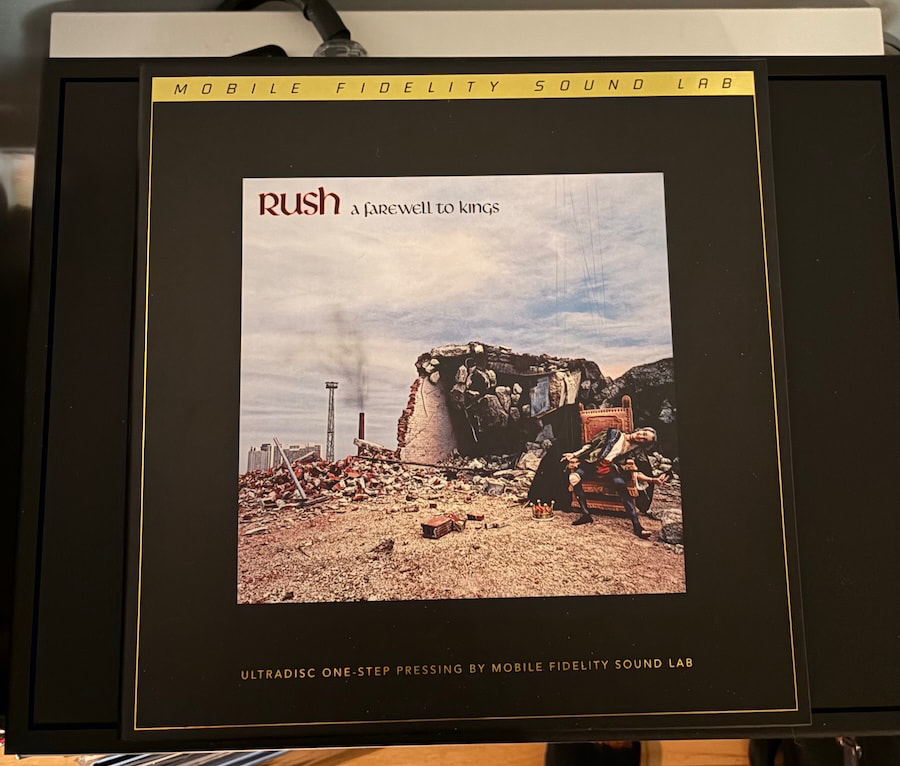
The first two Rush releases in this series cost $59.99 each. A Farewell to Kings jumps to $125 because Mobile Fidelity is using its more elaborate UltraDisc One-Step manufacturing process, limiting production to 5,000 numbered copies, and supplying deluxe packaging.
Conventional vinyl manufacturing involves multiple plating stages to create the stampers used to press records. MoFi’s One-Step process eliminates the intermediate mother and stamper-generation stages, using a metal part derived directly from the lacquer as the stamper. The approach requires more lacquers for larger production runs and is intended to reduce potential losses introduced during plating.
Whether those differences justify the additional $65.01 is another question.
The mastering process also deserves attention. Krieg Wunderlich used an analog tape source transferred through DSD 256 before the signal passed through an analog console to the cutting lathe. MoFi identifies the tape boxes as carrying both “master” and “safety copy” markings, which leaves the exact tape generation uncertain.
So no, this isn’t an all-analog pressing.
Anyone still recovering from the Great MoFi Digital Scandal might want to sit down. Personally, after hearing what the company accomplished with the first two Rush albums, I’m considerably more interested in the finished record than another argument over the presence of DSD.
At $125, however, the improvement had better be audible without requiring a forensic laboratory and a support group.
Mobile Fidelity A Farewell to Kings One Step Specifications
- Artist: Rush
- Album: A Farewell to Kings (1977)
- Label: Mobile Fidelity Sound Lab
- Catalog Number: MFSL45UD1S2-069
- Format: UltraDisc One-Step, 2LP
- Vinyl: 180-gram, 45 RPM, stereo
- Mastering: Krieg Wunderlich
- Source: 1/4-inch, 15 IPS Dolby A analog tape
- Mastering Chain: Analog tape → DSD 256 → analog console → lathe
- Pressing Plant: Fidelity Record Pressing
- Limited Edition: 5,000 numbered copies
- Packaging: Deluxe slipcase with individual foil-stamped LP jackets
- Price: $125
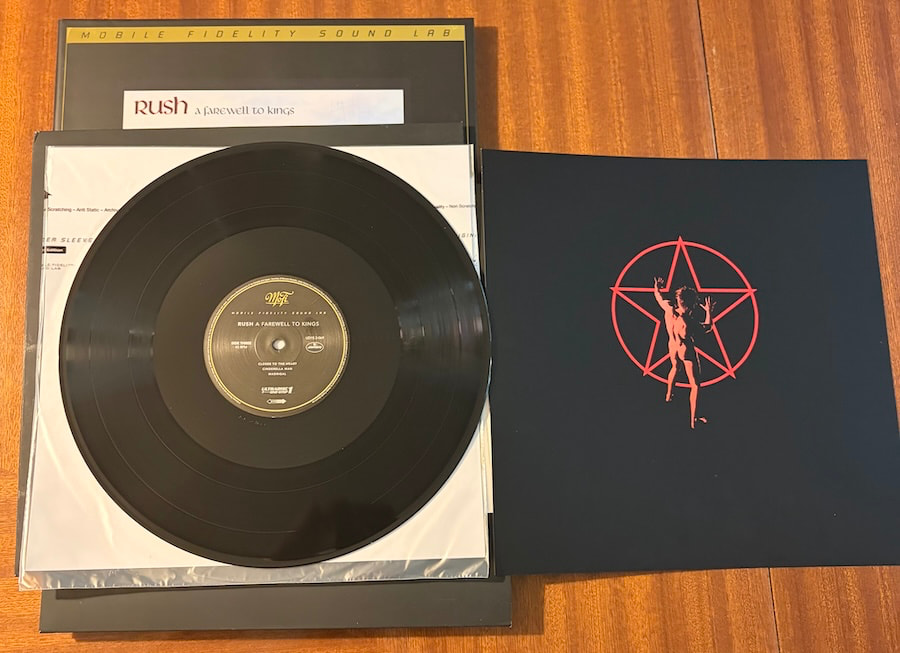
The 45 RPM UltraDisc One-Step edition spreads the album’s six tracks across four sides. Side A features “A Farewell to Kings,” while Side B is devoted entirely to the 11-minute “Xanadu.” Side C includes “Closer to the Heart,” “Cinderella Man,” and “Madrigal,” with Side D reserved for the closing epic, “Cygnus X-1: Book One: The Voyage.” Giving the two longest compositions their own sides allows for wider groove spacing and potentially better dynamics than the original single-LP pressing.
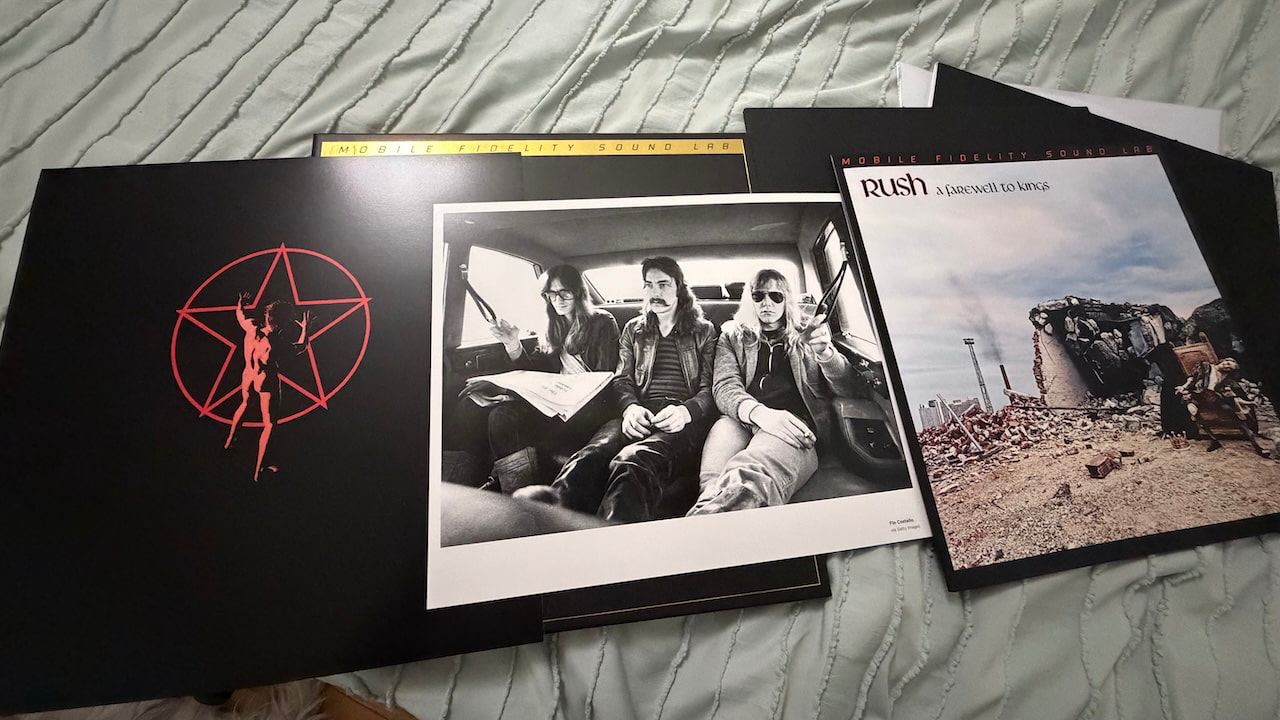
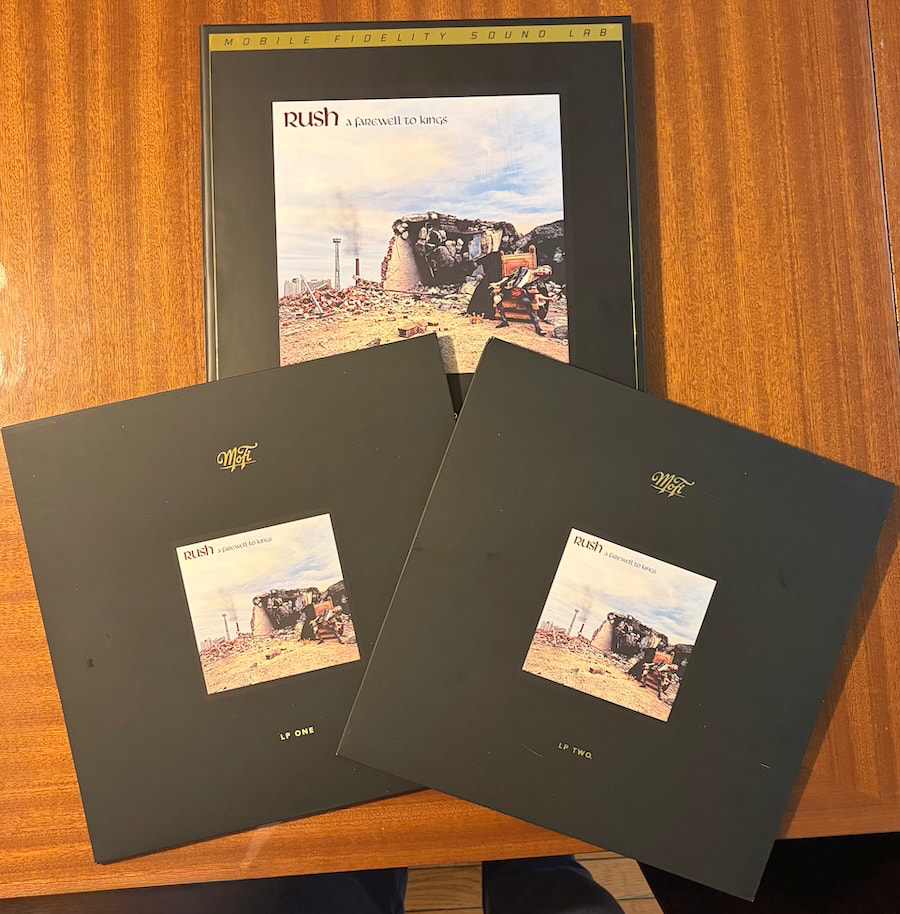
Mobile Fidelity has done an excellent job with the physical presentation of A Farewell to Kings. Both 180-gram LPs come in MoFi’s familiar anti-static inner sleeves, with each record also receiving its own substantial, foil-stamped outer jacket. Everything fits inside a sturdy, individually numbered slipcase that feels appropriately premium for a $125 release. The artwork is particularly well presented, including Hugh Syme’s original cover design and additional imagery featuring the iconic Starman from 2112.
There’s also a wonderful photograph of Geddy Lee, Alex Lifeson, and Neil Peart sitting together in a cab that I’m seriously considering framing. After seeing Rush 19 times, I have plenty of concert memories, but there’s something particularly appealing about seeing three of rock’s most talented musicians squeezed into the back of a taxi. It’s a nice reminder that even progressive rock royalty occasionally had to get somewhere without a spaceship. The entire package feels like something designed for collectors rather than another expensive reissue dressed up with a numbered sticker.
One Step Into Xanadu
One of my biggest frustrations with Rush’s vinyl catalog has always been the inconsistency between pressings. Growing up in Toronto, I suspect most of my original copies were Canadian pressings, and while I loved the music, I never considered them particularly impressive from an audiophile perspective. When I left Canada in 1989 for college, the collection continued to grow, thanks largely to Tower Records in Washington, D.C., and its magnificent Greenwich Village location in Manhattan. CDs, vinyl, imports — I bought the lot. My enthusiasm for Rush was never in question. The sound quality of some of those releases certainly was.
I’m also an unapologetic fan of Rush’s 1980s period, when Geddy Lee fully embraced synthesizers, eventually adopted the Wal bass, and Alex Lifeson occasionally found himself fighting for space in increasingly keyboard-heavy arrangements. Neil Peart’s lyrics became more concerned with politics, technology, and the human condition. I loved that evolution, but A Farewell to Kings has always been my favorite of the band’s earlier progressive albums. Yes, even more than 2112. You can put down your pitchforks.
Which explains why I approached this $125 Mobile Fidelity pressing with considerable excitement and a healthy dose of skepticism. I wasn’t prepared for just how much better it sounded than the versions I’ve lived with for decades. If you’re a Geddy Lee devotee, this might be worth the admission price on its own. His bass playing has extraordinary power, precision, texture, and speed, with individual notes remaining intelligible even during the most complicated passages. There’s genuine weight behind the instrument, but also the snap of the strings and the tonal character that made his playing so distinctive. I’ve never heard his bass reproduced this convincingly on a Rush studio album.
Neil Peart’s drumming is equally impressive, with a physical impact and clarity that should send an entire generation of air drummers into a frenzy. Sorry, Stewart Copeland, but some of us are still working on our imaginary double-bass technique. Alex Lifeson might be the biggest beneficiary of this mastering, however. His guitars have greater presence, body, and separation, making it easier to appreciate how much his playing contributes to the arrangements. Nothing feels artificially pushed forward. The three musicians simply occupy their own space with considerably more authority.
The soundstage isn’t enormous or stretched from wall to wall, but it has convincing width, depth, and scale. There’s also a slightly darker tonal balance that works in the album’s favor, particularly with Geddy’s vocals, which avoid the shrillness I’ve encountered on other pressings. The presentation is clear, powerful, and remarkably cohesive without polishing away the aggression that makes Rush sound like Rush.
And it absolutely demands to be played loud. Not because it needs additional volume to reveal its strengths, but because the music becomes almost impossible to resist once Geddy, Alex, and Neil get moving. I came dangerously close to being evicted from my own house during these listening sessions, which probably tells you more about this pressing than another paragraph discussing microdetail.
Mobile Fidelity hasn’t turned A Farewell to Kings into polite audiophile wallpaper. It’s given three extraordinary musicians the room to remind us why this album remains essential almost 50 years later. As for my older pressings? There’s a black hole waiting at the end of Side D, and they’re welcome to disappear into it.
Our Ratings:
★★★★★★★★★★ Music
★★★★★★★★★★ Pressing Quality
★★★★★★★★★★ Sound Quality
Where to Buy:
Hybrid SACD Alternative: $34.99 at MoFi
Related Reading: