

While listening to a record with my youngest daughter the other day, the conversation turned to why anyone still listens to vinyl when streaming is “clearly so much better.” As a committed Lana Del Rey fan, she then explained that the long and somewhat operatic wait for Stove is apparently proof that records still matter, because vinyl takes months to press and Lana is not going to rush the thing merely because the rest of us have jobs and limited attention spans.
This was followed by a pointed discussion of the price of concerts, which was less philosophical.
Living at the Shore has its advantages. PNC Bank Arts Center, the Count Basie Center, and Asbury Park are all close enough that a good show can become a family night without requiring a hotel, airport security, or a second mortgage. That does not mean every artist announcement is an automatic yes. A Lana Del Rey tour, should one arrive anywhere within reasonable driving distance, would almost certainly trigger negotiations normally reserved for hostage situations.
There are limits. Even in a household with multiple turntables, more records than shelf space, and a somewhat elastic definition of “necessary.”
“Do you know who invented the turntable?” I asked as she wandered around the den holding the jacket for Craft Recordings and Bluesville’s recent reissue of Albert King’s I’ll Play the Blues for You.
“Not Taylor Swift.”
“That would be correct.”
“My teacher told us that it was Thomas Edison. Or maybe Billy Madison. I’m confused.”
TikTok needs to be banned.
“Thomas Edison did not invent the turntable. Edison did make significant contributions to sound recording and playback, including the invention of the phonograph, but he did not invent the turntable as we understand it today.”
“Edison’s phonograph, patented in 1878, was a mechanical device that used a rotating cylinder covered in tinfoil to record and reproduce sound. It had a hand-cranked mechanism to rotate the cylinder, and a stylus traced the grooves on the cylinder, producing sound vibrations that were amplified by a horn.”
“The turntable, on the other hand, refers to the rotating platform on which vinyl records are played.”
“So how do you know it wasn’t Taylor Swift?”
“Have you ever heard of Emile Berliner?”
“Is he on TikTok or YouTube?”
Emile Berliner
Emile Berliner (1851-1929) was a German-born inventor, engineer, and entrepreneur who made significant contributions to the fields of sound recording and communication. He is best known for his invention of the gramophone, a device that played flat disc records.
Born on May 20, 1851, in Hanover, Germany, Berliner immigrated to the United States in 1870. He initially worked as a merchant and bookbinder but soon turned his attention to inventing. In 1887, Berliner developed a new method of sound reproduction, which he named the gramophone.

Berliner’s gramophone used flat disc records made of a zinc disc coated with a compound called shellac. The records had spiral grooves that were created by a cutting stylus. The sound vibrations from the stylus were transmitted through a diaphragm and a horn, resulting in amplified sound. The gramophone offered several advantages over Edison’s cylinder-based phonograph, including easier production, longer playing time, and the ability to mass-produce records.
In addition to the gramophone, Berliner also made notable contributions to the development of the microphone and telephone technologies. He invented the carbon microphone, which became widely used in telephony and early sound recording. Berliner’s improvements to the telephone transmitter greatly enhanced its performance and efficiency.
Berliner was also an astute businessman and established the Berliner Gramophone Company in 1895. The company later merged with the Victor Talking Machine Company, forming the Victor Talking Machine Company, which became a major player in the phonograph industry.
Emile Berliner held numerous patents throughout his career and made significant advancements in sound recording and communication technologies. His invention of the gramophone and disc records laid the foundation for modern turntables and the widespread consumption of recorded music. Berliner’s contributions to the field of audio technology continue to influence the way we enjoy and experience music today.
The Most Significant Turntables
Do you remember your first turntable?
I inherited a Thorens TD-145 from my parents in 1983 as part of my Bar Mitzvah gift and it gave me over a decade of service before I upgraded to an Audiomeca Romance table designed by Pierre Lurne of Goldmund.
Looking back I’m not entirely convinced that it was an upgrade but I did trade it in when I purchased a Michell Orbe SE in 1998; that table absolutely was a significant improvement and a great platform for a Wilson Benesch ACT 0.5 Tonearm and Benz Micro H2.0 high-output cartridge.
My ex-wife forced me to sell it during our rather quick and bloody divorce and it was painful to let that one go. I have never owned anything better and it’s unlikely that I would ever spend that kind of money on a turntable and cartridge again; especially not with college and private school tuition.
Three restored Thorens tables create wonderful music at home now and I’m not entirely sure that changing them would make a lot of sense. I also own a Yamaha YP-701 and NAD C 588.
Listening to records with my daughter sparked a different kind of conversation with some of our staff and my circle of audiophile friends.
Which tables were truly significant? We’ve included some tables from the late 1900s and the first part of the 20th century because they were indeed, very significant.
We could easily publish a list of the “best” turntables available right now but 99% of the planet could never afford them and will never have the opportunity to listen to one. This feels like a more interesting discussion.
What are we missing from this list? Please let us know.

Edison Phonograph
Thomas Edison’s 1877 phonograph was not a turntable in the modern sense, but it was the first practical machine designed to both record sound and play it back. Built at his Menlo Park laboratory in New Jersey, the original device used a hand-cranked cylinder wrapped in tinfoil, rather than the wax cylinders that arrived later. A diaphragm and stylus translated sound into physical indentations in the foil; reversing the process allowed the machine to reproduce those vibrations as audible sound.
It was crude, fragile, and hardly hi-fi, but Edison’s invention established the essential idea that recorded music and speech could be captured, stored, and replayed at will. The flat disc record and the turntable would come later, but the phonograph was where the whole strange, expensive, shelf-consuming affair began.

Victor Talking Machine
Introduced by the Victor Talking Machine Company in 1906, the Victor Victrola was not the first disc phonograph, but it helped turn one into a desirable piece of furniture rather than an awkward mechanical contraption parked in the parlor. Its spring-wound motor rotated flat shellac discs without electricity, while the key innovation was the horn: Victor concealed it inside a handsome wooden cabinet instead of leaving a large external horn perched on top. That made the machine easier to live with and far more socially acceptable in the increasingly style-conscious American home.
The Victrola became one of the defining music machines of the early 20th century, and the company’s Nipper “His Master’s Voice” trademark became one of the most recognizable images in recorded sound. It was not high fidelity by any modern definition, but it brought the disc record, the home playback system, and the idea of owning music into the mainstream long before anyone argued about Bluetooth codecs or whether the pressing was “AAA.”

Philips 22GA212 Electronic
Introduced in the early 1970s, the Philips 22GA212 Electronic was one of the more distinctive belt-drive turntables of its era. Its appeal was not that Philips had somehow invented electronic speed control, but that it combined a tacho-generator-regulated DC motor, floating subchassis, touch-sensitive 33, 45, and stop controls, and photo-electronic automatic shutoff in a relatively affordable domestic turntable.
The 212 used feedback from its tacho generator to help maintain speed under changing load, while separate fine-speed controls and a stroboscopic platter ring allowed owners to make small adjustments. Philips claimed low wow and flutter, low rumble, and stable operation; the important point is that the deck tried to bring electronic control and convenience to a traditional suspended belt-drive design without making it look like laboratory equipment. The illuminated touch buttons were gloriously early 1970s, and remain one of the reasons the 212 has developed something of a cult following.

Garrard 301
Launched in 1954, the Garrard 301 did not invent idler-wheel drive. That basic arrangement, in which a small rubber wheel transfers power from the motor to the platter’s inner rim, had already appeared in earlier phonographs and record changers. What Garrard did was apply the system to a serious transcription motor unit built for broadcasters, studios, and the growing number of home listeners who wanted something more substantial than a changer with a chrome arm and optimistic specifications.
The 301 used a powerful four-pole induction motor, a heavy platter, and an idler-drive system that delivered quick start-up, strong torque, and stable speed at 33⅓, 45, and 78 rpm. It was usually sold without a plinth, tonearm, or cartridge, allowing owners to build a system around it rather than accept a complete package chosen by someone in a sales office. The result was one of the first truly iconic high-fidelity turntables: industrial, durable, endlessly restorable, and still capable of sounding superb when properly rebuilt. A neglected example can be noisy and temperamental; a well-sorted one explains why the 301 has never really left the conversation.

Acoustic Research XA
Introduced in 1961, the AR XA was only $58 and what made it unique was how it handled vibration and how low its rumble measured. The package did not come with a cartridge but the price included the table, tonearm, stylus gauge, and dustcover.
The most interesting aspect of the design was its mounting system; Edgar Villchur realized that instead of attaching the motor, tonearm, and lightweight platter to the table’s top plate, it made more sense to mount the platter and tonearm to a sub platform which was suspended underneath the top plate at 3 very distinct points with damped springs with a low resonant frequency.
By doing so, the tonearm and record were isolated from footfalls and other acoustic vibration. Thorens and Linn would incorporate these concepts into their future tables.

Thorens TD-150
Introduced in 1965, the Thorens TD 150 was a compact and rather unflashy turntable that changed the direction of serious belt-drive design. It was not the first commercially viable suspended-subchassis deck; that distinction belongs to the Acoustic Research AR XA of 1961. But Thorens took the basic idea of isolating the platter and tonearm from the motor and plinth with a three-point spring suspension, paired it with a belt-driven inner platter, and turned it into something more refined, more adaptable, and considerably more influential.
The TD 150 was also Thorens’ first true belt-drive turntable, replacing the belt-and-idler arrangement of the earlier TD 124 with a cleaner and more modern engineering approach. Its suspended subchassis helped reduce the transmission of motor vibration and external disturbance to the cartridge, while its removable armboard made it possible to fit alternative tonearms rather than live forever with the factory choice. That combination became the blueprint for a long line of Thorens models and, more importantly, helped inspire the Linn Sondek LP12 and much of the suspended-chassis cult that followed. Small, slightly wobbly when improperly set up, and far more important than it first appears, the TD 150 was one of the key turntables of the modern hi-fi era.

Thorens TD-124
Introduced in 1957, the Thorens TD 124 was one of the great transcription turntables of the postwar hi-fi era: overbuilt, mechanically ingenious, and aimed at studios, broadcasters, and serious home listeners rather than anyone looking for a tidy all-in-one record player. Its most unusual feature was not a conventional idler drive, but a hybrid belt-and-idler system. A compliant belt linked the motor to a separate stepped pulley, which then drove the platter through an idler wheel. Thorens designed the arrangement to retain the torque and rapid start-up of idler drive while reducing the motor-borne vibration that could otherwise work its way toward the cartridge.
The TD 124 also used a substantial two-piece platter with a removable aluminum top section and a heavy main platter beneath, along with variable pitch adjustment, four speeds including 78 rpm, and interchangeable armboards for owners who wanted to fit their preferred tonearm. It was not a suspended-subchassis design; that came later with the TD 150. Instead, the TD 124’s reputation rests on its precision engineering, flexibility, and sheer durability. Properly restored and mounted in a serious plinth, it remains one of the most compelling vintage turntables ever made, with enough torque and authority to make many modern decks seem slightly apologetic.

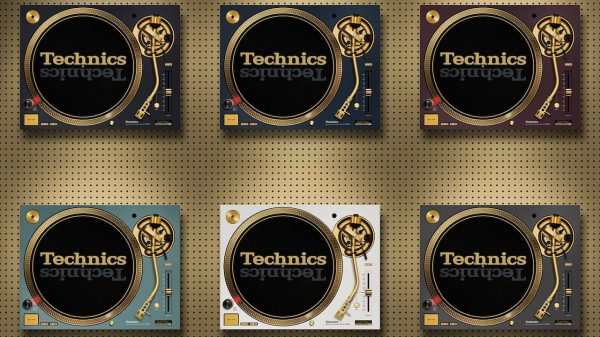
Technics SP-10
Introduced in 1970, the Technics SP 10 was the first commercially available turntable to use a direct-drive motor, and it changed the industry almost immediately. Rather than relying on a belt or idler wheel to transfer power from the motor to the platter, the SP 10 placed the motor directly beneath the platter itself. That eliminated an entire chain of mechanical compromises and delivered unusually quick start-up, very low wow and flutter, and the kind of speed stability that broadcasters and mastering engineers could trust without keeping one eye on the strobe.
The original SP 10 was sold as a motor unit, leaving broadcasters, studios, and ambitious home listeners to supply the plinth, tonearm, and cartridge. It was built for work, not Instagram, and its plain industrial appearance gave little indication of how important it would become. The SP 10 helped establish direct drive as a serious alternative to belt and idler systems, and its successors became fixtures in radio stations and professional installations around the world. The SL 1200 may have become the cultural icon, but the SP 10 was the machine that opened the door and made precision direct drive impossible to dismiss.

Linn LP12
Introduced in 1973, the Linn Sondek LP12 became one of the most influential turntables in high-end audio, not because it invented the suspended belt-drive turntable, but because it turned that established idea into a long-running argument about where sound quality actually begins. Its three-point suspended subchassis, belt-driven inner platter, single-point bearing, and separate armboard followed principles already explored by Acoustic Research, Thorens, and Ariston. Linn’s contribution was to refine the formula, make it modular, and insist that the source component mattered more than the hi-fi industry had previously been willing to admit.
That “source first” philosophy became the LP12’s real legacy. Ivor Tiefenbrun and Linn persuaded a generation of dealers and listeners that a better turntable could extract more musical information from the record before the signal ever reached the amplifier or loudspeakers. The LP12 also became famously upgradeable, with improved bearings, subchassis designs, power supplies, tonearms, and cartridges allowing owners to keep updating the same basic deck over decades. It was expensive, fussy about setup, and capable of developing a bounce that could make a wooden floor feel like an enemy combatant, but it became a benchmark for musical timing, long-term ownership, and the modern high-end turntable market.

Technics SL-1200
Released in 1972, the Technics SL 1200 began as a serious consumer direct-drive turntable, not as a purpose-built DJ tool. Its high-torque motor, heavy platter, die-cast chassis, stroboscope, and fine-speed adjustment gave it fast start-up and strong speed stability, qualities that quickly caught the attention of club DJs looking for a deck that could cue records precisely and survive a room full of bass, smoke, and people making bad decisions.
The version that truly changed music culture, however, was the SL 1200MK2 in 1979. Technics redesigned it with input from disco DJs, adding quartz-locked speed control, a more robust chassis and damping system, improved torque, and the familiar ±8 percent pitch slider that made beatmatching practical and repeatable. The MK2 became the working standard for clubs, radio stations, hip-hop DJs, and turntablists around the world. The original SL 1200 opened the door; the MK2 turned the turntable from a playback device into an instrument. It was rugged, precise, and so durable that many examples have outlived the clubs, DJs, and questionable carpet they were originally purchased to endure.

Rega Planar 3
Arriving in the late 1970s, the Rega Planar 3 became one of the defining affordable audiophile turntables because it refused to confuse complexity with progress. Its formula was almost aggressively simple: a light, rigid plinth, belt drive, 12 mm glass platter, straightforward manual operation, and a tonearm designed to do its job without adding a small engineering department’s worth of unnecessary parts. In an era when many manufacturers were loading decks with controls, mechanisms, and enough brushed aluminum to open a minor space program, Rega focused on keeping energy where it belonged: in the record and cartridge.
The original Planar 3 was developed from Rega’s earlier Planet and Planar 2 designs, and later versions benefited enormously from the company’s RB300 tonearm, introduced in 1983. Rega has refined the platform repeatedly through the P3, P3 24, RP3, and current Planar 3 generations, but the core philosophy has remained remarkably stubborn: low mass, high rigidity, sensible engineering, and sound quality that does not require a second mortgage or a plinth the size of a dining table. It helped make serious vinyl playback attainable for a far broader audience and remains one of the few turntables that can reasonably claim to be both an entry point and a lifelong habit.

Dual 1219
Introduced in 1969, the Dual 1219 was not the first automatic turntable, but it proved that convenience and serious record playback could coexist. Its idler-drive system, substantial platter, 33, 45, and 78 rpm capability, and gimbal-bearing tonearm gave it genuine hi-fi credentials, while its automatic mechanism could start a record, return the arm, and shut the machine down at the end of play.
It could be used for single records or as a changer for a stack of discs. Complex, sturdy, and very German, the 1219 remains proof that an automatic turntable did not have to sound like furniture with a motor.

Pro-Ject Debut Carbon
Introduced in 2012, the Pro Ject Debut Carbon became one of the defining entry-level audiophile turntables of the vinyl revival. It did not invent the affordable belt-drive deck, and it was not the first Pro Ject Debut; that model had been around since 1999. What the Debut Carbon did was add a one-piece carbon-fiber tonearm to an already proven, sensibly priced platform, giving buyers a feature normally associated with considerably more expensive turntables.
Manual operation, belt drive, a steel platter, and a pre-fitted Ortofon 2M Red cartridge kept the formula straightforward. The Debut Carbon was never designed to impress people who enjoy polishing machined aluminum for sport. It offered an honest route into proper vinyl playback at a price that did not require the sale of a kidney or a second listening room. For a generation of listeners moving beyond suitcase players and all-in-one systems, it became a legitimate gateway to better analog sound.
Goldmund Studio
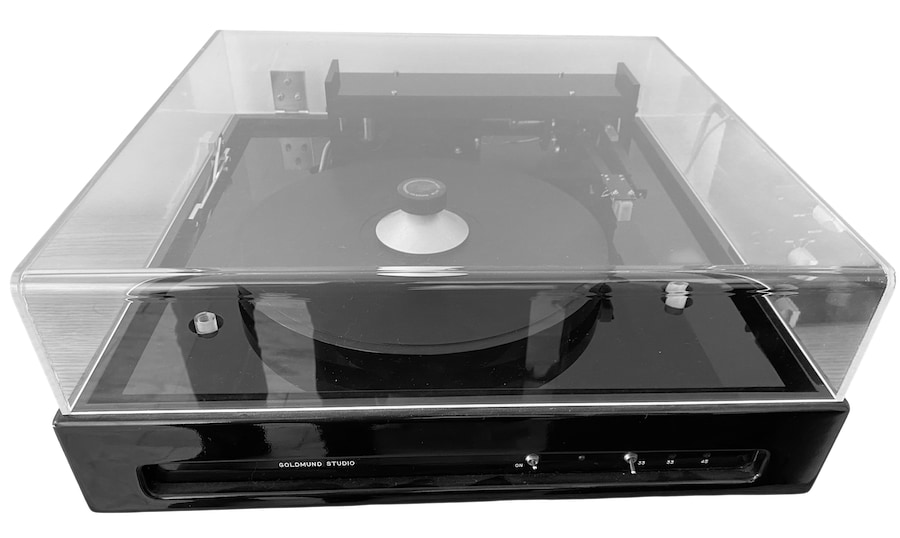
Introduced in 1979, the Goldmund Studio helped define the modern high-end turntable as something more ambitious than a conventional record player on a well-made plinth. Goldmund combined direct drive, an acrylic platter, and its “Mechanical Grounding” approach, which focused on controlling and draining unwanted vibration through a rigid mechanical structure rather than simply trying to isolate everything from everything else.
The Studio was often paired with Goldmund’s servo-controlled T3 tonearm, and the combination looked unlike almost anything else on the market. It was expensive, unconventional, and not especially interested in winning over people who believed a turntable should resemble furniture. Its importance lies in how it pushed analog playback toward the modern cost-no-object era, where materials science, vibration control, industrial design, and tonearm geometry became part of the same rather elaborate argument.
Transcriptors Hydraulic Reference
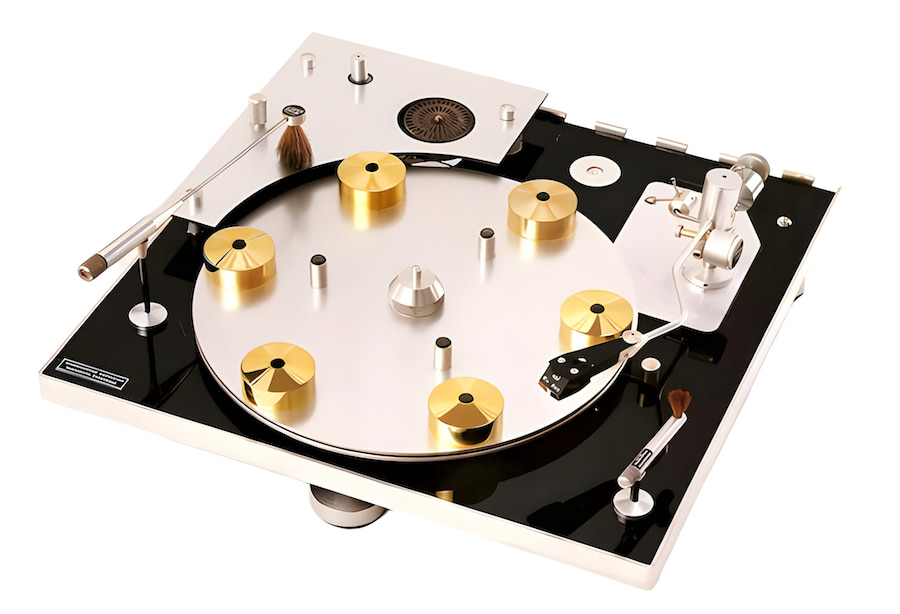
Introduced in 1964, David Gammon’s Transcriptors Hydraulic Reference was one of the most visually radical turntables ever made. This was a manual belt-drive design with a synchronous AC motor, a machined aluminum platter, and six conspicuous gold-plated brass inertia weights that made the whole thing look less like a domestic appliance than a piece of kinetic sculpture from a very well-funded Bond villain’s living room.
The “Hydraulic” name came from its unusual speed-control system: a vane interacted with silicone fluid in a well beneath the platter to provide fine regulation. The exposed acrylic, aluminum, and brass construction made the mechanism part of the experience rather than something to hide under a wood veneer. Its engineering was genuinely inventive, but its broader importance was cultural and aesthetic. The Hydraulic Reference appears in A Clockwork Orange, and a 1964 example sits in MoMA’s Architecture and Design collection. It did not create a dominant turntable template in the way the Thorens TD 150 or Technics SL 1200 did, but it permanently expanded the idea of what a record player could look like.
Related Reading:
- Clearaudio Debuts Beatles And Rammstein Inspired Turntables At High End Vienna 2026: Leise War Gestern
- Technics Unveils The SL1200/1210G Grand Class Master Edition Turntable: The End Of The Line
- VPI Turntable Featured In Lexus RZ EV Ad Costs Twice As Much As The Car Itself
- Thorens Picks MoFi Distribution For North America: Apparently Even Swiss Royalty Needs A Chicago Fixer























Michael
July 16, 2023 at 2:51 pm
I always wonder why most vinyl experts forget to mention here in this context the laser-turntable from ELP Corp., Japan, based on the prototype from Finial, USA.
Ian White
July 17, 2023 at 2:33 pm
Michael,
This table always fascinated me. I saw it at a trade show once and never again.
I might have to add it to the list.
Best,
Ian White
ORT
July 16, 2023 at 3:53 pm
Over the last couple of years I have purchased several ‘tables that caught not just my eye but what’s left of my soul.
Bestest fully
automatic turntable: Dual 1246
Bestest Beatles Tribute: Beatles Debut Carbon Esprit DB SC
Honorable Mention: Beatles Singles Debut
Beatles Essential Sgt. Pepper 50th
Overall Favorite ‘table: Pro-Ject
X2 in Walnut with Sumiko Moonstone
cartridge.
They are all mine and all paid for. When I am gone my children get them. The X2 is my favorite because of (as Auric Goldfinger might say) “…divine heaviness”.
I prefer vinyl for the memories associated with the medium. In my world, it does not “sound better” but there are certainly times when it “feels better”. Memories will soothe the end as death is but the birthday of Eternity.
I tried to make this pedestrian prose line up but who knows if it will look as intended or worse.
ORT
Ian White
July 17, 2023 at 2:32 pm
ORT,
I am very happy with my restored Thorens tables. My NAD and Yamaha are also working really well.
I did decide on a my final table after a few things sell. Michell Gyro SE with the new Michell Technoarm. Already have the cartridge and my previous experience with the Orbe SE was superb. Ex-wife made me sell it.
Ian
Jeffrey Keith Stratton
July 23, 2023 at 9:40 am
I bought my first hi-fi rig 50 years ago and insisted on an AR-XA turntable. I later replaced it with an AR-XB. A Phillips GA212 a GA312 and a couple of Japanese direct dive tables including a Mitsubishi LT-22 linear tracking table lead me to…David Fletcher’s brilliant Sota Sapphire! Outfitted with Fletcher’s Sumiko Premier(Jelco) MMT tonearm. This table cured the feedback problems I experienced with direct dive tables. The music emanates from a black hole. The Sota Sapphire take Edgar Vilchur’s seminal AR design and turns it upside down…literally! Inverted bearing, synthetic sapphire bearing thust plate. The suspension is not placed on top of dampened springs but suspended (hangs) from the springs there by utilizing pendulum effect to self correct. Too many innovations based on science to list them all. America’s first super premium turntable is still in production in it’s sixth series. I’ve owned mine since 1990 and it’s beeny daily driver all this time and never failed me?
Ian White
July 23, 2023 at 1:42 pm
Jeffrey,
Agree on the Sota. I’ve heard more than a few over the years and the performance was outstanding. I think it offers amazing value as well. The wood plinths are really beautiful.
Best,
Ian
tonyE
August 14, 2023 at 7:32 am
Nakamichi Dragon CT self centering table. No one has done it since.
Noam Bronstein
January 28, 2024 at 3:27 pm
Good list, Ian. If it could stretch a bit longer, I’d add the Oracle Delphi and Micro-Seiki 1500, if only because their design and aesthetic continue to influence so many modern decks.
All the best,
Noam
Ian White
January 28, 2024 at 3:53 pm
Noam,
Both solid options. I’ve listened to the Oracle a few times. Beautiful deck. The Micro-Seiki has a lot of fans.
Best,
Ian White
Ken Sargent
January 30, 2024 at 2:52 pm
Is this listing a compilation of quality playback devices, or significance? If, as the title suggests, the subject matter is significant, you really need to include the lousy-quality BSR changers. Those things were sold in audio stores by the bazillion, and quite awful in terms of audio quality. However, lower in price than even the AR table,it was the first record player I could afford that was equipped with a magnetic cartridge that I could afford. I suppose the VM changer that was standard equipment in most stereo consoles should also be considered; there were tons of those things produced.
Mr John Murphy
May 25, 2025 at 4:33 pm
Hi Ian
Interesting article.
Still using my Oracle Delphi ( MK 1 B, bought new late 1982, from Straight Gain Electronics, Toronto )
Just completed a full rebuild ( everything still available from Oracle, 43 years later and all upgradable ) incredible.
Fitted with FR 64 Black ( limited edition – Silver wired ) and Le Son modified Denon 103, still sounds amazing after 43 years.
Enjoy your articles.
Regards
John ( London England )
Ian White
May 25, 2025 at 10:13 pm
John,
That’s a great deck. Where in Toronto was that store? I grew up at Bathurst and Eglinton and matured (debatable) at BBR. That store doesn’t ring a bell. Oracle is still in business and still operating out of Quebec or the Maritimes. Easily the best turntable to come out of Canada. I’ve seen a few with SME tonearms and they were not inexpensive. Appreciate that you read us.
Cheers,
Ian
Mr John Murphy
May 27, 2025 at 11:34 am
Ian
SGE was on Elm Street, owned by Peter Chu, all top end brands – Oracle, Krell, Vandersteen, PS Audio, FR – etc etc – how did you miss it ?
We had an 18th floor apartment on Younge St, had a great time there, I hear it is much much changed now ( same as everywhere I guess )
Regards
John
Ian White
May 27, 2025 at 11:40 am
John,
Probably age. Was this south of Gerrard or closer to City Hall/Eaton Centre area? Bummed that I didn’t know about it. I was raised at Bay Bloor Radio. Family friends. There was another really good store in the last 1980s downtown but maybe on Queen Street East or Richmond that carried Levinson, Magnepan, Proceed, etc…had a few great listening experiences there.
Toronto is unrecognisable. Unaffordable. Explains why I live in FL and NJ now. They ruined my hometown. It’s a nightmare to travel through, crime exploded, and it’s just a tax hell.
IW
Mr John Murphy
May 28, 2025 at 9:03 am
Ian
35 Elm St is off Yonge St, between Gerrard and Dundas.
Perhaps you are too young to remember it, I was there 80 – 84, so so long ago !
If Toronto is bad you should try London, way way beyond unaffordable, £18 / day just to drive into ( £30/ day in wrong car, just announced EV’s to pay as well !!!! ) then average speed of 5mph – if you are lucky.
Ah the good old days eh !
John
Ian White
May 28, 2025 at 1:41 pm
John,
I was 10. Toronto is awful. Hours to cross the 401. And that’s at 11 pm. I wake up now in either FL or NJ and can see the ocean at the end of my street.
IW
Mr John Murphy
May 28, 2025 at 5:10 pm
Ian
Thanks for making me feel even more ancient !!!!
The Ocean that sounds lovely ( also a great track by Richard Hawley )
Good talking to you, keep up the good work.
John
Adina Hirschmann
September 3, 2025 at 7:51 pm
So glad my turntable made the list! I found and bought my AR XA turntable at a garage (estate?) sale during the 1990s for $15.00. Since then, I upgraded the cartridge to a Stanton 500 MKIII and bought a new felt mat for the platter. However, I was trying to stabilize the shelf it sat on and straighten the records under it for the proper Zoom background, which sent my precious bargain tumbling down the stairs. I since reconstructed and upgraded the shelf to a more stable design. However, the tonearm keeps skating over the grooves toward the center post, no matter what the tracking force. Anyone know how to fix this? I have my own tools.
Ian White
September 3, 2025 at 11:55 pm
Adina,
Reach out to Dave Archambault at Vinyl Nirvana. He used to do AR restorations before moving on to Thorens exclusively.
IW
Angry Scottish Guy
September 14, 2026 at 11:41 pm
The Transcriptors table is a thing of beauty but mechanical POS.
Just like the copycat Linn.
Ian White
September 15, 2026 at 12:34 am
Did the Orange man put you up to this?
The Transcriptors was a brilliant piece of engineering and industrial design and the company is making them again along with amplifiers and phono stages.
The Linn may have borrowed some ideas from the aforementioned tables (and don’t forget about the Systemdek…I owned one), but it was the most successful. Linn has been making them for almost 5 decades. The biggest issue with the Linn in 2026 is the price which seems totally out of whack when you can have a Kuzma, VPI, or DD Thorens for less.
IW
ORT
September 15, 2026 at 4:21 pm
Ian,
Thank you for the “reminder”. It took me just over an hour to swap the Pro-Ject X2 in Walnut for my Dual 1246. I am as weak as a regular guy now. Probably weaker, LOL! Once I recover and buy an affordable phono preamp I will swap my Sony BlooToof ‘table for my The Beatles Singles ‘table. Still awaiting delivery of my Peanuts 75th from Pro-Ject. Holdin’ on!
ORT