
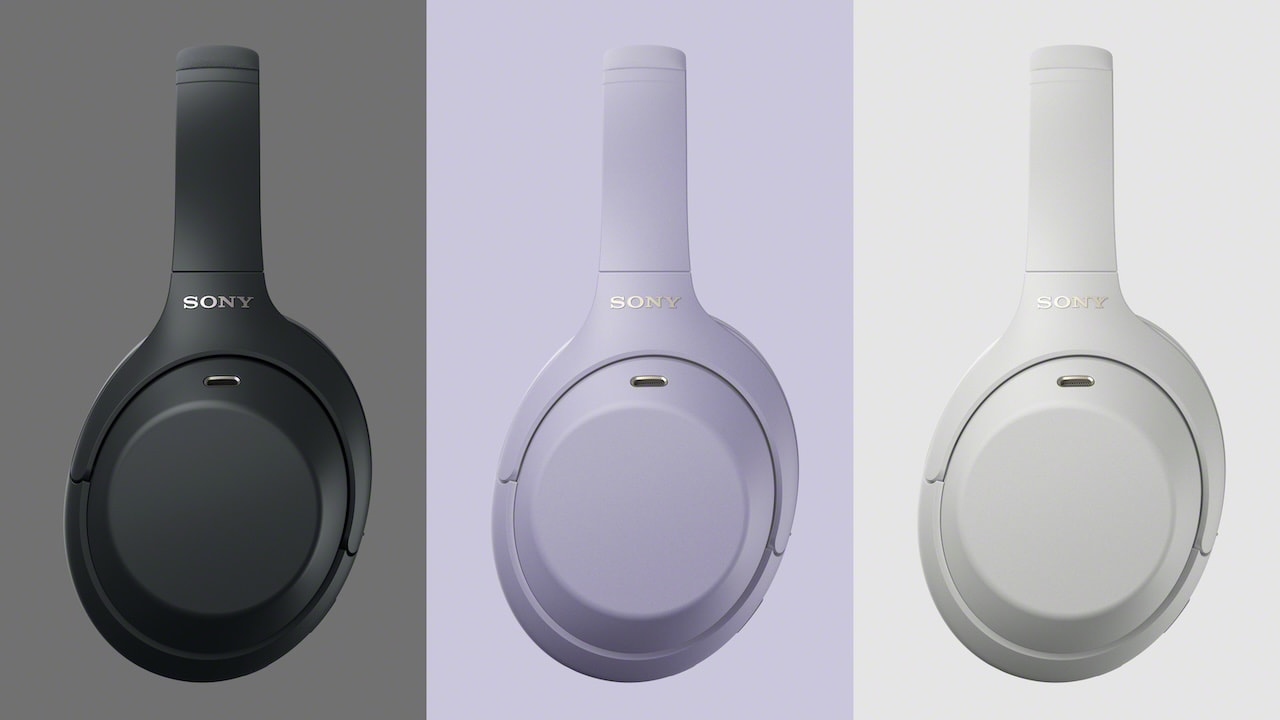
Sony and Bose have battled for ANC supremacy for more than a decade, with each new generation pushing noise cancellation, sound quality and features forward. Unfortunately, prices have tended to move in the same direction.
As a result, we often recommend the previous-generation model as the better value for buyers on a tighter budget or those who simply do not need every flagship feature. Sony has now added another option to that step-down space with the WH-1000XM4C, introduced on September 7, 2026.
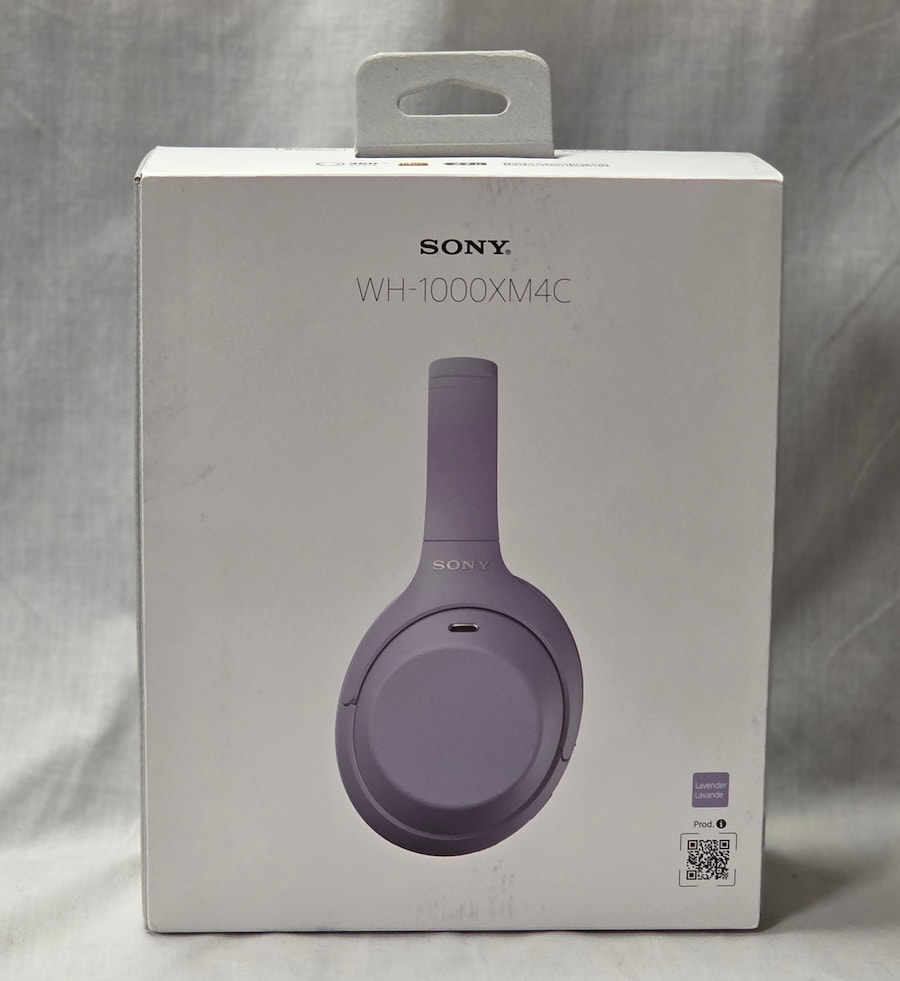
The WH-1000XM4C is Sony’s updated take on the WH-1000XM4 over-ear noise-cancelling headphones, a model that earned our Editor’s Choice award a few years ago. The new version retains much of what made the original so successful while adding more modern Bluetooth support, compatibility with Sony’s current app and a replaceable battery.
U.S. list price is $299.99, which is $50 below the original WH-1000XM4’s launch price and $160 less than Sony’s current WH-1000XM6 flagship. That still does not make the XM4C cheap, but it does make it more accessible than today’s top-tier ANC models.
The bigger question is where it fits in an increasingly crowded market. There is no shortage of capable wireless ANC headphones around $300, and many now offer strong sound quality, effective noise cancellation and extensive feature sets of their own. For occasional travelers and listeners who do not need Sony’s very best ANC, the XM4C may still provide more than enough performance. But at this price, familiarity alone is not enough; Sony has to prove that the refreshed XM4 still offers compelling value against a much broader field of competition.
Related Reading:
- Sony’s New XM4C Headphones Deliver Flagship Noise Cancellation And Sound Quality At A Lower Price
- Sony 1000X THE COLLEXION Headphones Review: A $650 Upgrade Or An Expensive Fashion Statement?
Build, Comfort and Controls
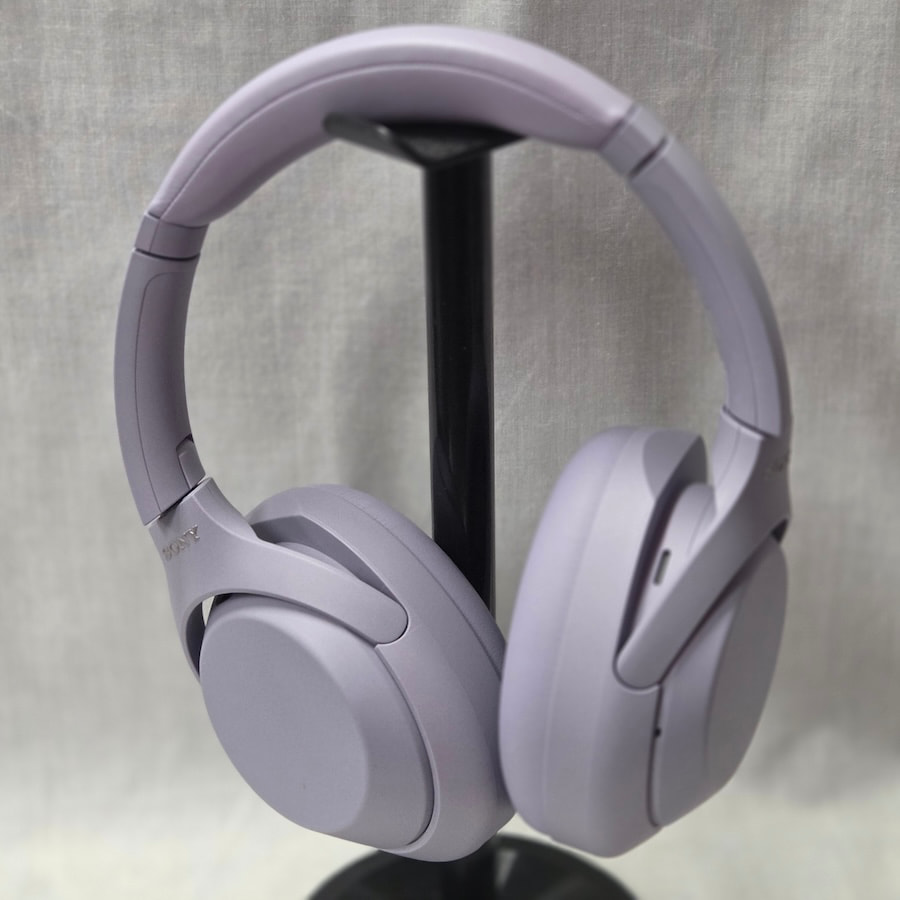
The XM4C, referred to internally by Sony as the XM4 Gen 2, retains the same basic look and design as the original model, with mostly polymer construction, hinged and foldable ear cups, and matching padding on the cups and center portion of the headband. Weight is relatively light at 255 grams, and clamping force is moderate, allowing for reasonable long-term comfort, although some heat does begin to build during extended listening sessions.
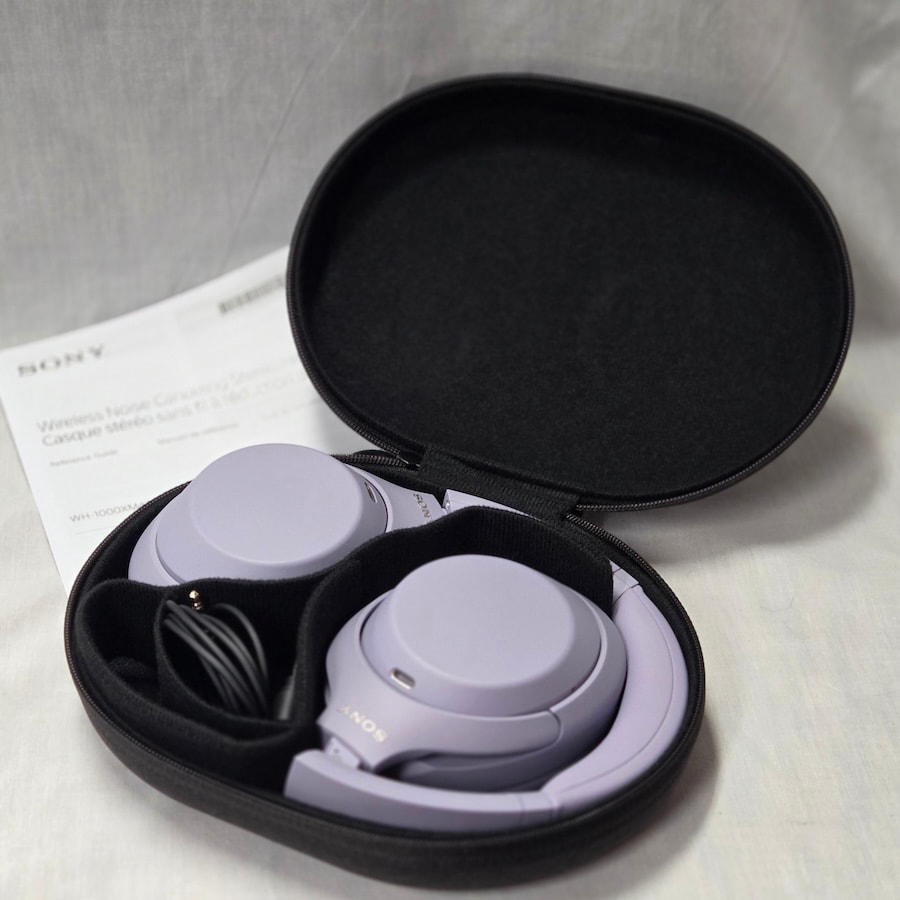
The kit is fairly basic, with a hard-sided storage case, the headphones and a 3.5 mm auxiliary cable. My pre-release sample did not include a charging cable, but that may be a pre-production anomaly or simply a nod to the fact that most people already have a USB Type-C charger at home. Color options include black, Phantom Silver and lavender, although the case remains black regardless of the colorway chosen; my lavender review sample arrived with a black carrying case.
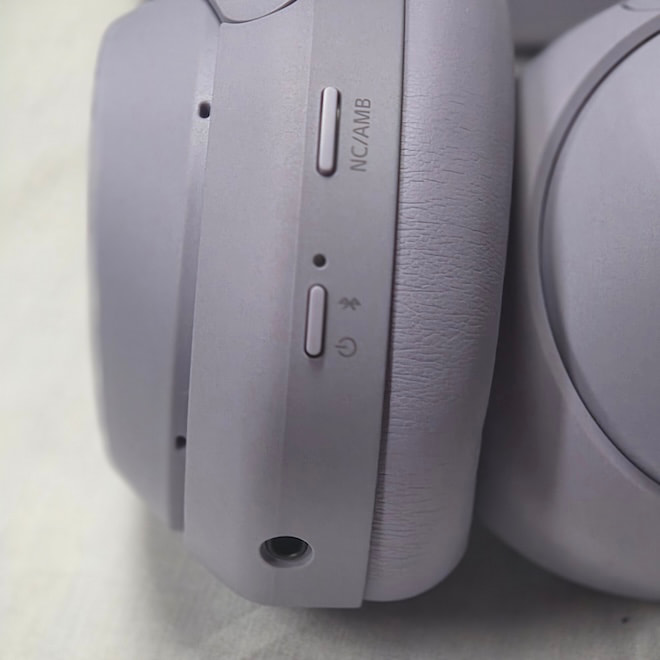
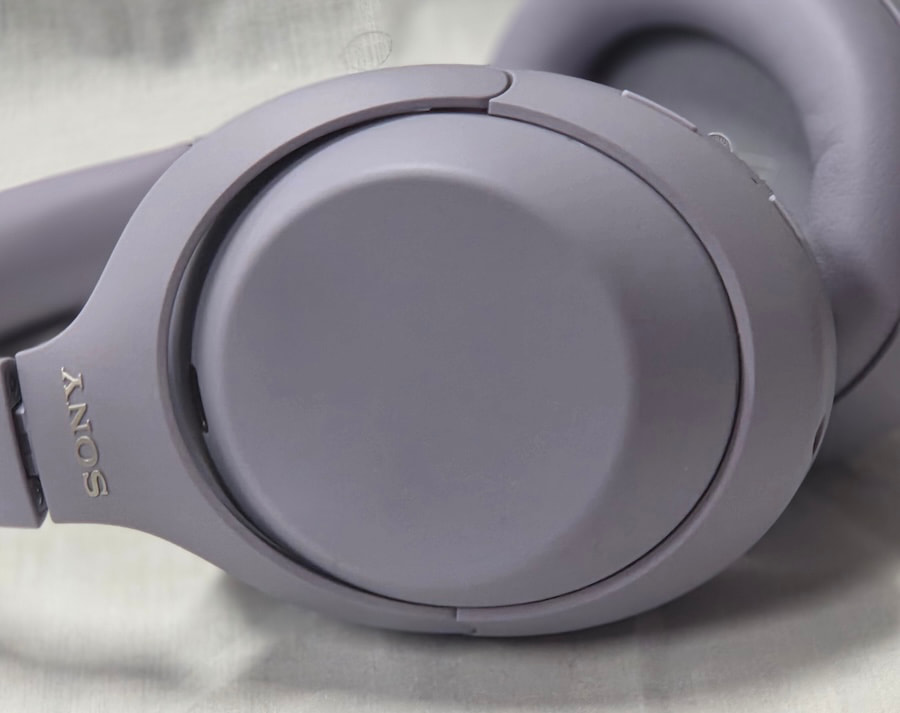
Controls are familiar, with two buttons on the left cup for power/Bluetooth and ANC/Ambient Sound, while touch controls occupy the outer face of the right cup. Operation uses a combination of taps and swipes: swipe backward or forward to change tracks, and swipe and hold up or down to adjust volume. The basic controls are reasonably intuitive, although less frequently used functions may be easier to access through the app than trying to memorize the entire catalog of gestures.
One gesture worth learning is Quick Attention, which allows you to cover the right cup with your hand to immediately lower playback volume and activate transparency mode so you can hear conversations or other sounds around you. Speak-to-Chat works similarly, automatically lowering playback volume and increasing ambient sound when it detects that you have started speaking.
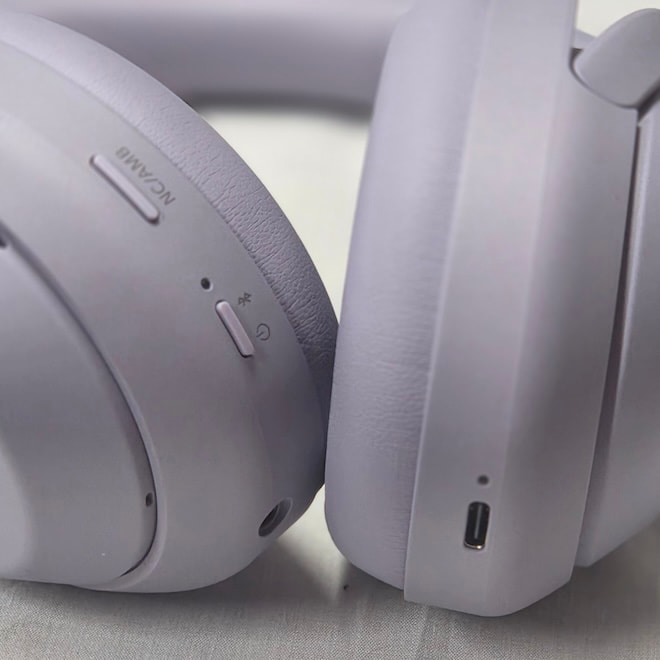
Connections include a 3.5 mm input on the left cup and a USB Type-C charging port on the right. A power LED sits immediately next to the charging port, while the Bluetooth pairing indicator is located just above the power button on the opposite cup.
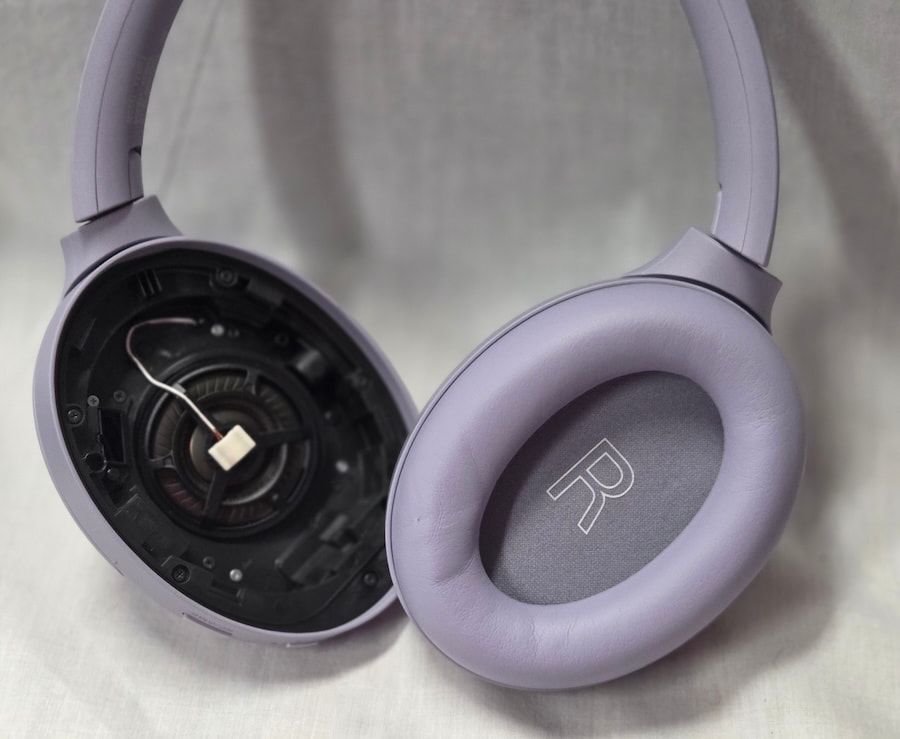
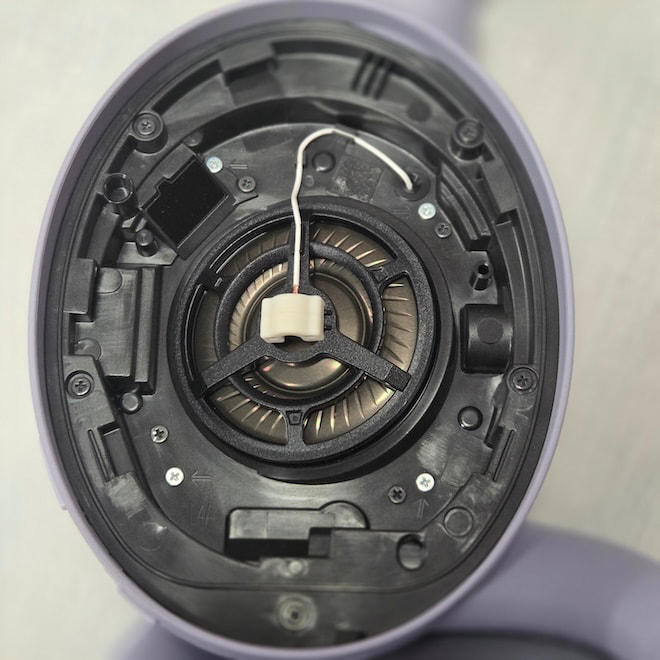
Inside the left cup is a visible wear-detection sensor, with a matching recess in the fabric covering the driver. Removing the ear pads reveals a foam damper over the driver and shows that the internal components are secured with screws rather than polymer welds, which should make repairs easier if they become necessary.
Drivers, Bluetooth and Connectivity
The XM4C uses the same 40 mm dynamic drivers with Liquid Crystal Polymer (LCP) diaphragms as the original XM4, and the basic specifications remain largely unchanged. Sony lists a Bluetooth frequency response of 20 Hz to 20 kHz, with LDAC extending the upper limit to 40 kHz. Wired frequency response is rated from 4 Hz to 40 kHz.
Impedance is listed at 40 ohms when powered and 16 ohms when unpowered. Sensitivity is 106 dB/mW with the headphones powered and 101 dB/mW when unpowered, making the XM4C compatible with most portable sources in passive mode and allowing wired listening even after the battery is depleted.
Sony pairs those drivers with Bluetooth 6.0 and the QN1 signal processor, which incorporates the HD Noise Canceling Processor, DAC and integrated amplifier. As with the original XM4, supported codecs include SBC, AAC and LDAC, providing compatibility with a wide range of devices. What Sony has not added is Bluetooth LE Audio or Auracast.
That distinction is worth noting. Some buyers may see Bluetooth 6.0 and assume that LE Audio and Auracast are automatically included, but Sony makes no mention of either feature in its documentation. Until Sony says otherwise, it is safest to assume they are not supported.
Google Fast Pair is supported, along with Bluetooth Multipoint for connections to two devices at once, making it easy to move between a phone and tablet or a phone and laptop once paired. In my testing with a Samsung Galaxy S25+, however, Multipoint and LDAC connectivity were mutually exclusive, with Multipoint requiring SBC or AAC.
Battery Life, Charging and Serviceability
Battery life is rated at up to 34 hours with minimal feature use and 27 hours with ANC enabled. In my testing, I managed roughly 25 hours at normal listening levels with both ANC and LDAC in use.
Once depleted, the battery takes approximately 3.5 hours to recharge using a standard USB Type-C charger. The XM4C also supports true quick charging, with a three-minute charge providing roughly one hour of playback. This does require a higher-current charger than the basic 5V/500 mA USB specification.
One reason for Sony revisiting the XM4 platform was the move toward user-replaceable batteries under new EU requirements. To accommodate that, the ear cups are assembled with screws rather than permanent polymer welds, making the battery easier to access and replace when the time eventually comes.
Software and Features
Sony offers Adaptive Sound Control (ASC), which adjusts according to detected noise levels and location, as well as a Personal NC Optimizer that accounts for head size and shape, ear pad fit, glasses and even hairstyles, if you believe Sony’s literature. In testing both, I found that ASC did increase the level of noise cancellation in louder environments. Sounds from vacuums and dishwashers were effectively removed from the background, and even the dog whining was reduced considerably.
I tried the XM4C with and without my glasses and honestly could not tell much of a difference, but that is the point after all, so no surprises there. The optimizer is accessed from the same screen in the Sound Connect app as the ANC adjustments, making it easy to find when needed.
The Sound Connect app is the main configuration tool for the XM4C, providing battery information, Noise Canceling and Ambient Sound adjustments, a much-improved equalizer, 360 Reality Audio configuration, DSP settings, DSEE Extreme, and options for customizing controls and prompts. As with most modern wireless headphones, you will also need the app to install firmware updates.
The equalizer has been expanded to 10 bands, up from the five-band version offered with the original XM4. It includes preset modes as well as the ability to create and save custom settings for different preferences, moods or playlists.
DSEE Extreme is Sony’s upscaling processor, and like most upsampling technologies, the results are mixed. Some tracks sound more spacious and open with it enabled, while others can sound artificial or simply worse. Experimentation is definitely required.
The app also lists Quick Access integrations for services including Spotify, Apple Music and YouTube Music. I’m told these options vary by region, so while those are the services available in the U.S., users elsewhere may see a different selection.
Listening
The default tuning is bass-elevated, with most of the emphasis from 110 Hz downward and a slow taper toward the lower mids as frequency rises. This gives the XM4C a pronounced sub-bass presence, with rumble more prominent than mid-bass impact in the default tuning. Pulling the lows back allows the mid-bass to show through more clearly and reveals that the XM4C is capable of good kick-drum slam when called upon, although it can be overshadowed unless those EQ tweaks are made.
The lower mids have good weight, and voices cut through the instrumentation well, as the steady decline from the lows does not reach its lowest point until somewhere around 1 to 1.5 kHz. From there, it almost immediately begins climbing again toward the lower treble. Instruments that fall into this valley, including guitars and some strings, can sound mildly recessed compared with material above and below them, and again, a bit of judicious EQ helps balance things out.
Higher vocals cut through well and sound clear without any nasal tendency. This being a closed-back, sealed design, do not expect those voices to have a lot of room to work, though. At times, things can feel a bit cramped as tracks become more complex and the instrumentation more dense.
The lower treble is boosted to roughly the same level as the sub-bass, providing some balance to the V-shaped signature and lending energy to the top end. Again, given the closed design and ANC implementation, these do not offer much air or sparkle up top, and percussion snap sounds mildly muted as a result. Overall, it is a polite treble that will not offend many listeners, but may not excite them either.
The soundstage is intimate at best, which is not surprising given the sealed design. One issue I noticed when using the 3.5 mm cable with the XM4C powered off was a notable channel imbalance. I suspect the sensor in the left cup occupies enough internal space to contribute to the difference, and with the electronics switched off, that imbalance is left uncompensated and audible. With the headphones powered on, the electronics do a good job of masking it.
Instrument separation is acceptable, but be aware that this is not the fastest driver in Sony’s lineup, and that aspect has improved noticeably on the company’s newer flagships.
Not being a huge fan of V-shaped signatures, I spent some time working through both the presets and the custom EQ to bring the XM4C closer to my preferences. The Vocal preset reduces the bass boost by roughly half while retaining most, if not all, of the treble lift, shifting the sound from a pronounced V-shape to a smaller one. It still retains much of the same character, but the bass boom is reduced enough to make it more pleasant to my ear.
The Bright preset also reduces the bass but pushes the treble forward more aggressively. Where it helps is in the mids, where the trough in the default tuning is much less recessed and sounds more realistic. The treble, however, is a bit overdone, and many listeners will likely find it fatiguing fairly quickly.
None of the other presets improved on the default tuning for my preferences, so I spent more time with the custom EQ. The 10 bands provide enough granularity to make meaningful changes without introducing too many unintended consequences, although I would still like narrower control in areas such as the 100 to 200 Hz bass region or the 1 to 1.5 kHz midrange.
The Bottom Line
There was a time when the WH-1000XM4 sat near the top of the ANC headphone market. Wireless headphones have moved quickly since then, and the XM4C now lands in a very different position: not as a flagship, but as a mid-range option that delivers much of the familiar Sony experience for less money.
For many listeners, that may be exactly enough. Occasional travelers do not necessarily need the very best noise cancellation available, and features such as comfort, battery life, app support, EQ flexibility and overall usability may matter just as much. The addition of a replaceable battery is also a meaningful improvement, although the lack of Bluetooth LE Audio and Auracast keeps the XM4C from feeling completely current.
The bigger challenge is competition. Around $300, buyers have no shortage of capable wireless ANC headphones, and the XM4C is far from the only model offering a strong feature set. Its default V-shaped tuning will also appeal more to some listeners than others, although Sony’s improved 10-band EQ provides enough flexibility to make useful adjustments.
For listeners who already like Sony’s sound and feature set, the WH-1000XM4C makes considerably more sense than hunting down a used former flagship. It can also be a smarter purchase than spending more for flagship features you may never use. Just do not mistake it for the market leader the original XM4 once was.
Pros:
- Improved ANC compared with the original XM4
- User-replaceable battery
- Updated tuning and processing
- Much-improved 10-band EQ
Cons:
- Replaceable battery is slightly smaller
- No virtualization or head tracking
- No NFC tap-to-pair support, unlike the original XM4
Our Ratings:
★★★★★★★★★★ Sound Quality
★★★★★★★★★★ Build Quality
★★★★★★★★★★ Features
★★★★★★★★★★ Comfort
★★★★★★★★★★ ANC
★★★★★★★★★★ Value
Where to Buy:
Related Reading:


















Baltazar
October 9, 2026 at 10:23 am
So in this price range which cans will be better value?
W. Jennings
October 12, 2026 at 4:05 pm
There are an awful lot of good headphones in the $299 space and picking just one as the best value is near impossible without knowing a use case. To me the XM4 probably only wins IF the ANC is far and away the most important feature to you. for my money, the Senn Momentum 4 at $229 is a better value if you don’t have to have class leading ANC.
ORT
October 9, 2026 at 2:26 pm
I have Sony XM4, XM5 and XM6 model headphoens. Well, in truth I sent the XM4 version back as I did not care for it at all. The other versions remain in my headphone rotation along with the new Sony 1000X Collexion which is right up there at the top along with…Another brands Flagship. 😉
Being somewhat handicapable (i.e., some days are better for me and some days are worser for me), I really enjoy using the Sony headphones with one of their excellent, fully automatic turntables. I have been waiting for almost 4 months for my Pro-Ject Peanuts 75th Anniversay ‘table to arrive and when it does I shall be using it to happily listen to music with my Sony headphones as well as other BlooToof ‘phones I have.
“If music be the food of love, play on”…Life is a buffet. Choose wisely and don’t over do the dumb stuff.
Superb-A-Mundo!
ORT
Ian White
October 9, 2026 at 3:06 pm
ORT,
Do you want to know the real reason why these came back? I wrote an article (that we couldn’t publish) during the summer that was one of the first leaks about this new version. We had signed an NDA that I wasn’t told about until after I was done, so my first piece was shelved.
Foldable. That one feature matters the most to a lot of people. It was dumb to get rid of that feature and Sony found out that their customers would buy something else if this model didn’t offer it.
IW
W. Jennings
October 12, 2026 at 4:08 pm
The XM5 was the one I sent back as I just could not get them to fit comfortably with my glasses and the fatigue set in almost immediately. Thankfully the Collexion seems to have remedied that, but with prices continuing to soar, its hard to justify the spend on a flagship these days.
Roy C Klostermeyer
October 11, 2026 at 10:11 pm
If the 4xmc phones have the similar screaming in your ear, and the head cup stops falling out and the cup separating, I doubt the replaceable battery is going to make a big deal. After having overheating issues with my WF xm4’s, burned my skin in my pocket off the charging cable, I kinda got concerned about their safety and mine. In the last few years otherwise great Sony products failed from cheap plastic parts or a cheap (nonreplaceble) battery.
Good Bye Sony. Bowers & Wilkins Px7 S2e. Not quite the noise cancelling, but the sound, light years ahead of the Sony’s.
Ian White
October 12, 2026 at 9:57 am
Roy,
I’m pretty sure Will (who is brutally tough on all headphone-related products he reviews) would have mentioned that. We definitely endorse the XM6 and Collexion in terms of both ANC and sound quality. And yes, the Bowers wireless headphones offer superior sound quality. I bought the ones you mentioned for my eldest, and the Px8 S2 are my daily driver and with me when I travel.
IW