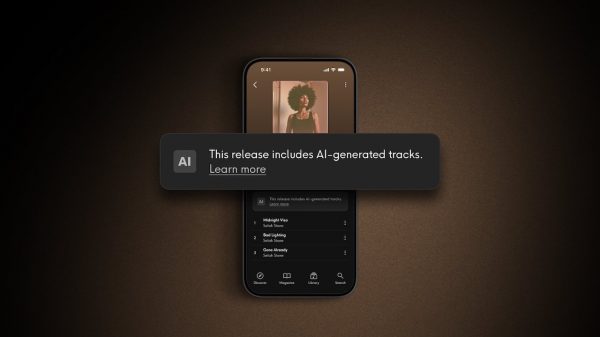
TIDAL is not banning AI music, but it is finally drawing a line where the money starts. Beginning July 15, 2026, TIDAL says it will start labeling music it determines to be wholly AI generated. More importantly, those tracks will not be eligible for royalty attribution. That does not mean TIDAL is banning every song that uses AI somewhere in the creative or production process, but it does mean the platform is no longer willing to let fully machine generated catalog filler collect royalties like music created, written, performed, and recorded by actual human beings.
TIDAL defines AI generated music as music “wholly generated using generative artificial intelligence.” For now, the company says it will only take action against fully AI generated tracks because detection technology remains imperfect and false positives could punish real creators. TIDAL says it may expand enforcement later to content that is “substantially AI generated” as detection improves.
That distinction matters. AI assisted production, restoration, mastering, stem separation, or creative experimentation is not the same thing as flooding a streaming platform with thousands of prompt generated tracks designed to game the royalty pool. One is a tool. The other is audio spam with better lighting.
TIDAL’s policy also gives the company room to block or remove AI generated music tied to fraud. That includes content designed to mislead listeners, impersonate artists, exploit an individual’s name or likeness, interfere with authentic artists and their audiences, or benefit from unusual upload or streaming activity. TIDAL Upload content is also covered, and fully AI generated tracks may be excluded from direct to fan monetization.
Why TIDAL Is Doing This Now
The AI music problem is no longer theoretical. Streaming services are being buried under synthetic tracks, many of them created not for artistic expression but for royalty arbitrage. The scam is simple: generate music at industrial scale, upload it cheaply through distributors, use bots or playlist manipulation to create listening activity, and siphon tiny payments from the same royalty pool that human artists depend on.
That might sound like penny ante fraud until you scale it across millions of tracks. Streaming already rewards volume, repetition, and algorithmic placement. AI makes all three easier to manipulate.
A recent academic study of AI music on streaming platforms found that most AI music receives little engagement, but that AI uploaders often follow a “spray and pray” model, releasing large volumes of tracks across genres in search of traction. The same study also found inconsistent distributor policies and warned that current AI music detection methods still lack robustness.
TIDAL’s move is therefore less about banning technology and more about protecting the economics of music streaming before the catalog turns into a landfill with album art.
How Qobuz, Spotify, and Apple Music Compare
TIDAL is not acting alone, but each major platform is approaching the problem differently.
Service Current AI Music Approach What It Means TIDAL Labels fully AI generated tracks starting July 15, 2026 and excludes them from royalty attribution. May remove AI content tied to fraud or impersonation. Strong royalty focused policy. TIDAL is allowing AI music to exist, but not letting fully AI generated tracks collect like human made music. Qobuz Uses an AI Charter, is developing detection and monitoring systems, excludes fraudulent streams from royalty reports, and prohibits delivery of 100% AI generated content through contractual clauses. Most aligned with human curation. Qobuz is treating AI spam as a discovery and trust problem, not just a payout issue. Spotify Strengthened impersonation rules, added a music spam filter, supports DDEX based AI disclosures, and says AI disclosure is not meant to punish responsible creators. Spotify is trying to separate legitimate AI assisted work from spam, voice cloning, and mass upload abuse. Apple Music Introduced AI Transparency Tags through metadata supplied by labels and distributors for artwork, tracks, compositions, and music videos. Apple is emphasizing disclosure through the supply chain, but the approach depends heavily on labels and distributors reporting AI use accurately.
Related Reading: Streaming, AI Music and Royalties
- TIDAL Raises Prices Again: What It Means For Music Streamers
- Qobuz Connect Is Finally Here (And There Was Much Rejoicing)
- Spotify Raises Prices Again — Is It Still Worth It?
- Apple Music & Its Switch To Lossless And What That Might Mean For MQA: Opinion
Qobuz Is Taking the Human Curation Route
Qobuz has been more explicit than most about protecting human artists and human led discovery. Its AI Charter says the company does not promote fraudulent or 100% AI generated content, prohibits scraping or crawling its catalog to train AI models, and excludes fraudulent streams from royalty reporting and payments. It also says contractual clauses prohibit delivery of 100% AI generated content.
In February 2026, Qobuz said it had started analyzing its catalog with a proprietary detection system to identify and tag content that is 100% AI generated. The company also said its editorial recommendations, playlists, Qobuzissimes, and Albums of the Week remain selected by human teams, effectively keeping industrial AI content out of the most visible discovery areas.
That is the most Qobuz answer possible: fewer fake artists, more actual record nerds. Honestly, not the worst business model and one that we will happily continue paying for every month.
Spotify Is Going After Spam and Impersonation
Spotify is taking a broader platform integrity approach. In September 2025, the company said it had removed more than 75 million “spammy” tracks over the previous 12 months and announced three areas of focus: stronger impersonation enforcement, a music spam filter, and AI disclosures through industry standard credits.

Spotify’s impersonation policy is aimed directly at AI voice clones and unauthorized vocal deepfakes. The company says vocal impersonation is allowed only when the impersonated artist has authorized it. Spotify is also testing new tools with distributors to prevent music, AI generated or otherwise, from being fraudulently delivered to another artist’s profile.
The company’s music spam filter is designed to identify uploaders and tracks using tactics such as mass uploads, duplicates, SEO hacks, artificially short tracks, and other “slop” strategies. Spotify says those tracks can be tagged and withheld from recommendation systems.
Spotify is also supporting DDEX based AI disclosures in song credits, allowing labels and distributors to indicate whether AI was used for vocals, instrumentation, lyrics, or post production. Spotify says this is not meant to punish responsible artists who disclose AI use.
That last part is important. Spotify is not saying “AI equals bad.” It is saying unauthorized voice clones, fake artist uploads, spam farms, and royalty manipulation are the enemy. Which is fair. Nobody asked for 48,000 fake lo-fi sleep tracks from “DJ Kelce’s MSG Honeymoon Playlist,” featuring a suspiciously Swift-adjacent bridge, a fake crowd roar, and the emotional depth of a sponsored luxury box.
Apple Music Wants Disclosure First
Apple Music has moved toward transparency tags rather than a TIDAL style royalty cutoff. According to Music Business Worldwide, Apple Music introduced metadata based “Transparency Tags” that labels and distributors can apply to content delivered to Apple Music. The tags cover four areas: artwork, track, composition, and music video.
Apple is placing responsibility on the content supply chain. Labels and distributors are expected to report when AI has been used in content they deliver. Apple’s model is therefore closer to a disclosure framework than a public demonetization policy.
Apple also continues to warn artists about stream manipulation, including bots, fake accounts, and paid services promising more plays. Apple says artificial play boosting undermines a fair playing field for artists whose success is based on legitimate listening activity.
The open question is enforcement. A transparency tag only works if the person uploading the content tells the truth. In an industry where people already fake streams, fake artist names, fake playlists, and fake engagement, trusting bad actors to self label their fake music feels charmingly optimistic. Very Cupertino. Very polished. Possibly wearing loafers and paying $11 for a coffee made by some kid with purple hair who thinks Platner’s Nazi tattoo was a progressive statement.
Deezer Shows How Big the Problem Has Become
Deezer is worth mentioning because it has been one of the most aggressive platforms in publicizing the scale of AI music uploads. In April 2026, Deezer said it was receiving almost 75,000 AI generated tracks per day, representing roughly 44% of daily uploads. Deezer also said consumption of those tracks remained low, around 1% to 3% of total streams, and that 85% of streams on AI generated music were detected as fraudulent and demonetized.
What This Means for Listeners
For listeners, the immediate change will likely be more labels, more disclosure language, and fewer synthetic tracks pushed into prominent discovery areas. That is good. Music discovery already has enough problems without asking listeners to figure out whether the artist, the voice, the album art, and the streaming activity are all fake.
For serious music fans, there is another issue: trust. Audiophiles have spent years arguing about lossless, hi-res, MQA, FLAC, Dolby Atmos, bit perfect playback, and whether a streamer sounds better over Ethernet than Wi-Fi. None of that matters if the catalog itself becomes polluted with content nobody actually made.
A 24-bit FLAC file of synthetic royalty bait is still synthetic royalty bait.
What This Means for Artists
For artists, TIDAL’s policy is a warning shot to distributors and uploaders. If a track is fully AI generated, TIDAL can label it and withhold royalties. If it is connected to impersonation, deception, or suspicious streaming activity, it can be blocked or removed.
Artists using AI responsibly should also start documenting their process. That means keeping project files, stems, credits, contributor information, and distributor metadata accurate. The industry is moving toward more disclosure, not less. The days of dumping machine generated tracks into the system and hoping no one asks questions are ending.
Or at least they should be.
The Bigger Issue
The streaming industry created a model where every play matters, every upload has theoretical earning power, and algorithms control discovery at massive scale. AI did not create those weaknesses. It just found them, brought snacks, and invited 75,000 friends per day.
TIDAL’s new policy is not perfect. AI detection remains difficult. False positives are possible. Fully AI generated and AI assisted music will not always be easy to separate. But the broader direction is clear: streaming services are beginning to decide that human creativity deserves protection inside the royalty system.
That is overdue.
The bigger question is whether listeners will care. They should. Because once streaming platforms become flooded with cheap synthetic catalog filler, the problem is not only that artists get paid less. It is that music discovery gets worse, trust gets weaker, and the platforms start to feel less like libraries and more like content farms with hi-res FLAC files.
TIDAL is drawing a line. Qobuz is reinforcing the wall with human curation. Spotify is building filters and credits. Apple Music is leaning on metadata and disclosure.
None of these approaches solves the problem alone, but at least the industry is finally admitting there is a problem. That is progress, even if it took a tidal wave of fake songs to get there.
Related Reading:
- The Fake Artists Problem Is Much Worse Than You Realize: The Honest Broker
- TIDAL Adds FLAC: Is It Really Dropping Support For MQA?
- Spotify Finally Tries Hi-Fi: Lossless Listening Lounge In London Built Around Horn Speakers And Bryston Power