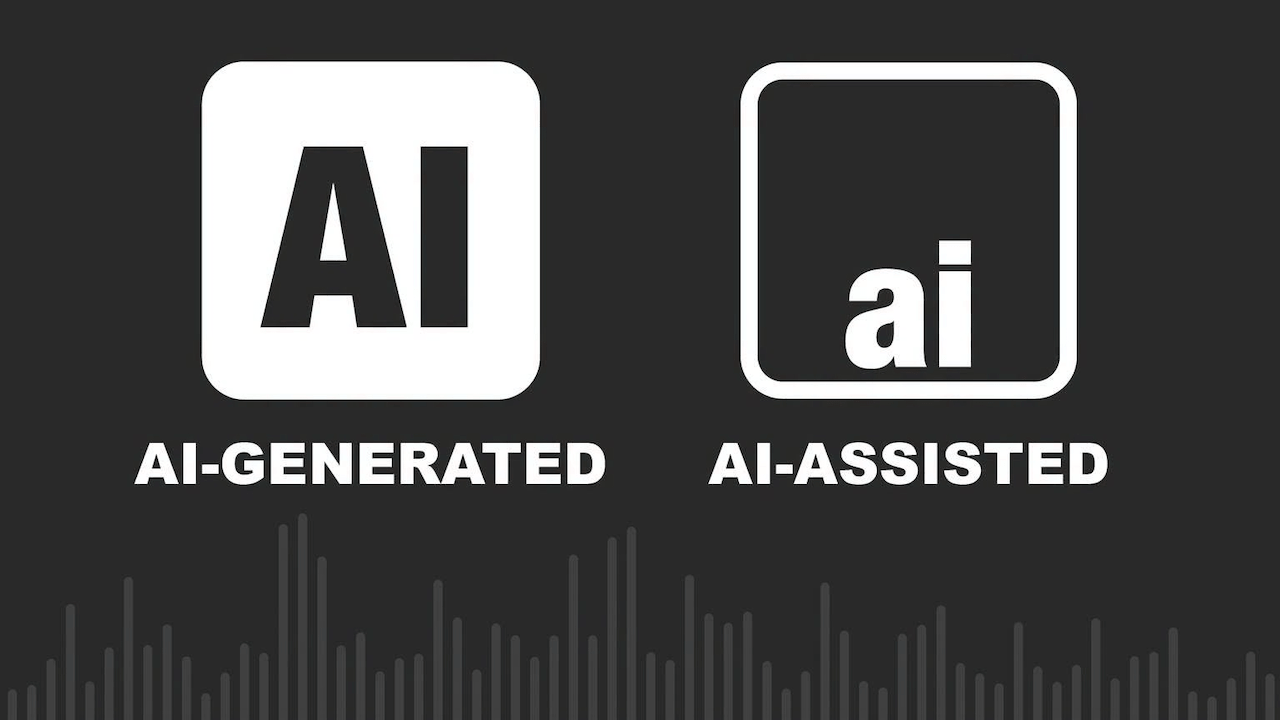
Music industry groups are backing a new voluntary labeling framework designed to tell listeners when generative AI has been used in sound recordings, and whether a track is fully AI generated or only AI assisted.
The announcement follows our recent coverage of TIDAL’s AI music policy, which will label wholly AI generated tracks and make them ineligible for royalty attribution. TIDAL’s move was a platform-specific policy. This new effort is broader, with IFPI, RIAA, A2IM, WIN, IMPALA, The Grammys, SAG-AFTRA, and the Human Artistry Campaign supporting a shared track-level labeling approach intended for digital music services and other industry partners.
The proposed system uses two labels: AI Generated and AI Assisted. For now, both are voluntary and designed to travel through the same metadata and delivery systems that already move music from labels, distributors, and aggregators to streaming platforms.
That is the important caveat. Nobody is flipping a master switch tomorrow that suddenly makes Spotify, Apple Music, TIDAL, Qobuz, Amazon Music, and Deezer display clean AI labels on every questionable track.
What AI Generated Means

Under the proposed framework, AI Generated would apply when generative AI created all or the primary creative elements of a sound recording. One obvious real-world example is “Heart on My Sleeve,” the viral fake Drake and The Weeknd track released by Ghostwriter977 in 2023. The song used AI-generated vocals that mimicked both artists and was removed from major platforms after Universal Music Group objected. That is exactly the kind of track-level disclosure this system is trying to address, especially when synthetic vocals are presented in a way that could confuse listeners.
That distinction matters because the industry is not trying to label every recording that touched a computer during production. Modern music already depends on digital editing, plug-ins, pitch correction, mastering software, and increasingly AI-assisted tools. The proposed AI Generated label is aimed at recordings where generative AI supplies the primary creative elements, not cases where an artist or producer used technology somewhere in the workflow.
What AI Assisted Means

The second label, AI Assisted, is intended for recordings created primarily by humans but with generative AI used in a limited creative role. A useful example is Holly Herndon’s 2019 album PROTO, which combined human voices with Spawn, an AI system Herndon and her collaborators trained to generate vocal material. The album was not marketed as a fake human artist or an entirely prompt-generated project; it was a human-led recording that openly incorporated AI as part of the creative process.
That is where this label gets more complicated. A fully AI-generated track is easier to identify and explain. A human-made recording that uses generative AI for backing vocals, textures, instrumental layers, or production elements is murkier. The industry is trying to draw a line between AI as the artist and AI as a tool. How that plays out in recording studios will depend on artists, producers, labels, distributors, and how honestly everyone documents the work before it reaches streaming platforms.
What the Labels Do Not Cover
The framework currently applies only to sound recordings. It does not cover generative AI used in lyrics, musical compositions, music videos, or cover art. That is a major limitation, but it is also an honest one. A label that tries to solve every AI problem in music on day one would probably solve none of them.
There is also no guarantee yet that every major streaming service will use the exact labels. Music Business Worldwide reports that DiMA, which represents digital music services including Spotify and Apple, supports improved AI metadata flow, but did not confirm whether its members would adopt the proposed AI Generated and AI Assisted tags.
Why the Industry Wants This Now
The timing is not accidental. AI music is arriving at scale, and streaming platforms are being asked to manage several problems at once: listener transparency, artist impersonation, royalty fraud, catalog pollution, and the use of human-created music to train generative AI systems without consent or compensation.
The industry clearly sees labeling as a first step toward transparency. It is not the same thing as licensing reform, royalty reform, artist consent, or reliable AI detection. A warning label only helps if it is accurate, visible, and consistently applied. If it is buried in credits that most listeners never open, the exercise becomes metadata theater with nicer icons.
Where TIDAL Fits
TIDAL has already moved beyond disclosure by saying music it identifies as wholly AI generated will not be eligible for royalty attribution. Beginning July 15, 2026, TIDAL says it will label wholly AI-generated music to provide listener transparency, while also excluding those tracks from royalty attribution.
That makes TIDAL one of the more aggressive platforms in this space, although its policy still depends on detection, disclosure, and distributor compliance. The company has also said it intends to expand its approach as detection improves, which is the right caveat. AI detection in music is still not something anyone should treat as infallible.
Where Qobuz Stands on AI Music
Qobuz has already taken a more human-first position on AI-generated music. Earlier this year, the company introduced an AI Charter and began using a proprietary detection system to identify and tag content it determines to be 100% AI-generated across both new releases and its existing catalog. Qobuz said those tags would become visible across its apps in the following months.
The company’s position is not that AI can never be used in music. Qobuz has acknowledged that AI can serve human creativity in areas such as demoing, mixing, mastering, and even composition. Its red line is when AI replaces the human creator entirely or is used at scale to flood streaming platforms with synthetic catalog filler.
Qobuz is also keeping its editorial and discovery areas human-led. Its Qobuzissimes, Albums of the Week, playlists, articles, and reviews remain selected by human teams, while its Discover page relies on curated data from its editorial staff and trusted partners. The goal is to keep industrially generated AI content out of the platform’s most visible recommendation areas.
On the royalty side, Qobuz says fraudulent streams are excluded from reporting and royalty calculations, and AI-generated content can be removed upon detection. The company also says it will not generate audio content for its catalog, replace human curation with AI, or use customer data to train external AI models.
Spotify: The 761 Million User Problem
Spotify’s position is more permissive than Qobuz and less aggressive than TIDAL on royalties. The company is not banning AI-assisted or AI-generated music outright, and it says royalties are still paid based on listener engagement rather than the tools used to create a track. Spotify’s focus is on three areas: unauthorized artist impersonation, spam uploads, and clearer AI disclosures in song credits.
In September 2025, Spotify said it had removed more than 75 million “spammy” tracks over the previous 12 months and announced a new music spam filter designed to identify uploads that abuse mass releases, duplicates, SEO tricks, artificially short tracks, and other tactics used to game royalties. It also tightened its impersonation policy, stating that AI voice clones are only allowed when the impersonated artist has authorized the use.
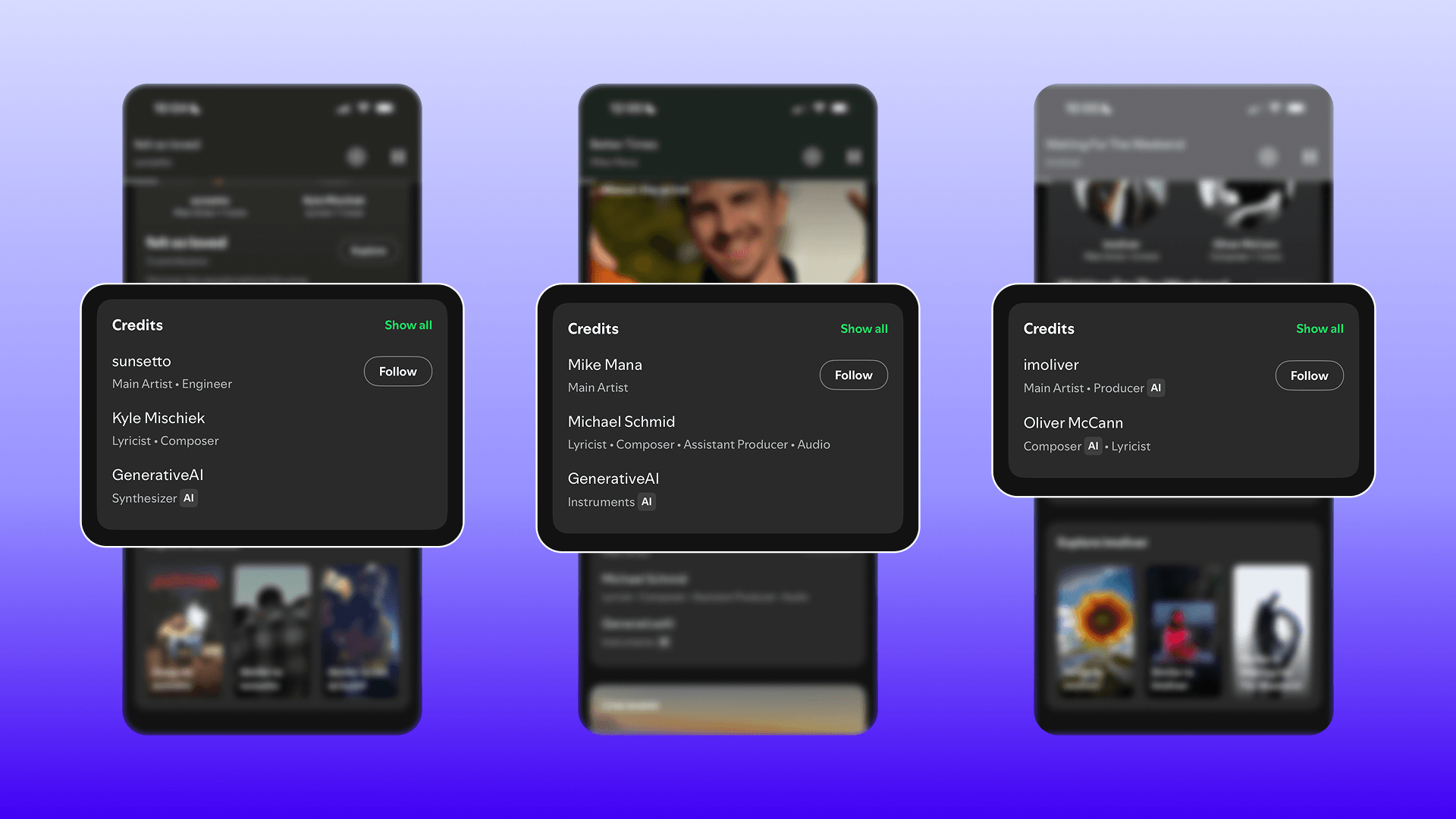
Spotify is also supporting DDEX-based AI disclosures in song credits, which should allow artists and rights holders to indicate whether AI was used for vocals, instrumentation, lyrics, or production. That is useful, but it still depends on disclosure from labels, distributors, and artists. In other words, Spotify is building a better warning light. It still needs the people uploading the music to stop pretending the dashboard is fine.
The Hard Part Is Enforcement
The biggest weakness in any AI labeling system is not the label itself. It is how the information gets verified.
The RIAA-backed framework is built around voluntary track-level labels supported by metadata and delivery systems. The organizations behind it say they will work with digital music services, distributors, aggregators, and standard-setting bodies on implementation. That is the correct path if the goal is scale, but it also means the system depends on a lot of parties doing the right thing before a track reaches the listener.
The labels can only work if everyone in the chain plays it straight. A streaming service can show the tag, and the metadata can carry the information, but somebody still has to disclose the AI use honestly in the first place.
That is the weak spot. If an uploader lies, a distributor waves it through, or a platform buries the label where nobody will ever see it, listeners are back where they started.
The Bottom Line
The proposed AI Generated and AI Assisted labels are a necessary step, but they are not a complete solution. They can help listeners understand whether they are hearing human-created music, AI-assisted music, or a recording primarily generated by AI. They can also give artists and labels a more standardized way to disclose AI use across platforms.
But the real test will be implementation. The labels need to be visible, consistent, and tied to reliable metadata. They also need to evolve beyond sound recordings if the industry wants to address AI-generated lyrics, compositions, artwork, and videos.
TIDAL’s own AI policy already goes further by connecting AI labeling to royalty eligibility. At the same time, TIDAL is also raising U.S. prices on the first billing date on or after August 3, 2026, with its Individual plan listed at $11.99/month, Family at $19.99/month, and Student at $6.99/month.
That gives the company a useful talking point around artist support, but it also raises the bar. If listeners are being asked to pay more for streaming, they should also expect more transparency about what they are actually hearing.
For more information: riaa.com
Related Reading: