
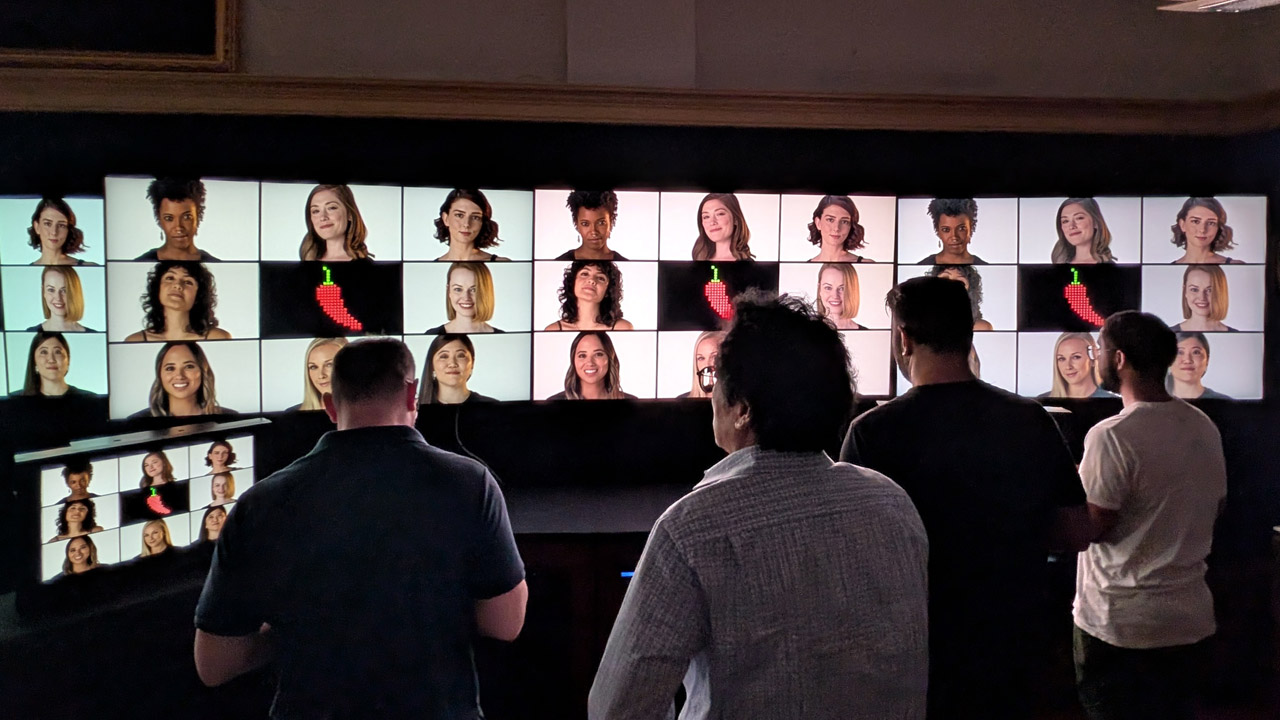
Every year, the top performing TVs are brought together into one room to determine which models offer the best video performance, and which don’t quite measure up. It’s called the “TV Shootout” and it’s hosted by electronics dealer Value Electronics. This year’s event included six of the top performing OLED and RGB backlit LCD TVs from Sony, LG and Samsung and it was held yesterday (July 18, 2026) at the company’s headquarters in Scarsdale, NY.
The Competitors
With Panasonic effectively dropping back out of the high end TV market in the United States (at least for now), and with TCL and Hisense choosing not to participate, just three manufacturers were represented this year: LG, Samsung and Sony. Each manufacturer was represented by one OLED TV and one RGB-lit LCD TV in the fight, for a total of six models.
OLED TV Models Competing in the 2026 TV Shootout (65-inch):

- Samsung S95H QD-OLED TV (QN65S95H)
- MSRP: $3,399, available at Best Buy
- Sony BRAVIA 8, Mark II QD-OLED TV (K65XR80M2)
- LG G6 Quad Stack W-OLED TV (OLED65G6WUA)
- MSRP: $3,299, available at Best Buy
RGB-Backlit LCD TV Models Competing in the 2026 TV Shootout (75-inch):

- Sony BRAVIA 9 II True RGB LCD TV (K75XR90M2)
- MSRP: $4,599, available at Best Buy and Crutchfield
- Samsung R95H Micro RGB LCD TV (MRN75R95H)
- MSRP: $4,499, available at Best Buy
- LG MRGB95B Micro RGB Evo LCD TV (75MRGB95BUA)
- MSRP: $4,999, available at Best Buy
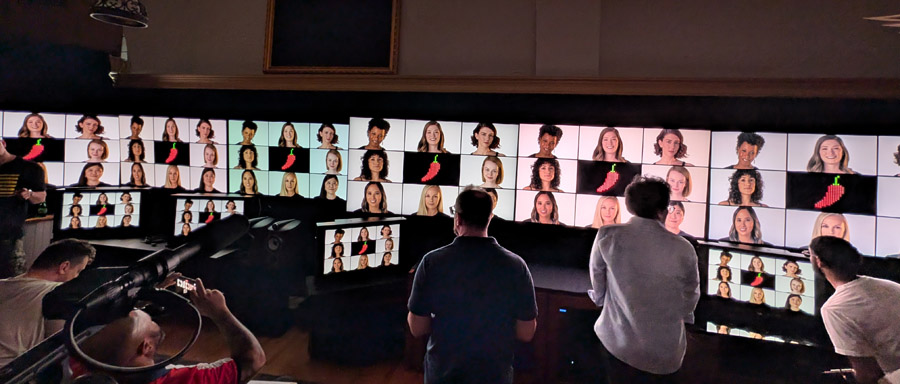
Although all six TVs were installed in the same room, along with four professional Sony broadcast monitors to use as reference displays, the competition was actually split into two groups: OLED on the left (all in 65-inch sizes) and RGB-lit LED/LCD TVs on the right (all in 75-inch sizes). Unlike in previous years, the judges were split into two groups as well: one group to judge the OLED TVs and one group to judge the RGB LCD TVs.
OLED vs. RGB Backlit LCD TV
OLED (Organic Light Emitting Diode) TVs use self-illuminating pixels to create the on-screen image. This allows them to create perfect black levels and outstanding contrast as each individual pixel can be turned fully on or fully off, or anywhere in between. If a star in deep space lights up exactly one pixel and is surrounded by pitch black space, that’s not a problem for an OLED TV.

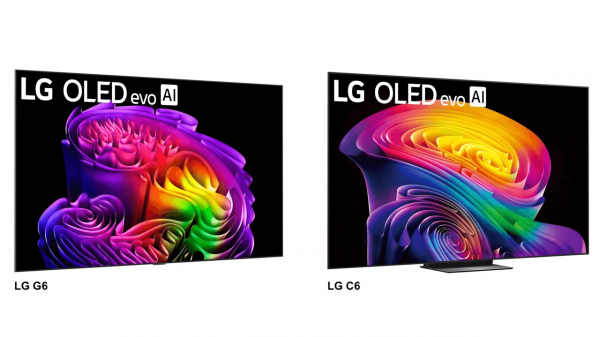
LG’s G6 OLED TV, the company’s flagship model, uses a quad-stack Tandem RGB OLED, also known as “W-OLED” (White OLED) because it uses a white OLED element. But each white OLED uses red, green, white and blue sub-pixels for color reproduction. Meanwhile Samsung’s 65-inch S95H and Sony’s BRAVIA 8 II OLED TVs use QD-OLED (Quantum Dot Organic Light Emitting Diode) technology in order to create the image. QD-OLED uses a blue OLED pixel combined with quantum dot technology to create the on-screen image and colors. While both technologies are capable of comparable brightness and contrast, QD-OLED TVs typically have slightly wider color gamut, which means they can reproduce a wider range of colors than W-OLED TVs.
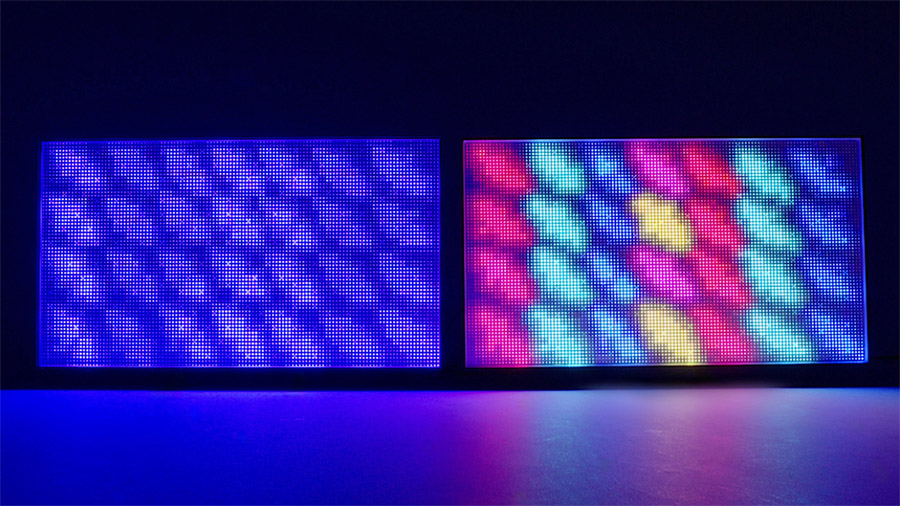
RGB backlit TVs, sometimes known as “Micro RGB” TVs, differ from traditional LCD TVs in that they use multi-color red, green and blue LED backlight elements instead of a single-color blue or white backlight. This allows RGB-lit TVs to offer higher efficiency, higher brightness and wider color gamut reproduction. But because RGB lit LCD TVs are still actually LCD TVs, there is no one-to-one match from each lighting zone to each pixel. One RGB backline “zone” may serve hundreds or even thousands of individual pixels, so RGB-lit LCD TVs can have issues with uniformity, elevated black levels, blooming and haloing.
When viewing a single-pixel star against a black space background, you will normally see a faint glow around the lit up pixel, due to the backlight bleeding through the LCD shutters. And that’s very difficult (if not impossible) to completely fix. But you can make it better by including a large number of backlight zones and using local dimming to control how these lighting zones operate. This minimizes the areas of light bleed and allows the lighting to be turned off completely in pitch black areas of the screen (like letterbox bars).
All of the RGB-lit LCD TVs in this year’s TV Shootout include advanced local dimming, with a high number of dimming zones, so many of the traditional drawbacks of LCD TVs are minimized. We also noticed that all three of this year’s RGB-lit TVs offered off-axis viewing that was superior to most other LCD TVs, though still not as good as OLED TVs.
Managing Ambient Lighting
In terms of bright room viewing, four of the TVs in this year’s competition include some form of advanced glare reduction to minimize the reflection of in-room light fixtures or sunlight. The Samsung S95H and R95H use Samsung’s “Glare Free” screen coating, now in its third generation. The Sony BRAVIA 9 II uses Sony’s new “Black Screen Immersive Pro” anti-glare coating. The LG G6 OLED TV uses LG’s new “Reflection Free Premium” coating. All of these are effective at minimizing the direct reflection of ambient light, but they can impact perceived black levels.
Originally, each TV was going to be judged both with its best “out of the box” default video mode selected as well as in bright rooms, but some technical glitches with the peripheral equipment caused delays so those two parts of the testing were omitted. All of the evaluations that we did were done with professionally calibrated TVs in a light-controlled dark room setting.
Having seen and experienced all three flavors of glare reduction, I personally feel that Sony’s Black Screen Immersive Pro coating is most effective at minimizing the reflection of ambient light without excessively washing out colors or changing the hue of black backgrounds. And LG’s Reflection Free Premium coating is good at reducing ambient light interference and preserving black levels, but not as effective at reducing direct reflection of light fixtures or direct sunlight.
Had “daytime viewing” been included in the tests, I believe the overall results would have remained the same. But it would have been great to see all TVs in default picture modes, since this is how more than 85% of TV buyers watch their TVs (in default picture modes with no tweaks to the settings).
Judges Assemble
As in previous competitions, all TVs were evaluated by professional judges from within the A/V community: tech journalists (including yours truly), content creators, trained calibrators and creative video content professionals. The pool of ten judges was split with five judging the OLED TVs and five judging the RGB-lit LED LCD TVs.
In addition to the TVs themselves, which were all professionally calibrated by expert ISF calibrator DeWayne “D-Nice” Davis, there were four professional Sony broadcast monitors on hand (BVM-HX3110), which typically sell for around $40,000 each. These are the pro monitors used by studios and mastering houses worldwide when grading and mastering movies and TV shows for home use. Judges were instructed to compare the image on the TVs with those on the broadcast monitors and rank each TV from 1 (not good) to 5 (best) based on how close they came to the reference monitors.
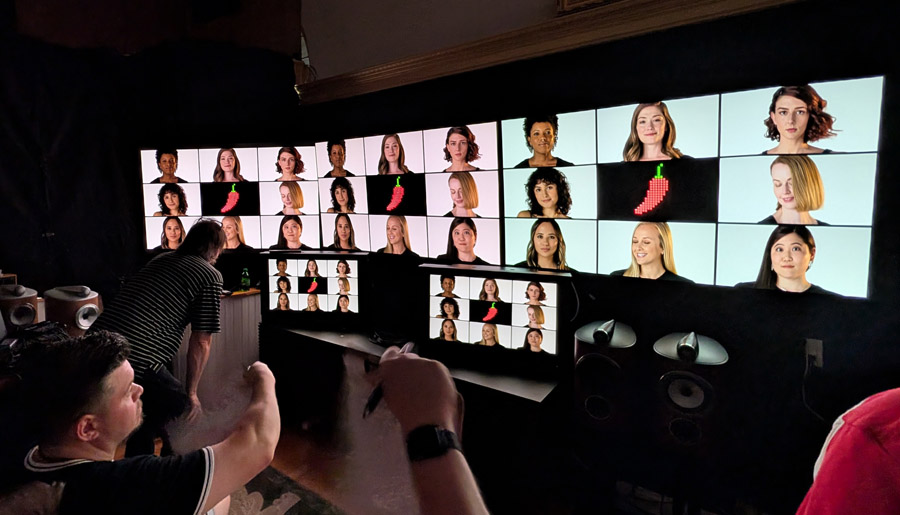
The evaluation featured video test clips, stills and real world movie scenes chosen to highlight specific areas of video performance such as contrast, brightness, color volume, color accuracy, motion reproduction, HDR tone mapping and image uniformity. After the tests, the judges’ scorecards were tabulated in order to crown a new “King of TV” for 2026. To be precise, two kings were crowned: one for OLED and one for RGB-lit LCD TVs.
As in previous years, it “takes a village” to put the event together, with many folks working behind the scenes to prepare for and run the event. It also takes a fair amount of gear. AVPro Global supplied the latest state-of-the-art switching, distribution, and test equipment for the event. Magnetar’s UDP-900MKII flagship 4K universal disc player and Kaleidescape’s Strato K 8K-capable Media Player were the reference sources for content with a Panasonic UHD Blu-ray Player also stepping in when the Magnetar player started misbehaving.
And the Winners Are…
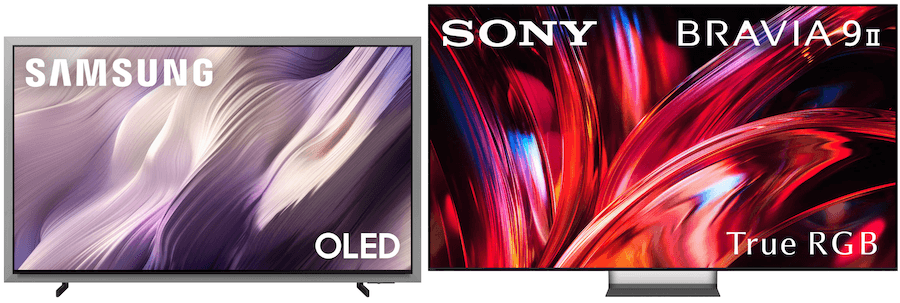
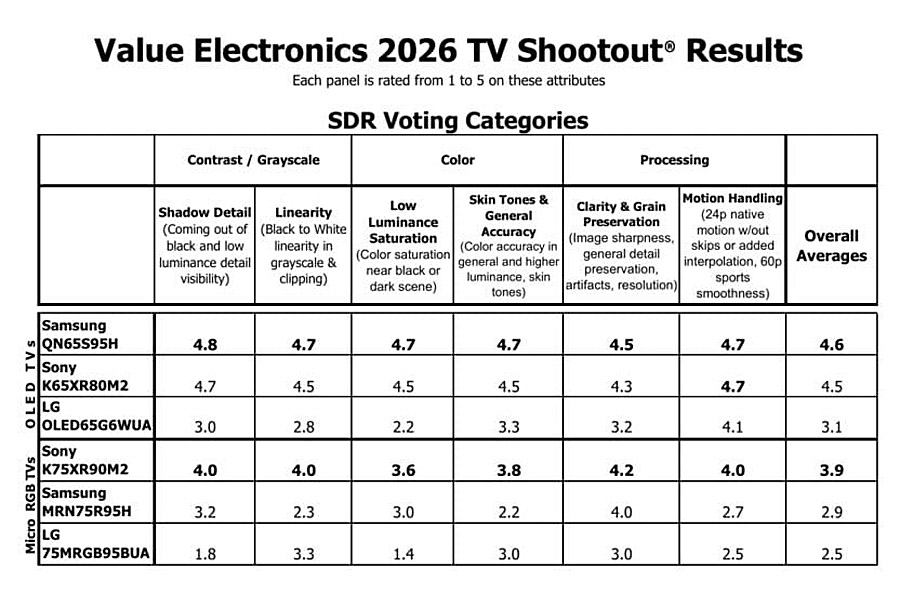
Since the event was effectively separated into two parallel contests, with one set of judges rating the OLED TVs and another set of judges rating the RGB/LCD TVs, two winners were declared for 2026, a “King of OLED TV” and a “King of Micro RGB TV.” The winner in the OLED category, by a pretty healthy margin was the Samsung S95H QD-OLED TV. The winner in the Micro RGB category was the Sony BRAVIA 9 II True RGB TV. And even though they were effectively two different contests, the Samsung S95H had such higher scores overall that it was declared the overall winner of the 2026 TV Shootout.
Full Scorecards for SDR (Standard Dynamic Range) and HDR (High Dynamic Range) are included below.

Did the Right TV Win?
Having spent a significant amount of time with both Sony TVs and both Samsung TVs, and also having more limited hands-on time with both LG models, I was not surprised by the results. OLED TVs still have significant advantages over LCD TVs, even advanced RGB-backlit LCD TVs, particularly when it comes to picture uniformity, black levels, contrast and color saturation. I rated the Samsung S95H as the winner in my own judging, but I would personally take any of the OLED TVs over any of the Micro RGB TVs as my personal television.
While the OLED TVs had fairly subtle differences on most of the test patterns and content, there was more variation among the RGB-lit LCD TVs. This is not entirely surprising since the Samsung model is only their second generation RGB-backlit model and the Sony and LG models are each of those companies’ first generation production models (though we first saw a prototype RGB-backlit TV from Sony in Japan in 2024). And while each of these TVs uses similar hardware for the backlighting units and LCD panels, the processing is the main differentiator. And, as we have seen in these comparative events in the past, Sony is really good at video processing. Apparently these companies are still learning how to optimize the processing for this new backlighting technology, so we expect to see further refinements in later generations.
The LG OLED did have some issues with color reproduction, with cooler whites and slightly muted colors – particularly on the SDR tests, but these were mostly only noticeable when compared to the reference monitors and to the two other OLED competitors. At home with a single TV on your wall or credenza, you’ll definitely appreciate the LG OLED TV’s deep inky blacks and outstanding contrast as well as its high quality upconversion of low resolution and low quality streaming content. And even though the Sony BRAVIA 8 II QD-OLED TV won last year’s TV Shootout (and its predecessors won for the prior three years), that TV is starting to show its age in processing, compared to the brand new Samsung S95H and LG G6. In my opinion, the LG G6 had stronger overall performance than the BRAVIA 8 II OLED, and any of the RGB-lit LCD TVs, but the Samsung S95H dominated the event due to its strong overall performance and no significant weak spots.
But does this mean everyone should go out and buy a Samsung S95H? Not necessarily. Some potential buyers are turned off by the S95H design, which features a large floating metal frame around the outside out the TV (which is not removeable). In my opinion, it makes the TV look more like artwork, particularly when it’s displaying art from the Samsung Art Store, but others prefer a more subtle narrow bezel. Also, the Samsung “Glare Free” matte screen, while extremely effective at reducing reflected light, can raise the black levels and add a subtle hint of purple to those blacks when viewed in a bright room. But if this bothers you, you can always just turn off the lights or draw the curtains. And in the dark, you’ll hardly notice that chonky metal frame.
Meanwhile, for those who are looking for a very large screen TV (above 83 inches), OLED is not really a viable option. Micro RGB TVs like the ones that competed in this year’s TV Shootout are available in sizes up to 115 inches diagonal. With the shift to RGB backlighting, LCD TV continues to improve in picture quality and the benefits of wider color gamut reproduction and higher brightness make them a solid choice if size, bright room viewing and picture performance are all important to you.
The Bottom Line
While there is sure to be some controversy with the results (no one likes when their personal favorite TV doesn’t win), the TV Shootout remains one of the premier TV comparison events as it pits the top performing TVs against each other in one room and hits them with a wide range of content to reveal each of their strengths and weaknesses. And we’ve seen its impact on actual TV picture performance over time. These manufacturers typically have representatives present at the event to take notes on where their products shine, and where they fall short, and we believe many of the advancements in these TVs over time have been informed by this event.
In any case, the event’s results should help inform TV buyers’ choices through the remainder of 2026 and beyond. See detailed scorecards above for the scores of each display in each category.
Note: Scorecards were added after the first version of this article was published as they were not yet available at publication time.
Where to Buy the Winning TVs?
- Samsung S95H (65-inch) QD-OLED TV – $3,399 at Best Buy and Crutchfield
- Sony BRAVIA 9 II (75-inch) True RGB TV – $4,599 at Best Buy and Crutchfield
For more information, all TVs are available at Value Electronics, Best Buy, and Crutchfield.
And special thanks to Robert and Wendy Zohn at Value Electronics for hosting the event.
Related Reading:
















STEPHEN FLESCHLER
July 20, 2026 at 5:04 pm
Apparently, OLED still crushes Sony Bravia 9-II in all categories in both SDR and HDR. 90% of my viewing is clearly SDR for 4K blu-ray (200) and DVDs (1000+) of 1910s to 1960s film. HDR is mainly used for internet channels viewing, mostly current video, occasionally streamed film. So, I will forgo the HDR value for SDR value. Still, those Bravia 9 scores of SDR are inferior to OLED. Only clarity and grain preservation are close. YouTube videos point to purchasing the Sony Bravia 9 85″ and 75″ which I will be doing.
Chris Boylan
July 20, 2026 at 11:24 pm
As one of the judges at the event, I would say it’s tricky to take those scores among all six TVs as absolutes for reference. There were 5 judges on the OLED side and 6 *different* judges on the RGB side. Having seen all of the TVs side by side for those 8 hours, I would rank the three OLEDs above the three RGB-lit TVs, but IMHO, the RGB LCD TVs did put in a solid performance overall. I personally would not recommend the older Mini-LED BRAVIA 9 over any of the TVs in this event. It was an excellent set (for an LCD TV) 2 years ago, but the 9 Mark II is appreciably better than the 9 in many ways, not the least of which is posterization and processing. But, again, I personally would get any of the OLEDs over the RGB LCD TVs. But I have the advantage of not needing/wanting a TV over 77 inches. For my really large screen viewing (117-inch 2.4:1 screen), I use a projector in a fully light-controlled room.
Ian White
July 21, 2026 at 10:08 am
Chief,
But of the 85″ TVs you have seen or judged so far, which one would make the top of your list?
IW
Chris Boylan
July 21, 2026 at 4:30 pm
83-inch LG G6 or 83-inch Samsung S95H, both OLED – actually both use LG Display W-OLED panels. But I would say try to see them in person before buying as their anti-glare treatments are quite different. Samsung is better at diffusing direct reflections but loses ground in black levels. LG is more of a glossy screen with some ambient light rejection. To save a bit, the 83-inch LG C6H is also an excellent choice as it uses the same panel as the G6, but doesn’t include the brightness booster tech or the reflection-free premium coating – it’s more of a traditional glossy screen.