

T+A does not build inexpensive audio components, and its new HV reference pairing makes no attempt to wander into that unfamiliar part of town where tourists buy four-euro spätzle and lederhosen assembled somewhere considerably less German.
The German manufacturer has formally launched the SDX 3100 HV streaming DAC and preamplifier for $44,900 alongside the A 3100 HV stereo power amplifier for $29,900. The complete two-box system costs $74,800 before adding loudspeakers, cables, an equipment rack, or the optional $2,190 MM or MC phono module.
We first encountered both components at AXPONA 2026, but confirmed pricing, final specifications, and availability make them worthy of a closer look. The A 3100 HV began shipping on July 9th in silver or titanium, while SDX 3100 HV availability is rolling out through dealers, with some North American listings indicating August delivery.
The price will dominate the conversation, because $74,800 remains a serious amount of money even by high-end audio standards. What T+A is offering, however, is not merely another streamer connected to a large amplifier. The SDX 3100 HV and A 3100 HV represent a highly integrated reference system that combines some genuinely unusual digital architecture with enough amplification to drive almost any conventional passive loudspeaker.
Related Reviews:
- Pass Labs X260.8 Monoblock Amplifier Review
- Advance Paris A10 Classic Review: A French Hybrid Amplifier With More Bordeaux Than Bubbles
The SDX 3100 HV Is More Than a Streamer
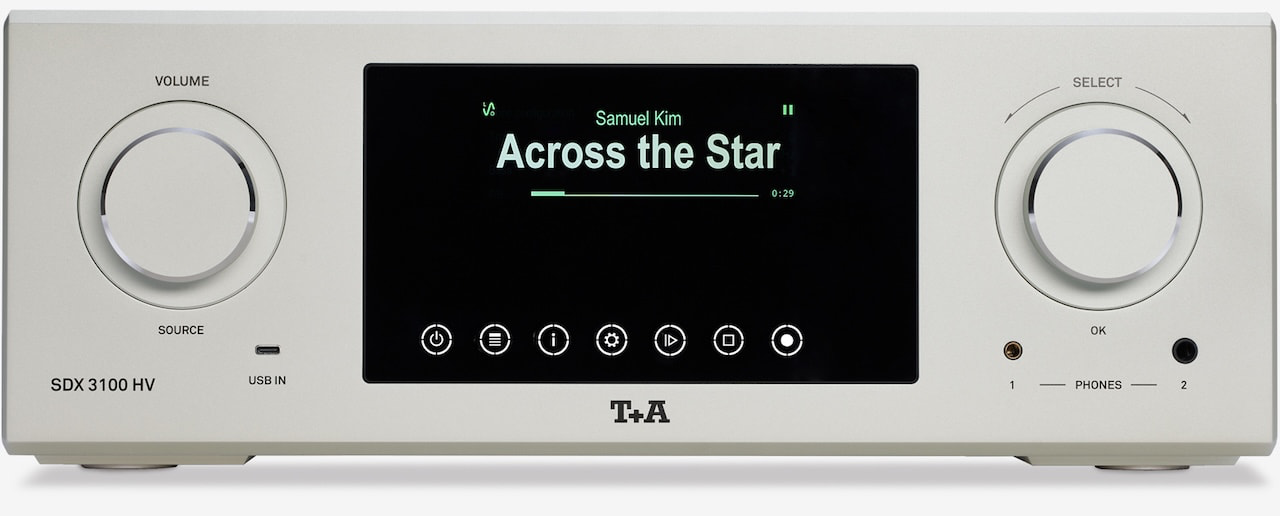
The SDX 3100 HV replaces the SDV 3100 HV at the top of T+A’s digital lineup, combining a network streamer, DAC, fully analog preamplifier, headphone amplifier, tuner, and system controller inside a 57-pound aluminum chassis.
Its most significant technical feature is T+A’s Path Separation Technology, which routes PCM and DSD through different conversion architectures rather than forcing both formats through the same DAC design.
PCM signals are handled by a double-differential quadruple converter using four 32-bit sigma-delta DAC channels per side, supporting rates up to 768kHz through USB. DSD travels through T+A’s proprietary True 1-Bit converter without first being converted to PCM, with USB playback supported up to DSD1024.
There is an important distinction buried beneath that impressive headline number. DSD512 and DSD1024 require a compatible Windows computer with T+A’s driver or a Linux system running a supported kernel. Network streaming is currently specified up to DSD256, which remains more than sufficient for almost every commercially available recording but is not quite the same as streaming DSD1024 from a NAS while congratulating yourself on having survived another firmware update.
T+A’s De-Jitter Masterclock examines incoming clock signals and routes anything failing its stability requirements through an additional PLL stage. Separate quartz oscillators are used for the 44.1kHz and 48kHz frequency families, reducing the need for sample-rate conversion between them. The SDX also provides selectable digital filters, including FIR, Bezier, and two NOS options.
Streaming Without Another Proprietary Island
The third-generation Audiophile Streaming Architecture, or ASA G3, supports TIDAL Connect, Qobuz Connect, Spotify Connect, Amazon Music HD, Deezer, HIGHRESAUDIO, Apple AirPlay 2, Audirvana, internet radio, and locally stored music.
Roon certification is still listed as being in progress. That will need to be completed quickly because a $44,900 streaming component should not arrive with a significant software feature still waiting in the departure lounge.
Wired Gigabit Ethernet and dual-band Wi-Fi 6 are included, along with Bluetooth 5.4 using aptX HD, AAC, SBC, and MP3. Bluetooth is clearly present for convenience rather than as the preferred method for extracting everything the SDX can deliver.
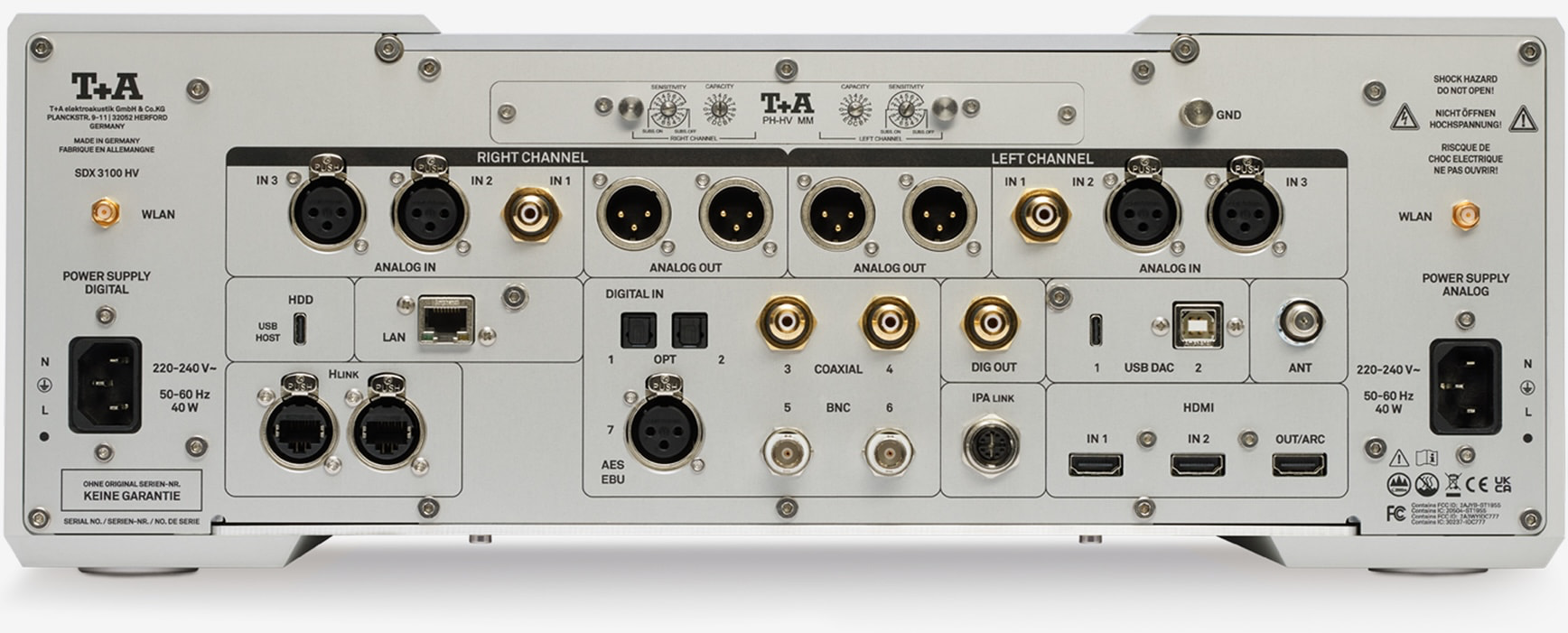
Physical connectivity is extensive. The digital section includes AES/EBU, coaxial, BNC, optical, USB, two HDMI inputs, and an HDMI output with ARC. The specification currently lists ARC rather than eARC, although that is unlikely to present a meaningful bandwidth limitation in a two-channel system.
A Proper Analog Preamplifier
Many streaming DACs offer variable output and describe themselves as preamplifiers. The SDX 3100 HV takes the role more seriously.
Its fully symmetrical, double-mono preamplifier is constructed with discrete components and galvanically isolated from the digital circuitry. Volume is controlled by a relay-switched network with channel matching specified within 0.05dB at minus 60dB, where less carefully designed controls can begin shifting the image toward one loudspeaker.
The SDX also includes balanced and single-ended analog inputs, making it possible to connect tape machines, external phono stages, or other analog sources without converting them into the digital domain.
T+A has even included fully analog tone controls with individually adjustable bass and treble levels and selectable turnover frequencies. That is a more sophisticated approach than the usual bass and treble knobs, allowing some correction for loudspeaker balance, room placement, and difficult recordings without passing the signal through DSP.
It is not room correction, and there is no automated measurement system or sophisticated subwoofer bass management. Buyers looking for Dirac Live, ARC Genesis, or Linn Space Optimisation will need to solve those problems elsewhere.
The optional phono board is available in separate MM and MC versions for $2,190. At this price, including both cartridge types in one adjustable module would not have caused the accountants to begin rationing office supplies, but the internal option is still useful for owners seeking to avoid another box.
A discrete Class A headphone amplifier supplies both 6.3mm and 4.4mm Pentaconn outputs. T+A specifies a six-ohm output impedance and up to 200mA of current, making it considerably more substantial than the convenience headphone circuits often added to digital components.
The A 3100 HV Offers Two Amplifiers in One
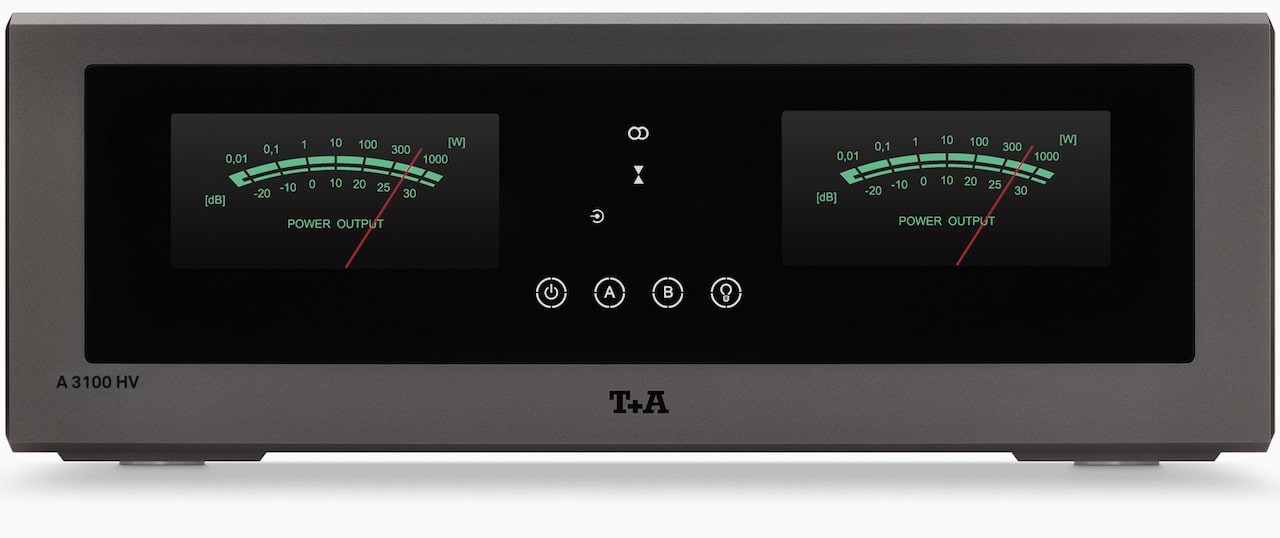
The matching A 3100 HV replaces the A 3000 HV, which remained in production for more than a decade. T+A claims more than 270 engineering changes, including revised board layouts, tighter-tolerance components, improved thermal management, and a new High Current operating mode.
T+A’s HV designation refers to its use of much higher internal operating voltages than conventional solid-state circuits. The objective is to keep the transistors working within a smaller and more linear portion of their operating range, pursuing some of the linearity associated with tubes without using tubes or their eventual maintenance requirements.
In High Current mode, the output stage runs at substantially increased idle current and can deliver up to 75 watts in pure Class A before transitioning into Class AB operation. This mode is intended for systems where listeners value the amplifier’s highest-bias operation and do not require maximum output.
Switching to High Power mode changes the priorities. The A 3100 HV is rated at 300 watts per channel into eight ohms and 500 watts into four ohms, with short-term output reaching 380 watts into eight ohms and as much as 650 to 700 watts into four ohms, depending on the measurement listed.
Those figures come from a 1,000-watt toroidal transformer and 120,000µF of reservoir capacitance. The power supply is magnetically shielded and physically separated from the audio circuitry behind a 10mm aluminum partition. Voltage and current amplification are located on separate boards and galvanically isolated to reduce interaction between the input stages and the current being delivered to the loudspeakers.
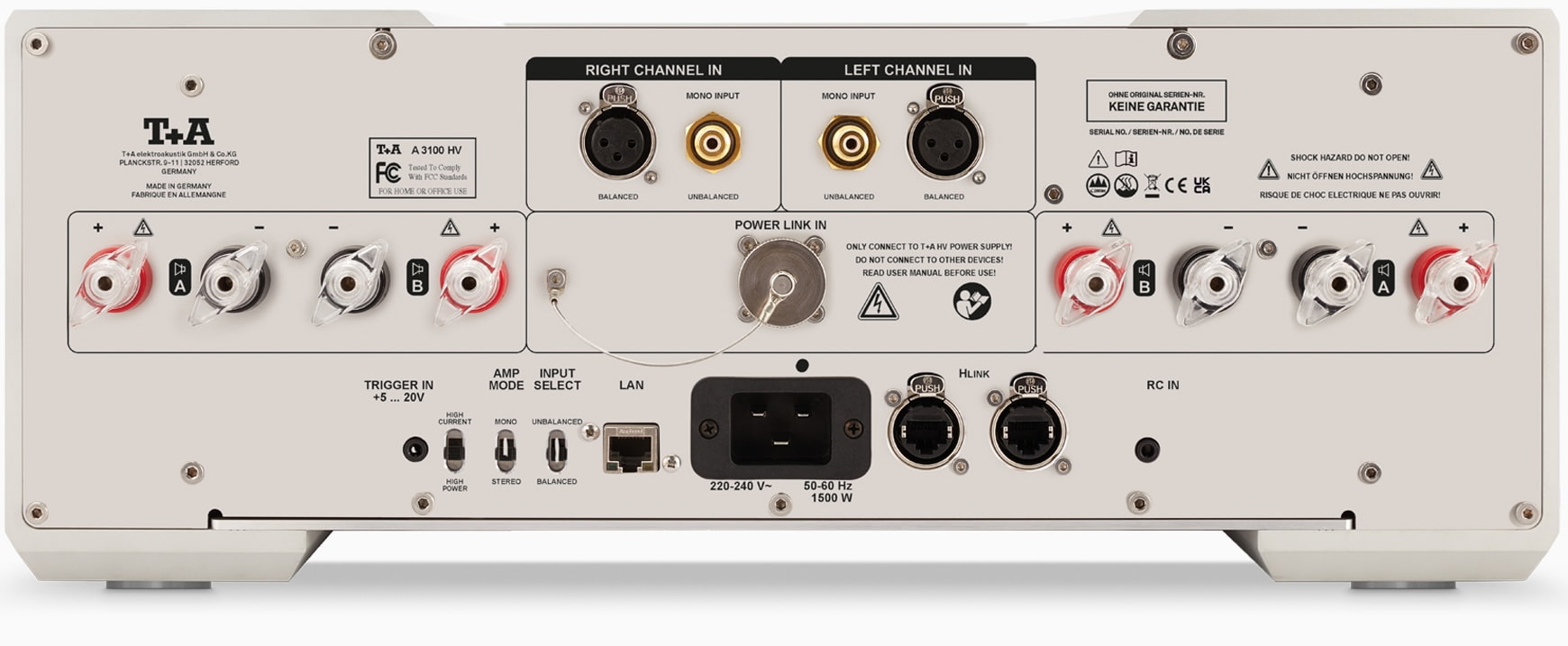
The amplifier can also be switched into mono operation, allowing owners to add a second A 3100 HV. At that point, the electronics alone rise to $104,700 before contemplating T+A’s optional external power supplies. The phrase “diminishing returns” may be heard faintly in the distance, but nobody in this market appears to be returning its calls.
What Does It Compete With?
There is no perfect direct competitor because T+A combines several product categories in an unusual two-box arrangement.
Naim’s closest conceptual alternative requires an NSS 333 streamer, NAC 332 preamplifier, and two NAP 350 mono power amplifiers. The NAP 350 delivers 175 watts into eight ohms and 345 watts into four ohms, making the Naim system less powerful on paper while requiring four chassis before optional external power supplies enter the discussion.
The CH Precision I1 takes the opposite approach. It combines preamplification, power amplification, DAC functionality, and optional streaming and phono modules in one configurable chassis. Its modular architecture is extremely flexible, but rated output is 100 watts per channel into eight ohms. The T+A system requires two shelves but provides far greater power and includes its full streaming platform as standard.
Boulder’s 866 Digital integrated amplifier also consolidates streaming, DAC, preamplification, and power amplification into one component. It delivers 200 watts into eight ohms and 400 watts into four ohms and supports Ethernet, USB, AES3, optical, AirPlay, and Roon. It is the more compact approach, although it lacks T+A’s separate native DSD conversion path and extensive direct streaming-service integration.
Linn’s Klimax DSM and Klimax Solo 800 amplifiers represent another logical comparison, especially for listeners interested in streaming, system integration, and room optimisation. Pricing places the T+A system in some perspective: a single Klimax Solo 800 starts at $51,190 in the United States, making a stereo pair $102,380 before adding the Klimax DSM source and preamplifier. Suddenly $74,800 starts looking merely extravagant rather than requiring intervention from concerned relatives.
Why This System Is Different
The SDX 3100 HV and A 3100 HV stand apart because they do not force buyers to choose between old-school analog engineering and a modern streaming system.
The SDX offers direct access to the major streaming platforms, HDMI ARC, high-resolution USB playback, analog inputs, optional phono support, proper preamplification, analog tone controls, and a robust headphone amplifier. The A 3100 HV can prioritize Class A operation for lower-level listening or switch to 500-watt Class AB output when the loudspeakers demand considerably more persuasion.
T+A has also managed to keep the complete system to two chassis. That will matter to buyers who want reference-level separates but have no desire to assemble a seven-box shrine requiring its own electrical subpanel and structural engineer.
The Bottom Line
There is no sensible way to describe $74,800 as affordable, and T+A does not need anyone performing financial gymnastics to make it sound reasonable.
A complete system with the phono module costs $76,990. Adding T+A’s optional $19,490 PS 3100 HV external power supply pushes the total to $96,480. Two amplifiers in mono operation take the system comfortably beyond six figures.
That pricing excludes almost everyone, including many serious audiophiles with excellent systems and perfectly healthy credit scores.
But judged within the reference electronics category, the T+A pairing is not an outlier. It competes with systems from Linn, CH Precision, Naim, Boulder, dCS, and other manufacturers for whom five-figure source components and power amplifiers are entirely normal.
The more relevant question is whether T+A’s two-box architecture can deliver enough of the performance, flexibility, and long-term usability of those larger systems to justify its substantial price.
On paper, the answer is at least plausible. The engineering is ambitious, the specifications are formidable, and the combination of native DSD conversion, real analog preamplification, selectable amplifier bias, and 500-watt output is unusual at any price.
Whether it sounds like $74,800 will require far more than reading the specification sheet while making approving German noises.
Pricing & Availability
The T+A A 3100 HV is available in silver or titanium for $29,900 and began shipping through authorized dealers on July 9, 2026.
The SDX 3100 HV is priced at $44,900, with dealer availability rolling out through July and August 2026.
The optional MM or MC phono module is $2,190.
The complete SDX 3100 HV and A 3100 HV system costs $74,800, or $76,990 with one of the phono modules.
For more information: ta-hifi.de
Related Reading:
- House Of Stereo’s $600,000 Focal/T+A Stereo System Steals The Show At Capital Audiofest 2024
- AXPONA 2026 Preview: New Hi-Fi Product Launches From Goldmund, SVS, Magico, Audio Note And More
- Dan D’Agostino Progression Neo Series Brings Relentless And Momentum Tech To New Preamplifier, Mono And Stereo Amps: High End Vienna 2026
- Dan D’Agostino Momentum C2Z Preamplifier Debuts With Z-Circuitry, Optional Streaming Module, And Reference-Level Design
















Jan De Hauwere
July 15, 2026 at 5:53 pm
Totally bullshit
I have been evaluating suystems (DAC and streamers)for more than a while
I can only say that the WIIM ultra beats all of these expensive systems hands on
of course there could be somethng wron with my ears
Ian White
July 15, 2026 at 5:56 pm
Jan,
I’ve had the WiiM Ultra since launch and while it’s very good, it’s miles behind the best streamers in sound quality.
IW