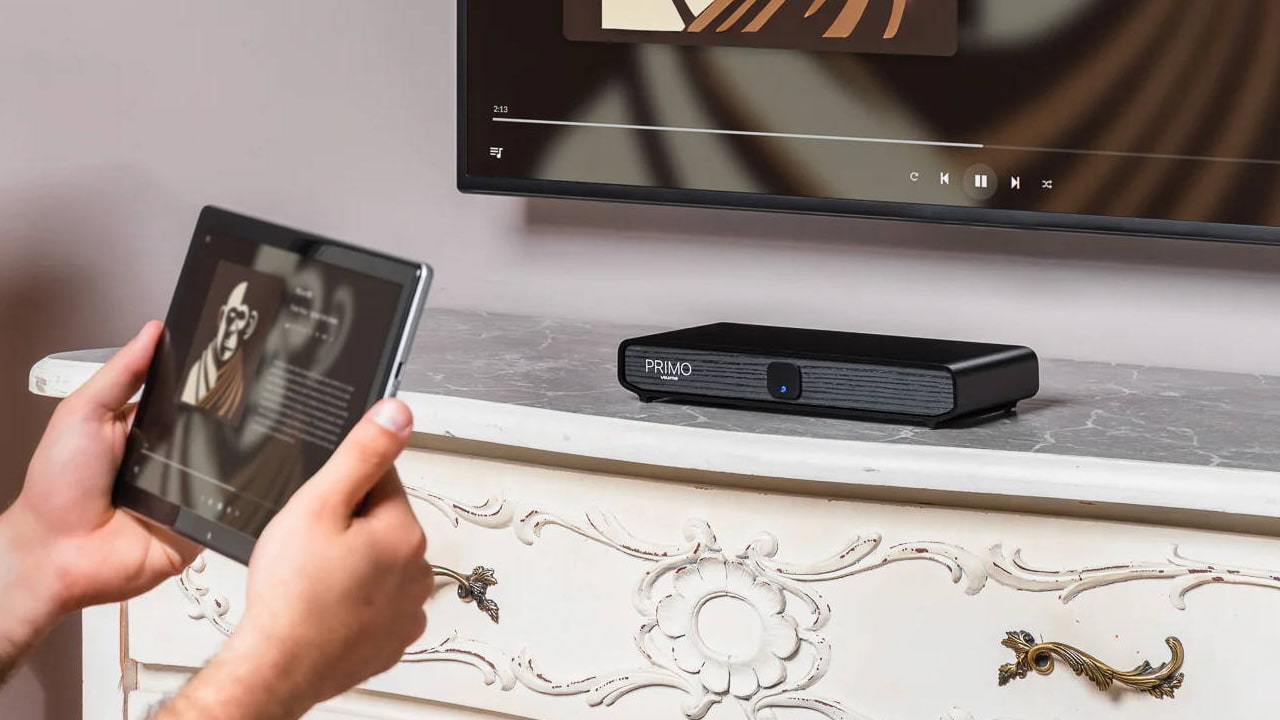
Volumio has introduced the Primo V3, the third generation of its Primo streaming DAC, and the company is not treating this as a light refresh. Founder and CEO Michelangelo Guarise describes the new model as “not an iteration” but a “complete reinvention,” which is exactly the sort of language every manufacturer uses until you look at the spec sheet and realize they mostly changed the badge. In this case, Volumio has done more than that.
The Primo V3 replaces the earlier Primo platform with a faster Quad Core A72 processor, an ESS Sabre ES9039Q2M DAC, an integrated linear power supply stage, NOS mode, eight selectable DAC filters, and adjustable output levels for both RCA and balanced XLR outputs. It is priced at $1,049 (£769 / €849).
That puts the Primo V3 in an interesting position. It is not a cheap streamer trying to win the “how much can we cram into a small aluminum box” contest. It is also not a five-figure digital transport built for people who discuss clocking schemes with the emotional intensity most people reserve for custody disputes. The Primo V3 is aimed at users who want one box that can function as a network streamer, DAC, and software-driven control hub without the steep learning curve.
Related Reviews:
- Volumio Integro Streaming Amplifier: Review
- Bluesound NODE Review: Is This $750 Streamer Finally Ready For WiiM And Cambridge?
What Changed?
The most obvious change is the move from the ESS 9038Q2M used in the previous Primo to the newer ESS ES9039Q2M. Volumio says the new DAC uses ESS Hyperstream IV architecture and is designed to reduce distortion and sensitivity to clock jitter. That does not automatically mean it will sound better in every system, because implementation still matters. A DAC chip is not a magic bean. Power supply design, clocking, output stage, layout, and software stability all matter.

Volumio has also moved the Primo V3 to a Quad Core A72 ARM processor running at 1.5 GHz, with 2 GB of DDR4 RAM and 16 GB of eMMC internal storage. That matters because modern streamers are no longer just digital bridges. They are small computers running streaming services, local file indexing, app control, metadata, wireless networking, firmware updates, and sometimes multi-room playback. Underpowered hardware can make even a good audio product feel like a 2012 Android tablet found in a drawer.
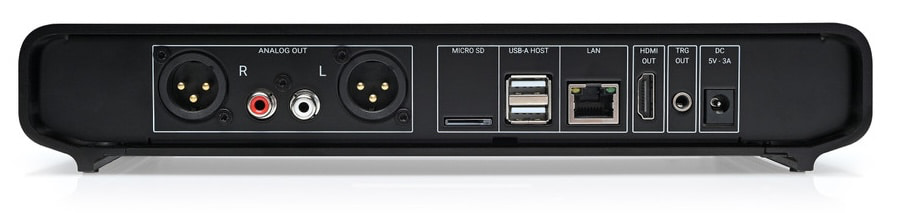
The analog output section has also become more flexible. The RCA outputs now offer eight selectable levels from 0.50 Vrms to 3.15 Vrms, while the balanced XLR outputs offer eight levels from 1.00 Vrms to 6.30 Vrms. That gives owners more room to match the Primo V3 with integrated amplifiers, power amplifiers, active loudspeakers, or systems where the input sensitivity is less forgiving.
That is a practical upgrade. Too many streamers and DACs assume every amplifier behaves the same way. They do not. Adjustable output voltage can help users avoid having all useful volume control squeezed into the first 12 degrees of the knob, which is not audiophile refinement. It is bad ergonomics in a Buck Mason heavy duty t-shirt.
Volumio Premium Is the Real Product
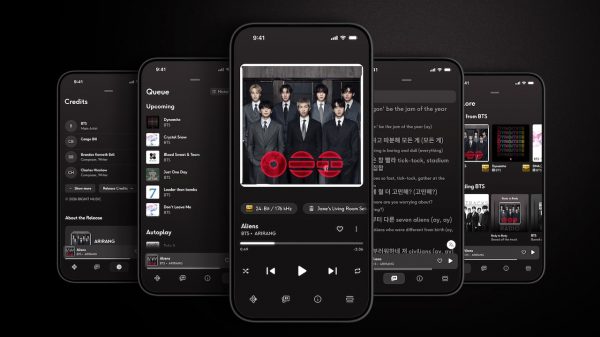
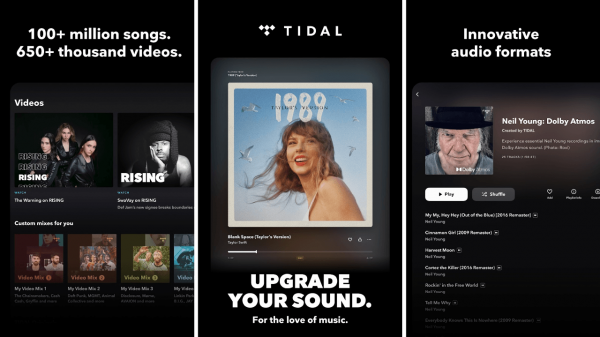
The Primo V3 is powered by Volumio Premium, which brings together TIDAL, Spotify, Qobuz, Radio Paradise, TuneIn Radio, and other sources inside one interface. Volumio also lists support for TIDAL Connect, Qobuz Connect, and Roon Ready operation, which gives users the option to control playback directly from preferred apps rather than being forced into one proprietary control scheme.
That is the part that matters most. Streamer hardware is important, but software determines whether owners use the product every day or quietly start shopping for something else six months later. Volumio has understood for years that the app, the library experience, the streaming integrations, and the update path are what consumers actually care about the most.
Volumio 4, released in late 2025 for Raspberry Pi and PC platforms, moved the OS foundation to Debian Bookworm and added improvements including a new app connection method, rewritten Bluetooth stack, NVMe storage support, improved large library handling, expanded USB DAC support, touchscreen display improvements, and day-one plugin availability. Volumio said its own branded products and OEM partner products would receive the Volumio 4 update in Q1 2026.
Primo V3 therefore lands at the right time. It gives Volumio fresh hardware to pair with a maturing software platform, rather than leaving the OS to carry older hardware that may not feel as responsive with increasingly demanding services and metadata-heavy user libraries.
NOS Mode and DAC Filters
Primo V3 adds selectable NOS mode and eight DAC filters. NOS, or non-oversampling mode, bypasses digital oversampling and sends the original samples through without the usual interpolation stage. Some listeners prefer that presentation because it can sound more direct, less processed, or more relaxed. Others prefer conventional oversampling because it can measure cleaner and better control ultrasonic artifacts.
Volumio previously added NOS mode to its Preciso DAC, so this is not a random feature bolted onto the Primo V3 for marketing glitter. It appears to be part of a broader Volumio push to give users more control over digital playback character without forcing them to buy a separate DAC immediately.
The eight DAC filters serve a similar purpose. They allow users to alter the DAC reconstruction behavior and potentially fine-tune the sonic presentation. This is not room correction. It will not fix bad loudspeaker placement, a glass coffee table, or the acoustic hostility of a bare condo living room in West Palm Beach. But in a revealing system, small filter differences can be audible enough to matter.
Streaming Support and Connectivity
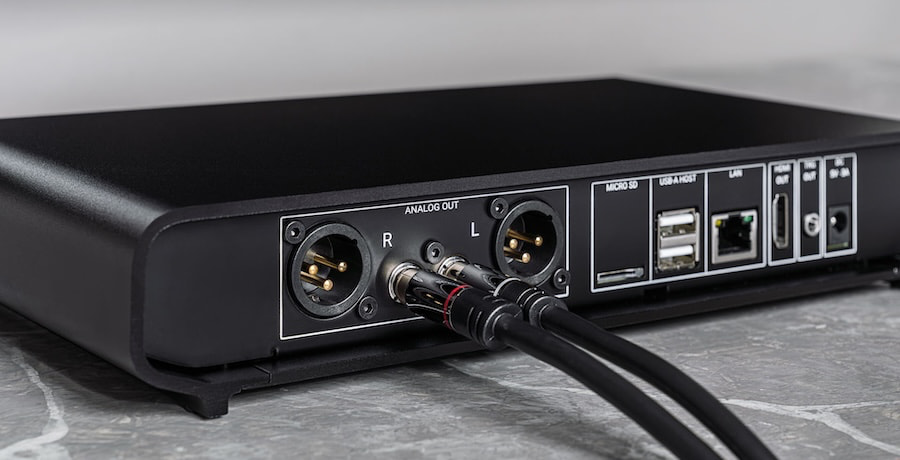
The Primo V3 supports high-resolution network playback up to PCM 384 kHz/32-bit through its onboard DAC. Its USB-A audio output can feed an external USB DAC at up to PCM 1536 kHz/32-bit and DSD1024, according to Volumio’s published specifications. Connectivity includes Gigabit Ethernet, dual-band Wi-Fi 802.11 a/b/g/n/ac, Bluetooth 5.0, HDMI video output up to 4K/60fps for app mirroring, two USB-A ports, RCA outputs, and balanced XLR outputs.
One important detail: Volumio’s published Primo V3 specifications emphasize USB audio output rather than the coaxial S/PDIF output listed on the previous Primo V2. That may matter for users who want to feed an older DAC that lacks USB input. Those buyers may be better served by a dedicated transport such as Volumio’s Rivo line or another streamer with broader digital output options.
That is not a deal-breaker, but it is worth knowing before buying. The Primo V3 makes the most sense when used as a complete streaming DAC with its analog outputs, or as a USB transport into a modern DAC.
New Volumio Powered Products Are Also Emerging
The Primo V3 is not arriving in isolation. Volumio’s platform is showing up in more hardware, and that may be the bigger long-term story.
Ferrum’s new BROEN network streaming transport is officially powered by Volumio, giving the Polish company’s DAC-focused ecosystem access to Spotify, Spotify Connect, TIDAL, TIDAL Connect, Qobuz, Qobuz Connect, AirPlay, UPnP/DLNA, web radio, CD playback, multi-room playback, AI-powered SuperSearch, Infinity Playback, and expanded metadata features. BROEN is designed as a transport for external DACs, especially Ferrum’s WANDLA models.
Volumio has also been expanding its OEM ambitions. Its AudioPro module, introduced for the professional audio and custom installation markets, is designed to let manufacturers add Volumio OS based streaming to amplifiers, active speakers, and installation products without building the entire software stack from scratch. Pequod Acoustics has shown Volumio integration inside its METACTIVE system, which points to Volumio moving beyond traditional home hi-fi boxes.
There is one caveat worth stating clearly. Some iFi streamers have been described in spec comparisons as using Volumio-based software, but Volumio has publicly stated that iFi is not an official licensed Volumio partner.
Who Is the Primo V3 For?
The Primo V3 is for listeners who want a highly capable network streamer and DAC without going fully down the separates rabbit hole. It should appeal to users with integrated amplifiers, powered loudspeakers, desktop systems, and compact two-channel setups where app control, streaming service integration, and analog output flexibility matter as much as the DAC chip.
It is also likely to appeal to users who like the idea of Roon but do not want to make Roon the center of their listening life. Volumio Premium gives users a broader native platform, while Roon Ready support keeps that door open for anyone already invested in the Roon ecosystem.
The most obvious buyer is someone who wants TIDAL Connect, Qobuz Connect, local library access, internet radio, Roon Ready support, balanced outputs, and a modern software experience in one component.
The less obvious buyer is someone who is tired of inexpensive streamers that measure well enough but feel disposable because the app experience is not there. A streamer is only as good as the thing you touch every day. Usually, that is the app. WiiM and Volumio seem to have figured that one out.
The Bottom Line
Volumio Primo V3 looks like a meaningful rebuild rather than a cosmetic refresh. The faster A72 platform, ES9039Q2M DAC, linear power supply stage, NOS mode, DAC filters, selectable output voltage, balanced outputs, and Volumio Premium integration all point in the same direction: Volumio wants the Primo V3 to feel like a complete digital front end, not just a streamer with a DAC stapled inside.
At $1,049 (£769 / €849) it is not chasing the budget streamer crowd. It is aimed at users who understand that streaming hardware without reliable software is just a very attractive source of irritation.
The success of the Primo V3 will depend less on whether the ESS chip looks impressive on paper and more on whether Volumio’s platform continues to feel stable, fast, flexible, and easy to live with. That is where the streaming category is heading. The box still matters. The software decides whether anyone wants to use it.
Where to buy: $1,049 at Volumio
Related Reading:
- Volumio AI Features Music Supersearch Discovery Powered By ChatGPT
- Volumio’s Motivo Music Streamer Offers Two Headphone Outputs And Support For I2S/DSD Over HDMI
- Ferrum BROEN Network Streaming Transport Brings Volumio And SFP Networking To The WANDLA Ecosystem
- IFi Audio Unleashes NEO Stream 3 And ZEN Stream 3 Music Streamers: What’s Different?