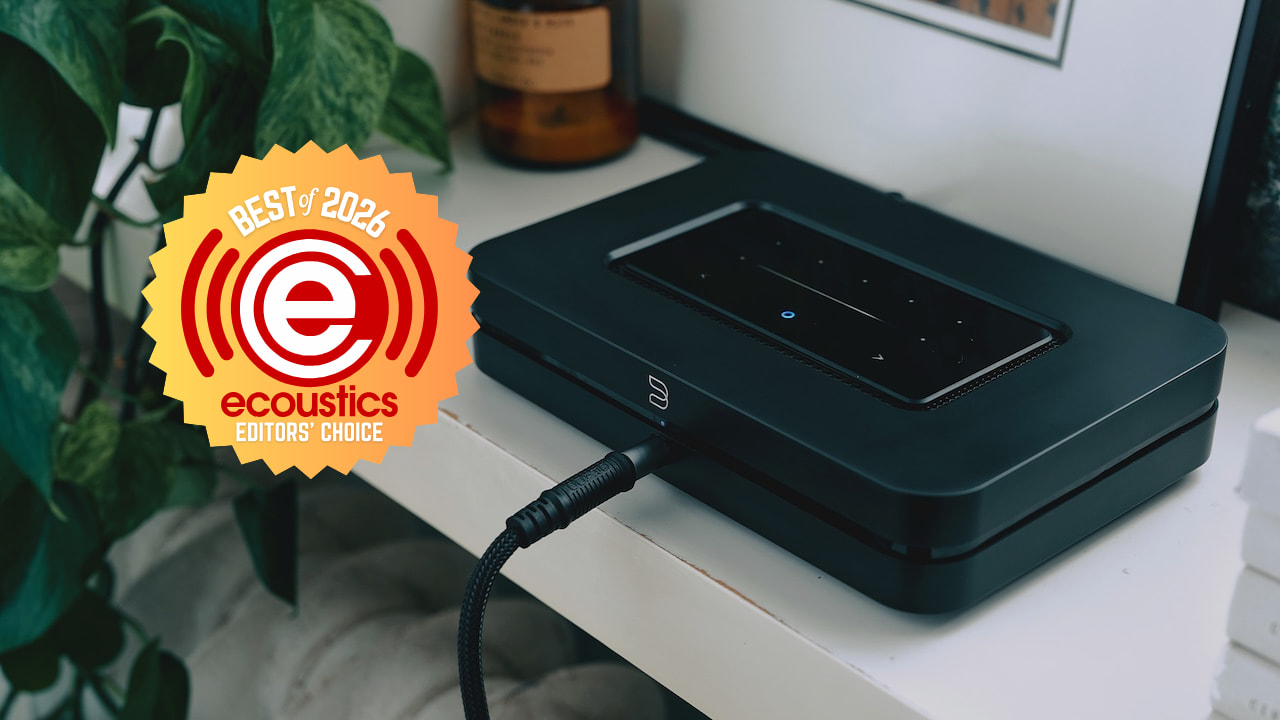
The network streamer market has become brutally competitive. WiiM upset the apple cart with the $329 Ultra, a compact digital hub with a touchscreen, HDMI ARC, phono input, headphone output, preamp functionality, and room correction. Eversolo then raised expectations at the next level with the $859 DMP-A6 Gen 2, which brings a large touchscreen, balanced outputs, internal storage capability, HDMI ARC, and software that is far more ambitious than its price suggests.
That leaves the $749 Bluesound NODE in a far less comfortable position than its predecessors enjoyed. Cambridge Audio’s $499 MXN10 and AXN10 offer serious competition for listeners who want a conventional, well-sorted network player without spending close to four figures. The days when BluOS alone was enough to make the NODE the automatic recommendation are gone.
Fortunately for Bluesound, BluOS has not been left to rot in the sun. The platform has gone through multiple updates and remains one of the more mature multiroom ecosystems available, with broad streaming-service support, reliable device control, and none of the “we will fix it in the next update” energy that still haunts too many audio apps. Ask Sonos how that worked out for them.
The current NODE also brings a stronger ESS DAC, THX AAA headphone amplification, HDMI eARC, DSD playback, and Dirac Live Room Correction support to the fight. Dirac is not included in the box; buyers need a license and calibration kit, and correction is not available through the NODE’s USB output. But for systems compromised by real rooms, rather than fantasy listening spaces with acoustics designed by the Ministry of Sound, it could be the feature that matters most.
Related Reviews:
- Bluesound PULSE FLEX Review: This $379 Hi-Res BluOS Speaker Has Range, But Does It Have A Pulse?
- Best Music Streamers: Editors’ Choice 2025
Bluesound NODE N132: What Is New Under the Hood
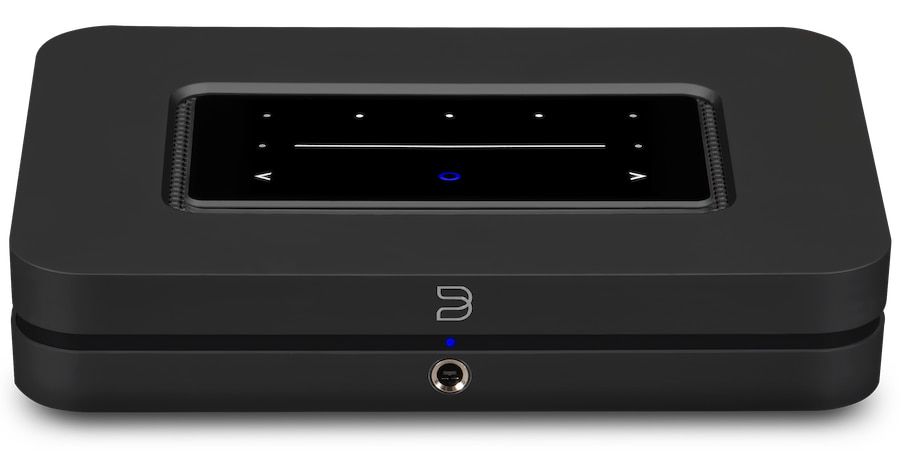
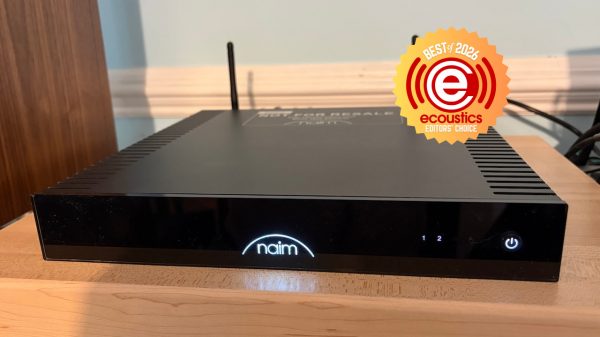
The current Bluesound NODE is not a cosmetic refresh of the older N130. The N132 uses an ESS ES9039Q2M SABRE DAC, an ARM Cortex A53 quad core processor running at 1.8GHz per core, and revised circuitry intended to keep jitter and electrical noise under control before the signal reaches your amplifier, powered speakers, headphones, or external DAC.
The NODE offers support for native PCM sampling rates up to 192kHz, 16-bit and 24-bit files, DSD256 playback, a specified signal to noise ratio of 118dB, and THD+N rated at 0.0007 percent. The NODE does not offer balanced XLR outputs, dual DACs, or the elaborate display found on the more expensive NODE ICON.
It is a stereo streamer and digital preamplifier designed to slot into almost any existing system. Connect it directly to a pair of active loudspeakers, use it as the front end for an integrated amplifier or separate preamp and power amp combination, or feed its digital outputs into an external DAC.
It can also serve as the central music source for an AVR through its analog, optical, or coaxial outputs, while BluOS lets it join a wider whole-home system with Bluesound’s PULSE FLEX wireless speakers, including stereo-paired FLEX units in another room. It is not a replacement for a full home theater processor, but it can be the component that makes a conventional two-channel or AV system feel considerably less stuck in 2016.

Supported Audio Formats & High Resolution Playback
The NODE supports the formats most people actually use, including MP3, AAC, WMA, WMA Lossless, OGG, ALAC, and OPUS. Its high quality file support includes FLAC, MQA, WAV, AIFF, and MPEG 4 SLS.
MQA remains part of the specification sheet for those with an existing MQA library. More relevant in 2026 is the NODE’s support for lossless FLAC through current streaming services and its ability to function as either a complete streamer DAC or a digital transport feeding an external DAC.
BluOS Streaming & Multi Room Control
BluOS remains the reason many people buy a Bluesound product in the first place. The NODE supports more than 23 music services and internet radio, along with Apple AirPlay 2, Spotify Connect including Spotify Lossless support, TIDAL Connect, Qobuz Connect, and Roon Ready operation.
The NODE can also access a music library over an SMB network share, with Bluesound rating support for libraries of up to 200,000 files. That will cover most collections unless you have inherited the entire Tower Records inventory and refuse to seek professional help. Call me if you need a number.

BluOS works across iOS, Android, macOS, and Windows. The NODE can be grouped with other Bluesound players for synchronized multi-room playback, or used independently in a traditional two channel system. It also supports Amazon Alexa skills and integrates with Crestron, Control4, RTI, ELAN, URC, Lutron, and Josh.ai control systems.
Wi-Fi, Ethernet, Bluetooth, and Local Storage
The NODE includes dual band Wi-Fi 5 and a Gigabit Ethernet port. Wired Ethernet remains the sensible choice for large local libraries, Roon use, or homes where the wireless network has been designed by people who believe mesh nodes belong behind furniture.
Bluetooth is specified as Bluetooth 5.2 with aptX Adaptive support and two way operation. That means the NODE can receive audio from a phone or tablet, but it can also transmit audio to compatible Bluetooth headphones or speakers.
The USB Type-A port is not a computer input. It supports FAT32 formatted external storage and Local Server mode, allowing the NODE to index music from an attached drive. The same port can also function as a USB Audio 2.0 digital output for an external DAC.
Analog, Digital, and TV Inputs
The NODE is far more than a streaming endpoint. Its HDMI eARC input lets it pull audio from a television, making it a practical front end for a two channel living room system with powered speakers or an integrated amplifier. It also supports Dolby Digital decoding, although this remains a two channel product rather than a replacement for an AV receiver.
There is also a combination 3.5mm analog and Mini TOSLINK optical input. That allows the NODE to accept a line level analog source or an optical source through the same connection. It is useful for a CD player, TV, game console, or external phono preamp.
The important distinction is that the NODE does not include a phono stage. A turntable requires a separate MM or MC phono preamplifier before connecting to the NODE’s analog input.

RCA, Optical, Coaxial, and USB Outputs
The NODE offers a proper range of outputs for a component that remains physically small. Its main analog output is stereo RCA, with the option to run at a fixed level into an integrated amplifier or preamplifier, or variable level into a power amplifier or pair of active speakers.
Digital outputs include coaxial RCA, optical TOSLINK, and USB Audio 2.0 through the USB A connection. The USB output is useful for owners who want the BluOS platform and system flexibility of the NODE but prefer to use an external DAC.
There is one important operational limitation: when USB Audio output is enabled, the analog RCA, coaxial, and optical outputs are disabled. Connecting headphones also takes priority over USB Audio output. It is not a deal breaker, but it is the sort of detail that tends to appear five minutes after an installation has gone from elegant to mildly profane.
Subwoofer Output & Bass Management
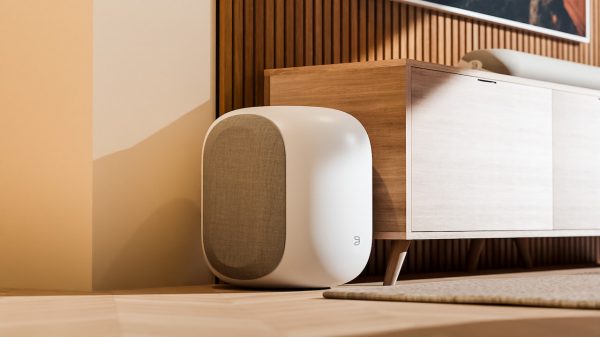
The NODE includes a dedicated RCA subwoofer output and can also connect wirelessly to Bluesound’s PULSE SUB+. The BluOS app offers adjustable crossover control from 40Hz to 200Hz, with 80Hz as the default setting.
When the subwoofer setting is enabled, the NODE applies a high pass filter to the RCA output and sends lower frequencies to the subwoofer output. The digital outputs remain full range, so users relying on an external DAC or digital preamp need to plan their bass management accordingly.
The NODE also offers basic bass and treble controls, ReplayGain options, mono and channel specific output modes, volume limits, and fixed output level. These are useful practical tools, but they are not a substitute for a full parametric EQ or sophisticated loudspeaker management system.
Dirac Live Room Correction

Dirac Live is the feature that changes the conversation around the current NODE. Support for the N132 arrived through BluOS 4.8.15 in January 2025, so this is not a future promise hiding behind a marketing asterisk. At least not anymore.
Dirac is not included with the NODE. Owners need to purchase a Dirac Live license and use a compatible calibrated measurement microphone, such as Bluesound’s Room Calibration Kit. Once installed, Dirac Live measures the room and creates correction filters intended to reduce the influence of bass peaks, cancellations, reflections, and other real world acoustic problems.
The NODE supports Dirac Live correction through its RCA, optical, and coaxial outputs. The USB Audio output does not support Dirac Live processing. That distinction matters. Owners planning to use an external USB DAC will get the NODE’s streaming platform and digital transport capability, but not its room correction.
For many systems, particularly those in smaller rooms or living spaces where speaker placement is limited by walls, furniture, spouses, or basic architectural hostility, Dirac Live may prove more meaningful than another incremental DAC chip upgrade.
THX AAA Headphone Amplifier
The front panel includes a full size 6.3mm headphone output driven by THX AAA amplifier technology. THX AAA uses feed forward error correction to reduce conventional distortion mechanisms, which is a less theatrical way of saying that the circuit is designed to remain clean and controlled rather than add its own flavor to the music.
Bluesound rates the headphone stage at 160mW into 16 ohms, 230mW into 32 ohms, 53mW into 250 ohms, and 22mW into 600 ohms, all at less than 0.1 percent THD. If you were thinking of driving a pair of your demanding planar headphones with the NODE, you might want to rethink that strategy. Grado? Sure. Meze Audio 99 Classics Generation 2? Absolutely.
The fact that Bluesound includes a legitimate dedicated headphone section rather than a token 3.5mm afterthought gives the NODE more value as a desktop or secondary system hub, but it’s not a replacement for a proper headphone amplifier.
Controls, Presets, and Remote Integration
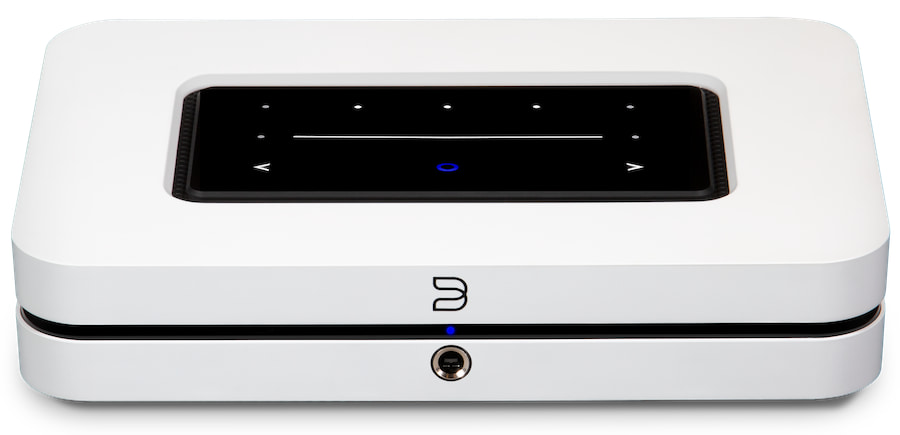
The NODE keeps physical controls simple. The top panel includes a touch sensitive volume slider, play and pause control, five programmable presets, status LEDs, and a proximity sensor that wakes the controls when a hand approaches.
Those presets can be assigned to favorite stations, playlists, albums, or inputs, which sounds modest until you have used a streamer daily and realize how often you want music without opening another app.
The NODE also includes a built-in IR receiver with remote learning, plus a 3.5mm IR input for integration with more elaborate systems. A 12 volt trigger output can power on compatible amplifiers, active speakers, or other components when the NODE wakes up.
Size, Finish, and Included Accessories
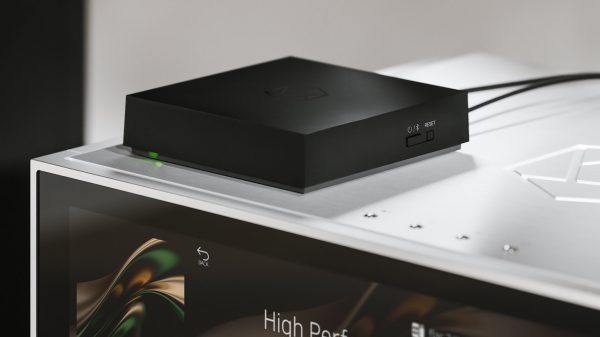
The NODE measures 8.7 inches wide, 1.8 inches high, and 5.7 inches deep, and weighs 2.4 pounds. It is available in matte black or white and is compact enough to disappear into most systems without looking like a discarded cable modem.
Bluesound includes stereo RCA cables, an Ethernet cable, a Mini TOSLINK adapter, power cords, setup documentation, and a Dirac Live information card. The NODE uses a universal 100V to 240V AC power input, which is useful for international use and far more practical than another proprietary external power brick cluttering the floor.
Setup and Listening
The network streamer market has become increasingly bifurcated. Below $1,500, WiiM, Eversolo, Bluesound, Cambridge Audio, Shanling, iFi Audio, and FiiO are making it difficult to spend more without asking some uncomfortable questions. At the other end sit brands such as Innuos, Nagra, NAD, Aurender, Esoteric, and TEAC, where performance, build quality, power supplies, digital architecture, and brand ambition all move into a very different conversation.
There are exceptions, naturally, but the middle has become less crowded than it should be. I have heard the Bluesound NODE ICON at several dealers and came away impressed, although never in my own system, so I am not going to pretend otherwise. Innuos would probably be my personal choice in a blank cheque scenario, but its newer range has moved decidedly upmarket. That leaves a product like the NODE in a rather sensible position.
Some buyers will complain that the NODE lacks a large touchscreen for album artwork and metadata. I am not one of them. I own an iPhone and an iPad Pro. So do tens of millions of other people. More importantly, displays are often among the first things to fail on modern components, and I cannot read most of them from across the room anyway.
In this case, I do not view the absence of a screen as a meaningful compromise. I would rather have a mature control platform, proper connectivity, and the option to improve the system around it than pay extra for a tiny digital picture frame I will barely use.
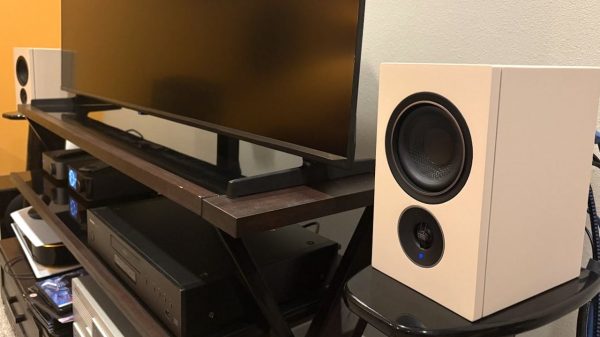
The NODE’s flexibility also made it easy to drop into a wide range of systems during the review. I used its analog and digital outputs with the Cambridge Audio Edge A, NAD C 316BEE V2, Audiolab 6000A, WiiM Vibelink, Quad 3, and Advance Paris A10 Classic, along with Q Acoustics’ M40 active speakers and Bluesound PULSE FLEX. External DAC duties were handled by the FiiO K11 R2R.
Cabling came from QED, Chord, Analysis Plus, and Cable Matters, including a CAT 6A Ethernet cable that had been blessed by my Rabbi. Network duties were handled by Verizon 2Gbps fiber service, its supplied modem, and an ASUS Wi-Fi 7 router. Music came primarily from TIDAL, Qobuz, and Spotify Lossless.
One advantage of owning other Bluesound and NAD components is that I have lived with BluOS through several generations. It has improved with each iteration. The interface may not feel quite as slick or immediate as WiiM Home, but it is the devil I know, and more importantly, every one of my streaming accounts has remained stable through it.
TIDAL Connect, Qobuz Connect, and Spotify Connect all worked reliably when used directly from their respective apps. That matters more to me than a few extra animations or a prettier home screen. A streaming platform that gets out of the way and plays music without drama is still worth something.
Bluesound streamers have carried a “warm” reputation for years, and that has generally been fair. Earlier NODE generations were not detail monsters. They tended to favor a full, generous bottom end over the last word in definition or impact, with a smooth, clear midrange, an above-average soundstage, and a slightly rounded treble. In a more neutral or lean sounding system, that balance could be rather appealing.
Push the rest of the chain too far in the darker direction, however, and things could become a little too warm cocoa and slippers for my taste. Pleasant enough, perhaps, but not especially exciting.
WiiM and Eversolo have largely taken the opposite approach. Both sound more linear, more explicit, and quicker on their feet, with sharper image outlines and more apparent detail. They can also sound a touch thin or overly matter-of-fact when paired with the wrong amplifier or loudspeakers. I own a WiiM and two Cambridge Audio network players, so I have a fairly solid baseline for that comparison.
Not Your Daddy’s Bluesound
The new NODE sounds different. Not “throw the Tim Hortons out and replace it with a cauldron of double-doubles” different, but clearly different. The presentation is more spacious, the low end is tighter, and there is a little less of the old Bluesound warmth in the midbass and lower midrange. Fine detail is easier to hear, transients have more snap, and the treble sounds more open and less toffee-coated.
It still does not turn into a WiiM or Eversolo overnight, nor should it. The NODE retains enough body and ease to avoid sounding clinical, but it is more neutral, more transparent, and more controlled than the Bluesound players that established the brand’s earlier sonic identity.
Nick Cave’s “Avalanche” showed off the NODE’s improved tonal balance particularly well. Cave’s piano had the right weight and dark resonance, while his weathered baritone retained its grizzly edge and low-register authority without sounding overly smoothed or thinned out.
The decay around the piano notes hung in the air long enough to preserve the recording’s atmosphere, and the NODE cast a wider, more open soundstage than earlier Bluesound streamers I have heard. The track still had real power, but the presentation remained controlled and appropriately bleak.
Sia’s bass-heavy pop, including “Unstoppable,” “Cheap Thrills,” and “Breathe Me,” revealed a similar shift. The NODE gave up a little of the old Bluesound thunder at the very bottom, but the bass was better defined and less prone to spreading across the lower midrange. Her voice also came through with more clarity, while the mixes sounded more open and spacious.
That worked particularly well with the Q Acoustics 5040, which can throw a wall-to-wall soundstage that seems slightly ridiculous for a compact floorstander. The NODE took full advantage of that quality. It also helped the Q Acoustics M40 active speakers sound less confined between the cabinets on tracks where they can occasionally pull the image inward. Not here. The stage opened up, and the music had more room to breathe without losing its weight.
Switching to electronic music, the NODE proved far more capable than older Bluesound streamers in keeping pace with less expensive WiiM and Eversolo rivals. Kraftwerk’s “The Robots” and “Tour de France Étape 2,” deadmau5’s “Strobe” and “Ghosts ’n’ Stuff,” The Orb’s “Little Fluffy Clouds,” Aphex Twin’s “Xtal,” and Boards of Canada’s “Roygbiv” all benefited from tighter, more convincing midbass and upper bass.
The NODE did not always deliver quite the same top-end bite or etched detail as some of those competitors, but it kept the pulse intact. Synth lines had better separation, bass patterns were easier to follow, and the music filled the space with more purpose. That matters with this material. I can live without the last degree of sparkle, but the low-end drive has to land somewhere below the rib cage and make you want to channel that increasingly tired Jon Hamm dancing-in-a-club meme. I am already on bipolar medication. Stronger chemical assistance seems unnecessary.
Bluesound has improved this aspect of the NODE considerably. It sounds quicker, more spacious, and more confident with electronic music without losing the fuller tonal balance that has long been part of the brand’s appeal.
The Bottom Line
The Bluesound NODE is not the least expensive way into high-resolution streaming, nor is it the most feature-packed box on paper. The WiiM Ultra remains a ridiculous value at $329, especially for listeners who want a more neutral presentation and the freedom to pair it with a better external DAC later. Cambridge Audio’s MXN10 and CXN100 SE also remain serious alternatives, offering a more familiar British balance that will appeal to listeners who value tonal weight and a more traditional hi-fi presentation.
At $750, the NODE has to justify the premium. It does. The N132 is a meaningful improvement over the previous generation, with a more open and spacious presentation, tighter bass, better clarity, and less of the soft warmth that defined earlier Bluesound players. It still sounds closer in character to the Cambridge streamers than to WiiM or Eversolo, but it delivers a little more transparency and control than I expected.
Neither BluOS nor the StreamMagic app is perfect. BluOS is not as slick as WiiM Home, but it has been more stable in my experience, and its ability to integrate the NODE into a larger Bluesound or NAD ecosystem remains a genuine advantage. The NODE’s real strength is that it can serve as a complete streamer, DAC, preamplifier, headphone amplifier, and television audio hub today, while also working as a very capable digital transport if the rest of the system improves around it.
The Dirac Live story is not finished. Bluesound did not provide access in time for this review, and I was not prepared to offer a verdict after trying it with only one amplifier and one pair of loudspeakers. A follow-up focused on Dirac Live is forthcoming, using multiple speaker and amplifier combinations. That is the only sensible way to judge whether it genuinely shifts the NODE’s value proposition.
The changes here also make me want to spend more time with the NODE ICON. A balanced DAC, preamplifier, and a very particular pair of speakers are already waiting in the listening room. That could get expensive quickly.
For now, the answer is straightforward: the new NODE is definitely a better streamer than the model it replaces. It costs more than the WiiM Ultra and asks buyers to live without a touchscreen, but its improved sound quality, mature platform, broad connectivity, upgrade flexibility, and eventual Dirac Live capability make it one of the more compelling network players in its class.
Pros:
- Clearer, tighter, and more spacious sounding than the previous NODE
- BluOS remains stable, mature, and excellent for multiroom use with Bluesound and NAD components
- Flexible connectivity, including HDMI eARC, analog, optical, coaxial, USB Audio, subwoofer output, and THX AAA headphone amplification
- Works equally well as a complete streamer, DAC, and preamp or as a digital transport for a better external DAC
- Dirac Live support adds useful room-correction potential
Cons:
- At $750, it still faces serious value pressure from the WiiM Ultra and Cambridge Audio alternatives
- Dirac Live requires an additional license and measurement microphone
- No balanced XLR outputs
- No touchscreen or onboard album-art display
- BluOS is stable, but the app is not as polished or immediate as WiiM Home
Where to buy:
Related Reading:
- WiiM Ultra Music Streamer: The Cabin Audiophiler
- Cambridge Audio MXN10 Network Player: Review
- Cambridge Audio Turns Up The Volume With The MXN10 And AXN10 Network Players
- Best Music Streamers: Editors’ Choice 2025