
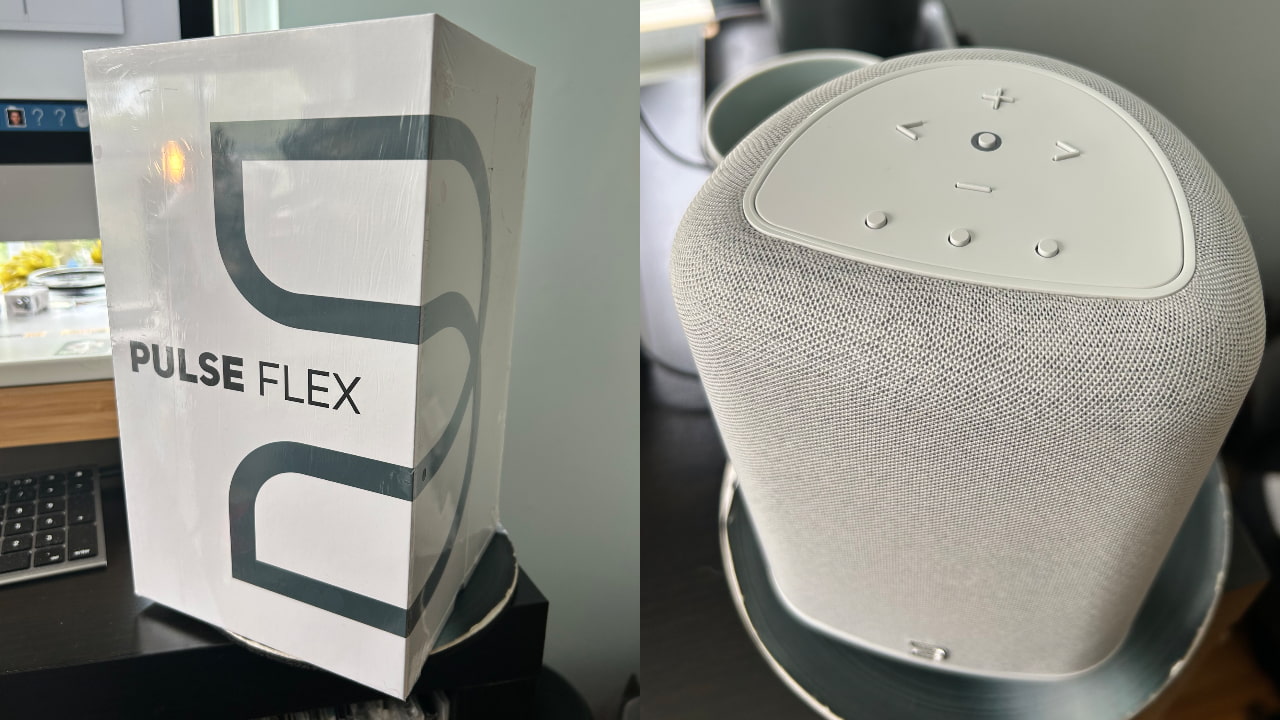
The new Bluesound PULSE FLEX P130 is the 2025 version of Bluesound’s compact BluOS wireless speaker, replacing the long running PULSE FLEX 2i. Compact wireless speakers are no longer background noise for kitchens, bedrooms, home offices, cottages, second homes, and the one shelf in the living room that somehow becomes everyone’s audio system. People buy a lot of these things, and the category has gotten a lot more serious than it used to be.
The new Bluesound PULSE FLEX arrives at $379 with BluOS streaming, hi-res and lossless audio support, Apple AirPlay 2, Bluetooth, USB-C audio, and the ability to work as a standalone speaker, part of a multi-room system, or as wireless surround channels with compatible Bluesound home theater products. That puts it directly in the path of the Sonos Era 100, WiiM Sound, and the Bose Lifestyle Ultra Speaker, which starts at $299 and rises to $349 depending on finish. We previewed the Bose last week, and our full review lands on May 15 when the embargo lifts. So yes, this fight is getting crowded. Good.
Bluesound also has something Sonos and WiiM cannot copy overnight: the Lenbrook ecosystem behind it. NAD Electronics, PSB Speakers, and BluOS give the PULSE FLEX a stronger hi-fi foundation than most compact wireless speakers chasing the same shelf space. That matters because this is not a throwaway category anymore. Build quality is improving. Sonic performance is improving. Connectivity is improving. And consumers are no longer just looking for a small speaker that makes noise while they burn toast.
The real question is whether the new PULSE FLEX actually lives up to the name. At $379, does Bluesound’s compact BluOS speaker play hard in the corners against Sonos, WiiM, and Bose, or does it merely have a pulse?
Design: Not Every Speaker Needs to Look Like Vader
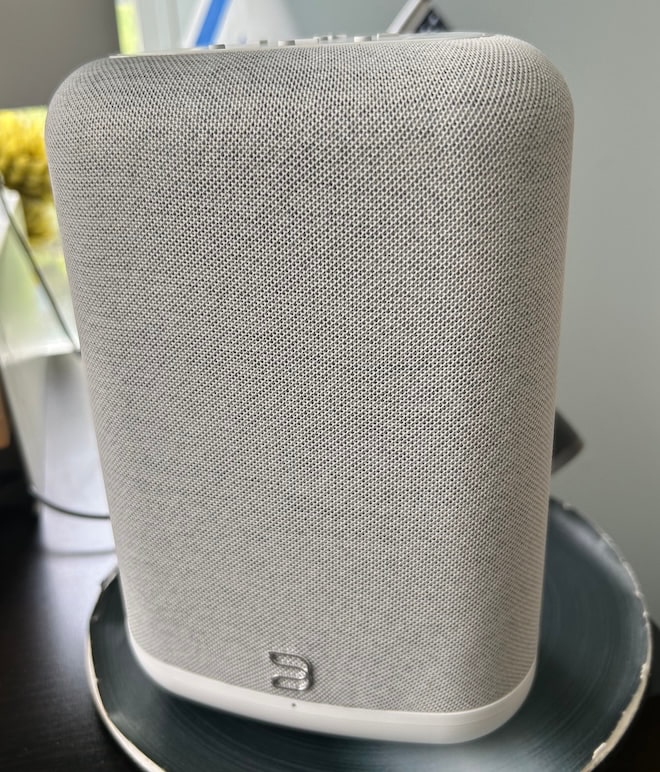
The PULSE FLEX has the kind of compact footprint that makes sense on a desk, nightstand, bookshelf, kitchen counter, or side table without announcing itself like a piece of networking gear from 2009. The rounded edges and cleaner cabinet design are a step in the right direction, and the finish options give Bluesound some needed visual flexibility.
Bluesound sent me the White Pebble Grey version, which is probably the safest choice for most homes. It is neutral enough to disappear into a lot of rooms without looking sterile, and that matters when these speakers end up in public spaces where spouses, partners, kids, guests, and people with actual taste get a vote.
The PULSE FLEX 2025 works as a standalone mono speaker, which is how many buyers will likely use it: on a desk, nightstand, bookshelf, kitchen counter, or in a home office. Add a second unit and it can run as a stereo pair, or serve as rear surrounds with compatible Bluesound home theater products.
At 5.15 x 7.73 x 4.37 inches and 3.55 pounds, it is compact enough to fit into real rooms without becoming the room. Bluesound includes 120V and 230V AC power cords, a Toslink mini adapter, safety and warranty documentation, and a quick setup guide. Not glamorous, but useful.
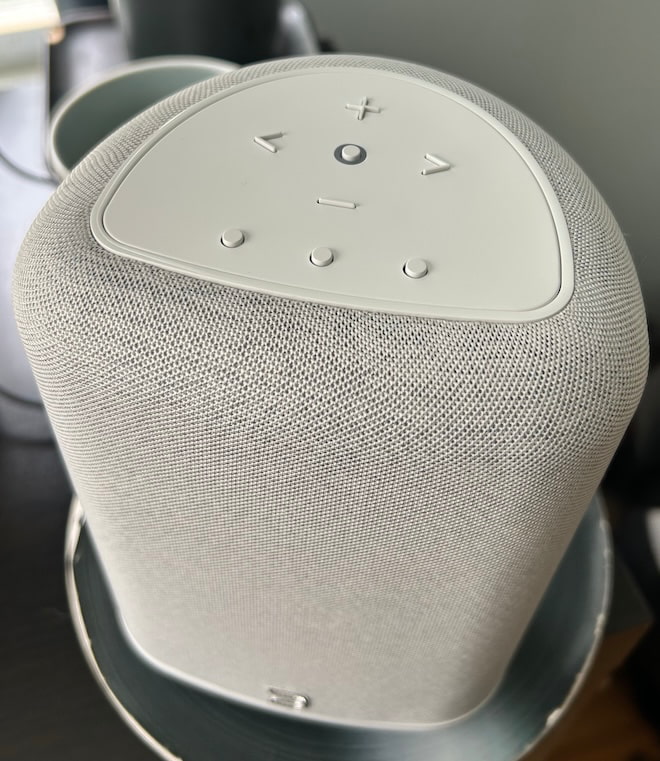
The top panel includes physical controls for play/pause, volume up/down, and track forward/back. There are also three preset buttons that can be assigned in the BluOS app to favorite radio stations, playlists, podcasts, or other commonly used sources. It is a small but useful touch, especially if the speaker ends up in a kitchen, office, or bedroom where reaching for the phone every time gets old fast.
Unlike the WiiM Sound, the PULSE FLEX does not include a touchscreen or display. Bluesound clearly expects you to control the speaker through the BluOS Controller app on your phone, tablet, or computer, with the top panel buttons handling basic playback and presets. That is not necessarily a problem, but it does make the PULSE FLEX feel more like a serious BluOS endpoint than a smart speaker trying to run the room from its own front panel.
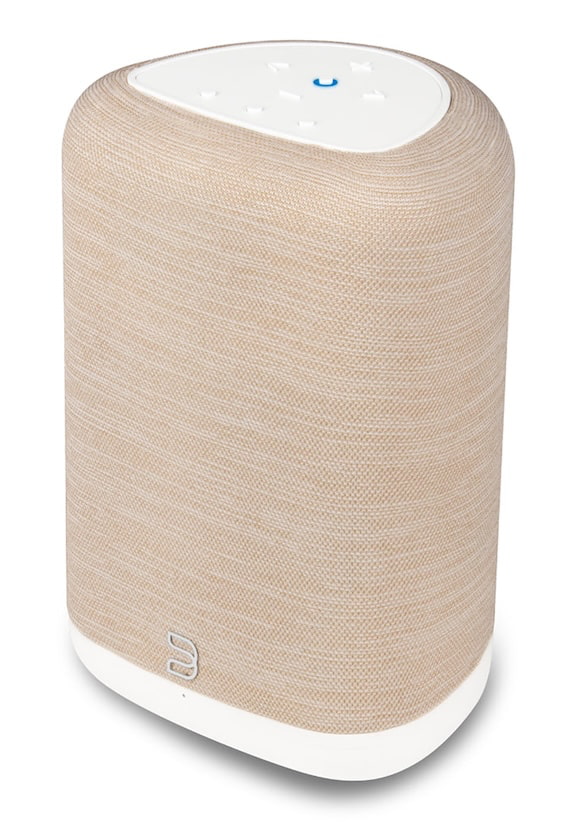
The PULSE FLEX is also available in White, Tan and Black Charcoal, with interchangeable fabric grilles in tonal weaves for those who want the speaker to blend in rather than become the room’s main character. Bluesound also offers the WM100 Wall Mount for cleaner wall installations and the FS230 Adjustable Stand for floor placement, which makes sense if you are using a pair as surrounds or trying to keep them off furniture already losing the war against charging cables.
Inside the PULSE FLEX
The Bluesound PULSE FLEX is built around a Smart DSP amplifier delivering 50 watts total system power, split between a 4-inch woofer and 0.75-inch tweeter. That makes it a compact mono wireless speaker, not a stereo miracle box pretending physics had the day off. Add a second unit and you can create a proper stereo pair, or use two as rear surrounds with compatible Bluesound home theater products.
The new FLEX supports hi-res audio up to 24-bit/192 kHz, along with FLAC, MQA, ALAC, WAV, AIFF, MPEG-4 SLS, MP3, AAC, WMA, WMA-L, OGG, and OPUS. It also supports DSD256, which gives it a stronger file support story than a lot of compact wireless speakers in this category. MQA and DSD “support” require a more detailed explanation, so let’s break down what those formats actually mean on the PULSE FLEX.
DSD256 and MQA?
DSD256 is not something most people will stream from TIDAL, Qobuz, Spotify, AirPlay 2, Bluetooth, or their phone. That is not how this works. On the PULSE FLEX, DSD support is mainly for people who already own downloaded high resolution music files and keep them on a USB drive, NAS, or computer-based music library.
Bluesound lists the USB Type-A port as being for external storage in Local Server Mode, which means you can connect a compatible USB drive with music files directly to the speaker. BluOS can also index music stored on a NAS or computer, making those files available through the BluOS Controller app. That is where DSD256 support actually matters.
The USB-C port is listed as a PC input, but Bluesound’s available information does not clearly state that it supports DSD256 playback from a computer over USB-C. Until Bluesound confirms that, it is safer not to make that claim or expect it to work. We will update if that question ever gets answered.
For most buyers, the more important formats and services will be FLAC, ALAC, WAV, Qobuz Connect, TIDAL Connect, Spotify Connect, Apple AirPlay 2, Bluetooth aptX HD, and Roon Ready.
MQA is more complicated. Lenbrook acquired MQA’s assets in 2023 and later created Lenbrook Media Group to commercialize BluOS, MQA, and SCL6 across the hi-res audio chain. But TIDAL officially removed MQA from its apps and integrations on July 24, 2024, replacing MQA content with FLAC where available.
For 99% of users, neither format will ever be part of the buying decision. But there is always one guy with a NAS, six versions of Kind of Blue, and the emotional stability of a Leafs fan in overtime, so we might as well be thorough.
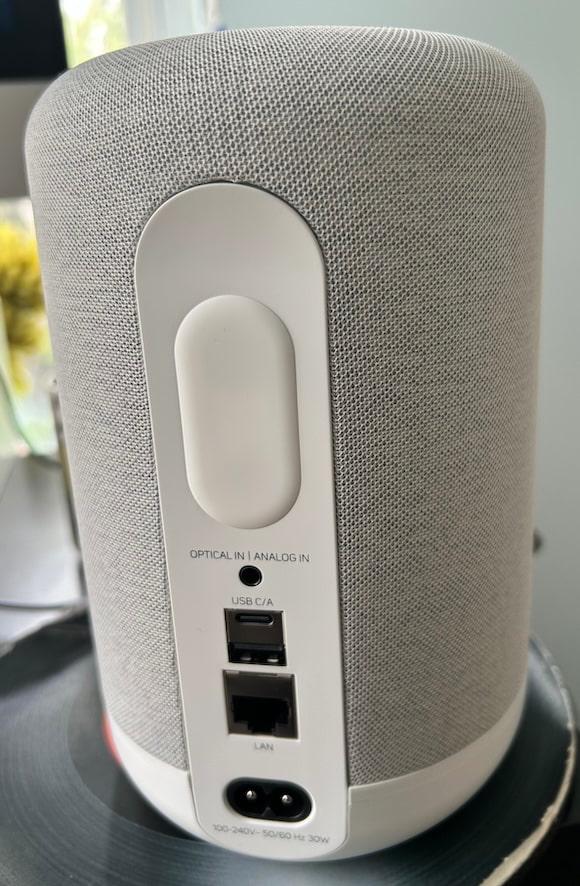
Connectivity: More Reliable Than Rogers on a Friday Morning
Connectivity is solid for a speaker this size. The PULSE FLEX includes Wi-Fi 5 dual band, Gigabit Ethernet, Bluetooth 5.3 with aptX HD, a 3.5mm optical/analog combo input, USB Type-A for external storage in Local Server Mode, and USB-C for PC input. It also offers IR learning, three onboard preset buttons, physical playback controls, and integration support for Crestron, Control4, RTI, Nice, URC, and Lutron.
The one spec that feels a step behind is Wi-Fi 5. It should be fine for most users, especially with hi-res streaming and BluOS multiroom playback, but plenty of homes have already moved to Wi-Fi 6E or Wi-Fi 7. At $379, Wi-Fi 6 would have been a welcome update.
That said, the PULSE FLEX offers more than the basics. It has useful wired and wireless options, practical control features, and enough integration support to work beyond a simple desktop or bedroom setup.
The BluOS Controller app remains one of Bluesound’s strongest advantages. It is detailed, mature, and gives users access to EQ adjustment, input level control, stereo pairing, multi-room setup, presets, music services, and system management without making the process feel like a firmware negotiation.
That matters. BluOS has had almost a decade of real world development, updates, and use across Bluesound, NAD, and other Lenbrook products. It is one of the better multiroom platforms out there, especially for listeners who care about hi-res audio, local libraries, and more serious system integration.
There are limits. EQ adjustment is fairly basic, and the PULSE FLEX does not offer room correction, which is something WiiM includes with the WiiM Sound. Voice control is available through Amazon Alexa Skills, but you will need the patience to set that up properly. Nobody said the smart home was actually smart.
I also ran the PULSE FLEX with multiple iPhones. The iPhone 14 and iPhone 17 worked without issue, but the older iPhone 11 was less consistent with BluOS. That tracks with my own experience using earlier PULSE FLEX models and other Bluesound speakers over the years: BluOS is very good, but not completely free of quirks, especially with older phones.
Listening
I came into the new PULSE FLEX with some preconceptions, mostly because I have owned and used other Bluesound speakers in the lineup. That prior experience led me to expect a somewhat bold presentation, which is not automatically a bad thing. But it can be.
Bold can work very well outside on the deck while eating char dogs with the kids and watching the dog get the zoomies across the lawn like he just stole something from a federal evidence locker.
At 5 a.m., it can be a different story.
I am a very early riser because sleep and I have a complicated arrangement, and some of my listening happens in the kitchen while I am making a pot of rooibos tea and staring into the backyard. That is usually when the fox and deer are sizing each other up like two extras in a Kurosawa film, while Tyrion the Westie scratches at the windowsill, furious that I will not let him outside to start a war he has absolutely no chance of winning.
That kind of listening tells you something useful about a compact wireless speaker. It is not just about how loud it can play, or whether it can sound impressive for 90 seconds in a demo. It is whether the tonal balance still works when the house is quiet, nobody else is awake, and you need music that has presence without behaving like it drank three espressos.
Right out of the box, after the mildly annoying LED light show that tells you whether the speaker is pairing, connecting, updating, or silently judging your Wi-Fi, it was obvious that the new PULSE FLEX does not sound like the older models.
The older Bluesound speakers I have owned leaned more bold and bass forward, with a presentation that could feel somewhat V-shaped. That is not what I heard here. The new PULSE FLEX sounds cleaner, more open, and more balanced through the midrange and treble. The tradeoff is that the lowest bass does not hit with the same weight. The sub bass has not left the building, but it definitely took the morning off.
That showed up across Nick Cave, The Orb, deadmau5, and Talking Heads. The presentation felt more spacious and better sorted, with less bass bloom getting in the way, but also less physical impact than I expected based on earlier Bluesound models.
Think less Vladdy Jr. sending one into the upper deck, and more Ernie Clement sneaking one just over the wall in left. It still counts. It just does not make the pitcher stare into the middle distance and reconsider his decision to leave Toledo.
Another positive change is that the new PULSE FLEX sounds more spacious than previous models I have used. That matters because this is still a mono speaker, and Bluesound, unlike Bose, did not send a stereo pair for evaluation. So no, it is not going to overwhelm a room with a huge wall of sound or create the kind of left/right separation you get from two properly placed speakers. Physics remains undefeated, even in Jersey.
What it does manage rather well is a sense of openness and placement within reasonable limits. The PULSE FLEX does a better job than I expected keeping vocals, percussion, and electronic textures from stacking up in one congested lump. Imaging from a single mono speaker is always going to come with an asterisk, but this version feels less boxed in than earlier Bluesound compact models. That is a meaningful improvement.
Another positive change is pacing. With less low end thickness, the PULSE FLEX sounds quicker, cleaner, and more open. There is more detail, better organization, and a little extra snap on rhythm driven tracks. It gives up some bass weight, but gains speed and clarity.
PULSE FLEX vs. Bose Lifestyle Ultra
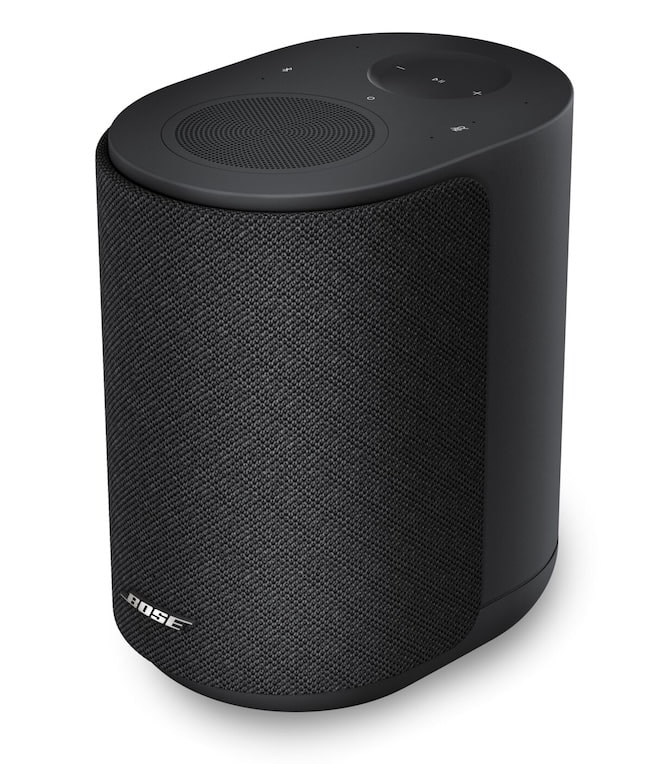
I am slightly limited in what I can say about the new Bose Lifestyle Ultra Speaker until my review publishes on May 15 under embargo, but there are too many similarities here to ignore.
Where the PULSE FLEX has the immediate advantage is software. BluOS gives Bluesound easy access to multiple streaming platforms, local libraries, multiroom playback, and system control from one app. The Bose app is more focused on setup, configuration, and system management. That is not a criticism, but it is a different approach.
The Bluesound also supports Spotify Connect, TIDAL Connect, and Qobuz Connect natively. Bose supports Spotify Connect, while TIDAL and Qobuz playback run through Apple AirPlay or Google Cast. For listeners already using Qobuz or TIDAL every day, that matters. Fewer steps. Less friction. Fewer reasons to mutter at your phone like it owes you money.
The real difference is how each speaker handles control and streaming access. Bluesound puts more of the music experience inside BluOS, especially for Qobuz Connect, TIDAL Connect, Spotify Connect, local libraries, and multiroom playback. That is a major advantage if you already use BluOS or want one app to manage everything.
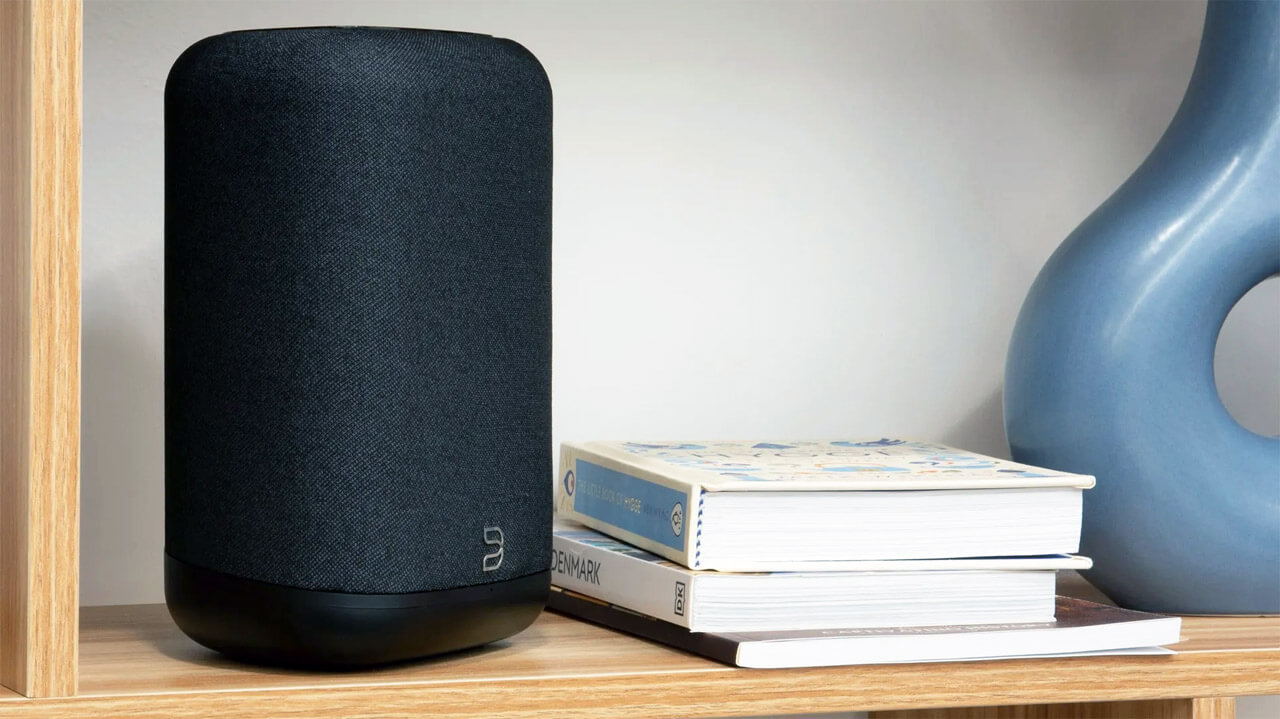
But there is a counterargument. Some users do not want to live inside another control app, even a good one. They would rather open their preferred streaming app and cast directly from there. Bose leans more in that direction with Spotify Connect, Apple AirPlay, and Google Cast handling broader streaming access, while the Bose app focuses more on setup and system control.
So the PULSE FLEX has the stronger platform for serious BluOS users and local library playback. Bose may feel more natural for listeners who prefer to stay inside the apps they already use. Pick your poison: one deeper ecosystem, or fewer reasons to open another app before coffee.
The Bottom Line
The Bluesound PULSE FLEX P130 is not trying to be the loudest compact wireless speaker in the room, and that is probably a good thing. Compared to older PULSE FLEX models, the new version sounds cleaner, more open, and better paced, with improved detail and less of the bass heavy thickness that defined some previous Bluesound compact speakers. The tradeoff is impact. If you want deeper bass and more room filling weight from one small speaker, this is not the obvious first pick.
What makes the PULSE FLEX unique is the combination of BluOS, strong file support, native Spotify Connect, TIDAL Connect, Qobuz Connect, AirPlay 2, Bluetooth aptX HD, Roon Ready, real wired inputs, and the ability to work as a standalone speaker, stereo pair, multiroom endpoint, or surround channel with compatible Bluesound home theater products. That is a lot of flexibility in a speaker this small. It also helps that the build quality and finish options finally feel more appropriate for public rooms, not just a shelf in the basement next to the router.
What is missing? Room correction, deeper EQ control, Wi-Fi 6, a touchscreen or display, and true stereo playback from a single unit. The WiiM Sound has a stronger feature story in some of those areas, and the Bose Lifestyle Ultra Speaker offers a different kind of integration for users already inside that ecosystem. Bluesound’s answer is BluOS, and for the right listener, that still matters.
The PULSE FLEX is best for someone who wants a compact wireless speaker for a desk, nightstand, bookshelf, kitchen, home office, cottage, or second home, but does not want to give up real streaming flexibility or local library support. It is also a smart buy for existing Bluesound, NAD, or BluOS users who want to expand into another room without starting over. Just know what you are buying: this is a refined compact BluOS speaker with better clarity and pacing, not a tiny subwoofer with fabric on it.
Pros:
- Cleaner, more open tuning than previous PULSE FLEX models
- Better pacing, detail, and snap with less low end thickness
- BluOS remains one of the strongest multiroom platforms
- Native support for Spotify Connect, TIDAL Connect, Qobuz Connect, Apple AirPlay 2, Bluetooth aptX HD, and Roon Ready
- Strong connectivity for the size, including Gigabit Ethernet, optical/analog input, USB Type-A, and USB-C
- Compact enough for a desk, nightstand, bookshelf, kitchen counter, or home office
- More spacious presentation than earlier models, within mono speaker limits
- Can be paired with a second PULSE FLEX for stereo playback
- Can be used as surround channels with compatible Bluesound home theater products
- Strong build quality and attractive finish options, especially White Pebble Grey
Cons:
- Less bass impact than previous Bluesound compact speakers
- Still mono unless you buy a second speaker
- No room correction, unlike the WiiM Sound
- EQ controls are limited
- Wi-Fi 5 feels slightly behind the times at $379
- No touchscreen or display, unlike the WiiM Sound
- BluOS can still be quirky with older phones
- Alexa is supported through Alexa Skills, but not built-in
- Some users may not want to rely on another control app
- Wall mount and floor stand accessories cost extra
Where to buy:
Related Reading:
- Bose Lifestyle Ultra Wireless Speaker Debuts With AirPlay, Spotify Connect, And Google Cast: Should Sonos Be Worried?
- Edifier M90 Review: Compact Speakers With Big Sound For Desktop Or TV Use
- First Listen: Denon Home 200, 400, 600 Wireless Dolby Atmos Speakers With HEOS Built-In
- Sonos Unveils Play And Era 100 SL Wireless Speakers Designed For Music That Moves With You













Catherine Lugg
May 12, 2026 at 5:35 pm
Ian,
THANK YOU for this detailed review. The less bass is a bit of a bummer, but my ears aren’t what they once were. BTW: I have 2 of the Flex 2.is on my first floor, one in the kitchen, the other parked on TOP of the china cabinet in the dining room. We have an “open concept” first floor, so that high speaker kinda “plumps out” the sound without me having to buy big, back breaking passive speakers. It’s a neat psychoacoustic trick.
Annnnddd… your observation of “the emotional stability of a Leafs fan in overtime,” put coffee out my nose this morning.
Again, THANKS!
Ian White
May 12, 2026 at 6:51 pm
Catherine,
Greatly appreciate the kind words. Don’t waste coffee. Especially on long-suffering Leafs fans. 🙂
IW