Five years is a long time in the soundbar business.
Sonos introduced the Beam Gen 2 in September 2021, adding Dolby Atmos, HDMI eARC and additional processing power to a compact soundbar that has occupied the middle of the company’s home theater lineup ever since. Today, Sonos sells the Ray for $219, Beam Gen 2 for $499 and Arc Ultra for $1,099, leaving plenty of room for something newer between its entry-level and flagship models.
That something may have just passed through the FCC.
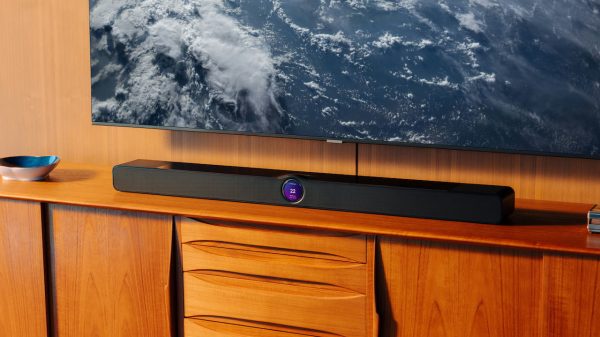
A new Sonos product carrying model number S59 and product code RM059 received FCC authorization on August 14, 2026. Sonos describes it in the filing as a “wireless smart speaker,” but documentation attached to the application contains the internal name Gambit, including metadata for a future “Sonos-Gambit” user booklet. Bloomberg first reported that the product closely resembles the Beam Gen 2 and is expected to be part of a September hardware reveal. Sonos has not announced the product, its final name, price or release date. This is still an FCC filing and a reported product launch, not an official Sonos announcement.
What Does the FCC Filing Actually Confirm?
Not as much as anyone hoping for a complete Beam Gen 3 specification sheet would like, but there is one potentially significant upgrade hiding inside the radio testing.

The S59 has been certified for Bluetooth along with Wi-Fi operation across 2.4 GHz, 5 GHz and 6 GHz bands, with the FCC documents also showing 2×2 MIMO operation. Sonos is keeping the user manual, external photographs, internal photographs and other revealing documents confidential until January 27, 2027.
That wireless upgrade matters because the current Beam Gen 2 is still listed by Sonos with Wi-Fi 4 and no Bluetooth, while the newer Arc Ultra supports Wi-Fi 6 and Bluetooth. If S59 is indeed the next Beam, Sonos appears to be bringing its compact soundbar onto a substantially more modern connectivity platform.
We still don’t know the number or type of drivers, whether there are dedicated upward-firing Atmos speakers, whether Sonos will incorporate its Sound Motion woofer technology, whether DTS will finally appear, how many HDMI connections it will offer, or whether the S59 will inherit Arc Ultra’s more advanced Speech Enhancement and Trueplay features.
Anyone claiming those specifications at this stage has discovered a section of the FCC website that the rest of us apparently cannot see.
Why Does a New Beam Matter?
Because the Beam Gen 2 remains one of the most important products in the Sonos lineup.

At 25.6 inches wide, the current Beam is considerably easier to accommodate than the 46.4-inch Arc Ultra, and Sonos recommends it for televisions up to 65 inches. It also supports Dolby Atmos, HDMI eARC, Trueplay, AirPlay 2 and expansion with Sonos wireless surrounds and subwoofers.
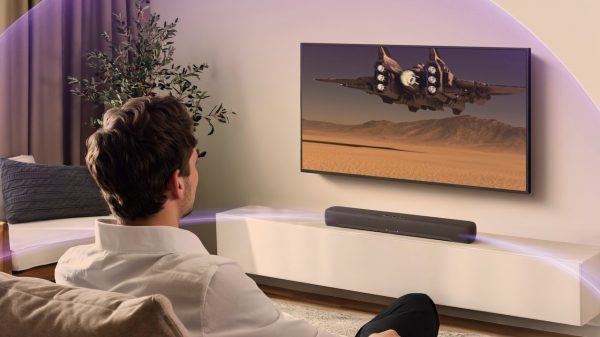
But its Dolby Atmos performance relies on processing to create phantom height channels rather than dedicated upward-firing drivers. Arc Ultra, by comparison, uses two upward-firing tweeters as part of its much larger acoustic architecture.
That creates an obvious opportunity for Sonos.
A next-generation Beam does not need to become a miniature Arc Ultra or cost $900. It needs to offer a meaningful improvement in immersion, dialogue intelligibility and connectivity while preserving the compact dimensions that made Beam attractive in the first place.
Dedicated height drivers would certainly help, but there is currently no evidence in the FCC documents confirming them.
What Would Make the S59 Unique?
We don’t know yet, but the potentially more important story will be the acoustic architecture.
Arc Ultra introduced Sonos’ Sound Motion technology, which uses a four-motor, dual-membrane woofer to generate more bass output from a relatively compact enclosure. It also added four levels of AI-assisted Speech Enhancement and finally brought Trueplay room optimization to both iOS and Android.
Whether any of that technology migrates down into S59 remains unknown.
There is also the question of Sonos Ace integration. Beam Gen 2 already supports TV Audio Swap with Sonos Ace, so merely maintaining that feature would not constitute much of an upgrade. A new soundbar arriving around the same time as the reported Ace Ultra, however, would give Sonos an opportunity to tighten the connection between its headphones and home theater ecosystem.
The Competition Has Not Been Waiting
Sonos also has more competition in this price range than it did when Beam Gen 2 arrived.
The Bose Smart Soundbar carries a $549 regular price and includes Dolby Atmos, Bose TrueSpace, AI Dialogue Mode, Wi-Fi and Bluetooth. It can also work with Bose Ultra Open Earbuds for the company’s Personal Surround Sound feature..
WiiM Bar may be the more dangerous competitor because it is built around a 3.0.2-channel configuration with actual top-firing height channels, Dolby Atmos, DTS:X, HDMI eARC, Wi-Fi 6E, Bluetooth LE Audio, and WiiM’s extensive streaming ecosystem. It can also expand into a 5.1.2-channel system using other WiiM products.
That creates a potentially uncomfortable comparison for S59. Beam Gen 2 relies on virtualized height effects and does not support DTS:X, while WiiM is already offering discrete height channels and broader codec support. If Sonos replaces Beam without addressing those limitations, WiiM suddenly becomes much harder to dismiss as merely the cheaper alternative.
Samsung’s HW-S60D is a compact 5.0-channel all-in-one soundbar with Dolby Atmos and Q-Symphony that currently lists for $399.99, although its deepest integration benefits are naturally reserved for Samsung television owners.
Higher up the ladder, Sony’s BRAVIA Theater Bar 7 costs $869.99 and offers nine speaker units, Dolby Atmos, DTS, 360 Spatial Sound Mapping and support for optional rear speakers and subwoofers. It also supports an HDMI input with 4K/120 and VRR passthrough — exactly the kind of connectivity Sonos continues to omit from its soundbars.
Sonos still has one considerable advantage: the ecosystem. A Beam owner can start with one compact soundbar and later add a Sub Mini or Sub, rear Sonos speakers, multi-room music and Sonos Ace headphones without replacing the original product.
S59 needs to make that ecosystem feel worth buying into again.
Who Is This For?
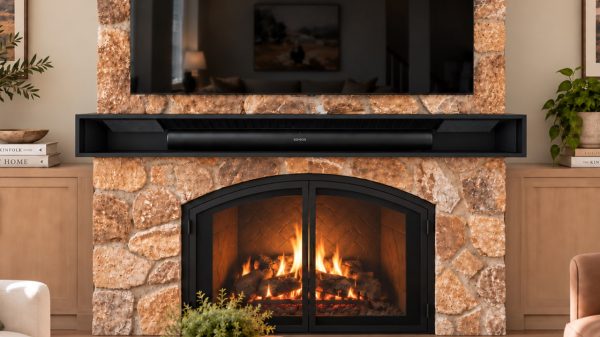
If S59 becomes a Beam successor, the obvious audience is someone who wants better television audio and Dolby Atmos without putting a 46-inch Arc Ultra beneath the screen or spending $1,099 before adding a subwoofer or surrounds.
It should also be interesting to existing first-generation Beam owners. Five years of hardware development since Beam Gen 2 and eight years since the original Beam, gives Sonos considerably more room for a meaningful upgrade than another cosmetic refresh.
Current Beam Gen 2 owners should probably do nothing for the moment. The existing model already supports Dolby Atmos, eARC, Sonos Ace TV Audio Swap and the broader Sonos ecosystem, and we simply don’t know whether S59’s acoustic improvements will justify replacing it.
Waiting a few weeks seems considerably less painful than buying a $499 soundbar immediately before its successor walks through the door.
The Bottom Line
The Sonos S59 looks increasingly like the compact soundbar refresh that the company’s lineup needs, but the FCC filing confirms connectivity rather than acoustic performance. Bluetooth and 6 GHz Wi-Fi support would already address two obvious limitations of Beam Gen 2, while the reported Beam-like form factor suggests Sonos is not abandoning the compact middle ground between Ray and Arc Ultra.
What will determine whether S59 actually matters is what Sonos puts behind the grille. Better dialogue, stronger bass, more convincing Dolby Atmos and possibly dedicated height drivers would give existing Beam owners something tangible to consider. Another round of virtual processing with newer Wi-Fi would be considerably harder to get excited about.
Sonos has not confirmed the name, specifications, price or September launch. But if you were planning to buy a Beam Gen 2 this month, I would keep the credit card in your pocket for a little longer.
Related Reading: