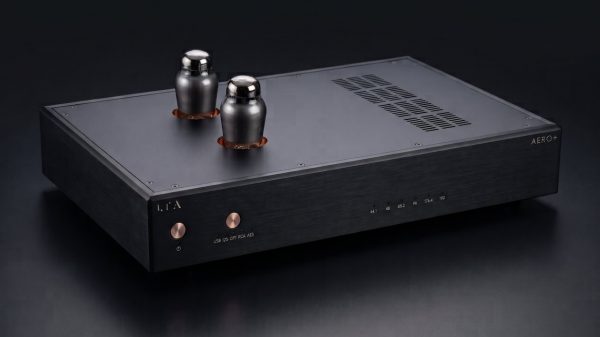
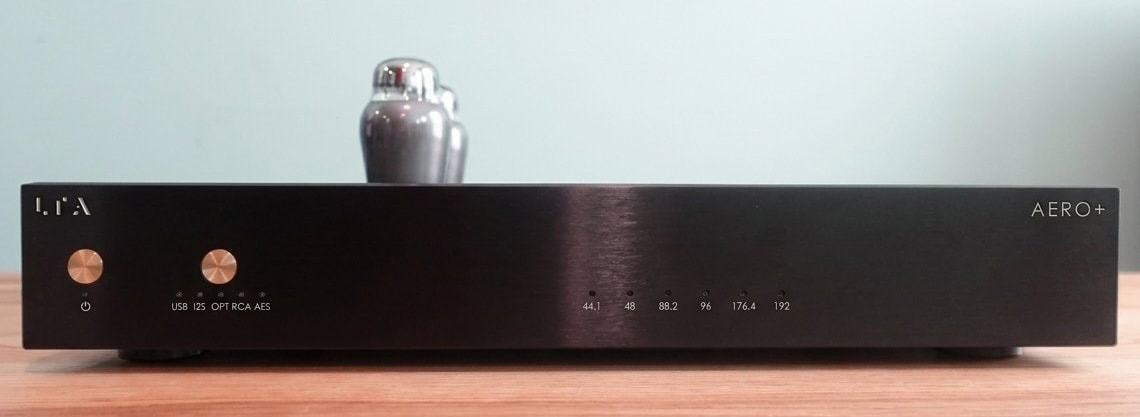
Linear Tube Audio is doubling down on its unconventional approach to digital audio with the new Aero+ and Aero+ SE DACs, priced at $4,400 and $5,800, respectively. Designed and built in Takoma Park, Maryland, the two models retain the original Aero’s vintage Analog Devices R-2R converter and David Berning-inspired ZOTL vacuum tube output stage, but introduce substantial changes to the digital interface, distortion management, and power supplies.
At a time when DAC manufacturers seem determined to support increasingly ridiculous sampling rates and publish distortion measurements with enough zeros to bewilder Godzilla, LTA is taking a different approach. The company believes its combination of older digital conversion technology and modern tube circuitry delivers a more natural listening experience, and the latest versions are intended to improve transparency without sacrificing that character.
The original Aero DAC, introduced in 2024, earned considerable praise for its tonal richness, spacious presentation, and ability to make digital recordings sound less mechanical. Rather than redesigning the entire product, LTA has concentrated on the circuitry surrounding its converter, where the company believes meaningful improvements were still possible.
Related Reading:
Why LTA Is Sticking With a Vintage DAC Chip
At the heart of both models is the Analog Devices AD1865, an 18-bit R-2R converter that has been out of production for years. It operates without digital oversampling or reconstruction filters, an approach favored by some audiophiles for its particular presentation of timing, tone, and musical texture.
Using an older chip doesn’t automatically make a DAC sound more analog, nor does non-oversampling guarantee greater accuracy. But LTA has built the Aero platform around the AD1865’s characteristics rather than chasing the specifications of newer converters, and that remains a defining part of its design philosophy.
The digital input stage uses an ARM-based processor rather than conventional standalone USB and S/PDIF receiver chips. New AES3 and I²S inputs expand connectivity beyond the original USB, coaxial, and optical connections, with I²S following the PS Audio pinout standard. That’s useful for owners of compatible digital transports and streamers, although I²S compatibility should never be assumed simply because two components have the same connector.
The Aero+ is also Roon Tested, confirming plug-and-play compatibility with Roon through its USB input.
Less Distortion Without Adding Negative Feedback
The most interesting engineering change involves LTA’s redesigned digital-to-analog interface, which converts the AD1865’s current output into a voltage signal before passing it to the tube stage.
According to LTA, the revised circuit generates distortion components with an opposing phase relationship to those produced by the single-ended tube output stage. The intention is to partially cancel unwanted distortion while retaining the low-order harmonic characteristics associated with the original design.
What’s unusual is that LTA accomplishes this without introducing negative feedback. The company continues to use its Class A, direct-coupled ZOTL architecture, which eliminates conventional output transformers and coupling capacitors from the signal path.
LTA says the changes produce greater resolution, more precise imaging, and a cleaner presentation. Those are manufacturer claims rather than independent listening findings, and the published THD+N figures aren’t directly comparable with every measurement of the original Aero because the stated test levels differ.
The larger point is that LTA isn’t trying to turn the Aero into another ultra-low-distortion solid-state DAC. It is attempting to improve the existing circuit while preserving the characteristics that made listeners interested in it in the first place.
Aero+ SE: Because the Power Supply Apparently Needed Its Own Address
The $5,800 Aero+ SE (Special Edition) takes a more aggressive approach to noise reduction, moving the larger toroidal transformer and filter choke into a separate enclosure connected to the DAC by an umbilical cable with XLR connectors.
Transformers and chokes generate magnetic fields, and removing those components from the main chassis reduces the potential for electromagnetic interference with sensitive digital and analog circuitry.

The external power supply incorporates a passive power-factor-correction network built around a 15mH choke, increased storage capacitance, and additional filtering. Selected audio-path components receive further attention, with LTA claiming quieter backgrounds, improved image stability, and greater soundstage depth.
The SE is not a different DAC architecture. It shares the standard model’s converter, output stage, and digital connectivity, meaning the additional $1,400 is going toward power-supply engineering, physical isolation, and selected components rather than new playback capabilities.
Whether those changes justify the premium will ultimately depend on the associated system and listening results. The external chassis also requires additional shelf space, which may be an acceptable trade-off for some audiophiles but is hardly an advantage for anyone already playing equipment Tetris.
Existing Aero Owners Haven’t Been Forgotten
Rather than forcing customers to replace their original DACs, LTA is offering a factory upgrade program. Owners can move to Aero+ circuitry for $900 or choose the more extensive SE modifications for $1,800, allowing them to retain their existing investment.
There is one important limitation: upgraded original Aero units do not gain the new AES3 and I²S inputs. Those connections are available on newly manufactured Aero+ and Aero+ SE models, so customers who specifically need the expanded digital connectivity must account for that distinction.
The upgrade program is a welcome alternative to the usual high-end audio routine of introducing a revised model and treating existing owners as yesterday’s news. It also acknowledges that the original Aero remains a capable product rather than something that suddenly became obsolete when LTA found another way to improve its circuitry.
How Do They Compare With Other High-End DACs?
LTA faces considerable competition from manufacturers taking different approaches to the same problem.
The Holo Audio Spring 3 KTE uses a discrete R-2R architecture with selectable non-oversampling and oversampling modes. Its broader PCM and DSD format support appeals to listeners who prioritize digital flexibility, although it doesn’t offer LTA’s vacuum tube output stage.
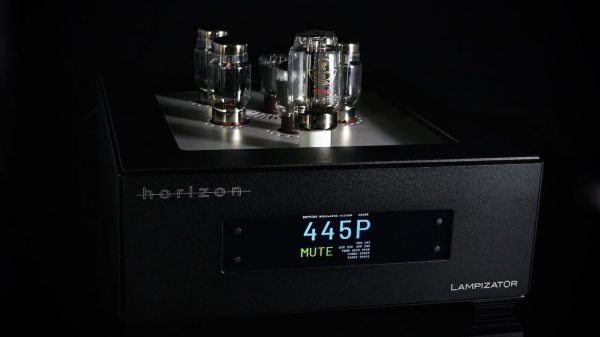
The LampizatOr Amber 5 combines modern digital processing with a tube-based analog section and support for higher-resolution PCM and DSD playback. It offers another interpretation of how vacuum tubes can fit into a contemporary digital source.
What distinguishes LTA is its combination of a vintage converter, proprietary ZOTL circuitry, and a deliberate refusal to pursue the highest possible digital specifications. These products are aimed at listeners who care more about the final presentation than collecting format logos.
Linear Tube Audio Aero+ and Aero+ SE Specifications
- DAC architecture: Analog Devices AD1865, 18-bit R-2R, non-oversampling
- Digital inputs: USB, RCA coaxial, Toslink optical, AES3, I²S (PS Audio standard)
- Digital formats: PCM up to 24-bit/192kHz
- Digital input processing: ARM-based architecture
- Analog outputs: Balanced XLR and unbalanced RCA
- Output voltage: 4.4Vrms (XLR), 2.2Vrms (RCA)
- Output impedance: 140 ohms (XLR), 70 ohms (RCA), per LTA’s published product page
- Frequency response: -0.3dB at 20Hz; -0.8dB at 20kHz, referenced to 1kHz
- THD+N: 0.1% (XLR), 0.3% (RCA), at maximum output
- Signal-to-noise ratio: 96dB (XLR), 90dB (RCA), per supplied press specifications
- Output topology: Balanced ZOTL, single-ended Class A amplification stages, direct-coupled and output capacitor-free
- Negative feedback: None
- Tubes: Two 12SN7 dual triodes; adjustable for compatible 6SN7 tubes
- Tube bias: Continuous automatic bias adjustment
- Estimated tube life: 10,000 hours
- Power architecture: Six isolated supplies; SE adds an external PSU with a 15mH filtering choke
- Power consumption: 33W operating, 8W standby
- AC voltage: User-selectable 120V/230V, ±10%
- Dimensions: 17 × 10.5 × 4.5 inches (W × D × H, including connectors and installed tubes)
- Weight: Aero+ 11.5 lbs (5.2kg); Aero+ SE 18 lbs (8.16kg), including external PSU
- Warranty: Three years
- Manufacturing: Takoma Park, Maryland, USA
The Bottom Line
The Aero+ and Aero+ SE make the most sense for audiophiles who already appreciate what LTA brings to the table: a different interpretation of digital playback that places considerable emphasis on analog circuit design and component interaction.
The standard Aero+ looks like the more practical choice for listeners who want the updated performance and broader connectivity without committing to a second chassis. The SE is aimed at more demanding systems where incremental gains in noise performance and imaging may justify the additional expense and rack space.
Neither model is trying to win the digital specifications contest, and that’s both their appeal and their limitation. Buyers who want native DSD support, more flexible digital processing, or exceptionally low published distortion figures have alternatives worth considering.
What makes this launch interesting is LTA’s willingness to revisit the fundamentals instead of simply replacing the converter chip and calling it progress. The original Aero demonstrated that there was an audience for its unconventional approach; the new models now have to prove that refining the surrounding circuitry makes an audible difference.
Pricing & Availability
The Linear Tube Audio Aero+ DAC is priced at $4,400, while the Aero+ SE retails for $5,800. Both models are available for preorder directly from Linear Tube Audio, with a 15% introductory discount bringing their respective prices down to $3,740 and $4,930. Shipping is expected to begin in December 2026.
For more information: lineartubeaudio.com
Related Reading:
- LampizatOr Horizon 2 Rebuilds Its $62,000 Tube DAC Without Raising The Price
- LAiV Harmony DAC 2 Is A $3,994 R2R DAC Aimed Straight At Denafrips And Holo
- WTF Is Upsampling? Why More Digital Audio Samples Don’t Always Mean Better Sound