When I reviewed the Apos x Community Gremlin Amplifier, I pointed out one obvious limitation. It only accepts balanced input through a 4.4 mm TRRS port or a pair of XLR jacks. No RCA. No 3.5 mm line input.
Of course, Apos had an answer for that in the form of the Merlin DAC that I reviewed at the time. It turns out the Merlin wasn’t the only thing in Apos’ plans, though. A bit more recently — although admittedly longer ago than I’d like to admit — I received the Druid, an R2R DAC featuring the same basic size, form factor, and XLR outputs as the Merlin. Listeners now have the choice of an AKM-based DAC or a discrete R2R design to pair with their Gremlin.
Like the community-driven Gremlin, the Druid was developed by Apos with input from its community and a group of guest experts. The Druid is not simply a DAC designed to match the Gremlin, though. Its R2R architecture raises a larger question: Can a $160 resistor-ladder DAC really deliver the musicality associated with more expensive R2R designs, and can its resistor tolerances be kept tight enough to prevent conversion errors from creeping into the mix?
We’ve seen a proliferation of R2R DACs over the past few years, partly because FPGA-based digital processing can handle filtering, timing, compensation, and other functions that make discrete ladder designs easier to implement accurately, and partly because modern surface-mount precision resistors have improved to the point that assembling a tightly matched ladder is no longer quite the labor of love it once was.
Still, $160 barely buys an oil change on some cars these days, so should we really expect that amount of money to buy a genuinely musical R2R DAC, or is the Druid more gimmick than useful audio tool?
Related Reading:
- Apos X Geshelli Merlin Balanced DAC Review: This $225 Box Should Not Sound This Good, But Here We Are
- Apos X Community Gremlin Tube Headphone Amplifier Review: The Little Monster That Crawled Out Of The Upside Down
Druid R2R DAC Unboxing & Build Quality
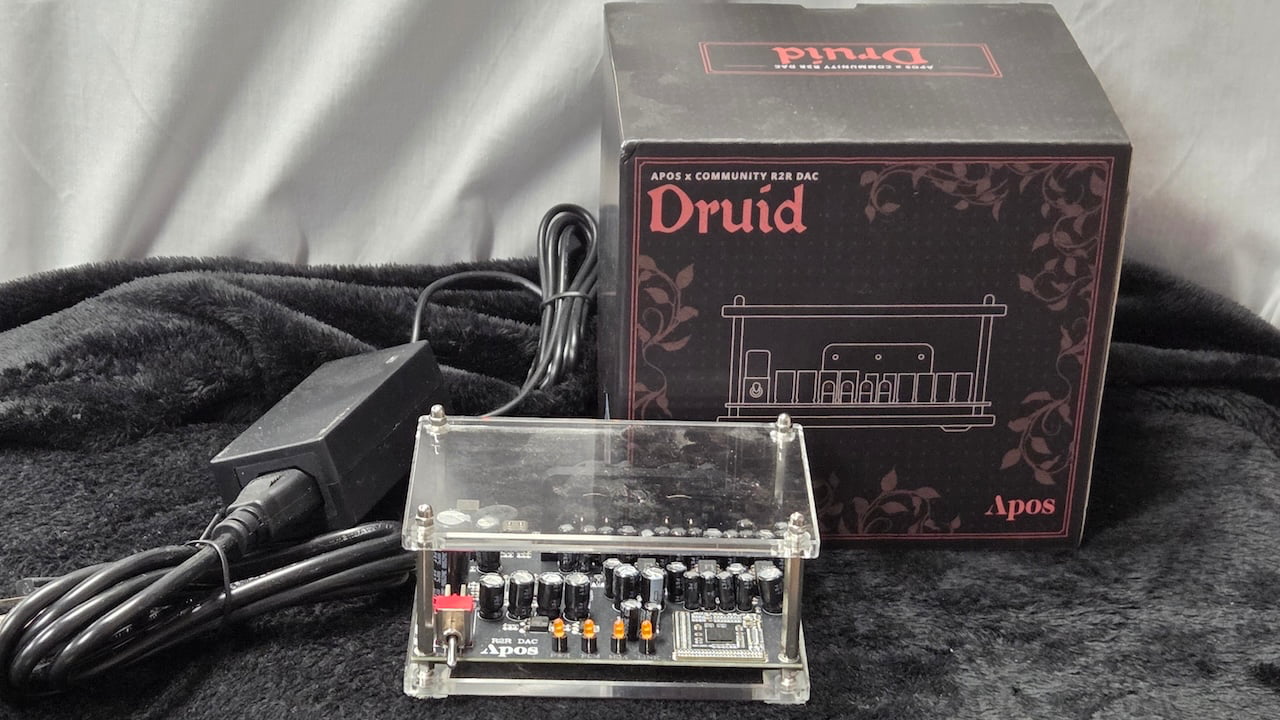
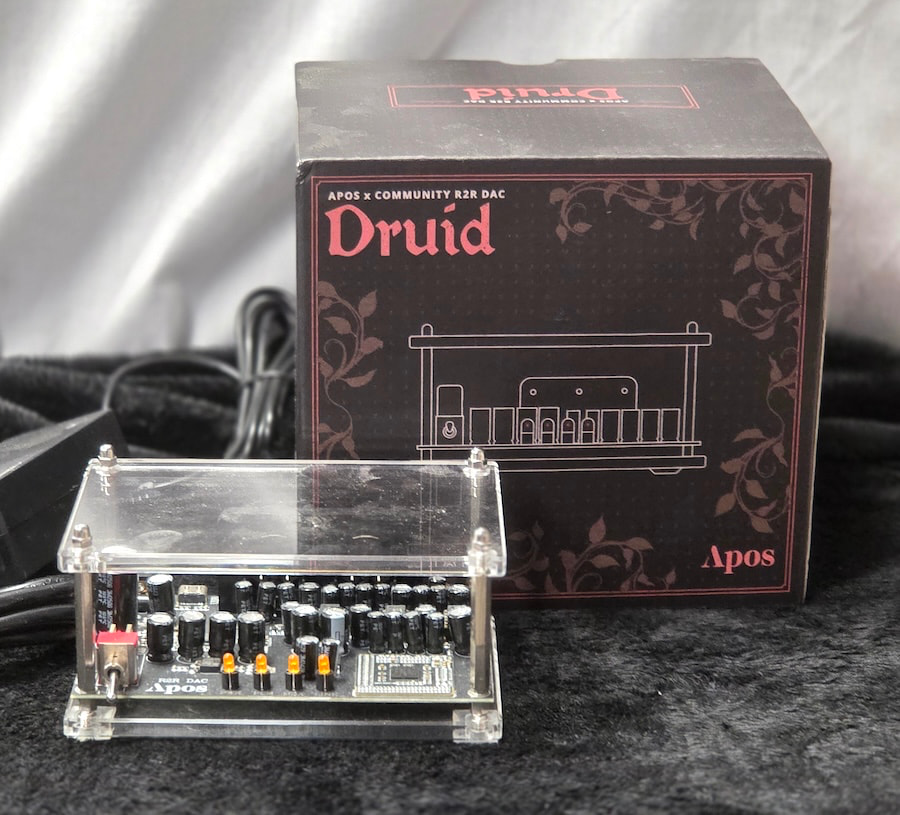
The Druid arrives in the same black box with red lettering as the Gremlin, carrying the same subtle “Stranger Things” aesthetic. Inside, the layout is familiar. The manual sits on top, the DAC rests securely in a foam cutout, and the power supply is tucked underneath.
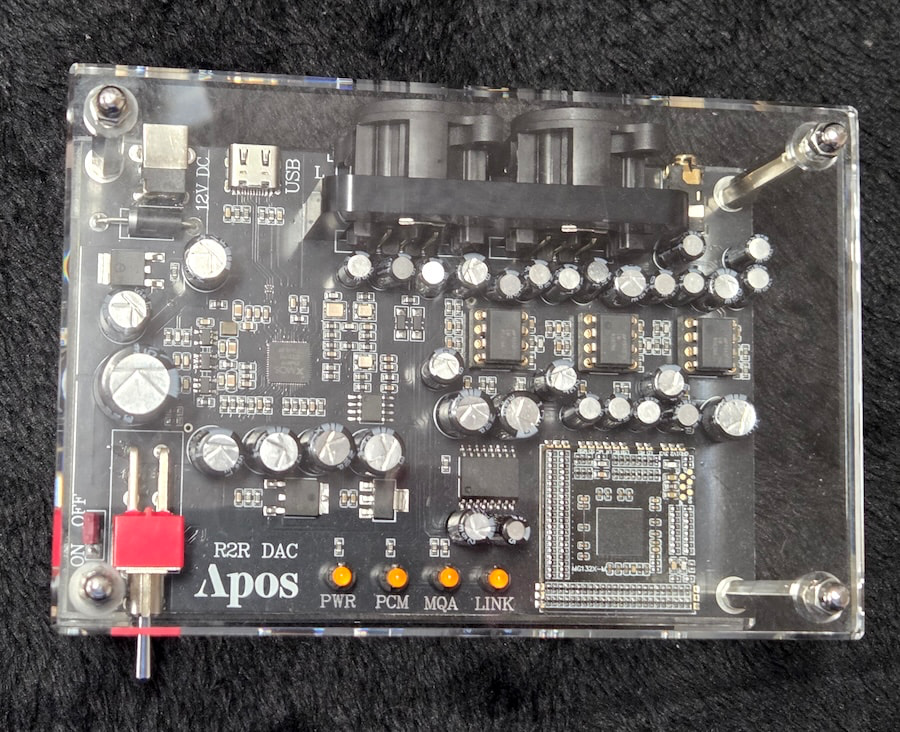
The Druid uses the same Lexan plates on the top and bottom, with stainless-steel standoffs at each corner, and shares the compact footprint of the Gremlin and Merlin. We’ve already covered the fact that the DIY appearance isn’t quite at home next to a Pass Labs amplifier or feeding a pair of classic walnut-cabinet loudspeakers. It looks more like something that escaped from a science fair.
The upside is that the design is entirely practical. It allows plenty of airflow through the chassis to promote cooling, wastes very little space, is easy to connect or move when needed, and keeps the controls both minimalist and easy to use. The one drawback is that the open design may prove attractive to small fingers, so keeping the Druid out of reach of children is advisable.
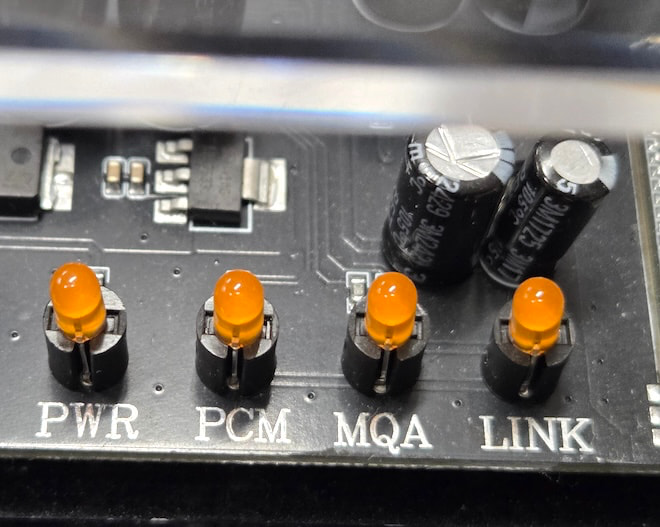
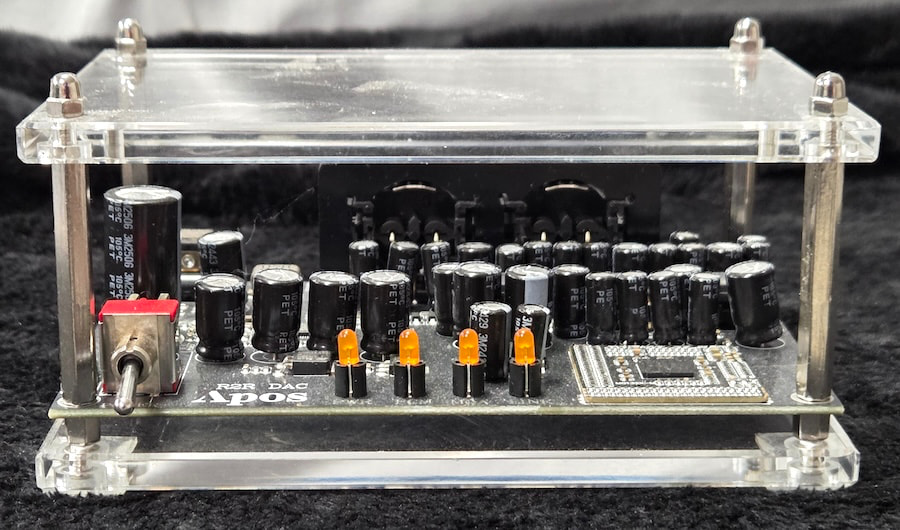
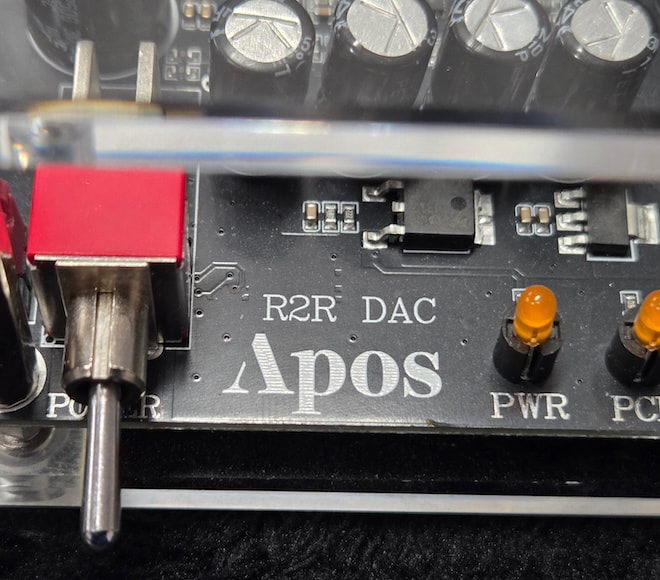
The front panel keeps things simple. A power switch sits on the left, while four LEDs indicate power, PCM, MQA, and USB link status from left to right. There is also a jumper next to the power switch for those who would prefer to disable the LEDs.
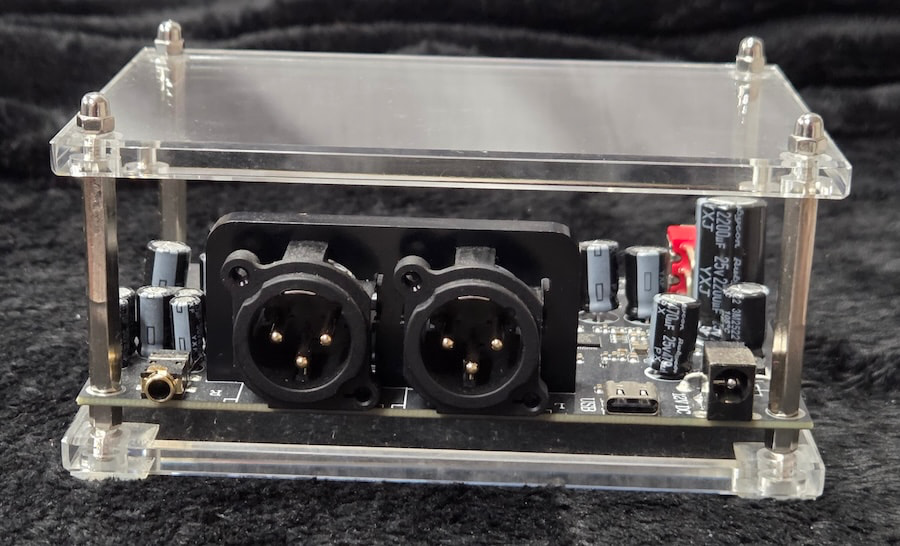
The rear panel is equally straightforward. From left to right, there is a 3.5 mm TRS output, a pair of female XLR outputs, a USB Type-C input, and the power connector. Power is supplied by a brick-style adapter similar to the one included with the Gremlin, which is a departure from the wall-wart-style power supply shipped with its sibling, the Merlin DAC.
R2R vs. Delta-Sigma
Before diving into the internals, it makes sense to address the obvious question: Why? If Apos already had the Merlin paired with the Gremlin, what was the point of introducing the Druid? The Gremlin only has one set of inputs, so buyers are now being asked to choose between two very different DACs.
R2R and Delta-Sigma are two different approaches to digital-to-analog conversion. An R2R DAC uses a ladder network built around two resistor values, R and 2R, with each digital bit contributing a weighted portion of the resulting analog voltage. Delta-Sigma DACs take a different route, typically using oversampling, noise shaping, and a high frequency low-bit conversion process before filtering the result into the final analog waveform.
That makes the R2R approach sound considerably more straightforward, and in some respects it is. But straightforward does not automatically mean more accurate. The catch is that the resistors in the ladder have to maintain extremely precise ratios. Any mismatch introduces errors that can affect linearity, distortion, and accuracy, particularly at very low signal levels.
And this is where R2R gets difficult and expensive. A ladder may only require two nominal resistor values, but those values have to track one another with extraordinary precision across the network. Historically, achieving that level of matching required expensive precision components, careful selection, trimming, or some combination of all three. That helps explain why high-performance discrete R2R DACs traditionally carried substantial price tags.
Delta-Sigma DACs avoid many of those component-matching headaches by doing much more of the heavy lifting through modulation, oversampling, noise shaping, and filtering. The technology is extremely mature, can deliver superb measured performance, and lends itself nicely to highly integrated DAC chips that are inexpensive and consistent from one unit to the next. There is a reason Delta-Sigma DACs became ubiquitous, and it wasn’t because the entire audio industry collectively lost its mind.
So why bother with R2R?
A good R2R DAC is often associated with a natural, relaxed, and tonally dense presentation. Instruments can sound more organic, with greater fluidity from one note to the next, without necessarily sacrificing dynamics or detail. Poorly implemented R2R designs, however, can produce higher distortion, reduced linearity at low signal levels, and worse measured performance than a competent Delta-Sigma DAC.
In practical listening, the difference between R2R and Delta-Sigma is often subtler than the marketing suggests. A warmer R2R DAC might be an excellent match for an analytical amplifier or headphone, while a clean Delta-Sigma design can add useful clarity to a warmer system. Implementation still matters more than the letters printed on the box.
Internal Technology
The USB input is handled by an XMOS XU316 interface, with support for PCM up to 32-bit/768 kHz and native DSD256. That gives the Druid more than enough bandwidth for virtually any commercially available high-resolution music file you’re likely to throw at it.
The discrete resistor ladder is clearly visible toward the front right of the unit, with rows of tiny resistors surrounding the supporting circuitry. Apos does not specify the actual bit depth of the physical ladder, so the important number here is on the input side: the Druid accepts PCM at 16, 24, or 32 bits, with support extending all the way to 768 kHz.
Once converted to analog, the signal is fed through three socketed op-amps: two for the balanced XLR outputs and one for the 3.5 mm single-ended output. From the factory, the Druid comes fitted with three Texas Instruments LM4562NA/NOPB op-amps, but Apos uses standard DIP-8 sockets and allows users to substitute other compatible op-amps, provided that no individual device draws more than 10 mA.
That opens the door to op-amp rolling for those inclined to experiment. Apos even offers the Druid with Sparkos SS3602 discrete op-amps as an optional upgrade, although any alternative still needs to meet the Druid’s electrical and physical requirements. This is not the place to assume that anything with eight pins and an audiophile reputation can simply be dropped into the sockets.
The Druid also does without the selectable oversampling filters commonly found on many modern Delta-Sigma DACs and some more elaborate R2R designs. Op-amp rolling therefore provides one of the few ways to tailor the Druid’s analog presentation without changing anything upstream.
For this review, all of my listening was conducted with the stock LM4562NA op-amps.
Listening
I started by stacking the Druid and Gremlin using the Apos-supplied bracket and XLR cables, both available as options when purchasing the Druid. The combination of a tube amplifier and R2R DAC also makes conceptual sense. The Druid provides a clean but organic digital source, while the Gremlin adds its own tube character and balanced amplification. The result sounds far more substantial than the size of either component would suggest.
In addition to the Gremlin, I connected the Druid’s 3.5 mm output to an xDuoo TA-26 using a 3.5 mm-to-RCA cable. The TA-26 was running a Ray 6SN7 and GE 6AS7 for the full OTL experience. I also connected the Druid to the EarMen CH-Amp to hear how it behaved in a clean, all-solid-state setup, just as I had previously done with the Merlin DAC.
That gave me the full spectrum: hybrid tube, OTL tube, and solid state, which covers just about every scenario someone shopping for an affordable desktop DAC is likely to consider.
I had high hopes this time because the Merlin had already surprised me and set the bar higher than expected. The Druid didn’t disappoint. It delivers a detailed sound with excellent tonality, good dynamic swing, and a slightly more organic presentation than most DACs anywhere near $160.
The first thing that stands out is the Druid’s sense of ease. It does not sound soft or lacking in resolution, but it avoids the harder, more etched character that some inexpensive digital sources can introduce. I also found very little obvious coloration in its basic tonal balance. It largely stayed out of the way, worked within the context of the source material, and did an admirable job of reproducing what was there without imposing too much of its own personality.
When A/B tested against the Merlin, the Druid sounds more fluid, but that does not mean detail is lost. The R2R presentation simply feels a little more effortless. Individual notes do not sound artificially sharpened or outlined, yet they remain clear enough to follow through complex arrangements.
Listeners accustomed to the most analytical Delta-Sigma DACs may initially perceive the Druid as slightly less resolving because of that smoother presentation. Spend more time with it, however, and the detail is still there. It is simply presented with less edge and less emphasis on drawing attention to itself, resulting in a more natural presentation that, to my ears, gets closer to the flow of live music.
How much of that character comes through depends heavily on the amplification that follows. A pair of early Mullard tubes in the Gremlin pushed the combination toward a slightly syrupy presentation that was more than I wanted. Switching to vintage Valvo tubes brought the balance back to a place that suited my preferences much better.
The Druid worked equally well with every amplifier I tried. Its balanced outputs make it a natural partner for the Gremlin, while the 3.5 mm output, combined with a 3.5 mm-to-RCA cable, allows it to feed a much broader range of equipment. With a clean solid-state amplifier, the Druid sounds more neutral and direct, while still retaining some of the smoothness and flow that distinguish it from the Merlin.
System matching still matters. Pair the Druid with a warm amplifier and warm headphones and the cumulative effect can become too relaxed, particularly with older or heavily compressed recordings. The Druid itself is not excessively warm, but neither does it have the relentlessly incisive character of some modern analytical DACs. That balance is ultimately one of its stronger qualities.
The Bottom Line
I could start with the drawbacks, but at $160, most of them feel almost irrelevant. Sure, the aesthetic won’t please everyone. No, there is no coaxial input, Bluetooth, or RCA output. But put simply: Who cares? Instead of complaining about what the Druid won’t do, plug it in and listen to what it actually does.
The sound is rich, fluid, detailed, and remarkably composed for something this inexpensive. At $160, the Druid delivers one of the more convincing implementations of discrete R2R conversion I’ve heard anywhere near its price, and it would not embarrass itself against considerably more expensive DACs.
Support for PCM up to 32-bit/768 kHz and DSD256 covers virtually any digital music library, while the socketed op-amps give enthusiasts another avenue for tailoring the sound. Add balanced XLR and 3.5 mm single-ended outputs, and this little DAC can work with a much wider range of amplifiers than its Gremlin-friendly dimensions might suggest.
The Apos Gremlin stack remains one of the more appealing affordable balanced desktop systems available, and having the choice between the cleaner, more analytical Merlin and the more organic, fluid Druid only strengthens the proposition.
But pigeonholing the Druid as merely the Gremlin’s matching DAC would be a mistake. It is good enough to use with tube amplifiers, solid-state amplifiers, vintage receivers, headphone amplifiers, and any other system that can benefit from a smooth, natural digital source.
At $160, Apos could have delivered an inexpensive R2R curiosity and called it a day. Instead, the Druid sounds like a serious DAC that just happens to cost $160. That is a much harder trick to pull off.
Pros:
- Smooth, fluid, and detailed presentation
- Discrete R2R architecture at an unusually low price
- Balanced XLR and single-ended 3.5 mm outputs
- Socketed op-amps allow for some sonic tailoring
- Compact footprint pairs neatly with the Gremlin
- Simple operation with very little setup required
- Excellent value for listeners curious about R2R conversion
Cons:
- Clear Lexan “science project” aesthetic will not appeal to everyone
- No coaxial or optical digital inputs
- No Bluetooth, network streaming, or remote control
- No selectable digital filters
- No RCA outputs
- Listeners who prefer a sharper, more analytical presentation may favor a different DAC
Our Ratings
★★★★★★★★★★ Sound Quality
★★★★★★★★★★ Build Quality
★★★★★★★★★★ Features
★★★★★★★★★★ Value
Where to Buy:
Related Reading:
- SMSL R100 And D400 MK2 DACs Challenge FiiO, Schiit And Topping Below $1,000
- Schiit Bifrost 3 DAC Goes Mesh, Adds EQ And Somehow Costs Less
- Geshelli’s Torc DAC At AXPONA 2026 Lets You Have It Your Way
- Apos X Geshelli Merlin Balanced DAC Review
- Best DACs: Editors’ Choice