High-end digital audio has developed a peculiar relationship with obsolescence.
Spend $500 on a DAC and replacing it five years later seems perfectly reasonable. Spend the equivalent of a well-equipped automobile on one and suddenly “new generation” becomes a phrase capable of ruining breakfast.
Polish manufacturer LampizatOr is taking a different approach with the Horizon 2, a substantial redesign of its flagship Horizon platform that incorporates technology developed for the considerably more expensive Aphrodite while retaining an upgrade path for existing owners.
The Horizon 2 costs $62,000 USD (€55,000) which the company says will remain unchanged through the end of Q1 2027. Horizon 360 and 360X owners can upgrade to Horizon 2 specification for $13,500 (€12,000), while owners of the original Horizon will pay $19,000 (€17,000) because their units require the newer digital engine as well.
No, $62,000 for a DAC has not suddenly become sensible. Giving somebody who already spent that kind of money a way to modernize it instead of politely suggesting they purchase another one, however, deserves some credit.
Related Reading:
- LampizatOr Baltic 3 DAC: The New Warsaw Spring
- Fezz Audio Equinox Vacuum Tube DAC Licenses Lampizator Technology
From Horizon To Horizon 2
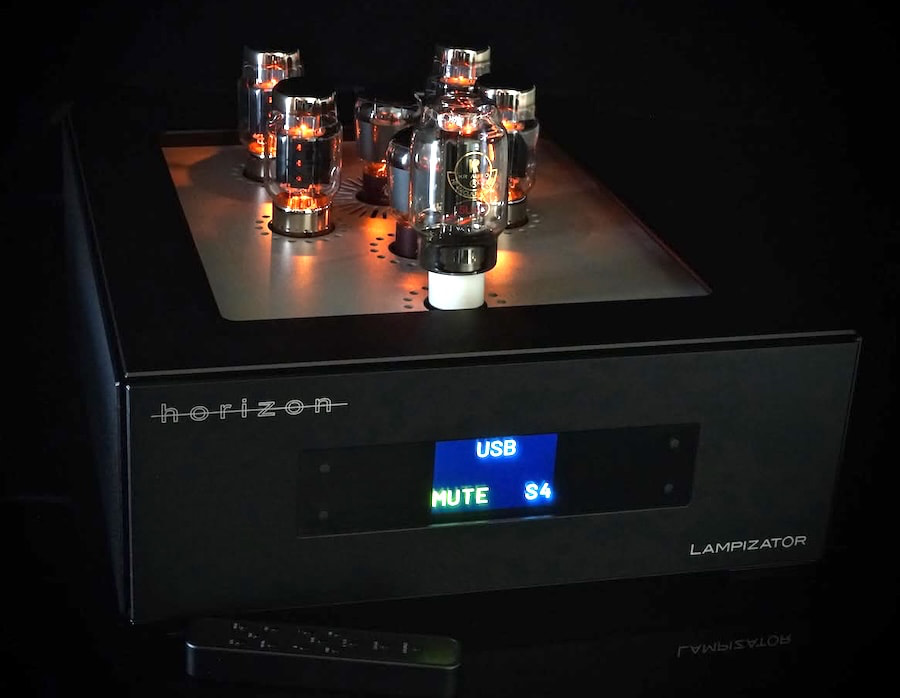
The redesign started with something far less glamorous than a new conversion architecture: LampizatOr was facing limited availability of the Nixie tubes used for the original display. Rather than simply replacing the front panel and going home early, Fikus and his team expanded the project into the first major overhaul of Horizon since the platform was introduced seven years ago.
Development work performed for the $99,000 Aphrodite supplied many of the ideas. Horizon 2 receives a completely redesigned analog section, LampizatOr’s latest SuperVolume implementation, new processing and control hardware, revised firmware, an updated front panel and remote, improved USB implementation, and a new 3xBNC I²S connection.
LampizatOr deliberately retained the existing chassis dimensions, output capacitors and overall tube concept. This is an evolution of Horizon rather than an Aphrodite squeezed into a smaller box with a cheaper price tag.
The Analog Stage Still Does Things The Polish Way
LampizatOr has never approached DAC design as an exercise in simply selecting the newest converter chip and surrounding it with increasingly elaborate marketing prose.
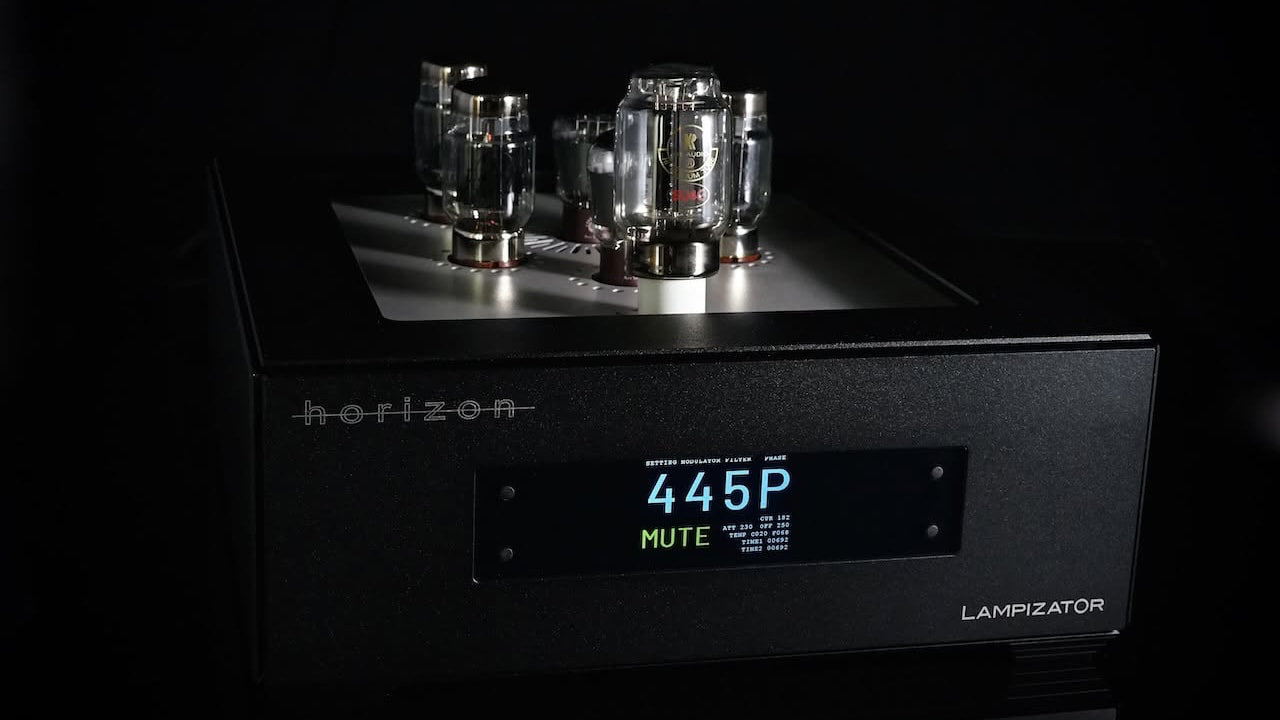
After digital conversion, Horizon 2 uses a tube-based analog signal path with no op-amps, no local or global feedback and no silicon after the conversion stage, according to LampizatOr. The power supply is tube rectified, internal signal wiring is silver, and copper-film capacitors are used in the signal path.
The published tube complement includes a 5U4G-family rectifier, two 6SN7-family tubes and four EL34-family output tubes, although the list of supported alternatives is extensive. Owners can substitute rectifiers including 274B and GZ34 types and experiment with output tubes ranging from 6L6 and KT66 through KT88, KT120, KT150 and 6550.
LampizatOr calls this Tube Rolling Paradise.
It is difficult to imagine anyone confusing Horizon 2 with a Benchmark DAC.
SuperVolume And Preamplifier Duties
Horizon 2 includes LampizatOr’s SuperVolume system as standard. The relay-less architecture provides 100 volume steps plus a complete bypass mode, allowing the unit to feed either a power amplifier directly or a separate preamplifier.
Analog RCA and balanced XLR inputs are also provided, which means Horizon 2 can serve as the control center of a mixed analog and digital system rather than operating exclusively as a standalone DAC.
That flexibility matters at this price because owners are unlikely to be building systems around a single USB cable and a pair of active loudspeakers. Although stranger things have happened in high-end audio, usually immediately before somebody explains why their Ethernet switch needs its own isolation platform.
Proprietary Digital Conversion
LampizatOr uses its own firmware-controlled conversion process rather than treating Horizon 2 as another implementation of a readily available DAC chipset.
The company describes the architecture as capable of processing up to 1.52MHz PCM and DSD1024 under software control, while the current published operating specifications list playback support up to PCM 768kHz and DSD512. Those are different claims, so it is worth keeping the distinction clear.
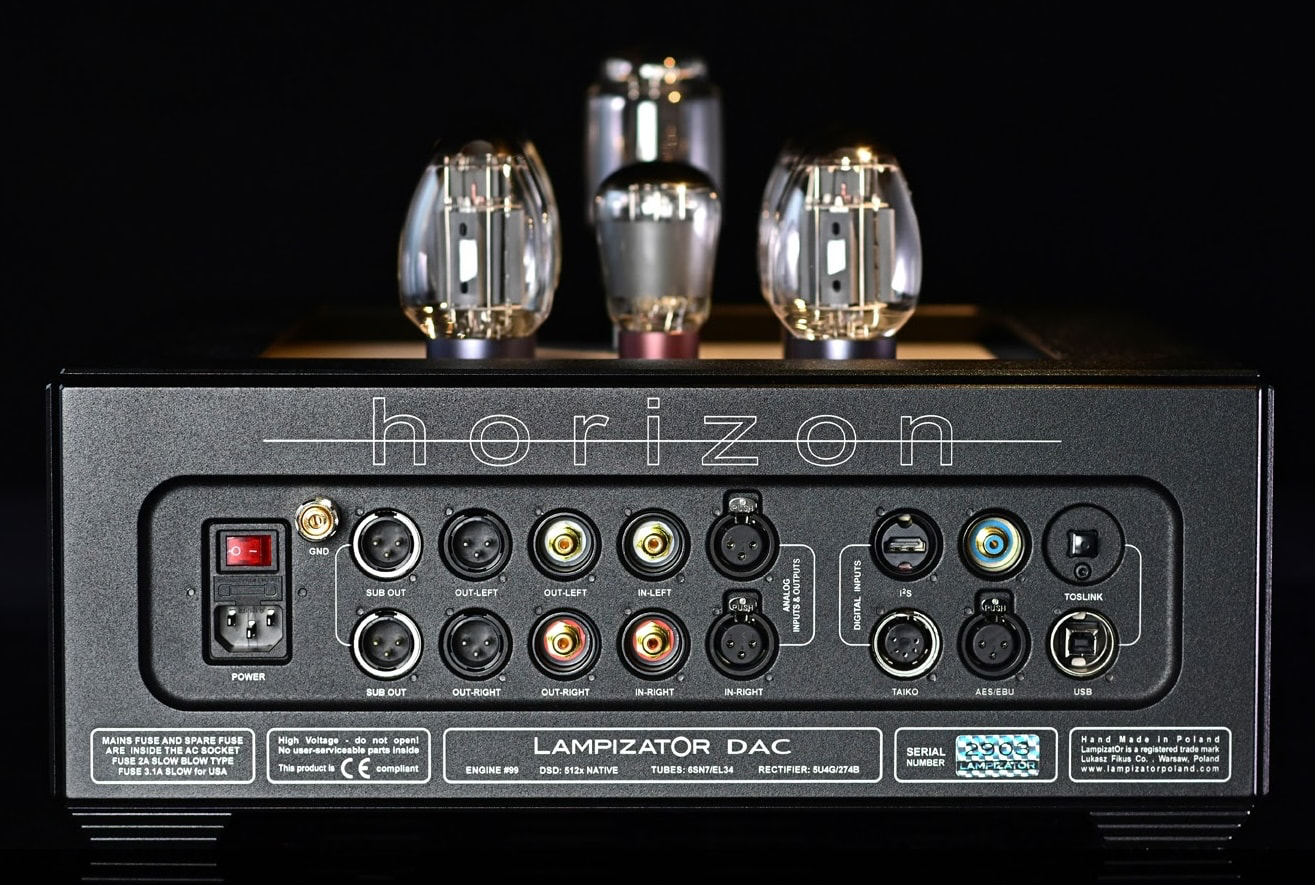
USB has also been revised with reclocking and optical isolation, and the digital section uses high-precision clocking and extensive independent power regulation. LampizatOr replaced the standard Taiko XDMI input with its 3xBNC I²S interface, although XDMI can still be specified when ordering at no additional charge.
HDMI-based I²S, AES/EBU, coaxial S/PDIF and Toslink round out the digital connectivity.
LampizatOr Horizon 2 Specifications
- Type: Tube DAC and digital preamplifier
- Current Playback Support: PCM up to 768kHz; DSD512
- Conversion: Proprietary firmware-controlled architecture
- Digital Inputs: USB, coaxial S/PDIF, AES/EBU, Toslink, 3 x I²S
- Optional Digital Input: Taiko XDMI by request
- Analog Inputs: RCA and balanced XLR
- Analog Outputs: RCA, balanced XLR and XLR bypass
- Volume Control: SuperVolume, 100 steps with full bypass
- Analog Signal Path: No op-amps; no local or global feedback
- Rectification: Tube
- Internal Signal Wiring: Silver
- Signal Capacitors: Copper-film metal-sheet
- Rectifier Tube: 5U4G family
- Small Signal Tubes: 2 x 6SN7 family
- Output Tubes: 4 x EL34 family with multiple supported alternatives
- Dimensions: 440 x 550 x 170mm without tubes
- Height With Tubes: 290mm
- Weight: 33 kg / approximately 70 pounds
- Power Consumption: 60VA
- Finishes: Matt Black Hole or Silver Sahara
- Packaging: Custom handmade flight case
At 70 pounds and almost 22 inches deep, “desktop DAC” feels somewhat optimistic.
Why Is The Horizon 2 Unique?
There are plenty of brutally expensive DACs, so price alone does not make Horizon 2 special. What separates it is LampizatOr’s willingness to combine proprietary digital processing with an unapologetically tube-driven analog stage and then let owners alter part of that presentation through tube selection.
The company is effectively pursuing two goals at once: increasingly sophisticated digital conversion at the front end and a deliberately analog-centric signal path after conversion. That philosophy has been consistent across the LampizatOr products we’ve heard, including the Baltic 3, which delivered tonal density and dimensionality without simply turning every recording into warm soup.
Horizon 2 also stands apart because LampizatOr designed the new hardware to be retrofitted into older Horizon models. At a level where manufacturers routinely replace flagship components with something newer, heavier and more expensive, that approach protects the investment better than another commemorative faceplate and a press release.
Mola Mola Tambaqui Takes The Opposite Road
The Mola Mola Tambaqui is one of the most interesting counterpoints because Bruno Putzeys arrives at high-end digital reproduction from almost the opposite engineering direction.
Incoming audio is asynchronously upsampled to 3.125MHz/32-bit and converted into noise-shaped PWM. Two mono DAC sections then use a discrete 32-stage FIR architecture followed by a single-stage fourth-order filtering I/V converter. Mola Mola specifies 130 dB signal-to-noise ratio, with THD and IMD below the measurable noise floor.
LampizatOr and Mola Mola therefore represent two very different answers to the same question. One relies heavily on tubes, zero feedback and component voicing after conversion; the other pursues vanishing noise and distortion using advanced discrete digital and analog engineering.
Audiophiles will naturally spend several hundred forum pages explaining why only one approach can possibly reproduce a piano correctly.
MSB Cascade Offers A Third Philosophy
The MSB Cascade DAC takes yet another route. Its architecture separates the Digital Director, Analog Converter and Powerbase into three chassis, physically isolating processing, conversion and power delivery.
At approximately $95,000, the Cascade operates even farther up the financial ladder, but its relevance is architectural rather than merely economic. MSB emphasizes proprietary ladder conversion, extensive isolation and extreme separation of functions; LampizatOr concentrates much of its personality in the analog output stage and tube implementation.
Neither approach is remotely inexpensive, but at least the engineering philosophies are meaningfully different. That’s more interesting than comparing DACs based solely on who can print the largest sample-rate number on the brochure.
Horizon 2 Versus Aphrodite
Although Horizon 2 benefits significantly from Aphrodite development, LampizatOr is explicit that the two products remain very different.
Aphrodite uses a substantially larger physical platform, four custom EI transformers, a more elaborate analog stage and eight KT88 tubes. Horizon 2 receives selected circuit and control developments without duplicating the flagship’s larger power supply and output architecture.
In other words, this is genuine trickle-down technology.
Granted, it is trickling down from $99,000 to $62,000, so nobody should start throwing around the word “affordable.”
Can You Hear The Horizon 2 In Warsaw?
Anyone seriously considering one should keep an eye on Audio Video Show 2026 in Warsaw, which runs October 23-25, 2026, where Horizon 2 is expected to be on active display in Warszawa A.
October in Warsaw is also considerably more civilized than February.
For more information: lampizatorpoland.com/horizon
Related Reading: