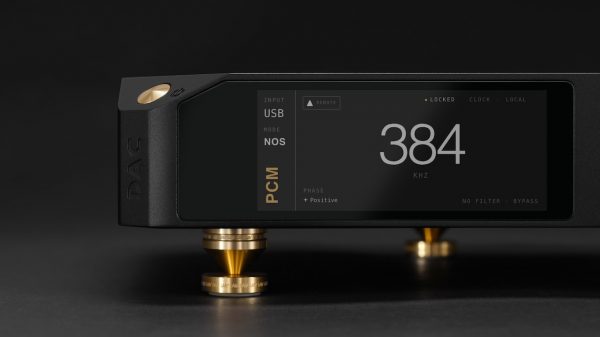
High-end DACs face a slightly uncomfortable dilemma in 2026. Spend a few hundred dollars and the market will happily offer a compact unit from overseas with a color display, Bluetooth, balanced outputs, a headphone amplifier, app control, enough filter options to occupy a rainy weekend, and sample-rate support that looks impressive in a product listing. Feature density has never been higher. Whether all of that translates into superior digital conversion, lower real-world noise, better clock recovery, a more convincing analog stage, or simply a more natural and involving presentation is another matter entirely.
That is the space Weiss Engineering continues to occupy. Bluebird Music has announced the DAC204-MK2 for the U.S. and Canadian markets, updating the Swiss company’s compact DAC204 with an ESS ES9028PRO conversion chip, improved jitter rejection, and a revised near-zero-ohm analog output stage. Weiss has also said that its distortion behavior and reconstruction filters were optimized by ear, which is a refreshingly direct reminder that a DAC is not supposed to win a spreadsheet contest; it is supposed to make the system sound better.
Related Reading: WTF is a DAC?
Weiss DAC204-MK2

The DAC204-MK2 updates the original DAC204 with a completely redesigned DAC board, an upgraded ESS ES9028PRO DAC chip, enhanced jitter elimination, and a new near-zero-ohm analog output stage. Weiss says these revisions are intended to improve conversion performance while making the DAC better suited to a wider range of connected components and cable loads.
Designed by Swiss digital-audio engineer Daniel Weiss, the DAC204-MK2 reflects the company’s long-standing mastering-studio background and its belief that technical performance should serve the musical result. The goal is not feature overload, but clean, stable digital conversion with careful attention paid to the analog output stage and final voicing.
The DAC204-MK2 is deliberately focused in its execution. It forgoes network streaming, onboard DSP, remote control, and a built-in headphone output in favor of a compact DAC designed around USB, Toslink, and S/PDIF inputs, balanced XLR and single-ended RCA outputs, and support for PCM up to 384 kHz and DSD64/128.
Rather than competing on menus, displays, or an endless list of digital extras, the DAC204-MK2 concentrates on the fundamentals: clocking, conversion, output-stage design, and the quality of the analog signal delivered to the rest of the system.
What’s New In The DAC204-MK2
Redesigned DAC Section: The DAC204-MK2 replaces the original DAC board with a new design built around the ESS Sabre ES9028PRO DAC chip and a revised analog output stage.
Enhanced Jitter Elimination: Weiss says the ES9028PRO incorporates an advanced jitter-elimination circuit intended to preserve conversion quality when connected to sources or digital links with higher jitter levels.
Near-Zero-Ohm Output Stage: The new analog output stage offers near-zero-ohm output impedance, which Weiss says improves compatibility with difficult cable loads and low-impedance headphones used with a suitable external adapter.
Acoustically Optimized Filters: Weiss has also fine-tuned the DAC204-MK2’s distortion behavior and reconstruction filters by ear, rather than relying exclusively on laboratory measurements. The company’s aim is a more natural and musically convincing result without adding unnecessary features or complexity.
General Features Carried Over From DAC204
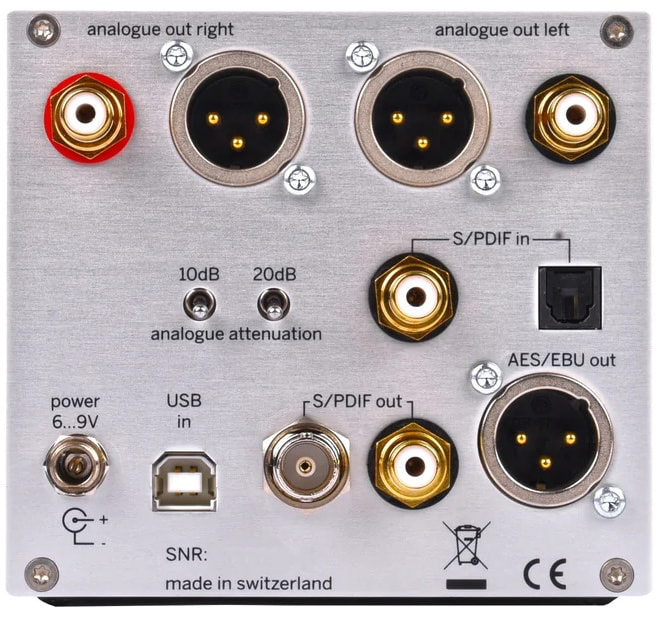
Source Inputs: The DAC204-MK2 provides three digital inputs: USB, RCA, and optical Toslink. The RCA and Toslink connections accept AES/EBU or S/PDIF signals.
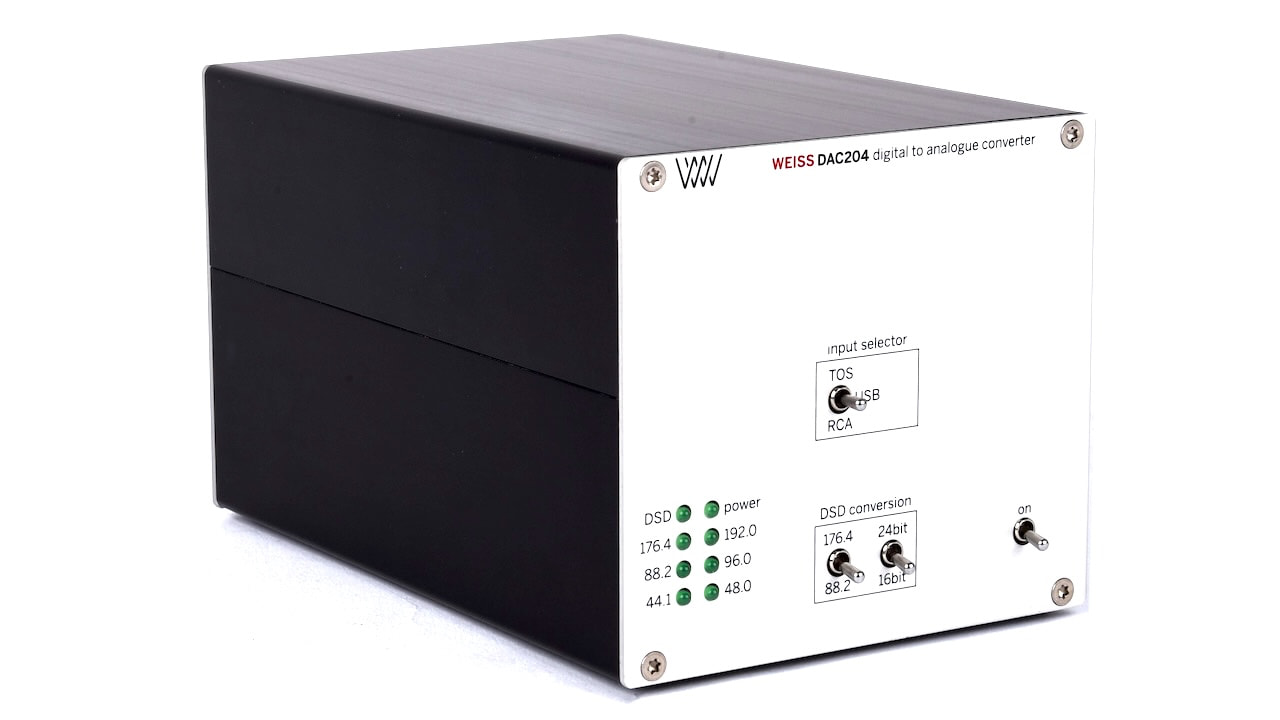
Input Selection: Multiple digital sources can remain connected at once, with a front-panel Input Selector switch used to choose between USB, Toslink, and RCA.
Input Signal Compatibility: USB accepts PCM from 44.1 kHz to 384 kHz, along with DSD64 and DSD128. The RCA input supports PCM through 192 kHz, while the Toslink input supports PCM through 96 kHz. DSD signals received via USB can be converted to PCM.
Analog and Digital Outputs: Analog output is available simultaneously through balanced XLR and unbalanced RCA connectors. Digital output is provided on XLR, RCA, and BNC connectors for use in digital-to-digital conversion applications.
D/A Conversion and Clocking: The DAC204-MK2 uses four oversampling sigma-delta D/A converters per channel, operated in parallel to improve signal-to-noise performance. Weiss also combines several reclocking schemes to provide high jitter attenuation.
External Power Supply: An external power supply is included. Weiss uses separate linear regulation for sensitive voltage rails, a design intended to minimize digital noise and channel crosstalk at the analog output.
Weiss DAC204-MK2 and DAC204 Specifications
Note: The specifications below are the same for the DAC204-MK2 and DAC204 unless otherwise indicated
Weiss Model DAC204-MK2 / DAC204 Product Type DAC Price $3,990 US,
$4,895 CAD (price point retained from the DAC204)DAC Chip ES9028PRO (DAC204-MK2)
ES9018S (DAC204)Digital Inputs (1) RCA (digital coaxial) connector,
(1) Toslink connector (optical)
– All inputs accept professional or consumer standard, i.e., accept AES/EBU or S/PDIF signals.
– Sampling frequencies: 44.1, 48.0, 88.2, 96.0, 176.4, or 192 kHz on the RCA (digital coaxial) input.
– Sampling frequencies: 44.1, 48.0, 88.2, 96.0 kHz on the Toslink input.
– Maximum input word-length: 24 Bits.
(1) USB connector – Accepted sampling frequencies: 44.1, 48.0, 88.2, 96.0, 176.4, 192, 352.8, 384 kHz, DSD64, DSD128 Analog Outputs (2) XLR connectors (hot output on pin 2, not servo controlled), DC coupled, short circuit proof output circuitry – Output impedance: DAC204: 44 Ohm, DAC204-MK2: Close to 0 Ohm
(2) RCA connectors, DC coupled, short circuit proof output circuitry – Output impedance: DAC204: 22 Ohm, DAC204-MK2: Close to 0 Ohm
Output level: Selectable by two toggle switches, 4 settings
XLR outputs:
7.5 Vrms, +19.7 dBu, with a 0 dBFS sinewave input
2.3 Vrms, +9.7 dBu, with a 0 dBFS sinewave input
0.75 Vrms, -0.3 dBu, with a 0 dBFS sinewave input
0.23 Vrms, -10.3 dBu, with a 0 dBFS sinewave input
RCA outputs:
3.75 Vrms, +13.7dBu, with a 0 dBFS sinewave input
1.15 Vrms, +3.7dBu, with a 0 dBFS sinewave input
0.375 Vrms, -6.3dBu, with a 0 dBFS sinewave input
0.115 Vrms, -16.3dBu, with a 0 dBFS sinewave input Digital Outputs (1) XLR connector
(1) RCA connector
(1) BNC connector Synchronization Synchronized via the input signal in the case of RCA (digital coaxial) or Toslink inputs. In the USB input case, the DAC204 is the master clock. –
Extremely efficient Jitter attenuation. –
Sampling frequencies supported: 44.1 kHz, 48.0 kHz, 88.2kHz, 96.0kHz, 176.4khz, 192kHz, 352.8kHz, 384kHz, DSD64, DSD128 Power – DC input voltage: 6 to 9 volts
– DC input current: 1050mA at 6V, 700mA at 9V
– Power consumption: 6.3 W Frequency Response at Sampling Frequency Points Fs = 44.1 kHz, 0Hz-20kHz: within +- 0.25dB
Fs = 88.2 kHz, 0Hz-20kHz: within +- 0.25dB
Fs = 88.2 kHz, 0Hz-40kHz: within +- 0.8dB
Fs = 176.4 kHz, 0Hz-20kHz: within +- 0.25dB
Fs = 176.4 kHz, 0Hz-40kHz: within +- 0.8dB
Fs = 176.4 kHz, 0Hz-80kHz: within +- 2.5dB Total Harmonic Distortion plus Noise (THD+N) −116 dBr (0.00016 %) at −3 dBFS input level
−125 dBr (0.000056 %) at −40 dBFS input level
−125 dBr (0.000056 %) at −70 dBFS input level Linearity At 0 dBFS to −120 dBFS input level: less than ±0.4 dB deviation from ideal Spurious Components (including harmonics) At 0 dBFS input level, maximum output level, 1 kHz, all components at less than −120 dBr
At 0 dBFS input level, maximum output level, 4 kHz, all components at less than −115 dBr Crosstalk Better than 120 dB, 20 Hz–20 kHz Interchannel Phase Response +- 0.05° 20 Hz–20 kHz +- 0.30° 20 Hz–80 kHz Dimensions (HWD) 3.8” x 4.2” x 6.5” Weight 2.4 lbs
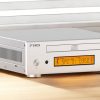
The DAC204-MK2 is housed in a compact black chassis with a silver faceplate and follows a deliberately focused design philosophy. Unlike Weiss’s more fully featured DAC501-MK2 and DAC502-MK2, it does not include onboard DSP, remote control, network streaming, Roon support, or a dedicated headphone output.
That is not an oversight. The DAC204-MK2 is designed as a straightforward digital-to-analog converter, concentrating its engineering budget on conversion, clocking, jitter suppression, and the analog output stage rather than features that many listeners may already have elsewhere in their system.
Pro Tip: Although the DAC204-MK2 does not include a built-in headphone jack, Weiss offers an optional headphone adapter that allows the DAC’s analog output stage to be used with headphones. Contact Weiss Engineering or an authorized dealer for compatibility and availability details.
The Bottom Line
At $3,990 in the U.S. and $4,895 in Canada, the Weiss DAC204-MK2 is not trying to be the least expensive or most feature-packed DAC on the market. The MK2 upgrade is focused where it matters: a redesigned conversion board built around the ESS ES9028PRO DAC chip, improved jitter elimination, a new near-zero-ohm output stage, and acoustically optimized reconstruction filters.
That makes the DAC204-MK2 a compelling option for listeners who already own a streamer, transport, preamp, or integrated amplifier and want a compact, Swiss-engineered DAC with serious mastering-studio pedigree. It offers flexible digital connectivity, balanced and single-ended analog outputs, DSD-to-PCM conversion, and digital output capability, but skips streaming, DSP, room correction, phono, remote control, and a built-in headphone output.
There are certainly DACs near this price that offer more functionality. The Denafrips Venus 15th, at $3,999, is a similarly priced R-2R alternative for listeners looking for a different conversion approach. The Ferrum WANDLA HP, at $3,295, adds a preamp stage, remote control, HDMI ARC, I2S, touchscreen interface, and a powerful balanced headphone amplifier. Benchmark’s DAC3 HGC is considerably less expensive at $2,399 and remains a strong option for listeners who value a compact DAC with headphone capability and a more studio-oriented feature set.
But the Weiss is not competing on screen size, streaming platforms, or menu depth. The DAC204-MK2 is for listeners who want to put their money into digital conversion, clocking, output-stage quality, and a straightforward component that can disappear into an existing high-end system. Sometimes fewer features are not a compromise.
Price & Availability
The Weiss DAC204-MK2 has a suggested US retail price of $3,990 ($4,895 in Canada), and is available now from Bluebird Music and authorized Weiss dealers throughout the United States and Canada.
Related Reading: