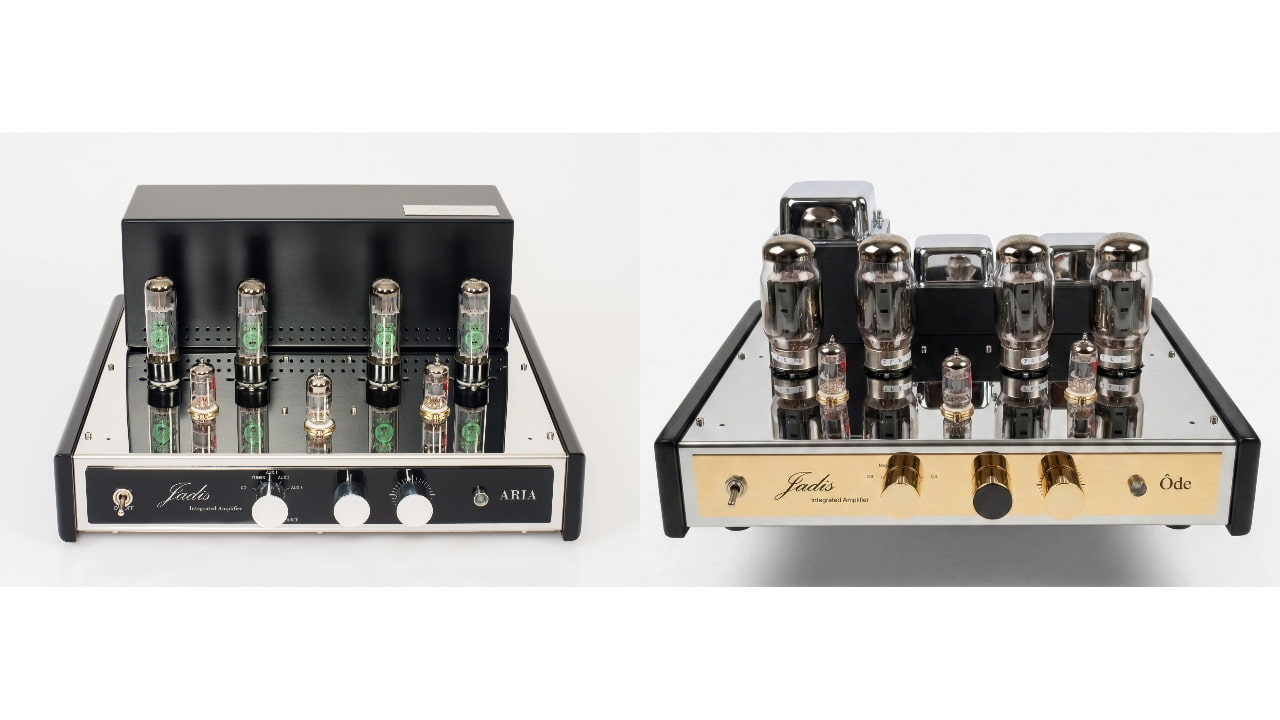
Jadis has never been the quiet corner of French high-end audio. Devialet, Advance Paris, Focal, and Triangle have each carved out their own version of French design culture, often cleaner, more modern, and less likely to blind you from across the room. That is not a swipe at Devialet, which remains one of the strongest industrial design stories in high-end audio. Jadis is different. Jadis is the gold trim, chrome, glowing tubes, and “yes, the château has a listening room” side of the family.
Bluebird Music has announced that the new Jadis Aria and Jadis Ode integrated amplifiers are now shipping in the United States and Canada, bringing the French tube brand’s very recognizable aesthetic and sonic identity to more attainable price points. That matters because Jadis has spent more than four decades building amplifiers that look like they were assembled by jewelers, monks, and someone’s eccentric uncle in Burgundy who refuses to explain the wiring diagram.
I owned a Jadis tube integrated amplifier many decades ago, and like many French mechanical things of that era, it could be brilliant, beautiful, rather temperamental, and occasionally in need of a cigarette and a philosophical reset. But it sounded wonderful. Time has moved on, and so has Jadis. The company’s current products have earned a much stronger reputation for reliability, build quality, and consistency, without losing the visual drama and tube-driven performance that made the brand famous in the first place.
Jadis Aria: French Tube Glamour Gets a More Useful Starting Point
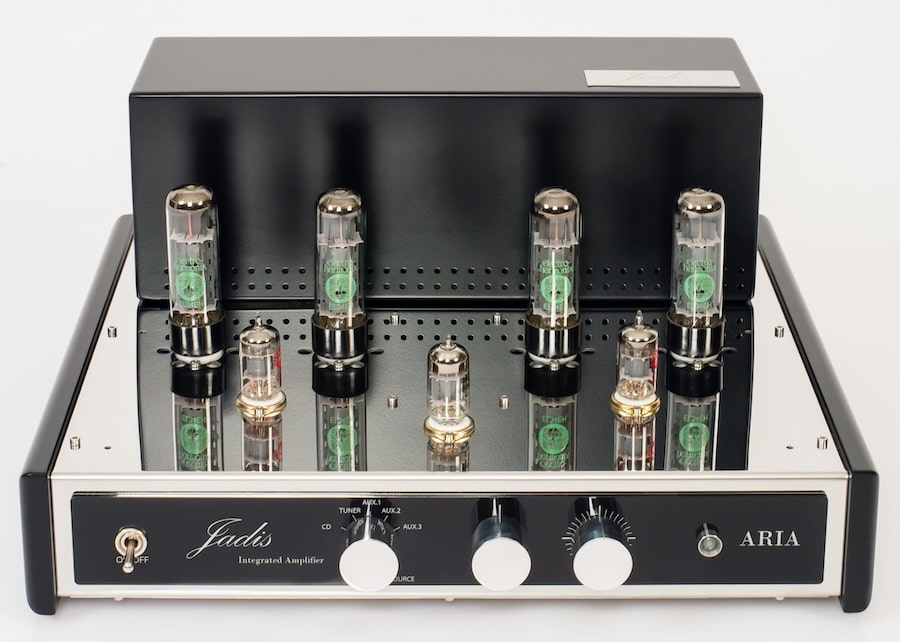
The Jadis Aria is not a clean-sheet replacement for the long-running Orchestra Reference so much as a more focused evolution of it. The big technical change is the move to a newly developed, fully tube-based input stage, replacing the earlier hybrid transistor/tube design. That matters because the Aria now keeps the signal path tube-based from input to output, which is very much the point if you are buying a Jadis in the first place. Nobody buys one of these because they want anonymous black-box utility from aisle seven.
The Aria uses four EL34 output tubes as standard, along with one ECC82 and two ECC83 small-signal tubes. Jadis describes the EL34 as the more romantic option, which is very French, very on brand, and only missing a waiter judging your wine order. For listeners who want a different flavor, Jadis also lists KT88 or KT120 tube compatibility, giving owners some room to tune the amplifier’s presentation without moving into one of the company’s more expensive models. Output is rated at 30 watts per channel in Class B operation, with a frequency response of 10Hz to 40kHz at -3dB and 300mV input sensitivity.
The Aria also addresses some of the practical complaints that can come with tube ownership. Jadis lists a bias adjustment/semi-automatic bias system, designed to make tube setup less painful than the old ritual of meter, screwdriver, prayer, and mild profanity. The amplifier includes five line-level inputs, remote control, and a more compact chassis measuring 43 x 36 x 26 cm. Power consumption is listed at 300VA.
Visually, it is still very much a Jadis. The Aria is available in multiple finishes, including white, black, and Toile de Lu, and it keeps the brand’s unmistakable blend of chrome, tubes, and jewelry-counter bravado. Devialet may own the museum-grade industrial design lane, and Focal, Triangle, and Advance Paris each do French audio with less flash, but Jadis still shows up wearing gold cuffs to breakfast. Subtle? Non. Fun? Absolument.
Jadis Ode: Pure Class A, French Style
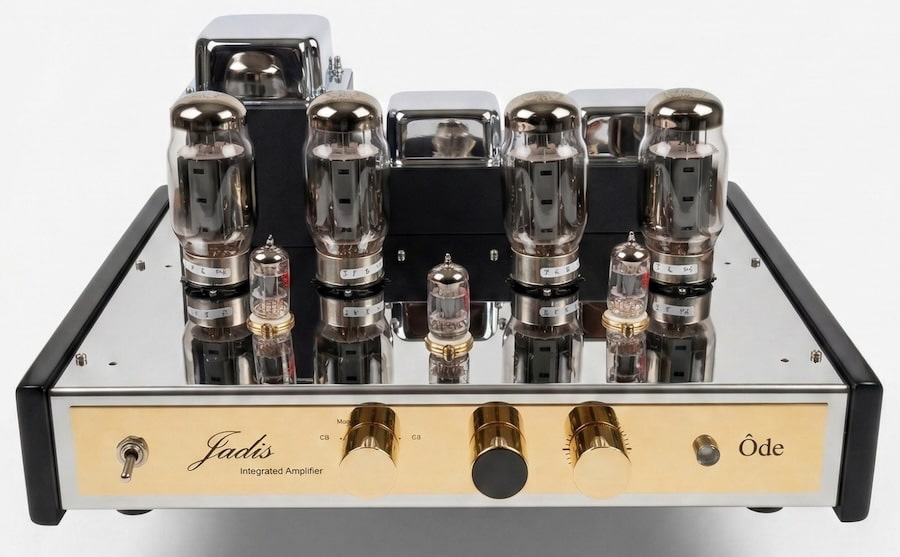
The Jadis Ode takes a more purist route than the Aria. Where the Aria updates the long-running Orchestra Reference formula, the Ode is aimed at listeners who want a simpler, more focused tube integrated amplifier built around pure Class A operation. Jadis rates the Ode at 25 watts per channel in Class A, so this is not about chasing big output numbers. It is about tube topology, transformer quality, and the kind of midrange body and dimensionality that have helped define the brand.
The Ode can be configured with EL34, KT88, or KT120 output tubes, along with one ECC82 and two ECC83 small-signal tubes. That tube flexibility gives buyers some room to shape the amplifier’s presentation. EL34s typically lean warmer and more saturated, KT88s can add grip and scale, and KT120s generally offer more authority and control when the circuit supports them properly. The Ode includes five RCA line-level inputs, remote volume control, 250-300mV input sensitivity, input impedance greater than 100k ohms, and a 5Hz to 60kHz frequency response at -3dB. It is specified for 1 to 16 ohm loudspeaker loads, with factory settings for 4 to 8 ohms.
The transformer story is central here. Jadis has long placed major emphasis on proprietary transformers designed and built in-house, and that matters in a tube amplifier. Output transformers have a direct impact on bandwidth, bass control, stability, tonal balance, and how well the amplifier behaves with real loudspeaker loads. They are not decorative chrome luggage. They are the business end of the amplifier.
The Ode also follows the traditional Jadis construction approach: hand-built in France, point-to-point wiring, custom internal components, and listening-based voicing. The chassis measures 44 x 40.5 x 21.5 cm, weighs approximately 25 kg, and consumes 300VA. Finish options include Gold and Silver, with the gold version delivering the more recognizable Jadis look. Subtle? Not exactly. But Jadis has never been trying to pass as Danish furniture.
Positioned below many of Jadis’ larger and more expensive amplifiers, the Ode gives music lovers a more attainable way into the brand’s pure Class A tube sound without stripping away the core ingredients: tubes, transformers, hand assembly, and a visual identity that remains unapologetically French.
Comparison
| Ode | ARIA | |
| MSRP | $10,900 | $6,900 |
| Type | Integrated amplifier with remote control | Integrated amplifier with remote control |
| Bias | Automatic | Semi-automatic |
| Power | 25W Class A | 30W Class B |
| Input/Output | 5 lines | 5 lines |
| Bandwidth | 10Hz to 40kHz @ -3dB | 10Hz to 40kHz @ -3dB |
| Sensitivity | 300 mV | 300 mV |
| Tubes | 4 x KT120, 1 x ECC82, 2 x ECC83 | 4 x EL34, KT88 or KT120, 1 x ECC82, 2 x ECC83 |
| Consumption | 300VA | 300VA |
| Dimensions | 43 x 36 x 26 cm | 43 x 36 x 26 cm |
The Bottom Line
The Jadis Aria and Jadis Ode make the Jadis experience more accessible, but they are still serious high-end tube integrated amplifiers. The Aria offers 30 watts per channel from EL34 output tubes, a fully tube-based input stage, easier bias adjustment, remote control, and a more compact chassis. The Ode is the more purist model, delivering 25 watts per channel in pure Class A operation with KT120 tubes, hand-built Jadis transformers, point-to-point wiring, and the brand’s traditional build approach.
What makes them different is not a long feature list. It is the combination of French tube design, in-house transformer manufacturing, hand assembly, and the unmistakable Jadis aesthetic at prices below the company’s larger amplifiers. The Aria is the more practical choice. The Ode is for listeners who want the Class A version of the Jadis formula.
What is missing? Neither model is a modern all-in-one system. There is no DAC, no streaming, no HDMI ARC, no room correction, and no phono stage listed, so buyers will need to bring their own sources and choose loudspeakers carefully. At $6,900 for the Aria and $10,900 for the Ode in the U.S., and $8,900 and $13,900 CAD, these are not impulse buys.
They are for listeners who want a dedicated tube integrated amplifier from a long-running French high-end brand and are willing to trade convenience features for craftsmanship, tube character, and a more traditional approach to two-channel listening.
For more information: jadis-electronics.com
Related Reading:
- Jadis Pushes Back Against The Trend Of Affordable DACs With The JS5 And JS2 SL
- Advance Paris NOVA Range Debuts At AXPONA 2026: Integrated Amplifiers, Streaming Module, And Bi-Directional Bluetooth Dongle With AptX Low Latency Support
- Bluebird Music Is Holding The Line On Prices: Begun The Tariff Wars We Have
- Mein Tweeter: Notes From The Shallow End Of European Hi-Fi