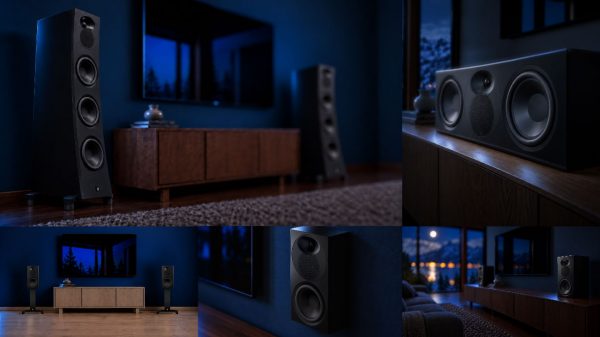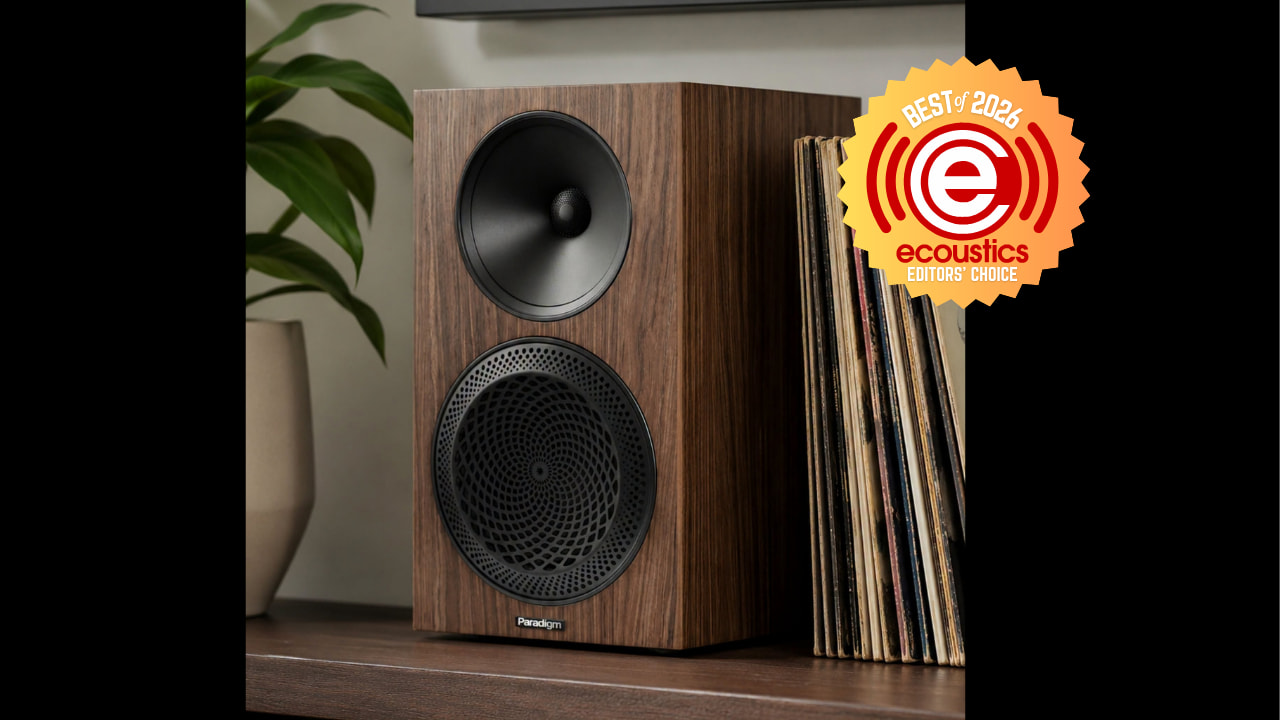
The passive standmount loudspeaker isn’t going away quietly. Wireless speakers might get more attention from mainstream consumers, but the $500 to $1,500 category remains one of the nastiest places for a traditional loudspeaker manufacturer to compete because buyers have an almost unreasonable amount of choice.
PSB, ELAC, Wharfedale, Q Acoustics, and Paradigm all approach the category differently. PSB’s Imagine B50 leans on decades of Canadian research and a neutral tonal target. ELAC’s Debut 3.0 Series has pushed better driver technology further downmarket, while Wharfedale continues to make a very persuasive argument for larger cabinets, richer tonal balance, and British heritage with models like the Super Denton. Q Acoustics has turned industrial design and clever cabinet engineering into a serious competitive weapon with the 5020. Paradigm now enters that scrum with the Premier 220B v2 at $549.99 each, or $1,099.98 per pair.
For those of us who grew up in Toronto on Lake Ontario, PSB and Paradigm hardly qualify as exotic Canadian hi-fi brands. Both came out of a period when Canadian loudspeaker designers became almost pathologically interested in measurements, controlled listening tests, and proving that reasonably priced speakers did not have to sound reasonably mediocre. The work conducted with Canada’s National Research Council helped establish an engineering culture that continues to influence both companies decades later.
Paradigm is also no longer a small independent speaker company working out of a modest Ontario facility. It sits within PML Sound International, the larger Canadian audio group that also includes Anthem, MartinLogan, and, since 2025, GoldenEar. Paradigm’s current Mississauga operation spans roughly 225,000 square feet and includes manufacturing, engineering, double-blind listening rooms, and what the company describes as the largest privately owned anechoic chamber in North America.
I received my own rather memorable education in Paradigm’s approach to acoustic testing during a visit in 2000, when I nearly lost my lunch inside one of its anechoic chambers. Until you’ve heard your own heartbeat while standing on a suspended walkway over a massive dead-silent room filled with giant wedges of acoustic foam, you have not fully appreciated what “quiet” means. The whole experience had a distinct Luke versus Vader on Cloud City quality to it; minus the missing hand and deeply problematic family revelation. Mostly I remember thinking that human beings were not designed to hear their internal organs that clearly.
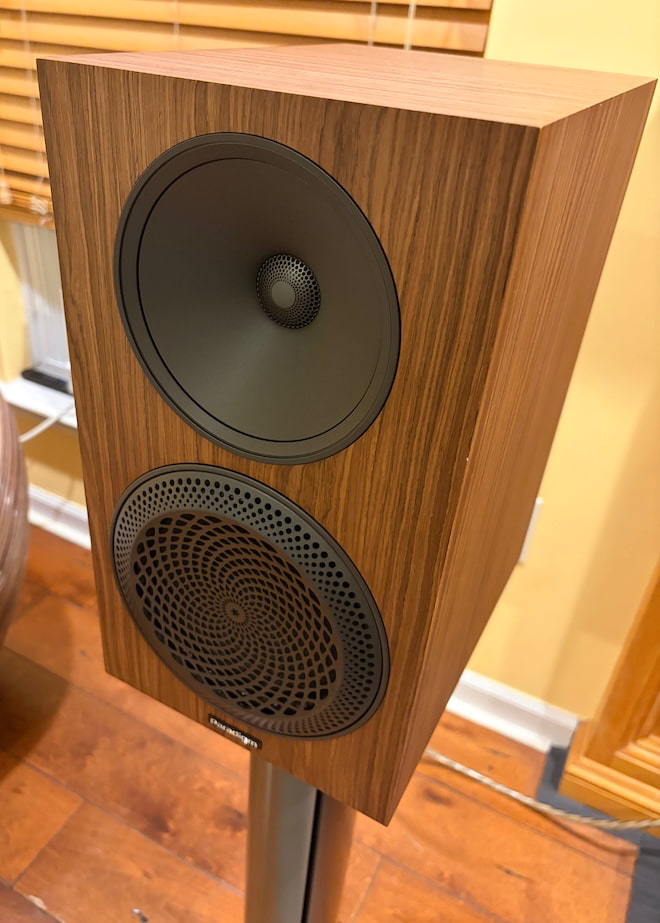
That obsession with measurement matters here because the Premier v2 Series occupies a very different price bracket from Paradigm’s Founder and Persona loudspeakers. The goal is not to reproduce those models at one-third the price, but to push some of the company’s driver, dispersion, and cabinet engineering into products that remain attainable by people who do not consider a loudspeaker purchase a substitute for a decent used car.
Related Reading:
- Wharfedale Super Denton Review: The British Bulldog Of Standmount Speakers
- Triangle Borea BR03 Vs. BR04 Review: An Upgrade Or A Different Beast Entirely?
Design & Finish
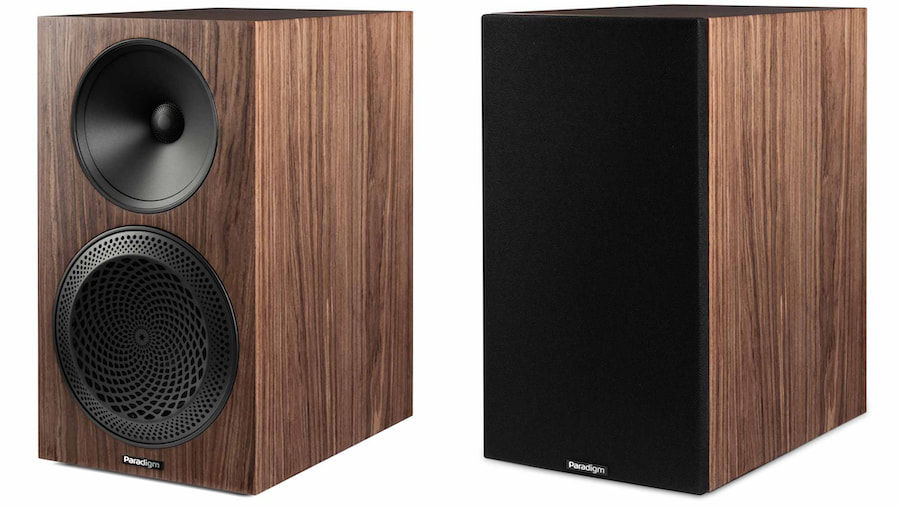
The Premier 220B v2 is a two-driver, two-way ported standmount measuring 14.6 x 8.3 x 12.9 inches (H x W x D), or 37.1 x 21.1 x 32.8 cm, including the grille. Each loudspeaker weighs 20.1 pounds (9.1 kg), so calling it a “bookshelf” speaker feels a little optimistic unless they are very deep and tall.
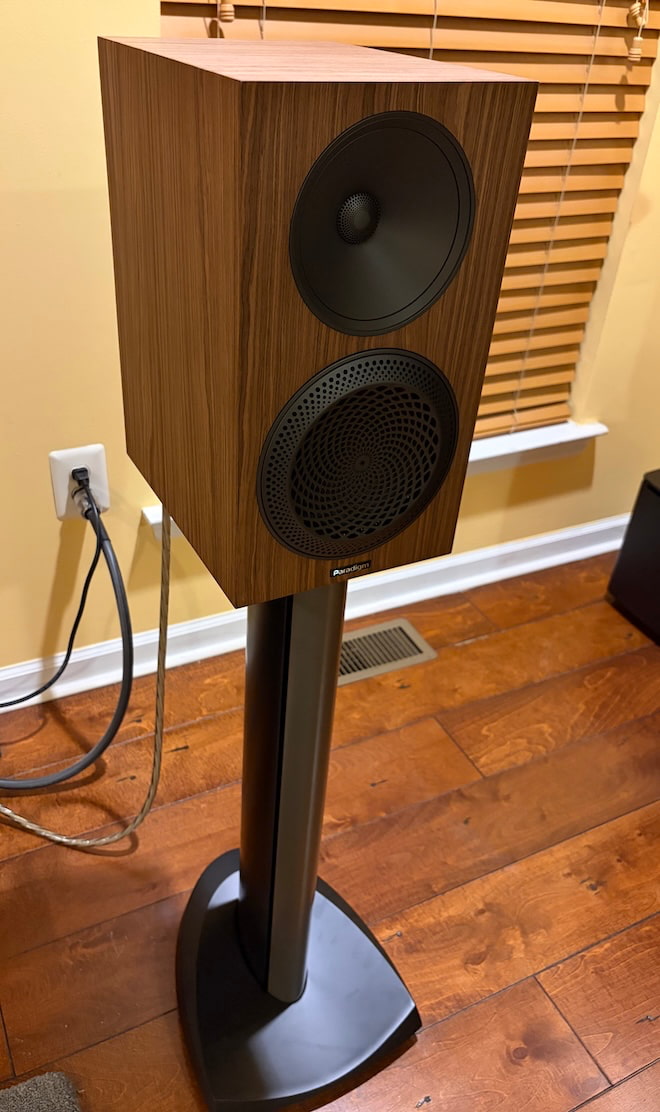
Paradigm supplied the Walnut finish for this review, and it is exceptional. The surface is not glossy, which gives it a more natural and understated appearance, but the quality of the veneer and overall execution is well beyond what I normally see at this price. I asked several people what they thought the pair cost without telling them the MSRP, and every answer came back at $2,000 or more.
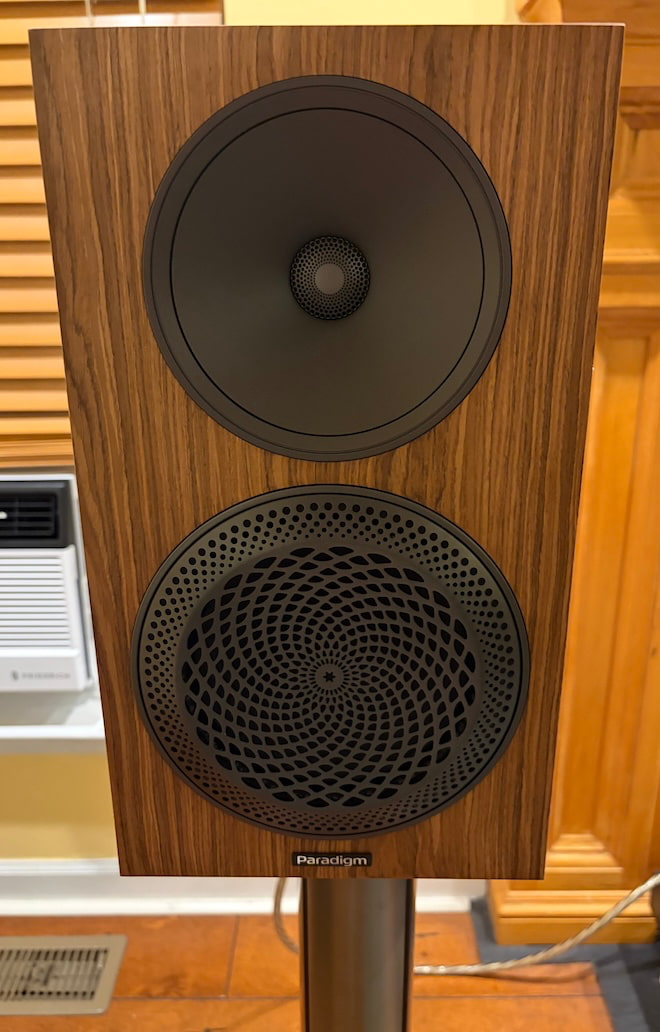
That reaction is understandable once you handle them. The MDF cabinet feels extremely solid and inert, with none of the hollow resonance you can sometimes get from less expensive enclosures. The detailing is equally impressive, with aluminum accents and stainless-steel trim that give the 220B v2 a more upscale appearance without pushing it into lifestyle-speaker territory.
The rear panel deserves some credit as well. The binding posts support bi-wiring and bi-amping, and both their appearance and mechanical feel are closer to what I would expect on loudspeakers costing two or three times as much. There is nothing flimsy about them, and the same is true of the cabinet, finish, and hardware throughout.
The 220B v2 is offered in Piano Black, Walnut, and Black Walnut, although Paradigm currently lists Black Walnut as “coming soon” on its U.S. product page. Satin White is available elsewhere in the Premier v2 lineup but not on this model.
Driver Technology
The 220B v2 uses a 1-inch (25mm) AL-MAC ceramic-dome tweeter and a 6-inch (152mm) AL-MAG high-excursion mid/bass driver. Those acronyms are more than an excuse to make the front baffle look technologically busy.
AL-MAC combines aluminum, magnesium, and ceramic materials in a lightweight and rigid high-frequency diaphragm designed to suppress unwanted resonances. The tweeter is ferrofluid damped and cooled and sits behind Paradigm’s Perforated Phase-Aligning (PPA) lens inside an Oblate Spheroid Waveguide (OSW). The waveguide controls dispersion toward the listening area and reduces energy directed toward nearby room boundaries, while the perforated lens is designed to filter out-of-phase output before it reaches the listener.
The 6-inch AL-MAG mid/bass cone uses an aluminum/magnesium construction and gets its own PPA lens. Paradigm also equips the driver with its third-generation Active Ridge Technology (ART) surround and Vertical Mounting System (VMS). The ART surround is molded directly onto the cone and is designed to permit greater excursion than a conventional surround; Paradigm claims a 3dB increase in distortion-free output compared with a standard design. VMS increases the usable cone area within the available frame diameter.
Behind the cone is a 1-inch high-temperature multilayer voice coil with a ventilated Apical former. The two drivers meet through a second-order electro-acoustic crossover at 1.1kHz, which is unusually low for many conventional two-way standmount designs and places considerable responsibility on both the tweeter system and its waveguide.
One point worth clarifying from the broader Premier v2 story: Paradigm’s Carbon-X bass drivers belong to the floorstanding and larger multichannel models. The 220B v2 does not use Carbon-X; its single 6-inch AL-MAG driver handles both midrange and bass duties.
Sensitivity, Impedance and Amplification
Paradigm rates the 220B v2 at 91dB sensitivity in-room and 88dB anechoic, with an impedance described as “compatible with 8 ohms.” Recommended amplifier power is 15 to 130 watts per channel, which puts the speaker in a fairly friendly part of the universe and does not suggest that buyers need a welding machine disguised as an amplifier.
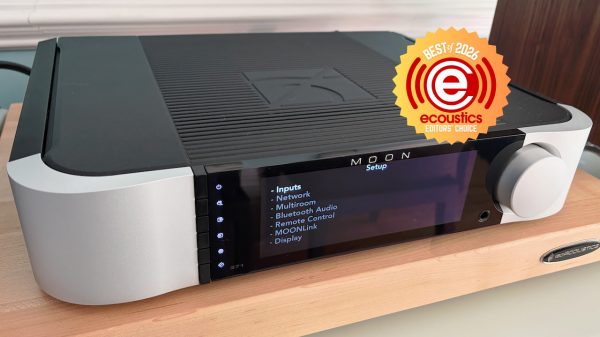
Rather than overthink the numbers, I drove the 220B v2 with a fairly eclectic group of amplifiers: the Cambridge Audio Edge A, MOON by Simaudio 371 Network Amplifier, NAD C 316BEE V2, Marantz Model M1, and Quad 3. That gave me everything from modest integrated amplification to considerably more expensive and powerful electronics, which is far more useful than pretending one amplifier tells you everything you need to know about a loudspeaker.
Sources were equally varied. Vinyl playback came from my Thorens TD-160 Super with an Ortofon 2M Black, feeding phono stages from E.A.T. and MOON by Simaudio. Digital sources included network players from WiiM, Esoteric, and Cambridge Audio, while cabling came from Clarus, QED, and Chord Company.
In other words, the 220B v2 was not given one carefully curated system and allowed to hide there. It had to work for a living.
Paradigm Premier 220B v2 Technical Specifications:
- Design: 2-driver, 2-way ported standmount loudspeaker
- Price: $549.99 each / $1,099.98 per pair
- Tweeter: 1-inch (25mm) AL-MAC ceramic dome
- Tweeter Technology: OSW waveguide, PPA lens, ferrofluid damping/cooling
- Mid/Bass Driver: 6-inch (152mm) ultra-high-excursion AL-MAG cone
- Mid/Bass Technology: PPA lens, Gen3 ART surround, Vertical Mounting System
- Voice Coil: 1-inch high-temperature multilayer coil with ventilated Apical former
- Crossover: 2nd-order electro-acoustic at 1.1kHz
- Frequency Response On-Axis: 58Hz to 23kHz ±3dB
- Frequency Response 30° Off-Axis: 58Hz to 20kHz ±3dB
- Low-Frequency Extension: 36Hz DIN
- Sensitivity: 91dB room / 88dB anechoic
- Impedance: Compatible with 8 ohms
- Recommended Amplifier Power: 15 to 130 watts
- Maximum Input Power: 80 watts
- Dimensions: 14.6 x 8.3 x 12.9 inches / 37.1 x 21.1 x 32.8 cm (H x W x D)
- Weight: 20.1 pounds / 9.1 kg each
- Finishes: Piano Black, Walnut, Black Walnut
- Grille: Removable magnetic grille
Setup
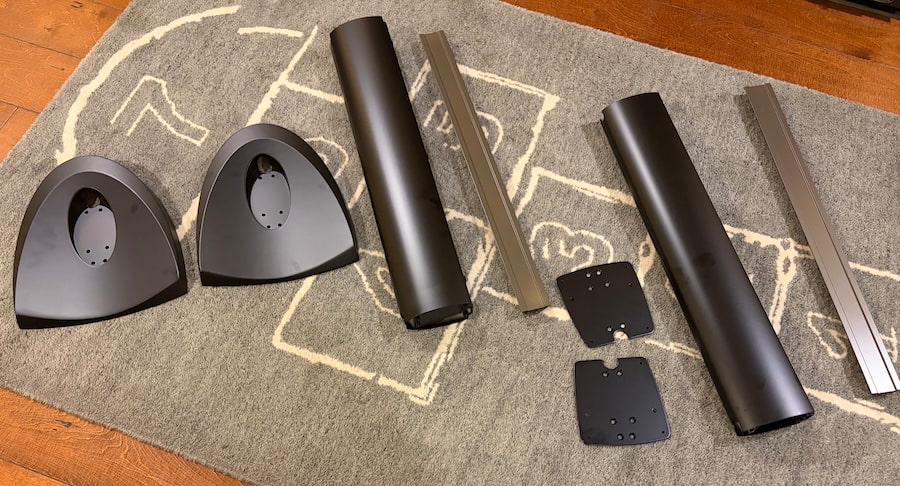
Paradigm supplied its matching stands for the review, and the same attention to build quality found in the 220B v2 carries over here. Assembly is required, and the stands can be sand-filled to add mass and make an already solid platform even more inert. No, I did not walk down to the beach here on the Jersey Shore for free sand.
Paradigm also supplies bolts to secure the speakers to the stands, although installation is not as simple as tightening them from underneath. The bolts need to be threaded into position first, after which the speaker is carefully lowered onto them and aligned largely by feel. Having a second person at eye level to guide things into place is not a bad idea if scratching the underside of a new cabinet sounds unappealing.
The 220B v2 is rear-ported and benefits from some breathing room. I settled on roughly 36 inches from the wall behind the speakers and about 78 inches apart, which gave the ports enough space to work without pushing the speakers excessively far into the room.
Listening
The Cambridge Audio Edge A has been my reference integrated amplifier for a little over five years, although at $6,500 it is unlikely to be the first amplifier most 220B v2 buyers will consider. Still, I wanted to hear how far the Paradigm could be pushed before moving down the amplification ladder. The Edge A has always sounded more powerful than its published numbers suggest, and in my 16 x 13 x 9-foot room, I never needed to push the volume beyond noon to achieve room-filling levels.
The 220B v2 remained engaging at lower volumes, but it clearly preferred being given some freedom. Warm and fuzzy it is not. Compared with the Wharfedale Super Denton, the Paradigm sits almost at the opposite end of the spectrum: less midrange warmth, less softness through the top end, and more emphasis on clarity, openness, speed, and image specificity. Detail retrieval is strong without becoming obsessive, and the presentation never felt congested or constrained by the cabinet size.
Nick Cave’s “Avalanche” made the contrast especially obvious. His gravelly vocal had more edge and definition through the Paradigm than the Super Denton, while giving up some of the tonal weight and fleshiness that makes the Wharfedale so seductive with male vocals. The 220B v2 compensated with sharper placement, more air around the voice, and a soundstage that felt considerably more precise.
And despite their dimensions, they do not sound small. Paradigm apparently forgot to tell them.
Closer to the Heart of the Bass
Depending on what you listen to, it may take some time to discover just how low and forceful the 220B v2 can sound within the obvious limits of a 6-inch driver. I spent the first week mostly with jazz, country & western, pop, and chamber music from John Coltrane, Dolly Parton, Sia, Orville Peck, John Prine, Natalie Bergmann, and some Dvořák I dragged home from Cactus Music in Houston.
None of that material immediately screams “test the foundations,” although Dolly and John Prine both proved long ago that you could do more with a great song, an acoustic guitar, and a few chords than most people manage with an entire recording studio. RIP Dolly and John. Somewhere, Prine probably would have had a verse ready about audiophiles arguing over bass extension while staring at frequency-response charts.
In my den, the Paradigm produced enough weight and extension to sound balanced without a subwoofer, but I would consider that about the largest room where I would use them alone if meaningful low-frequency impact matters. Move into a larger space and the tonal balance will begin shifting upward; at that point, adding a subwoofer makes considerably more sense than asking a pair of standmounts to ignore physics.
Once the house was empty, I stopped being polite.
Deadmau5 tracks including “Seeya,” “Silent Picture,” and “Deus Ex Machina,” along with Aphex Twin’s “Windowlicker” and “T69 Collapse,” and Kraftwerk’s “The Robots” and “Tour de France,” gave the 220B v2 a much better opportunity to show what happens below 80Hz. The Paradigm has real impact down there, but its character is more about speed, definition, and control than shaking the room. It will not punch you in the chest like a large floorstander or a properly integrated subwoofer, but it is anything but anemic.
In a smaller room, I could easily see many listeners deciding that the 220B v2 produces enough bass on its own. There is enough weight to make electronic music feel grounded, and enough control to keep bass lines from turning into one-note sludge when things get busy.
Rush’s “Xanadu” sounded enormous, with Peart, Lifeson, and Lee firing on all cylinders and the Paradigm keeping the scale of the track intact without losing separation. The percussion had snap, Geddy Lee’s bass lines remained easy to follow, and the layered guitars never collapsed into a wall of sound.
I did not feed on honeydew or drink the milk of paradise during the test.
But I understood the impulse.
You Know I’m No Good… to Bad Recordings
Vocals were not a mixed bag, but the 220B v2 can be rather unforgiving of recordings that already have some hardness baked into them. Amy Winehouse’s “Valerie” from the BBC sessions is a useful test because the late Beehive Queen’s voice can become somewhat aggressive through a brighter tweeter, and I did find myself turning the volume down a notch when the Paradigm pushed that edge a little too far. It never became shrill, but the 220B v2 was not interested in applying makeup to the recording either.
Sam Cooke’s “Lost and Lookin’” went in the other direction. Cooke’s voice was a gift from G-d, and the Paradigm locked him firmly in place within a wide, open soundstage with excellent clarity and focus. Compared with the Wharfedale Super Denton, there was less tonal richness and sweetness through the upper registers, but also greater image specificity and a cleaner view into the recording.
If you want every vocalist wrapped in cashmere, there are warmer options. The 220B v2 would rather tell you what is actually on the record and let you deal with the consequences.
Moving Down the Amplifier Ladder
Rather than turn this into an amplifier roundup, I’ll keep it simple: every amplifier I tried brought something useful to the 220B v2.
The almost-vintage NAD C 316BEE V2 was one of the more interesting matches. Its slight upper-bass/lower-midrange lift and gently rolled top end complemented the Paradigm rather well, adding some body and taking just enough edge off the treble. Canadian cousins apparently still know how to get along.
The MOON 371 offered the best control and the strongest mid/sub-bass impact of the group, although its more explicit top end could become a little aggressive with brighter recordings. The Marantz Model M1 and Quad 3, however, were my favorite combinations from a realistic system-building perspective.
In a smaller room, both had enough grip, tonal weight, and overall balance to make the 220B v2 the foundation of a very satisfying system for under $2,500. That may sound modest by high-end audio standards, where a power cord can apparently develop a mortgage, but I could live quite happily with either combination in a den, office, or smaller apartment.
The Bottom Line
The Paradigm Premier 220B v2 feels like a loudspeaker designed by people who forgot to check what everyone else was offering for $1,099.98 per pair. The cabinet, Walnut finish, binding posts, driver technology, and overall construction all suggest something considerably more expensive, and the performance mostly follows suit.
You can connect the 220B v2 to electronics costing several times its asking price without feeling as though you’ve put snow tires on a Ferrari. The Cambridge Audio Edge A and MOON 371 exposed just how much resolution, control, scale, and imaging the Paradigm is capable of delivering. More importantly, you don’t need either of them. The Marantz Model M1, Quad 3, and even the venerable NAD C 316BEE V2 demonstrated that a well-chosen, realistically priced amplifier can make these sing without requiring a second mortgage or an awkward conversation with your spouse.
The tonal balance will not work for everyone. The top end is brighter and more explicit than the Wharfedale Super Denton or Q Acoustics 5020, while the midrange gives up some of the warmth and romance that make those speakers so easy to fall for. The Paradigm counters with greater clarity, speed, openness, image specificity, and a sense of scale that consistently belies the cabinet dimensions.
Would I occasionally trade a little of that treble energy for some of the Super Denton’s tonal richness? Absolutely. But the 220B v2 does so many things well that I found its less romantic personality rather easy to forgive.
At this price, it belongs in the conversation with the best standmount loudspeakers below $1,500. It is beautifully made, technologically ambitious, relatively easy to drive, and good enough to keep revealing improvements as the rest of your system gets better.
For a Canadian loudspeaker, the 220B v2 is remarkably impolite. Consider it a two-minute minor for making several more expensive competitors look a little soft.
Pros:
- Exceptional build quality and Walnut finish for the price
- Precise imaging with excellent clarity, speed, and openness
- Scales impressively with more expensive amplification and source gear
- Strong, well-defined bass for a standmount of this size
- Relatively easy to drive and works well with realistically priced amplifiers
Cons:
- Brighter top end than the Wharfedale Super Denton or Q Acoustics 5020
- Less midrange warmth and tonal richness than some rivals
- Can be unforgiving of poor or aggressive recordings
- Rear port needs meaningful space from the wall
- Stand mounting hardware is secure but unnecessarily fiddly
Our Ratings:
★★★★★★★★★★ Sound Quality
★★★★★★★★★★ Build Quality
★★★★★★★★★★ Value
Where to Buy:
Related Reading:
- Buchardt Audio E50-S Bookshelf Speaker Offers A Different Take On The Acclaimed E50
- QUAD Elegan 1 And Elegan 2 Speakers Bring British Hi-Fi Back To Earth From $995
- Wharfedale Denton 1S Bookshelf Speakers: Heritage Hi-Fi Gets A Coaxial Rebirth For $999