
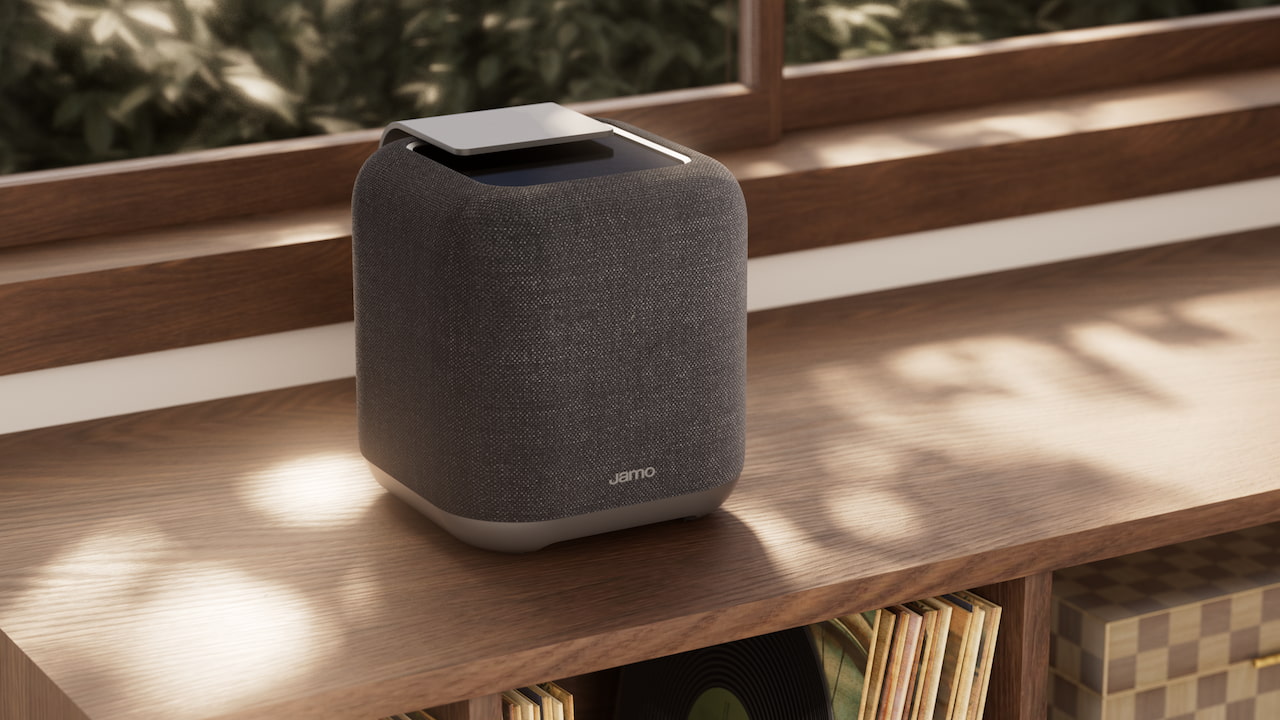
Jamo is expanding its revived HYG wireless speaker lineup with the HYG 5, a $399 all-in-one Wi-Fi speaker that combines streaming, amplification, and a three-driver audio system inside a fabric-wrapped cabinet. Arriving October 20, the new flagship is designed for listeners who want something more sophisticated than a conventional Bluetooth speaker without dedicating half their living room to an amplifier, streamer, and bookshelf speakers.
The Danish company has embraced hygge, the national obsession with comfort, warmth, and domestic tranquility, as the guiding philosophy behind the HYG Series. Think candles, wool blankets, soft lighting, and a comfortable chair overlooking the fjords. Good music is also part of the arrangement, although I’d argue that listening to Nine Inch Nails at an antisocial volume can be rather comforting as well.
More importantly, the HYG 5 represents a meaningful evolution for a brand that has been working hard to reestablish itself in a crowded loudspeaker market. Jamo is finally adding the network streaming features that were conspicuously absent from its first generation of HYG products, and the asking price puts it directly into competition with some very established players.
Jamo’s Comeback Is Getting More Interesting
We’ve been following Jamo’s return to the market since its relaunch under Cinemaster and Rayleigh Lab, following the brand’s departure from Voxx International in 2024. The Danish name still carries considerable recognition, but heritage alone wasn’t going to be enough to compete with established European and American loudspeaker manufacturers.
The first serious evidence of that comeback arrived with the Concert Legacy and Concert Element loudspeaker ranges, which made their public debut at HIGH END Vienna 2026. Those products reintroduced Jamo to traditional two-channel hi-fi, while the HYG Bluetooth speaker family targeted a very different audience.
We were generally encouraged by the design and functionality of HYG Reflect, Flow, and Flex, but there were some obvious limitations. None offered Wi-Fi streaming or app-based control, and the range had to compete against brands already offering more capable connected audio ecosystems.
The HYG 5 is Jamo’s answer to those omissions, with network playback and more extensive control options designed specifically for home listening.
Three Drivers and a Different Approach to Stereo Sound
Underneath its seamless textile covering, the HYG 5 employs two 2.5-inch full-range drivers angled upwards and outwards. The arrangement is designed to create a wider stereo presentation than listeners might expect from a single enclosure, with Jamo claiming a horizontal dispersion of 125 degrees at -6 dB.
Low frequencies are handled by a 4-inch down-firing woofer supported by two symmetrical, flared bass reflex ports underneath the cabinet. Jamo has incorporated ribbed internal port walls intended to reduce unwanted vibration and airflow disturbances, although the effectiveness of that design will require actual listening and measurement.
Amplification is provided by a three-channel system delivering 30 watts RMS, divided between 5 watts for each full-range driver and 20 watts for the woofer. Jamo specifies a frequency response of 45 Hz to 18 kHz (±6 dB), with claimed in-room bass extension to 40 Hz.
Those figures suggest a speaker engineered for comfortable listening levels in smaller and medium-sized spaces rather than replacing a serious pair of floorstanding loudspeakers. The angled driver configuration is interesting, but widening the soundstage inside a single cabinet is not the same thing as reproducing the stereo separation available from two properly positioned loudspeakers.
Streaming Without the Usual Compatibility Headaches
One of the HYG 5’s biggest strengths on paper is its unusually comprehensive selection of streaming options for a speaker at this price.
It supports Spotify Connect, TIDAL Connect, Qobuz Connect, TuneIn, and QPlay II, with Apple AirPlay 2 and Google Cast providing additional wireless playback and multiroom options. This flexibility should appeal to households that use different music services or operate a mixture of Apple and Android devices.
The addition of Qobuz Connect is particularly welcome for listeners who prioritize high-resolution music. Jamo specifies system audio resolution up to 24-bit/96kHz, although that figure should not be interpreted as a guarantee that every supported service or connection will deliver that resolution.
Bluetooth 5.0 is also included, with SBC and AAC codec support. Interestingly, that’s an older Bluetooth specification than the Bluetooth 6.0 connectivity offered by some of the original HYG models, and Jamo doesn’t list Auracast support for the HYG 5.
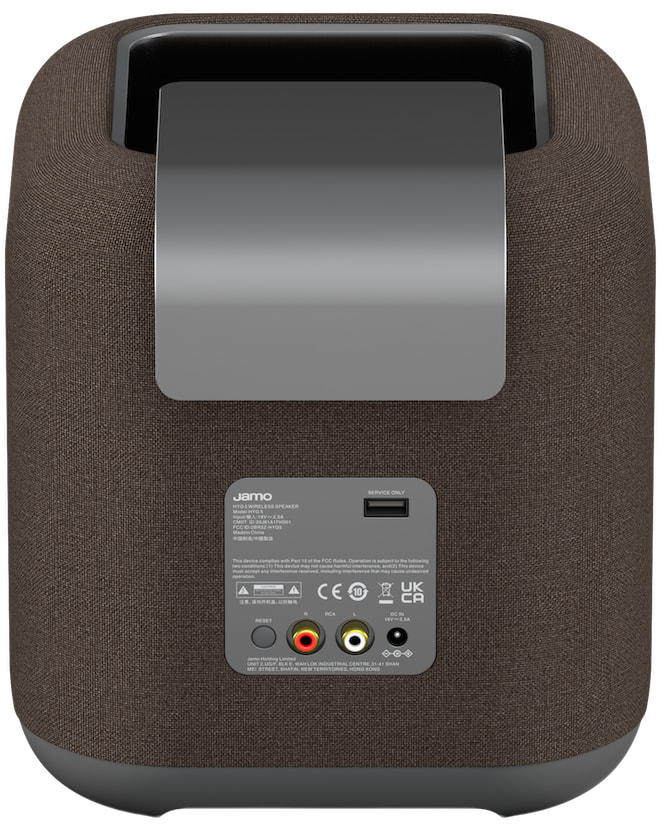
For wired sources, there’s a stereo RCA line input that can accommodate a CD player, external streamer, or a turntable with a suitable phono preamplifier. Owners of conventional turntables without an integrated phono stage will need to add one; the HYG 5’s line input isn’t a dedicated phono input.
Everything is managed through the Jamo Play app for iOS and Android, which handles setup, playback, and personalized EQ adjustments. That last feature is particularly useful because a speaker designed to sit on a cabinet, desk, or sideboard will interact with its surroundings, and some tonal flexibility is welcome.
Danish Comfort Meets Touchless Controls
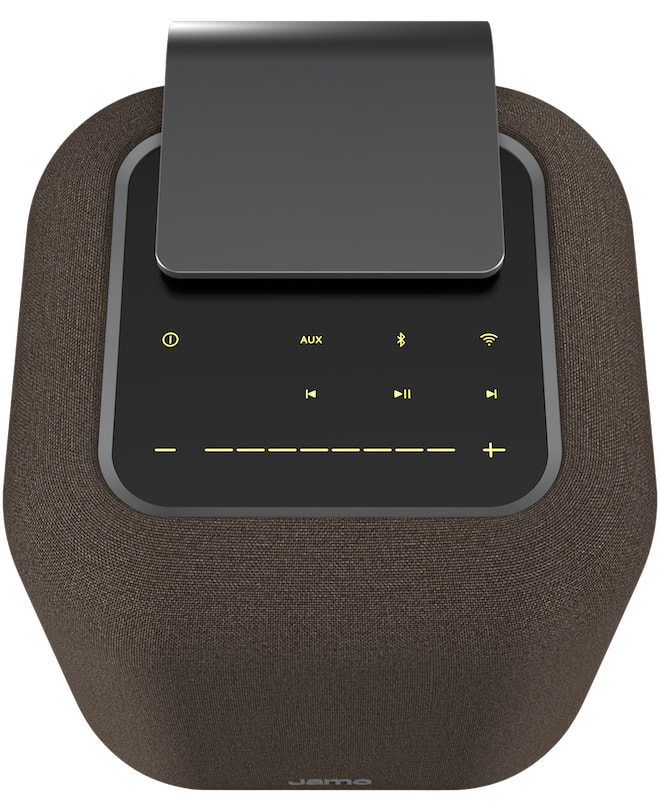
Jamo has also put considerable effort into making the HYG 5 feel less like a conventional electronic component. A wave of the palm wakes the speaker and resumes the previous source, while the touch interface dims when the unit enters standby.
A built-in ambient light sensor adjusts the brightness of a warm light ring according to the room’s lighting conditions. Owners can also adjust the brightness manually through the app or switch the lighting off completely, which is good news for anyone who thinks their loudspeaker should reproduce music rather than audition for a supporting role in a Scandinavian spa.
Jamo worked with Danish creative sound agency Unmute to develop the power-on, pairing, and interface sounds across the HYG Series. Those cues draw inspiration from Nordic nature and acoustic instruments, reinforcing the company’s intention to make the technology less intrusive.
It’s a thoughtful collection of features, even if none is individually revolutionary. The challenge will be whether the gesture controls, app, and automatic lighting work reliably enough to make the experience genuinely simpler instead of adding another layer of interaction.
Jamo HYG 5 Specifications
- Type: Active all-in-one Wi-Fi speaker
- Driver configuration:
- 2 x 2.5-inch (63.5 mm) full-range drivers
- 1 x 4-inch (101.6 mm) down-firing woofer
- Enclosure: Bass reflex with two symmetrical flared down-firing ports
- Amplification: 30 watts RMS total
- Amplifier distribution:
- 2 x 5 watts full-range
- 1 x 20 watts woofer
- Frequency response: 45 Hz to 18 kHz (±6 dB)
- Claimed in-room bass extension: 40 Hz
- Maximum SPL: 96 dB
- Horizontal dispersion: 125° at -6 dB
- Maximum system audio resolution: 24-bit/96kHz
- Wi-Fi: 802.11 a/b/g/n/ac, dual-band 2.4GHz and 5GHz
- Bluetooth: Version 5.0
- Bluetooth codecs: SBC, AAC
- Streaming: Spotify Connect, TIDAL Connect, Qobuz Connect, TuneIn, QPlay II
- Multiroom and casting: Apple AirPlay 2, Google Cast
- Wired input: Stereo RCA line input
- Control: Jamo Play app for iOS and Android, touch interface, gesture activation
- Additional features: Adaptive ambient lighting and personalized EQ
The specifications are manufacturer supplied. eCoustics has not independently tested the HYG 5, and the launch information does not provide cabinet dimensions, weight, or a complete list of available finishes.
The Competition Is Already Very Comfortable
At $399, the HYG 5 enters a wireless speaker category with plenty of capable alternatives, including two models that deserve particular attention.
Sonos Era 100 ($219): The Era 100 remains a formidable competitor thanks to its compact design, stereo playback, Wi-Fi, Bluetooth, Apple AirPlay 2, and extensive multiroom ecosystem. Sonos also offers Trueplay room tuning, although connecting an analog source requires a separate USB-C line-in adapter. The Jamo offers direct RCA connectivity, Google Cast, and Qobuz Connect, but Sonos has the considerable advantage of an established platform and a much lower current selling price.
Audio Pro C10 MkII W ($425): The Swedish manufacturer’s compact wireless speaker is arguably the more direct alternative, with an 80-watt amplification system, 5.25-inch woofer, two ¾-inch tweeters, and support for AirPlay 2, Google Cast, Spotify Connect, and TIDAL Connect. It also includes an RCA line input and subwoofer output, giving buyers another path toward expanding their system. The Audio Pro is slightly more expensive, but its larger woofer and greater rated amplifier power make it a serious rival for listeners who prioritize output capability.
Neither comparison tells us which speaker sounds better. Jamo still needs to demonstrate that its acoustic tuning, stereo presentation, and software experience are competitive, especially when both rivals have established track records.
Who Is the Jamo HYG 5 For?
The HYG 5 makes the most sense for listeners who want a self-contained home audio system without the expense, wiring, or visual footprint of traditional hi-fi separates. Its streaming options should appeal to subscribers who frequently move between Qobuz, TIDAL, Spotify, and locally connected sources.
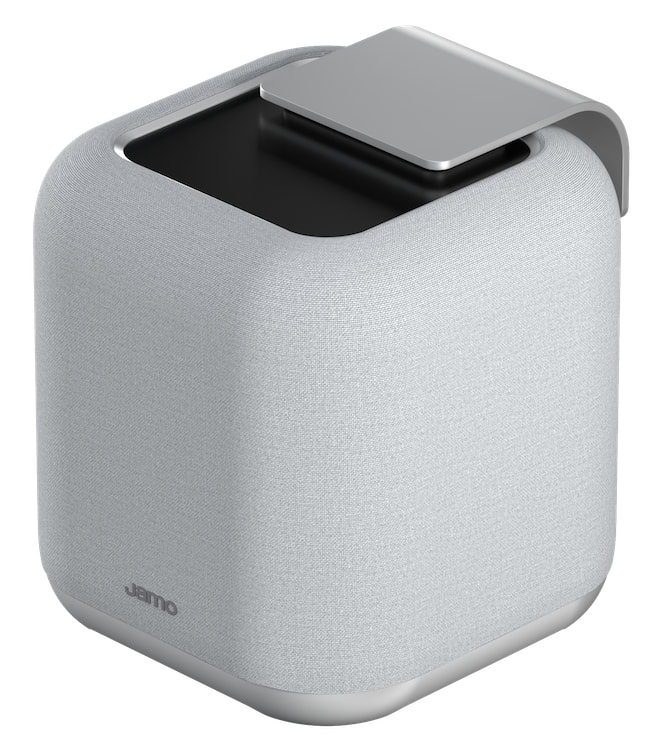
It’s also an interesting option for apartment dwellers, home offices, and secondary listening spaces where design and convenience are as important as sound quality. The textile exterior and adaptive lighting should help it blend into domestic environments where a stack of black electronics isn’t particularly welcome.
Anyone expecting a replacement for a dedicated stereo system should approach that claim with reasonable expectations. The HYG 5 may create a wide presentation for its size, but cabinet dimensions, driver spacing, room placement, and acoustic physics still impose limits that no amount of Danish coziness can overcome.
The Bottom Line
Jamo’s return has moved surprisingly quickly, from reviving its traditional loudspeaker identity to establishing a lifestyle range and now introducing a proper network-connected system. The HYG 5 is arguably the most commercially significant step in that process because it targets listeners who want better everyday audio without becoming hobbyists.
The feature list is strong, the pricing is competitive with some premium wireless alternatives, and the emphasis on multiple streaming ecosystems is a sensible decision. The unresolved questions concern acoustic performance, software reliability, and whether Jamo can build the long-term support infrastructure that buyers should expect from a connected product.
Sonos and Audio Pro have spent years developing that side of the business, and Jamo won’t catch them simply by wrapping three drivers in tasteful fabric. Still, this is the kind of accessible product that could introduce the revived Danish brand to a much broader audience.
Hygge might get the HYG 5 into the living room. Keeping it there will depend on how well it plays music once everyone has finished admiring the upholstery.
Pricing & Availability
The Jamo HYG 5 will launch on October 20, 2026 at the following prices:
- United States: $399
- United Kingdom: £349
- Europe: €399
For more information: Jamo
Related Reading:
- JBL Takes On Sonos With Cove M1, P1 And X1 Whole Home Speakers From $229
- Triangle AIO Twin Gets A Macassar Makeover Because French Speakers Refuse To Dress Down
- Denon Home 200 And Home 400 Wireless Speaker Review: Can HEOS Finally Challenge Sonos?














Alain
October 20, 2026 at 1:52 pm
Don’t forget the WiiM Sound, which is one of the only with UPnP connectivity.