

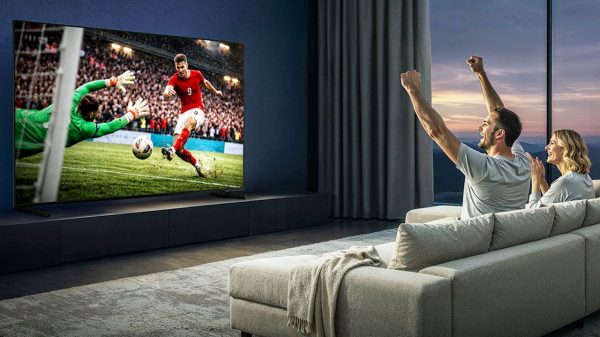
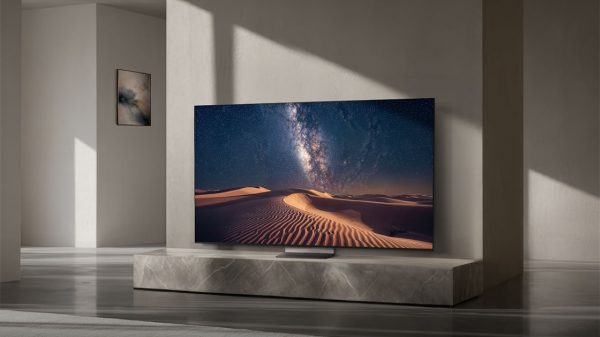
TV manufacturers are convinced that consumers are ready to take the massive TV plunge in 2025, and have introduced flat panel TVs up to 116-inches. Meanwhile the current sweet spot in extra large TV pricing is at 98-inches, with models priced as low as $999. However, consumers who want something larger than 100 inches, can expect sharp increases in pricing. The 115-inch TCL QM7 (2025 model) is now selling for $9,997, but the latest Hisense RGB MiniLED and Samsung Micro RGB TVs are both priced upwards of $20,000.
Above a 100-inch screen size, there is room for Ultra Short Throw (UST) projectors to come into the picture, some of which can offer viewing up to 150-inches or even larger. And while you can use a UST projector with a wall as the screen, you’ll get vastly better results with a dedicated screen. There are a number of UST/ALR (Ambient Light Rejecting) screen combinations that start around $3,000 and we expect to see more of them as more competitors jump into the market and the technology becomes more affordable. Especially at the 120-inch screen size, there isn’t a more affordable or easier alternative than an Ultra Short Throw (UST) projector with an ALR screen.
What is an Ultra Short Throw (UST) Projector?
An Ultra Throw Projector (aka UST) has a specially constructed lens assembly that allows images to be displayed from a very short distance, generally less than a foot away from the screen. This means instead of placing the projector far way behind the seating position, it sits close up below a screen without sacrificing image size or screen geometry. UST projectors can project very large images without taking much more space than a large TV. They are also great for those that have small rooms.
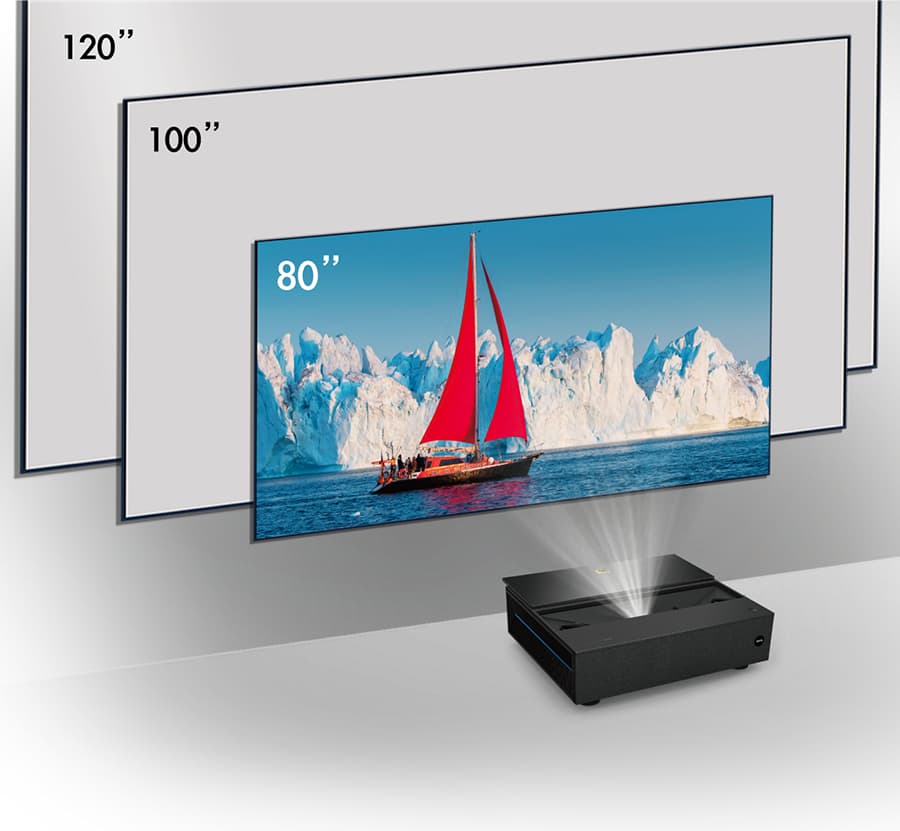
The key advantage of a UST projector with a screen is the substantial cost savings when compared to purchasing a flat panel TV sized above 85 inches. The next big advantage is the elimination of glare that plagues every glass panel. With the appropriate screen, a UST projector can create enjoyable big screen images, even in relatively bright rooms.
Tip: Most 2025 UST projectors offer 4K or 4K-like resolution via a process called Pixel Shifting. There are no 8K models yet for sale, although some have been announced. Some 1080p HD UST projectors are also available at more budget-friendly pricing.
Of course, there are some drawbacks to 4K UST projectors. Like any projector, or really any display of any kind, their main enemy is light in the room. Specialized ambient light-reflecting (ALR) screens can mitigate the problem, but as with any projector, they still look best in a darkened room.

Having reviewed The Premiere by Samsung LSP9T 4K UST Projector, we can attest that watching movies on a 103-inch screen is even more enjoyable than a near pixel-perfect 65-inch Sony OLED 4K TV. Bigger is just better.
Tip: UST Projectors are sometimes referred to as Laser TVs (such as Hisense models). This is because they use lasers in place of standard projection bulbs and their built-in speakers and simplified installation makes them a viable replacement to a flat panel TV.
Although the Samsung LSP9T is one of the best UST projectors, it’s also one of the most expensive, which opens the door to competition. In 2025, Hisense introduced their L9Q flagship UST projector, which bests the Samsung in most measurements. But it, too, is expensive, selling for around $6,000. The current “sweet spot” for 4K UST projectors is in the $2,000-$3,000 price range, and there is quite a bit of competition here.

4K UST Projector Comparison Chart
Since we have reported on many UST projectors, we thought it would be great to provide a guide that lists the brands and models, some of the key features, plus a link back to our more detailed articles on each brand and model reported.
Click the brand/model of each projector for more details in our original article or click the price to check current pricing and availability. Did we miss anything? Let us know in the comments.
Comparison
| Projector | MSRP | Light Engine | Lumens | Sound | Streaming Platform/OS | Size |
| AWOL LTV-2500 | $2,999 | Triple Laser | 2,600 | 2 x 18 watts | Android | 80-150″ |
| AWOL LTV-3000 PRO | $3,999 | Triple Laser | 3,000 | 2 x 18 watts | Android | 80-150″ |
| AWOL LTV-3500 PRO | $5,399 | Triple Laser | 3,500 | 2 x 18 watts | Android | 80-150″ |
| BENQ V5000i | $3,499 | Triple Laser | 2,800 | 2 x 5 watts 2 x 15 watts subwoofer | N/A | 70-100″ |
| BenQ V7050i | $2,299 | Laser / Phosphor | 2,500 | 2 x 5 watts | Android | 90-100″ |
| Epson LS500 | $2,982 | Laser 3LCD | 4,000 | 2x 10 watts | Android | 70-130″ |
| Epson LS650 | $2,499 | Single Laser | 3,600 | 2 x 5 watts 1 x 10 watts subwoofer | Android TV | 60-120″ |
| Epson LS800 | $3,799 | Laser 3LCD | 4,000 | 20 watts total | Android | 80-150” |
| Epson QS100 | $4,999 | Laser | White 4500 Lumens Color 4500 Lumens, | None | N/A | up to 160 inches |
| Formovie 4K Max | $3,699 | Triple Laser | 4,500 | N/A | Feng OS 1.2 | 100-200″ |
| Formovie C3 | $1,899 | Single Laser | 2,250 | 2 x 15 watts | FengOS 3.0 | 80-120″ |
| Formovie Cinema Edge | $2,199 | Single Laser | 1900 (ISO Lumens) | 15W x 2 Sound by Bowers & Wilkins | Google TV | 80 to 150 inches |
| Formovie Theater T1 | $2,999 | Triple Laser | 2,800 | 2 x 15 watts | Android | 80-150” |
| Formovie Theater Premium | $3,499 | Triple Laser | 2200 (ISO Lumens) | 15W x 2 | Google TV | 80″ – 150″ |
| Hisense L5H | $3,797* | Laser / Phosphor | 2,700 | 40 watts total | Android | 100/120″ |
| Hisense L9H | $6,497* | TriChroma Laser | 3,000 | 40 watts total | Android | 100/120″ |
| Hisense L9Q | $5,499 | TriChroma Laser TV | 5,000 | 116 watts (6.2.2 channels) | Google TV | 100, 110, 120, 136, and 150 inches |
| Hisense PL1 | $2,499 | Single Laser | 2,100 | 2 x 15 watts | Google TV | 80-120″ |
| Hisense PL2 | $2,499 | X-Fusion Laser Engine | 4,000 | 30W (Stereo 15 watts x2) | Google TV | 80″-150″ |
| Hisense PT1 | $2,999 | TriChroma Laser | 2500 | 2.0.2 channels – 46W total | Google TV | 80″-150″ |
| Hisense PX3-PRO | $3,499 | TriChroma triple-laser | 3.000 | 2 x 15 watts, 2 x 8 watts | Google TV | 80 to 150 inches |
| JMGo OS2 Ultra | $2,999 | Triple Laser | 3,600 (ISO Lumens) | 10 x 2 Sound by Dynaudio | Google TV | Up to 150 inches |
| Leica Cine 1 | $9,495 | TriChroma Laser | 3,000 | 2 x 25 watts | Google TV | 100 or 120” |
| LG HU715QW | $2,499 | Laser / Phosphor | 2,500 | 20 watts x 2 | WebOS | 80-120″ |
| LG HU915QB | $5,499 | 3-Channel Laser | 3,000 | 2.2 channels, 40 watts total | WebOS | 90-100″ |
| LG HU915QE | $4,398 | 3-Channel Laser | 3,700 | 2.2 channels, 40 watts total | WebOS | 90-120″ |
| Nexigo Aurora Pro | $2,999 | Triple Laser | 2,400 | 2 x 15W Woofers, 2 x 15W Tweeters | Android | 80-150″ |
| Nexigo Aurora Pro, Mk. II | $2,999 | ALPD 5.0 (Triple Laser + LED) | 2,400 | 60W speakers with Dolby Atmos | N/A | 80-150″ |
| Optoma CinemaX P2 | $3,376 | Single Laser w/ 6-SegmentColor Wheel | 3,000 | 40 watts total | Android | 85-120″ |
| Optoma GT3500HDR | $1,499 | DuraCore Laser | 3,800 | 1 x 15 watts | None | Up to 130 inches |
| Optoma GT4000UHD | $3,208 | DuraCore Laser | 4,000 | 1 x 15 watts | None | 100″ ~ 150″ diagonal |
| Optoma Photon Go | $999 | DuraCore MultiColor Laser | 650 | 2 x 10 watts | Google TV | 50 to 100 inches |
| Samsung LPU7D | $2,999 | Single Laser | 2,400 | 2.2 Channels, 30 watts total | Tizen | 90-120″ |
| Samsung LPU9D | $5,999 | Triple Laser | 3,450 | 2.2.2 Channels, 40 watts total | Tizen | 100-130″ |
| Samsung LSP7T | $3,496 | Single Laser | 2,200 | 2.2 Channels, 30 watts total | Tizen | 90-120″ |
| Samsung LSP9T | $6,499 | Triple Laser | 2,800 | 4.2 Channels, 40 watts total | Tizen | 100-130” |
| Ultimea Thor T50 | $3,999 | Laser Phosphor | 3,000 | 2 x10 watts | Android TV 11.0 | 80-150″ |
| Ultimea Thor T60 | $4,999 | Triple Laser | 4,999 | 2 x 15 watts | Android | 80-200″ |
| Vava Chroma | $3,599 | Laser / Phosphor | 1,800 | 2 x 30 watts | Android | 80-150″ |
| Viewsonic X2000B-4K | $2,499 | Laser / Phosphor | 2,000 | 2 x 25 watts | Android | 65-150″ |
| XGIMI Aura | $2,349 | Laser / Phosphor | 2,400 | 4 x 15 watts | Android | 80-120″ |
| XGIMI AURA 2 GTV | $2,699 | Hybrid Laser/LED | 2,300 | 4 x 15 watts | Google TV | 90 – 150 |
*Includes screen.
Note: As new projector models are released, we’ll keep this list up-to-date, while also removing models that become discontinued. See something we missed? Let us know in the comments.
Pricing noted as of November 2025, but may vary due to promotional or market conditions. As always click the pricing links or visit our affiliate partners below to view current pricing on each model.
Where to buy: Value Electronics | Projector Screen | Amazon | Crutchfield
Related reading:



















Phil Davis
November 11, 2023 at 2:21 pm
I bought an Epson laser projector
directly from Epson for under $800.
Works fine….any of these pricy front
projectors will get U a better view
of every flaw on a woman’s face….etc
I don’t need that.
Neil
June 5, 2024 at 5:38 pm
Should Wemax not be listed as well?
Mike Zerby
March 31, 2026 at 3:33 pm
Are ANY available that will show 3D?