Gaming speakers have spent a lot of years trying to distinguish themselves with RGB lighting, oversized subwoofers and enough software features to make changing the volume feel like filing a tax return.
Sony Interactive Entertainment is trying something rather different.
The company has confirmed that its Pulse Elevate wireless speakers will launch on November 12, 2026 for $219.99, with U.S. preorders beginning September 1 at 10 a.m. ET. More interesting than the price is what Sony has put inside them: planar magnetic drivers, dedicated woofers, lossless low-latency PlayStation Link connectivity, simultaneous Bluetooth and an integrated microphone with AI-enhanced noise rejection.
These are also the first wireless speakers developed by Sony Interactive Entertainment, extending PlayStation audio beyond headphones and earbuds and into a category where Sony’s 2023 acquisition of Audeze suddenly looks even more interesting.
Related Reading: Audeze Is Shaping The Sound Of Every Future PlayStation Audio Product As Sony’s Bet Takes Shape

Why Are the Pulse Elevate Speakers Different?
Planar magnetic drivers remain unusual in desktop loudspeakers, especially in a wireless gaming system selling for $220.
Each Pulse Elevate speaker uses what Sony describes as a studio-inspired planar magnetic driver covering the primary audible range, paired with a dedicated woofer for additional bass output. On compatible PS5 titles, Sony says the speakers work with Tempest 3D AudioTech to improve the positioning of directional audio cues.
That driver technology is important because Sony Interactive Entertainment has spent the past three years pushing planar magnetic audio deeper into the PlayStation ecosystem.
The $149.99 Pulse Elite headset and $199.99 Pulse Explore earbuds already use planar magnetic drivers. More recently, Audeze told us that it is helping develop the sound of future PlayStation audio products and described its role as an internal audio development group within the PlayStation organization.
Sony Interactive Entertainment acquired Audeze in 2023 specifically to strengthen its PlayStation audio capabilities. Audeze continues to operate as its own brand and build products for multiple platforms, but its engineering expertise is now very much part of Sony’s broader gaming audio strategy.
There is an important caveat here: Sony has not stated that Audeze designed the planar magnetic drivers inside Pulse Elevate. The connection between Audeze and Sony’s broader audio roadmap is real, but assigning specific Pulse Elevate engineering work to Audeze would currently be speculation.

Maxwell 2 Shows Where Sony Is Heading
The most obvious reference point inside Sony’s own corporate family is not another loudspeaker.
It is the Audeze Maxwell 2.
The $329 Maxwell 2 uses large 90mm planar magnetic drivers, supports low-latency wireless audio up to 24-bit/96kHz, provides more than 80 hours of claimed battery life and incorporates Audeze’s FILTER AI microphone processing. The PlayStation version also supports Sony’s Tempest 3D Audio platform.
Pulse Elevate and Maxwell 2 are clearly different products, but the philosophy is becoming recognizable: planar magnetic transducers, low-latency wireless connectivity, spatial audio and increasingly sophisticated voice processing.
Sony did not spend money acquiring Audeze merely because somebody in accounting wanted nicer headphones.
The larger objective appears to be raising the baseline for PlayStation audio and spreading technology once associated primarily with expensive audiophile headphones into products aimed at a substantially larger gaming audience. Sony’s own $149 Pulse Elite already demonstrated how aggressively it could push planar magnetic technology downward in price. Pulse Elevate moves the concept into loudspeakers.
PlayStation Link Plus Bluetooth
Pulse Elevate uses PlayStation Link, Sony’s proprietary wireless system designed for lossless, ultra-low-latency audio with PS5, PC, Mac and PlayStation Portal.
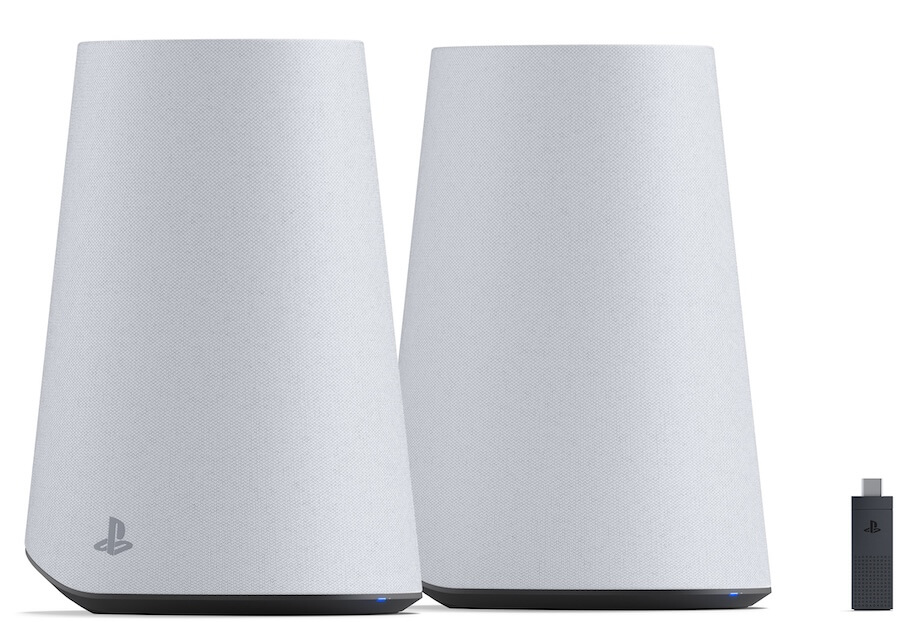
The included USB-C PlayStation Link adapter handles the primary gaming connection, but the speakers can also maintain a separate Bluetooth connection at the same time. That means someone could hear game audio from a PS5 while receiving music, communications or other audio from a phone.
Sony has also built a microphone into the right speaker rather than requiring a headset or separate desktop mic. AI-enhanced noise rejection is designed to suppress unwanted sounds during voice chat.
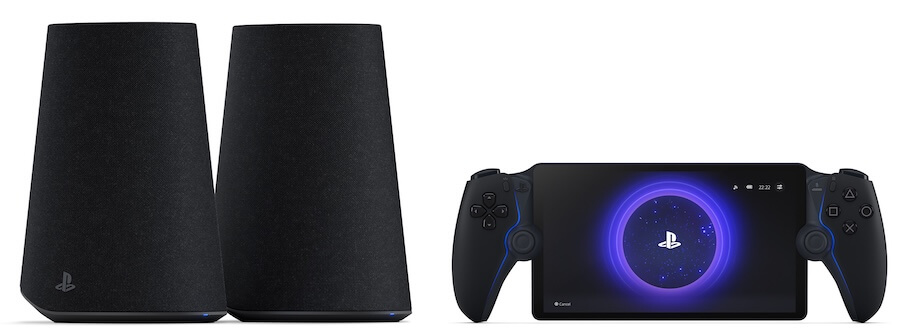
The speakers contain rechargeable batteries and sit on included charging docks, allowing them to be removed from a desktop and used with PlayStation Portal or Bluetooth mobile devices. They can also be positioned horizontally or vertically, with EQ, volume and microphone controls available through PS5 and, following launch, PC system menus.
Sony has not yet published battery life, amplifier power, planar driver dimensions, woofer size, frequency response or supported Bluetooth codecs, which leaves some meaningful blanks on the specification sheet.
What Does the Competition Look Like?
At $219.99, Pulse Elevate lands in an interesting part of the desktop gaming market.
The Logitech G560 currently sells for $249.99 and is a more conventional 2.1 system with a separate subwoofer, 240 watts of claimed output and extensive LIGHTSYNC RGB integration. It is likely to deliver considerably more bass output, but it lacks the Pulse Elevate’s planar magnetic drivers and PlayStation Link ecosystem.
Razer offers several alternatives. The Nommo V2 X costs $129.99, but the Nommo V2 Pro climbs to $449.99 with a wireless subwoofer, THX Spatial Audio and Chroma RGB.
At $249.99, the Edifier G2000 Pro offers 7.1 virtual surround sound with RGB lighting from only a pair of desktop speakers.
Those products are primarily trying to create a bigger, more theatrical desktop presentation.
Sony appears to be chasing something different.
Pulse Elevate does not include a separate subwoofer and Sony has not disclosed amplifier output, so anyone expecting the low-frequency impact of a dedicated 2.1 system should keep expectations realistic. Its advantages instead revolve around driver technology, portability, integration with PlayStation hardware and a wireless architecture designed specifically for low latency.
The Bottom Line
The Sony Pulse Elevate are interesting because they are not merely another pair of computer speakers wearing a PlayStation logo.
Planar magnetic drivers remain uncommon in this category, PlayStation Link eliminates many of the latency compromises associated with conventional Bluetooth gaming audio, and the ability to combine lossless game audio with a simultaneous Bluetooth connection makes considerable practical sense.
The $220 price also puts Sony below several established premium gaming speaker systems while introducing audio technology more commonly associated with Audeze headphones costing considerably more.
There are still unanswered questions. Sony needs to disclose battery life, amplifier power, driver specifications and more detailed audio measurements before anyone can determine whether Pulse Elevate delivers the performance its architecture suggests.
But the broader direction is hard to miss.
We recently reported that Audeze is helping shape the sound of future PlayStation audio products. Now Sony is moving planar magnetic technology beyond headphones and earbuds into desktop speakers.
The Maxwell 2 remains the more ambitious personal audio product, but Pulse Elevate could expose considerably more gamers to the same underlying idea: gaming hardware does not have to sound like gaming hardware.
And at $219.99, Sony is not asking them to spend audiophile money to find out.
Price & Availability
The Sony Pulse Elevate wireless speakers will cost $219.99 in the U.S. and launch beginning November 12, 2026. Preorders begin September 1 at 10 a.m. ET in the United States.
Midnight Black will be offered globally through PlayStation Direct and participating retailers. The White version will have more limited regional availability, including the U.S. and selected European markets.
Related Reading: