
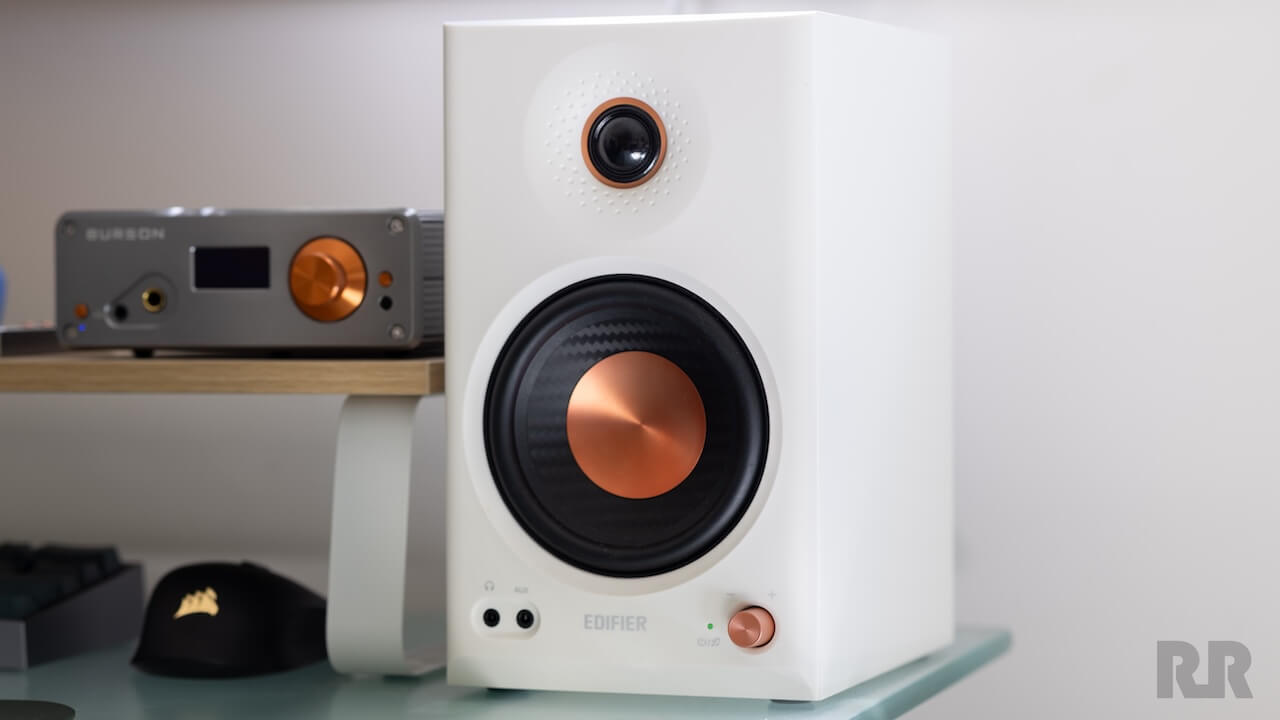
Edifier is a popular speaker brand that aims to deliver cost-effective, feature-rich audio gear. The company has a knack for building attention-grabbing products—not because of loud or esoteric designs, but because of just how much value you get for your dollar.
Today, we’re looking at the $250 Edifier MR4.5, a compact pair of powered bookshelf speakers designed primarily for desktop use. With dual drivers, bi-amplification, and a feature set aimed at both entertainment and more serious listening, the MR4.5 sits in an increasingly crowded category of affordable powered desktop monitors.
Edifier is clearly trying to make the MR4.5 a one-stop solution for gamers, music lovers, and anyone who wants better desktop audio without adding a separate amplifier or building a more complicated system. At $250, that means delivering enough performance, connectivity, and flexibility to stand out in a category where value matters almost as much as sound quality.
About My Preferences: This review is a subjective assessment and is therefore influenced by my personal preferences. While I try to mitigate those biases as much as possible during the review process, I’d be lying if I said they were completely erased. So, for you, my readers, keep the following in mind:
- My ideal sound signature includes competent sub-bass, textured mid-bass, a slightly warm midrange, and extended treble.
- I have mild treble sensitivity.
Testing equipment and standards can be found here.
Related Reading:
Edifier Specifications Compared
| MR4 | MR4.5 | MR5 | |
|---|---|---|---|
| MSRP | $169.99 | $249.99 | $349.99 |
| Total output power (RMS) | 21W x 2 | 10W x2 (Treble), 30W x2 (Mid-bass) | 10W x2 (Treble), 15W x2 (Mid), 30W x2 (Bass) |
| Frequency response | 60Hz – 20kHz | 50Hz – 40kHz | 46Hz – 40kHz |
| Signal-to-noise ratio | ≥ 85dB (A) | ≥ 85dB (A) | ≥ 85dB (A) |
| Bluetooth | – | 6.0 | 6.0 |
| Inputs | TRS, RCA, AUX | TRS, RCA, AUX, XLR, Bluetooth | TRS, RCA, AUX, XLR, Bluetooth |
| Outputs | 3.5mm | 3.5mm | 3.5mm |
| Woofer / mid / tweeter | 1″ silk-dome tweeter, 4″ woofer | 1″ silk dome tweeter, 4.5″ mid-bass | 1″ silk dome tweeter, 5″ woofer, 3.75″ mid |
| Dimensions (W x H x D) | 5.5 x 9 x 7.2 inches (140 x 228 x 184 mm) | 5.5 x 9.6 x 9 inches (140 x 244 x 229 mm) | 6.3 x 10.4 x 10.1 inches (159 x 264 x 257 mm) |
| Weight | 9.9 lbs (4.5 kg) | 14.6 lbs (6.63 kg) | 22.9 lbs (10.38 kg) |
| Hi-Res Audio | – | Yes | Yes |
| EQ / app | – | Yes | Yes |
Build
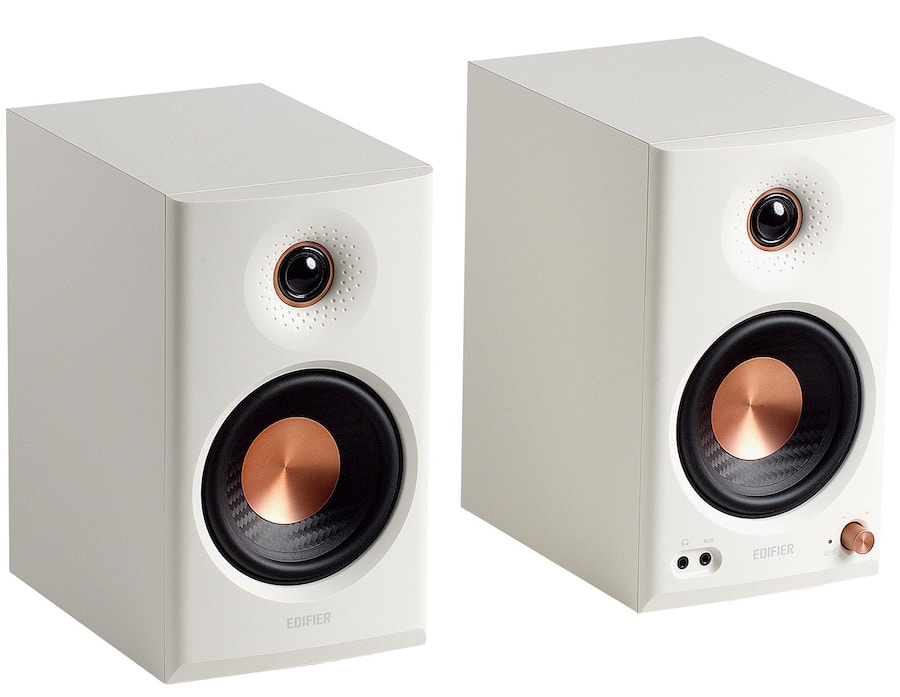
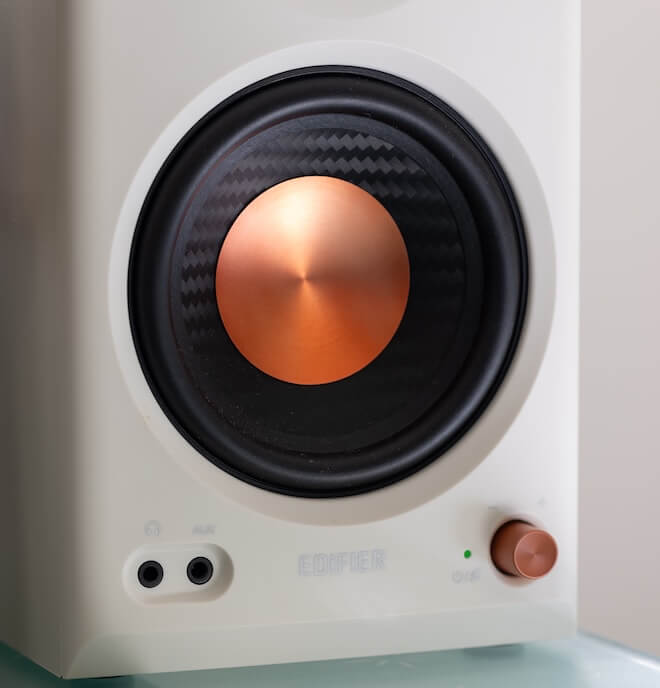
The MR4.5’s chassis is constructed from MDF and features a semi-matte finish. It is available in two color options, black or white, and feels quite sturdy.
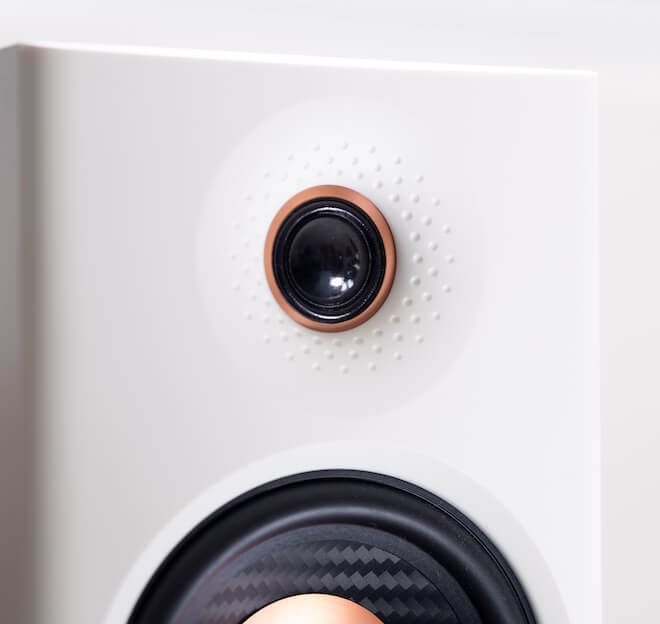
The front of each speaker houses the tweeter and woofer array, set within simple recessed surrounds. The right speaker also features an LED status light, a digital volume knob, and two 3.5mm jacks. One serves as an auxiliary input, while the other functions as a headphone output.
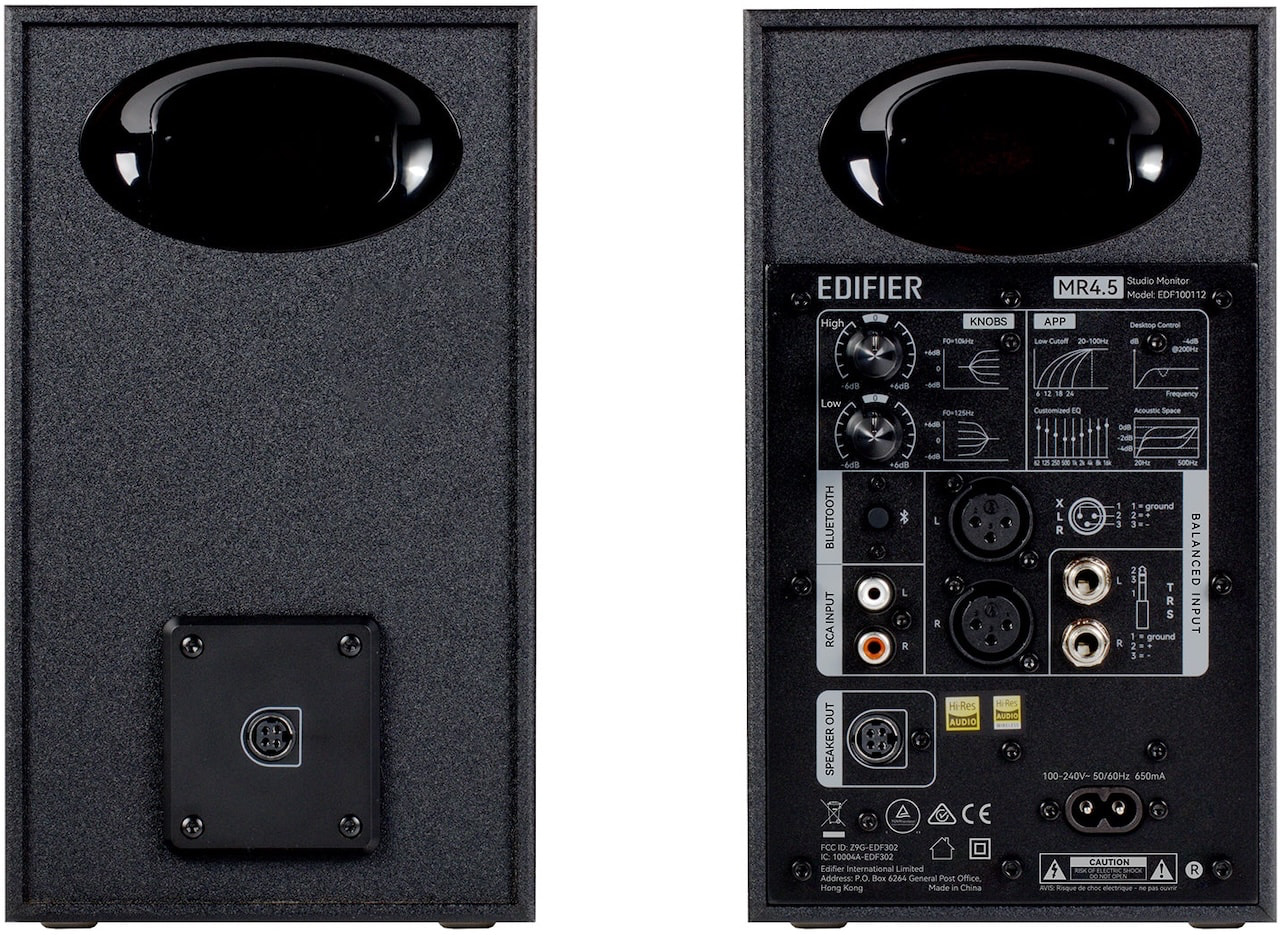
The rear of the right speaker features a metal plate with cutouts for the various inputs and controls. Here, you’ll find the MR4.5’s XLR, TRS, and RCA analog inputs, along with a pair of tuning knobs. We’ll touch on those in more detail later.
There’s no USB-C input, which is a shame, but the connections that are present feel sturdy and well integrated into the chassis.
Listening
The MR4.5 targets a reference-style sound signature, maintaining a largely neutral sonic profile. Edifier claims that the MR4.5’s frequency-response curve is virtually flat, but that’s not how it sounds when placed on my desk.
In its default tuning mode, the MR4.5 rolls off around 45Hz and reaches a modest mid-bass hump around 125Hz. The lower midrange is fairly flat, but it dips as it transitions into the upper mids around 2-3kHz. That relative lack of presence adds some warmth to the lower mids. The upper mids even out around 4kHz before picking up again near 5kHz, carrying a few extra decibels of emphasis through the lower treble.
These deviations from a perfectly flat response place the MR4.5 squarely in “north of neutral” territory, and I think it actually sounds better for it. The “Acoustic Tuning” knobs on the rear panel are also quite useful, providing easy access to both basic room compensation and tonal adjustment.
Gaming with the MR4.5
Competitive multiplayer shooters like Call of Duty and Apex Legends are particularly sensitive to spatial cohesion, and the MR4.5 demands a bit of planning to extract its full potential.
The MR4.5’s spatial-rendering sweet spot is narrower than its marketing might suggest. At a listening distance of about three feet, I needed an angled stand to align the tweeters with my ears and achieve proper staging. Reference-style tuning generally works well for rendering spatial cues such as footsteps, and I had no trouble identifying left-to-right or vertical directionality. While the MR4.5 performs very well for an affordable pair of desktop speakers, it doesn’t outperform top-tier gaming headphones such as the ASUS ROG Kithara or Audio-Technica ATH-ADX3000 when it comes to positional accuracy.
Single-player gamers, particularly those who enjoy story-driven titles, may want a bit more presence in the 2-3kHz range for vocal separation, along with greater output between 10-80Hz for explosive impact and depth. The small dip in the MR4.5’s midrange can be addressed easily through the Edifier ConneX companion app. The lack of true sub-bass extension, however, will require a separate subwoofer.
The Companion App
Just about every active speaker seems to come with a companion app these days, and the MR4.5 is no exception.
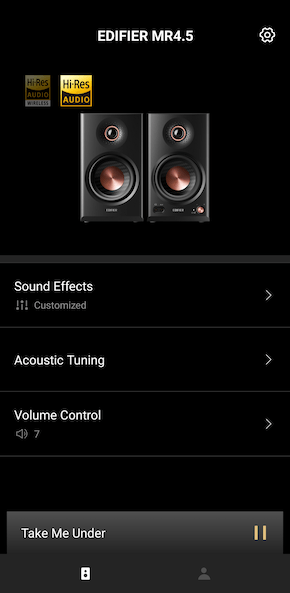
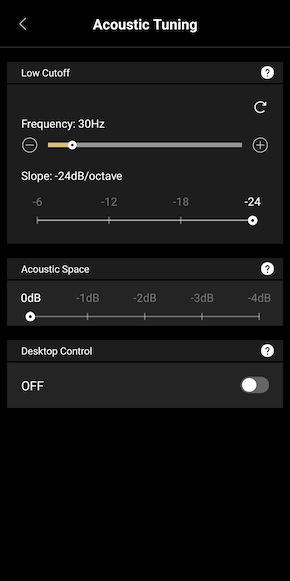
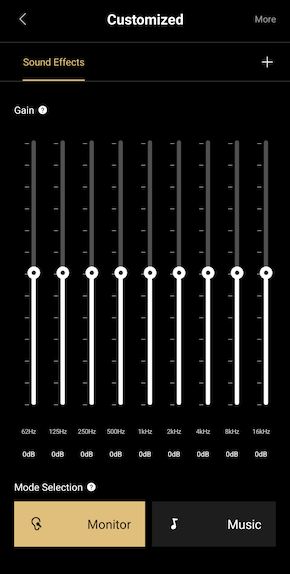
Edifier’s app works well and doesn’t demand any odious rituals, such as creating an account or handing over your personal information. That’s a welcome change, and I’m hoping Edifier sticks with this model.
Beyond that, the MR4.5 offers a useful set of app-based controls, including an equalizer, fine-grained acoustic tuning for room compensation, and additional playback and setup options.
The Bottom Line
The Edifier MR4.5 does not quite live up to every claim in the company’s marketing, but it remains a very capable near-field speaker for desktop listeners. Its reference-style tuning is generally well judged, bass performance is impressive for a cabinet this small, and the combination of XLR, TRS, RCA, 3.5mm, and Bluetooth connectivity gives it plenty of flexibility for both casual and more serious setups.
There are compromises. The lack of a USB-C input is disappointing at this price, the spatial sweet spot is relatively narrow, and listeners looking for true sub-bass or room-filling output will need either a subwoofer or a larger pair of speakers. The app-based tuning options help address some of the tonal limitations, but they cannot overcome the physical constraints of a compact desktop design.
At $250, though, the MR4.5 gets the fundamentals right. It sounds balanced, offers useful room-adjustment tools, and provides more connectivity than many competing powered speakers in its class. For near-field listening, gaming, and everyday music playback, it is an easy speaker to live with—and one I’m happy to keep on my desk.
Pros:
- Appealing reference-style tuning
- Wide selection of input types
- Excellent bass extension relative to size
- Discrete front-facing mic input, headphone output
- Aggressively-priced
- Useful companion app
- Well-designed physical tuning knobs
Cons:
- Mild unevenness in upper-register
- Not suited for medium-to-long listening distances
- Distortion, dynamic compression above 90dB output
- No USB-C input capabilities
Our Ratings:
★★★★★★★★★★ Sound Quality
★★★★★★★★★★ Build Quality
★★★★★★★★★★ Value
Where to Buy:
Related Reading:
- Audioengine A2+ Gen 3 Adds AptX Adaptive And More Power For $299
- Edifier R2750DB MKII Review: Big Sound Without The Big Price
- Edifier MR5 Review: $350 Studio Monitors
- Edifier M90 Review: Compact Speakers with Big Sound for Desktop or TV Use






















jedics
October 5, 2026 at 11:51 pm
Have the Mr4’s which are unbeatable for $100 including these by the looks of it. Those gold accents are tacky compared to the clean minimal look of the originals, all an update needed was more power and an easy way to add a sub so they could be used in situations far beyond just desktop speakers broadening their appeal. Being able to market something as new is more important to companies than ensuring they arent finding solutions to problems that dont exist nowadays.