Bass shakers are one of home theater’s more entertaining blunt instruments. Attach a tactile transducer to a recliner or platform, feed it low-frequency information, and explosions, engines, dinosaurs, and spacecraft can suddenly be felt as much as heard.
The problem is that the chair, sofa, mounting method, transducer, amplifier, and even the person sitting in the seat can change how those vibrations actually feel.
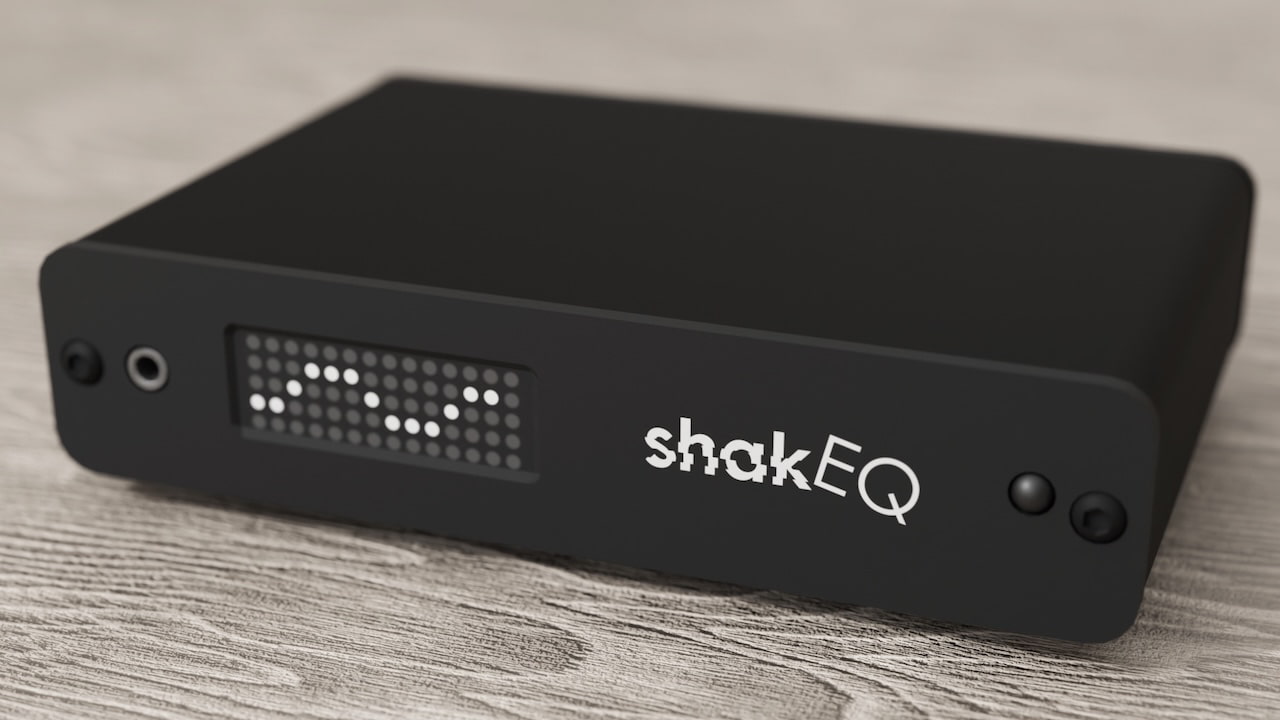
DSPeaker ShakEQ is designed to do something about that. The Finnish company will demonstrate its dedicated tactile signal processor at CEDIA Expo 2026 in Denver, September 1 through 4, including a new Content-Based Adaptive Bass Lift feature that CEDIA says will make its first public appearance at the show.
Room Correction for Your Sofa?
That description sounds ridiculous until you understand what ShakEQ actually does.
DSPeaker describes ShakEQ as the first digital signal processor developed specifically for bass shakers and tactile transducers. Rather than simply sending the same low-frequency audio destined for a subwoofer into a shaker amplifier, ShakEQ processes a dedicated tactile signal and can measure how the shaker system is behaving at the listening position.
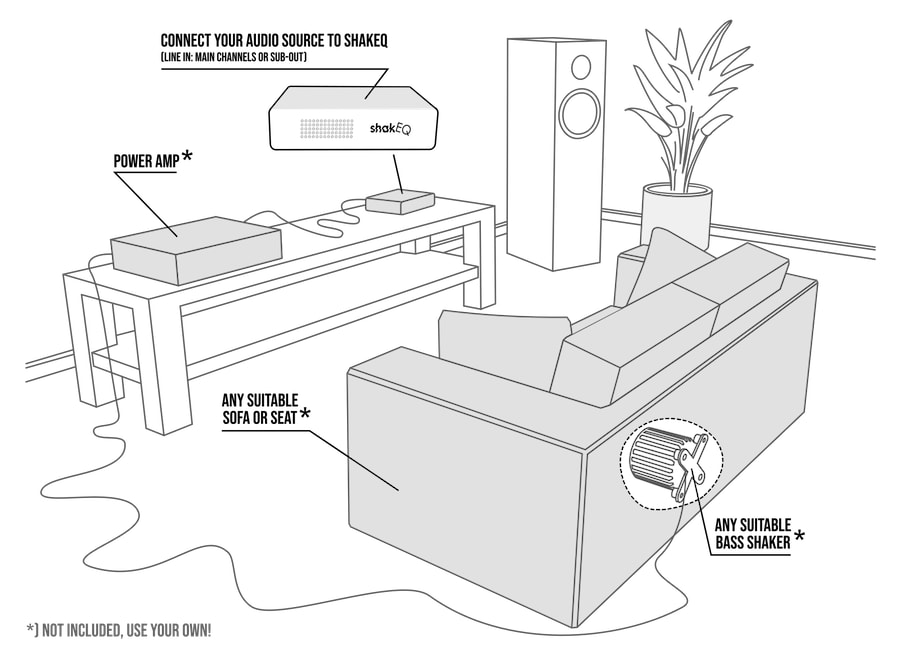
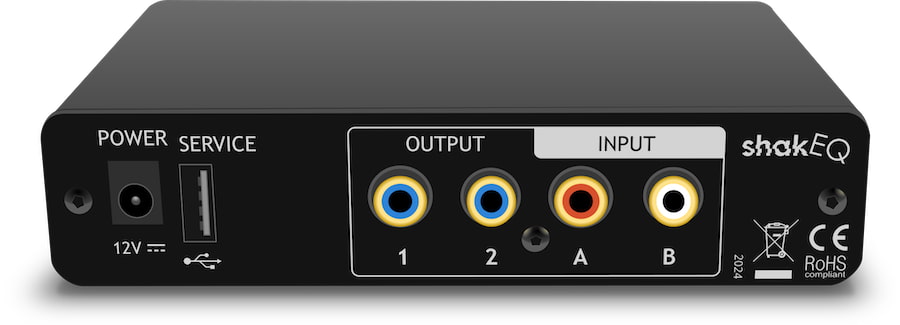
The unit connects between the audio source or AVR and the amplifier powering the tactile transducers. Two RCA inputs and two RCA outputs support either dual shaker outputs or a configuration combining a shaker with a subwoofer. DSPeaker recommends separate subwoofer and shaker outputs from the AVR when available because that allows the two signal paths to be handled independently.
One thing needs to be clear: ShakEQ is not an amplifier and does not replace your ButtKicker, Crowson, or other tactile transducer. You still need the shaker hardware and suitable amplification.
The Interesting Part Is the Calibration
This is where ShakEQ separates itself from conventional tactile systems.
During automatic calibration, the listener places the supplied vibration sensors on the seat and actually sits on them while ShakEQ measures the movement of the furniture. Three measurements are taken from slightly different seating positions, allowing the processor to analyze the complete shaker, mounting structure, furniture, and listener combination.
Yes, your backside has effectively become part of the measurement chain.
ShakEQ then applies automatic equalization intended to reduce resonance peaks and compensate for weaker areas of the tactile response. Manual EQ, crossover adjustment, delay alignment, and separate profiles for movies, games, and music are also provided.
That delay control could be particularly useful because tactile energy reaching your body at noticeably different times from the corresponding audible bass can make an otherwise expensive installation feel disconnected.
What Else Does ShakEQ Do?
Bass Extender analyzes mid-bass information and creates deeper low-frequency tactile energy when the original soundtrack does not contain enough content to generate meaningful movement. DSPeaker positions this as a way to produce useful tactile information from material that might otherwise barely activate the transducers.
The Dynamic Range Optimizer adjusts tactile dynamics according to the source material and shaker system. DSPeaker says its context-aware processing can increase low-level tactile detail or impact without simply compressing everything continuously.
ShakEQ can also provide optional Anti-Mode subwoofer room correction, although that feature requires a compatible measurement microphone; the tactile measurement sensors supplied with ShakEQ perform a different job.
CEDIA also lists Content-Based Adaptive Bass Lift (ABL) among the features being demonstrated in Denver. At this point, neither the CEDIA listing nor DSPeaker’s current product information provides enough technical detail to explain precisely how ABL differs from the existing Bass Extender processing, so we will wait for DSPeaker to explain that at the show rather than invent an answer.
Why Is ShakEQ Different?
Companies including ButtKicker and Crowson have been selling sophisticated tactile transducers and dedicated amplifiers for years. ButtKicker’s home theater products use the audio system’s bass or LFE signal, while Crowson’s dedicated amplifiers provide filtering, gain, phase adjustment, and presets.
ShakEQ takes the concept one step further by measuring the actual vibration occurring at the seat and automatically equalizing that response.
A powerful shaker attached badly to a resonant sofa can produce plenty of movement without producing convincing tactile feedback. ShakEQ attempts to treat the chair and transducer combination rather like a room-correction system treats loudspeakers and a listening room.
For dedicated home theaters with multiple recliners, platforms, large tactile transducers, or installations where the owner wants substantial physical bass without simply turning the subwoofers up another six decibels, that could be extremely useful.
The ShakEQ hardware itself has already been available and was reviewed during 2025, so CEDIA 2026 is not its initial product launch. The significant CEDIA development is the public demonstration of its complete tactile-processing approach and the new Adaptive Bass Lift feature.
The Bottom Line
Bass shakers are not new, but automatically measuring and correcting how one interacts with your actual seat is a clever extension of room correction into the tactile domain. ShakEQ will not turn a mediocre transducer into a better one or eliminate the need for proper installation and amplification, but it could make existing tactile systems considerably easier to integrate with the rest of a home theater.
And if CEDIA 2026 proves anything, it may be that after spending decades calibrating our speakers, subwoofers, displays, and projectors, we have finally reached the point where the sofa needs calibration too.
For more information: dspeaker.com
Related Reading:
- ButtKicker LFE Kit For Home Theater Review
- WTF Is WaveForming?
- Best Audio Gear At CEDIA Expo 2025
- Best Home Theater Systems At CEDIA Expo 2025