Vinyl enthusiasts have spent decades arguing about the evils of digital audio, only to discover that Bluetooth headphones, computer recording, and wireless speakers can make life considerably more convenient. Audiolab has clearly been paying attention, because its new PPA7 phono preamplifier is designed to accommodate both sides of that increasingly ridiculous argument.
The British manufacturer has introduced its first standalone phono stage in almost 20 years, and it is not content simply amplifying the delicate signal from a turntable cartridge. The $699 PPA7 combines moving magnet and moving coil compatibility with a dedicated headphone amplifier, Bluetooth 5.3 transmission, USB-C recording, and variable analog outputs. It’s a rather ambitious list of capabilities for a component that most manufacturers still expect you to hide behind the turntable.
Audiolab has built its reputation on providing serious engineering without requiring customers to liquidate their retirement accounts, and the PPA7 continues that philosophy. The more interesting question is whether all this additional functionality comes at the expense of the analog performance that should remain its primary responsibility.
Related Reading:
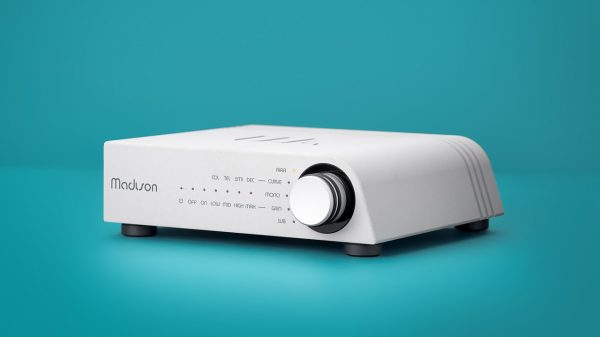
- Wattson Audio Madison Phono Uses Digital EQ On Vinyl And Some Audiophiles May Need A Minute
- Audiolab’s New D7 And D9 DACs Have Massive Shoes To Fill (Good Luck With That)
Audiolab PPA7: Serious Phono Engineering Comes First
Before we get to wireless streaming and digitizing records, it’s worth examining what Audiolab has done with the actual phono circuitry. A cartridge produces an extremely small electrical signal that requires substantial amplification and precise RIAA equalization, making noise control, power supply regulation, and proper electrical matching essential.
The PPA7 provides separate stereo RCA inputs for moving magnet (MM) and moving coil (MC) cartridges, with adjustable loading and gain to accommodate different designs. MM users can select between 100pF and 220pF capacitance settings with a fixed 47kΩ input impedance, while MC owners have a choice of 100 or 330 ohms.
Gain is adjustable by ±6dB in 1dB increments, with maximum values of 52dB for MM and 66dB for MC cartridges. Those settings should accommodate a broad range of popular cartridges, although the limited MC loading options make the PPA7 less flexible than some dedicated phono stages at similar prices.
Audiolab has also paid attention to the power supply, converting the external 12V DC input into internally regulated positive and negative 8.5V rails for the analog circuitry. The goal is to maintain stable operating conditions and minimize electrical interference when amplifying signals that can be measured in fractions of a millivolt.
That engineering deserves considerably more attention than the Bluetooth logo on the packaging. A phono stage that cannot reproduce music quietly and accurately isn’t redeemed by its ability to send a noisy signal to wireless headphones.
One Phono Stage, Several Ways to Listen
The PPA7’s most useful feature might be its dedicated headphone amplifier, which delivers up to 600mW through a front panel 6.35mm output and supports headphone loads from 20 to 600 ohms. Audiolab uses a current feedback design intended to provide wide bandwidth and low output impedance, although we’ll reserve judgment on its performance until we’ve tested it with demanding headphones.
For vinyl listeners who prefer private listening, the appeal is obvious. A turntable, the PPA7, and a suitable pair of wired headphones become a complete listening system without requiring a separate integrated amplifier or headphone component.
The inclusion of Bluetooth 5.3 with aptX HD adds another option, allowing records to be transmitted to compatible wireless headphones or speakers. Importantly, the Bluetooth connection is a transmitter, not a receiver, so the PPA7 cannot accept music streamed from your smartphone.
There’s also a technical reality worth acknowledging. Bluetooth transmission requires the analog signal to be digitized and compressed for wireless delivery, even when using aptX HD. The cartridge hasn’t suddenly become digital, but the signal reaching your headphones certainly has.
Some analog purists will consider this sacrilege. Those same people can continue arguing about whether their records sound better after being washed in water collected from a mountain spring in Switzerland.
Turning Records Into Digital Files
The PPA7 incorporates an analog to digital converter (ADC) that supports recording at resolutions up to 24-bit/192kHz through its USB-C output. Connected to a PC or Mac running suitable recording software, it allows owners to archive their records without purchasing a separate ADC or USB audio interface.
Recording is supported at 16-bit and 24-bit resolutions, with sample rates ranging from 44.1kHz to 192kHz. Audiolab also provides recording level adjustment from -12dB to +3dB, allowing users to manage levels and reduce the risk of clipping during transfers.
This isn’t going to eliminate surface noise, repair damaged grooves, or improve the quality of the original recording. However, for collectors with rare pressings, albums unavailable on streaming services, or records they would prefer to preserve digitally, it’s a genuinely useful addition.
The PPA7 also offers fixed or variable RCA outputs, with variable mode engaging its volume control for direct connection to a power amplifier or active speakers. That makes it particularly interesting for listeners building a compact system around a single analog source.
Compact Design With Some Familiar Audiolab DNA
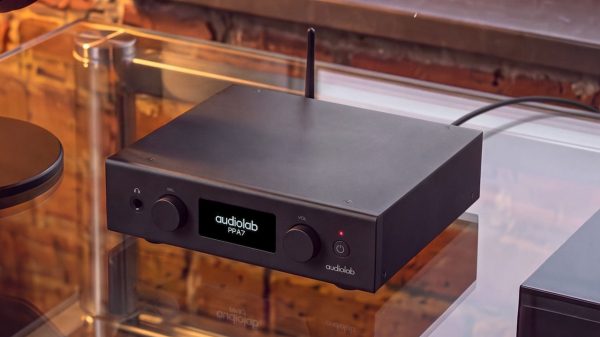
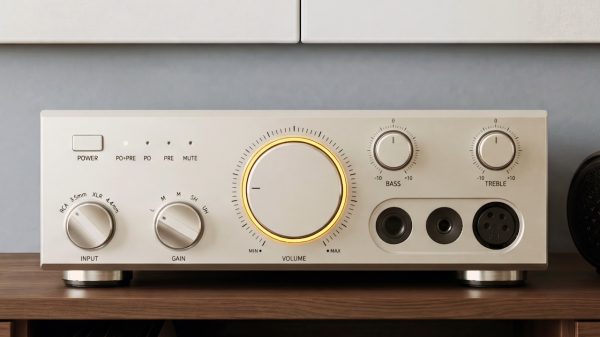
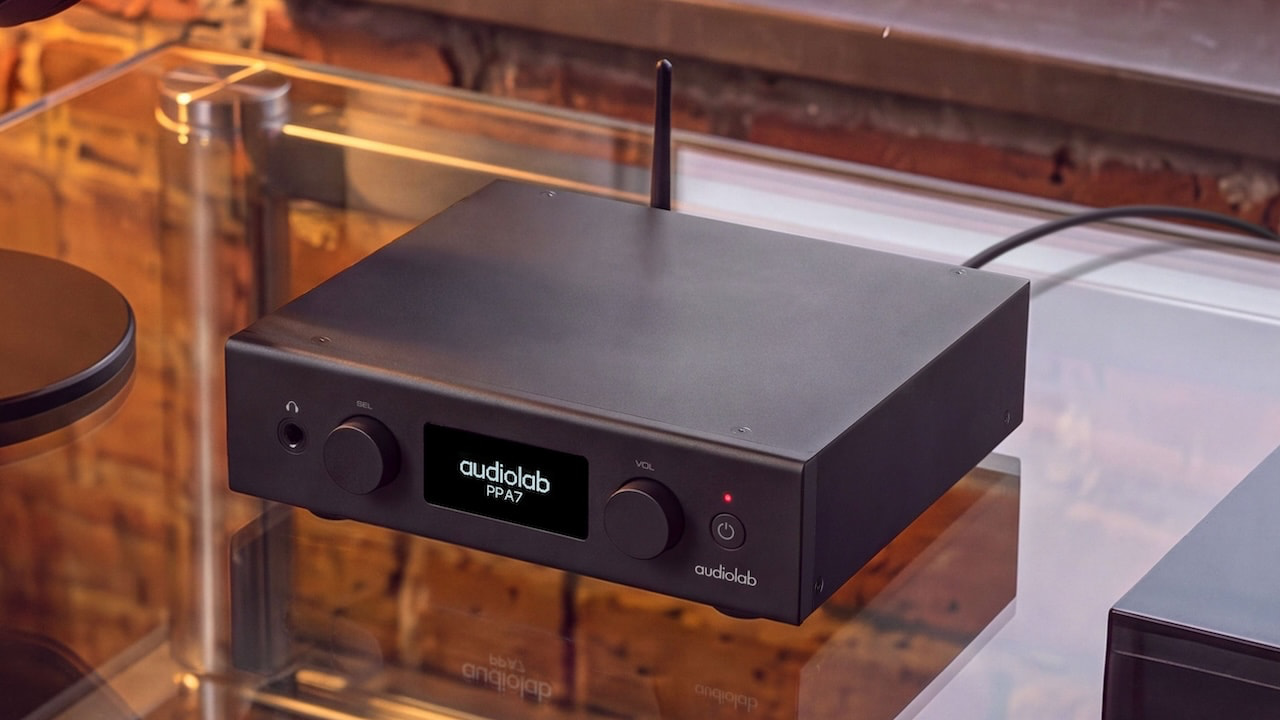
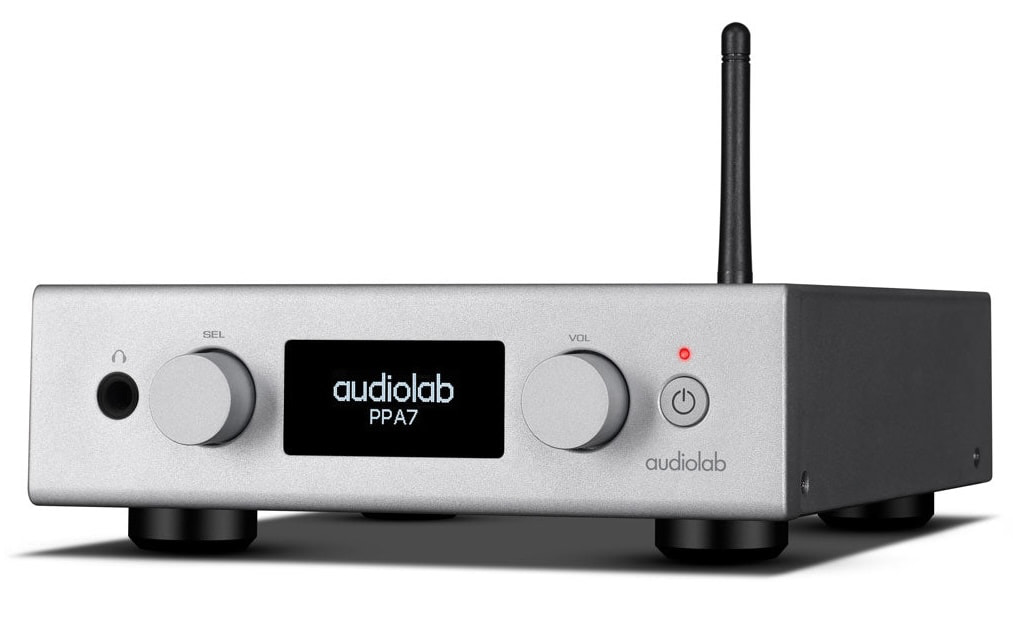
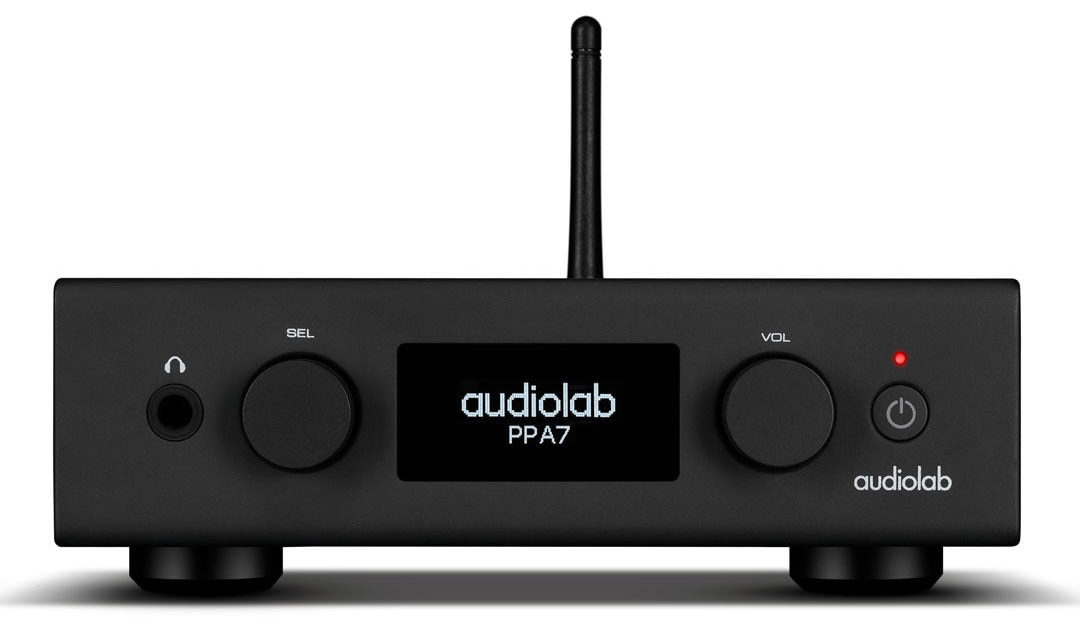
The PPA7 shares its compact aluminum chassis design with Audiolab’s D7 DAC, measuring just 208 x 56 x 180mm. A centrally mounted 33mm OLED display is flanked by two multifunction rotary controls, and Audiolab includes a remote control for convenient operation.
The two components are natural companions in Audiolab’s lineup. The D7 handles digital to analog conversion, while the PPA7 offers the reverse process for recording, alongside its conventional phono amplification duties.
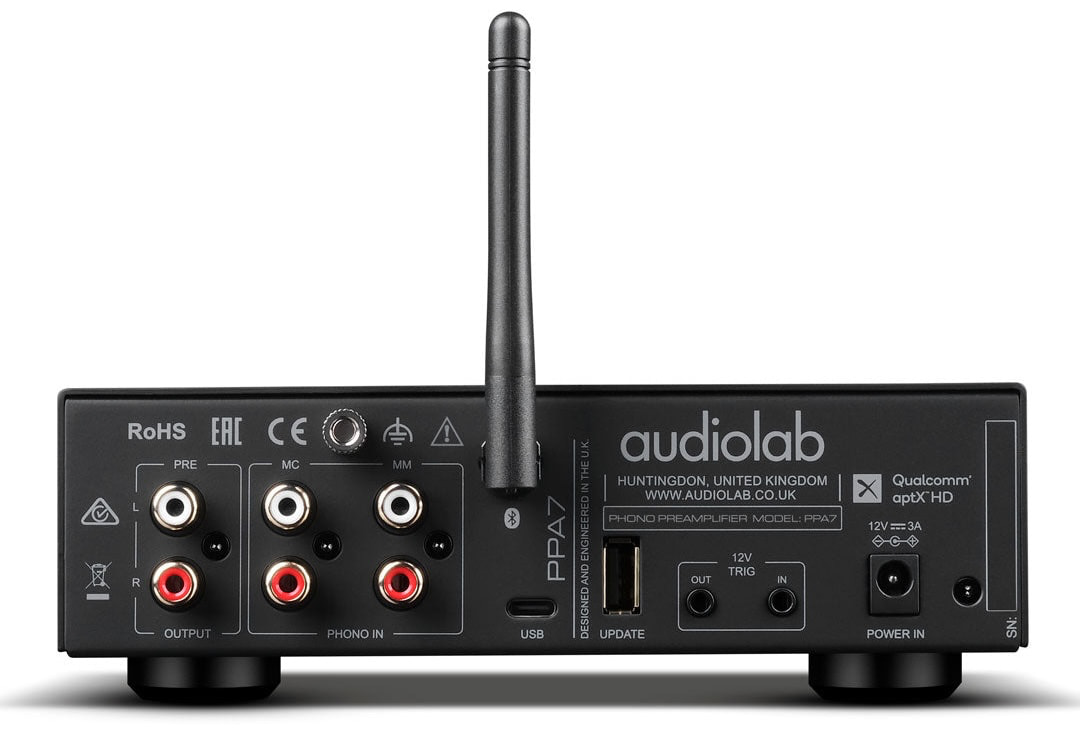
Audiolab also includes 12V trigger connections for integration with compatible components and a separate USB-A port reserved for firmware updates. Available in black or silver, the PPA7 should fit comfortably into a desktop system or a conventional hi-fi rack without requiring much additional space.
Audiolab PPA7 Specifications:
- Type: MM/MC phono preamplifier with headphone amplifier
- Phono Inputs: Separate stereo RCA inputs for MM and MC cartridges
- MM Input Impedance: 47kΩ
- MM Capacitance: Selectable 100pF or 220pF
- MC Loading: Selectable 100Ω or 330Ω
- MM Gain: 46dB nominal, adjustable up to 52dB
- MC Gain: 60dB nominal, adjustable up to 66dB
- Gain Adjustment: ±6dB in 1dB increments
- Frequency Response: 20Hz to 20kHz (±0.5dB)
- Total Harmonic Distortion: Less than 0.003% at 1kHz
- Signal to Noise Ratio: 80dB (A-weighted, MM and MC)
- Analog Outputs: Stereo RCA with fixed or variable output
- Headphone Output: 6.35mm (¼-inch)
- Headphone Amplifier: Current feedback design, up to 600mW output
- Headphone Impedance Compatibility: 20 to 600 ohms
- Bluetooth: Version 5.3 transmitter
- Bluetooth Codec: aptX HD
- USB Recording: USB-C output for PC and Mac
- Recording Resolution: 16-bit or 24-bit, 44.1kHz to 192kHz
- Recording Level Adjustment: -12dB to +3dB
- Display: 33mm OLED
- Additional Connectivity: USB-A for firmware updates; 12V trigger input and output
- Power Supply: External AC power adapter with internally regulated analog circuitry
- Dimensions (W × H × D): 208 × 56 × 180mm (8.2 × 2.2 × 7.1 inches)
- Weight: 1.42kg (3.1 pounds)
- Finishes: Black or silver
- Remote Control: Included
- U.S. Price: $699
- Availability: Expected late October 2026
The Competition: Do You Really Need All These Features?
Cambridge Audio Alva Duo ($399)
Cambridge Audio’s Alva Duo is one of the most logical alternatives for anyone who wants a straightforward MM/MC phono stage with a built-in headphone amplifier. At $399, it delivers the fundamental functionality many vinyl listeners require without making them pay for wireless connectivity or digital recording features they may never use.
The Alva Duo also includes a switchable subsonic filter, which can be valuable when dealing with warped records and unwanted low frequency rumble. Its cartridge loading options are less extensive than the Audiolab’s, but the $300 price difference is difficult to dismiss if your system is entirely analog.
Pro-Ject Phono Box DS3 B ($799)
We’ve covered the Pro-Ject Phono Box DS3 B extensively, and its approach could hardly be more different. The $799 phono stage emphasizes balanced analog circuitry, flexible cartridge matching, and low noise performance rather than combining several listening functions in one chassis.
Its MC loading is continuously adjustable from 10 to 1,000 ohms, with four capacitance settings and six gain options. Balanced XLR connections also make it particularly appealing to owners of compatible turntables and cartridges who want to minimize interference and optimize analog playback.
The Pro-Ject lacks the PPA7’s headphone amplifier, Bluetooth transmitter, and USB recording capabilities, but that doesn’t necessarily make it the inferior product. For serious cartridge experimentation and a dedicated analog system, its additional flexibility may be considerably more valuable.
Who Should Buy the Audiolab PPA7?
The PPA7 makes the strongest case for vinyl listeners who want to simplify their systems without giving up future upgrade options. Someone using an affordable MM cartridge today could eventually move to a compatible MC design, while owners of active speakers or a separate power amplifier can take advantage of its variable output.
Headphone enthusiasts are another obvious audience, particularly those who enjoy listening to records without disturbing everyone else in the house. The ability to choose between wired and Bluetooth headphones adds convenience, although the latter won’t deliver an entirely analog signal path.
Collectors interested in archiving vinyl may find the PPA7 even more compelling. Rather than assembling a phono stage, headphone amplifier, recording interface, and additional cabling, they can accomplish those tasks with one component.
However, owners of demanding low output MC cartridges should examine the available loading and gain settings carefully before purchasing. Audiolab provides useful adjustments, but the PPA7 isn’t intended to replace the extensive cartridge matching flexibility of more specialized phono preamplifiers.
The Bottom Line
The Audiolab PPA7 is an intriguing addition to a category that has remained surprisingly conservative despite the vinyl revival. Its appeal isn’t that Audiolab has invented a revolutionary new way to reproduce records, but that it recognizes how people actually listen to music in 2026.
There is also a legitimate engineering challenge here. Combining sensitive phono amplification with digital conversion and wireless circuitry in a compact enclosure requires careful attention to noise, isolation, and signal integrity. Whether Audiolab has executed that successfully will require proper listening tests and measurements rather than an enthusiastic reading of the feature list.
At $699, the PPA7 looks especially interesting for someone assembling a modern vinyl system from scratch, but owners of an already excellent phono stage shouldn’t feel compelled to upgrade simply because their existing equipment lacks Bluetooth.
Audiolab has made a persuasive case for a more versatile phono preamplifier. Now it needs to prove that convenience hasn’t come at the expense of the music.
Pricing & Availability
The Audiolab PPA7 is priced at $699 in the United States and £499 in the UK, with the British launch scheduled for late October 2026. It will be offered in black and silver finishes, although U.S. dealer inventory and delivery dates should be confirmed before ordering.
For more information: www.audiolab.co.uk
Related Reading:
- Vertere Phono-1 LX MM/MC Phono Preamp Brings Lower Noise And Greater Control To Vinyl Playback
- Audiolab’s 6000A MkII Integrated Amplifier Has Finally Arrived…But We’re Not Ditching Its Predecessor Quite Yet