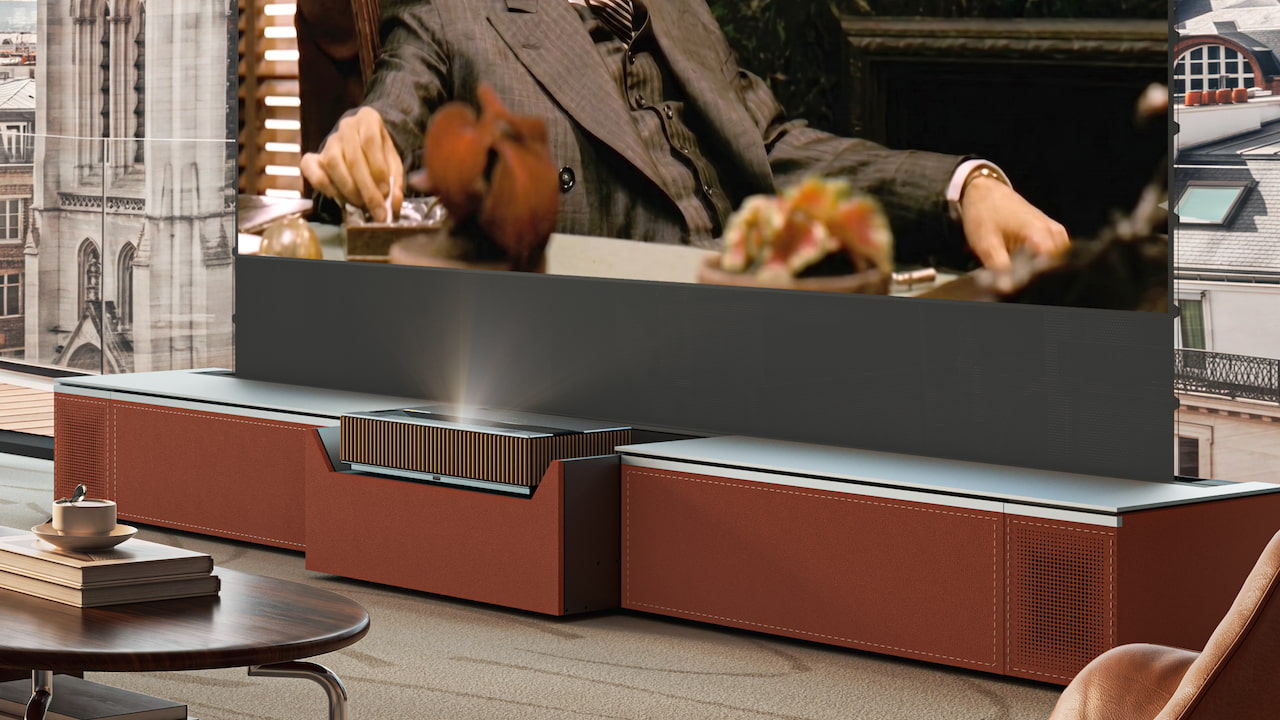
Ultra-short-throw projectors can produce enormous images from only inches away from a wall, but getting one perfectly aligned with a fixed screen can involve far more furniture shuffling than anyone anticipated when they bought it.
AWOL Vision thinks it has a better solution.
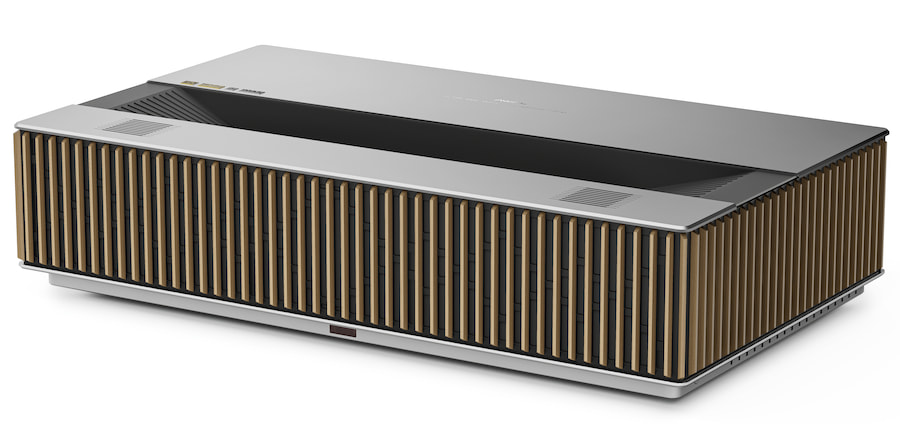
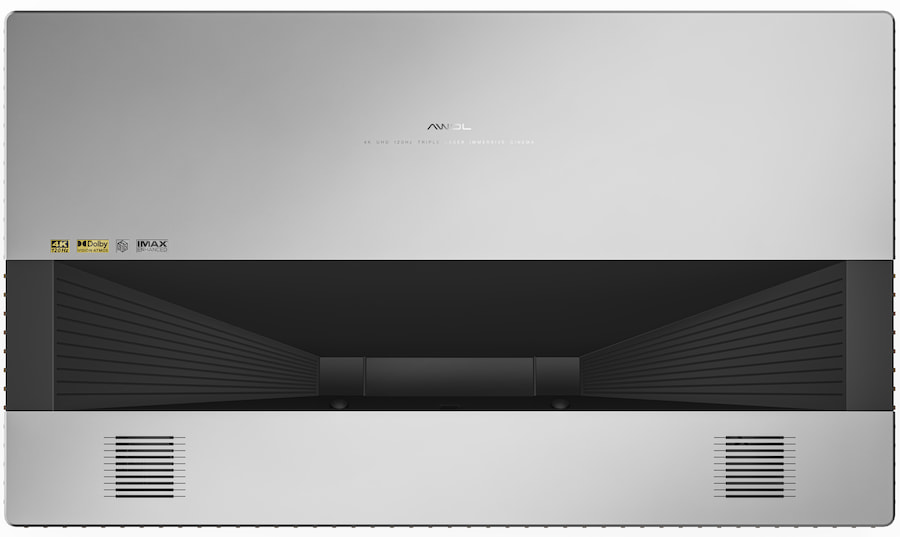
Introduced at IFA 2026 in Berlin and being demonstrated simultaneously at CEDIA Expo 2026 in Denver, the new AWOL LuxVision is a flagship RGB triple-laser UST projector with vertical optical image shift, allowing owners to reposition the picture without relying entirely on digital geometric correction.
AWOL describes LuxVision as the world’s first 4K/120Hz ultra-short-throw projector with optical shift. We have not independently verified every UST projector ever manufactured, so AWOL can keep possession of the trophy for now. What matters more is that the feature addresses a very real installation problem.
The projector carries a $5,999 U.S. MSRP and is expected to arrive around October 2026.
Related Reviews:
- I Rewatched My Blu-Ray 3D Collection On A Projector At Home, And It Has Never Looked Better
- Podcast: 2025 UST Projector Showdown Results Analyzed
- Best UST Projectors Revealed At 2025 UST Showdown – Check Out The Results
Why Optical Shift Matters
UST projectors are unusually sensitive to physical placement. A small change in distance or angle can move the picture far enough that it no longer matches the screen.
Digital keystone and geometric correction can reshape the image electronically, but doing so may involve scaling or sacrificing portions of the active imaging area.
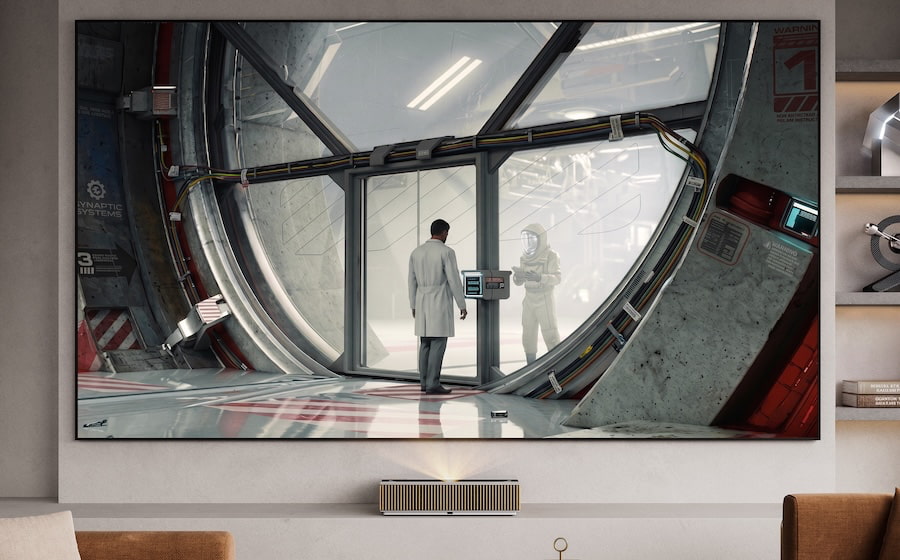
LuxVision instead uses vertical optical shift to move the projected image while preserving its native pixel structure. AWOL specifies an image offset range of 142% to 152%, and automatic screen alignment is also available during setup.
Anyone who has spent an afternoon moving a UST projector a few millimeters at a time will understand why this is considerably more useful than another animated screensaver in the menu system.
Built for Gaming as Well as Movies
LuxVision accepts 4K signals at up to 120Hz and supports VRR and ALLM, putting it much closer to the capabilities expected from modern gaming displays.
AWOL also claims input latency as low as 1 millisecond, although that number will need independent measurement under clearly defined resolution and refresh-rate conditions before we engrave it in stone.
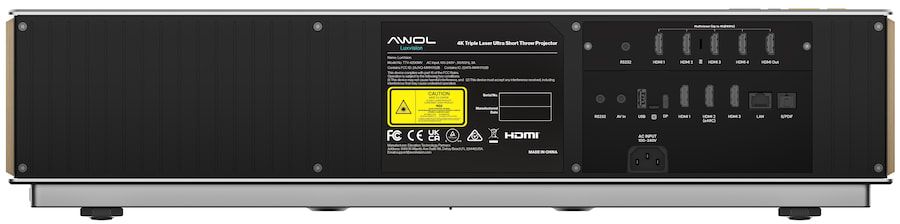
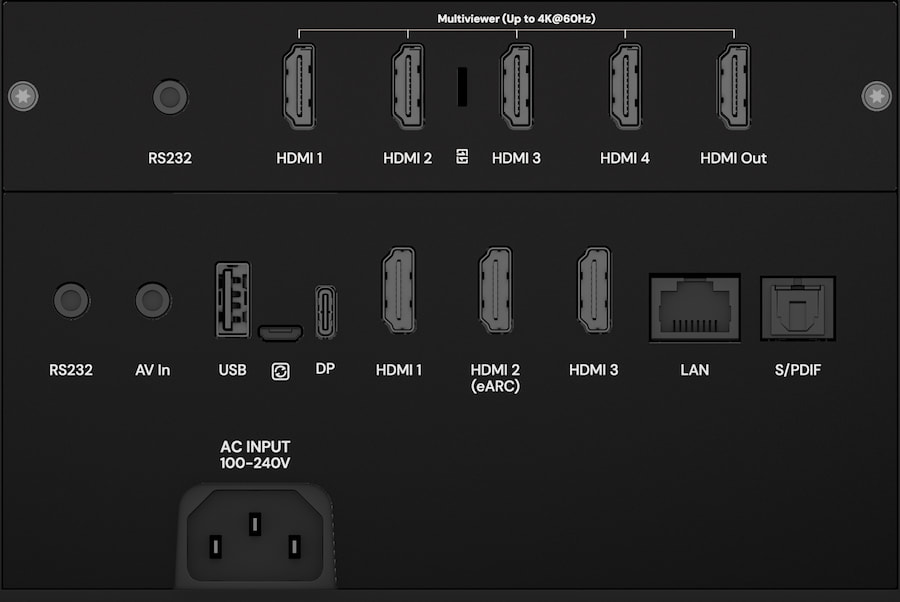
Dolby Vision Gaming is supported, and the inclusion of DisplayPort alongside HDMI makes the projector especially interesting for high-performance gaming PCs. Its 120Hz capability also allows 24fps film content to be displayed using an even 5:5 cadence without requiring 3:2 pulldown.
RGB Triple Laser Light Engine
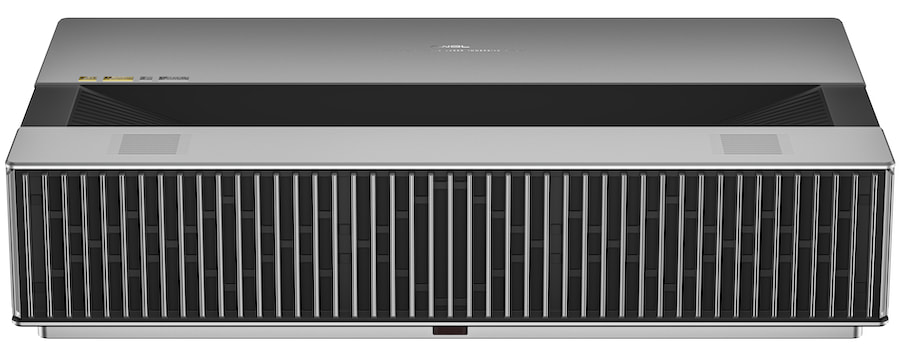
LuxVision uses separate red, green and blue laser light sources and is rated at 6,000 ISO lumens with 110% Rec.2020 color-gamut coverage.
AWOL specifies 10,000:1 native contrast and supplements the optical system with a seven-level Dynamic Iris and its EBL Enhanced Black Level processing. Blackened internal components are also used to reduce reflections within the optical path.
Those are ambitious figures for a DLP-based UST projector. Actual calibrated brightness, black level and HDR performance will matter considerably more than what survives the journey onto a trade-show placard.
AWOL LuxVision Tech Specs
- Type: Ultra-short-throw home theater projector
- Resolution: 4K UHD
- Maximum refresh rate: 120Hz at 4K
- Light source: RGB triple laser
- Brightness: 6,000 ISO lumens
- Native contrast: 10,000:1 claimed
- Color gamut: 110% Rec.2020
- Throw ratio: 0.18:1
- Maximum image size: Up to 200 inches
- Optical adjustment: Vertical optical image shift
- Image offset range: 142% to 152%
- Dynamic iris: Seven levels
- Black-level processing: AWOL EBL Enhanced Black Level
- HDR: Dolby Vision and Dynamic Tone Mapping
- Gaming HDR: Dolby Vision Gaming
- Gaming: VRR and ALLM
- Claimed minimum input lag: 1ms
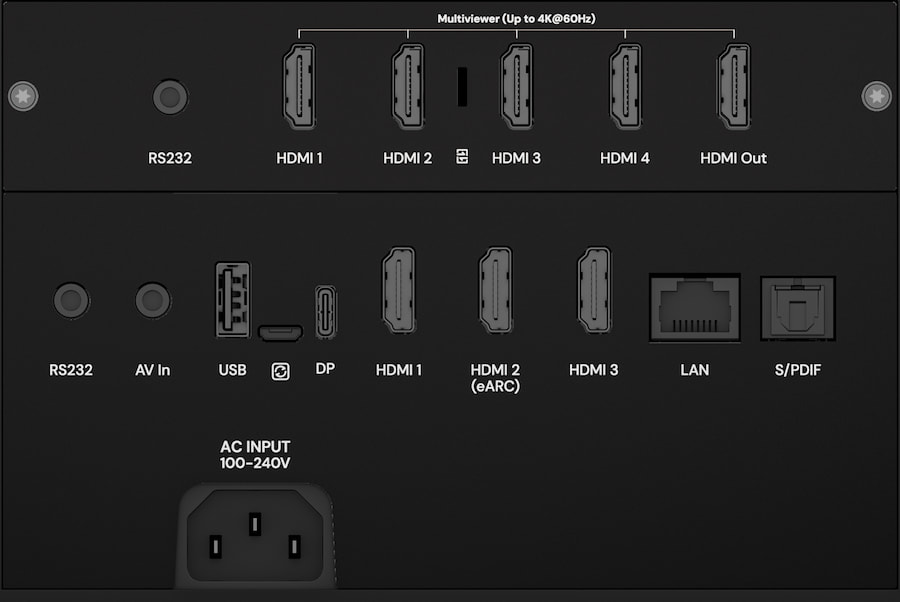
- HDMI: Three HDMI 2.1 inputs
- Additional video input: DisplayPort
- Multiview: Four-channel HDMI Multiview
- Cinema support: IMAX Enhanced
- Picture mode: Filmmaker Mode
- 3D: Supported
- Rainbow-effect reduction: Second-generation Anti-RBE technology
- Lens: Zero-light-leakage design
- Lens cover: Motorized
- Automatic setup: Screen alignment
- Finish options: Customizable color, material and finish configurations
- U.S. MSRP: $5,999
- Expected availability: Around October 2026
AWOL has not yet published a complete production specification sheet covering dimensions, weight, built-in audio, smart-TV platform, wireless connectivity or the detailed audio capabilities of each HDMI connection. Those details remain TBD rather than something we are going to borrow from another AWOL model and hope nobody notices.
Addressing the Rainbow Effect
Single-chip DLP projectors can sometimes produce brief red, green and blue flashes around bright objects against dark backgrounds. Sensitivity varies considerably from one viewer to another.
AWOL uses its second-generation Anti-RBE technology in LuxVision and says it has been validated using more than 10,000 films. The system is designed to reduce visible rainbow artifacts during both 2D and 3D playback, particularly during fast-moving, high-contrast scenes.
That is another claim best evaluated with actual content and actual eyeballs.
Two Strong Competitors
At $5,999, LuxVision lands directly in premium UST territory rather than creating an entirely new price tier. Two established models provide useful context.
Hisense L9Q
The Hisense L9Q carries a regular U.S. price of $5,999.99, although Hisense is currently advertising the projector itself for $4,999.99. It also uses a 0.18:1 RGB triple-laser system and supports screen sizes up to 200 inches.
Hisense approaches the category more like a complete television replacement. Google TV is built in, along with a 116-watt 6.2.2-channel Devialet audio system, making the L9Q considerably more self-contained.
Hisense L9Q Tech Specs:
- Resolution: 4K UHD
- Refresh rate: 4K/60Hz
- Gaming mode: Up to 2K/120Hz
- Claimed gaming latency: 12ms at 2K/120Hz
- Light source: RGB TriChroma triple laser
- Brightness: 5,000 ANSI lumens
- Native contrast: 5,000:1
- Color gamut: 110% BT.2020
- Throw ratio: 0.18:1
- Image size: 80 to 200 inches
- DMD: 0.47-inch
- HDR: Dolby Vision, HDR10+, HDR10 and HLG
- Cinema: IMAX Enhanced
- 3D: Supported
- Smart platform: Google TV
- HDMI: Two HDMI 2.1 plus two HDMI 2.0
- Gaming: ALLM
- Audio: 116-watt 6.2.2-channel Devialet system
- Wireless: Wi-Fi 6E and Bluetooth 5.3
- Smart-home integration: Control4, Google Assistant and Alexa
- Laser life: 25,000+ hours
- Regular U.S. price: $5,999.99
- Current direct price: $4,999.99
The L9Q’s strengths are integration and built-in audio. LuxVision is aimed more aggressively at viewers who prioritize installation flexibility and high-refresh-rate sources.
Samsung The Premiere 9
Samsung’s The Premiere 9 also carries a $5,999.99 MSRP and represents the large-brand alternative at almost exactly the same price.
Its triple-laser system is wrapped around Samsung’s Tizen smart-TV ecosystem, Gaming Hub and integrated Dolby Atmos audio, making it another product designed to function without an external streamer or sound system. Samsung currently lists the model as out of stock through its U.S. store.
Samsung The Premiere 9 Tech Specs:
- Resolution: 4K UHD
- Light source: Triple laser
- Maximum image size: 130 inches
- Brightness: 3,450 ISO lumens
- Color performance: 154% DCI-P3 color volume claimed
- HDR: HDR10+
- Video processing: 4K AI Upscaling
- Ambient-light processing: Vision Booster
- Smart platform: Samsung Tizen OS
- Gaming platform: Samsung Gaming Hub
- Built-in audio: 40-watt 2.2.2-channel system
- Immersive audio: Dolby Atmos
- Voice/smart-home support: Bixby, Alexa and SmartThings
- U.S. MSRP: $5,999.99
Samsung’s advantage is the completeness of its ecosystem. AWOL is betting that enthusiasts at this price are more interested in projection-specific performance and installation control.
The Bottom Line
The most compelling aspect of LuxVision is not that AWOL has found another way to increase brightness or attach a longer list of acronyms to a projector. Optical image adjustment solves a practical weakness of the UST format, particularly for owners using large fixed-frame screens where small placement errors become very obvious.
The emphasis on high-refresh-rate gaming also distinguishes it from premium UST models built primarily around movies and streaming.
Hisense remains the stronger all-in-one proposition, while Samsung offers the most mature consumer ecosystem. AWOL is taking the enthusiast route instead: prioritize the optical system, give gamers more connectivity and leave some of the lifestyle conveniences to everybody else.
Whether LuxVision can deliver on AWOL’s ambitious contrast, latency and brightness claims will determine how disruptive it actually is.
But making a UST projector easier to align without spending the afternoon crawling around on the floor? Our knees remain cautiously optimistic.
Price & Availability
The AWOL LuxVision carries a U.S. MSRP of $5,999, with availability expected around October 2026. European pricing is €5,999, while the U.K. price is £4,999.
LuxVision is being demonstrated at IFA 2026 in Berlin at Booth H22-113 and CEDIA Expo 2026 in Denver at Booth 4019.
For more information: awolvision.com
Related Reading: