The projector industry has a rather large problem in 2026: 98-inch televisions are getting cheaper, brighter and increasingly difficult to ignore. Simply telling consumers that a projector can make a bigger image is no longer enough when enormous Mini-LED televisions are becoming attainable without requiring a dedicated projection room.
That has forced projector manufacturers to become considerably more ambitious. We recently looked at the XGIMI MIRA, which attacks the more affordable end of the ultra-short-throw market, along with newer lifestyle projectors such as the XGIMI HORIZON 20 Series and Hisense XR10, which combine easier placement with increasingly sophisticated optics, HDR processing and gaming features.
The new $2,399 XGIMI AURA 3 Max pushes that trend into the premium UST category with an RGB triple-laser light engine rated at 5,700 ISO lumens, a dual-iris optical system, claimed 8,000:1 native contrast, 110% BT.2020 color coverage, Dolby Vision, HDR10+, Google TV and support for 4K/120Hz gaming over HDMI 2.1.
This is not simply an AURA 2 with more light coming out of it.
Related Reviews: Hisense XR10 Triple Laser 4K Lifestyle Projector Review
What Makes the AURA 3 Max Different?

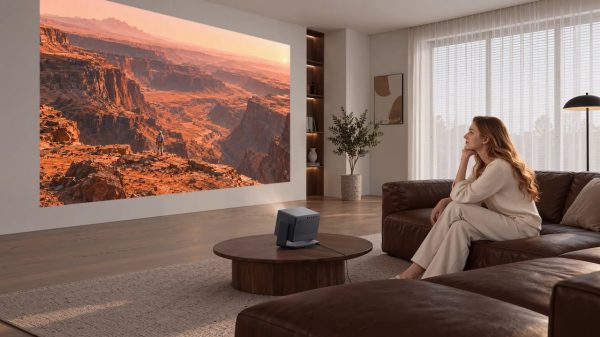
Ultra-short-throw projectors have always made a compelling lifestyle argument. Instead of hanging a projector from the ceiling and running cables through the room, a UST can sit on a cabinet beneath the screen and create a very large image from only a short distance away.
The AURA 3 Max has a 0.163:1 throw ratio and can produce a 120-inch image with roughly eight inches between the projector and screen. XGIMI also includes automated screen alignment, autofocus, keystone correction, wall-flatness compensation, wall-color adaptation and eye protection to make installation less intimidating for consumers who do not want to turn their living room into a weekend calibration project.
Those conveniences are increasingly common, however. What separates the AURA 3 Max from less expensive UST models is the amount of attention XGIMI has paid to contrast, optics and gaming performance, areas where lifestyle projectors have historically made compromises.

RGB Triple Laser and 5,700 ISO Lumens
The AURA 3 Max uses an RGB triple-laser light source with a claimed maximum output of 5,700 ISO lumens and coverage of 110% of the BT.2020 color space.
That level of brightness is clearly intended for multipurpose living spaces where total light control may not always be practical, although manufacturer brightness specifications should never be confused with independently measured output in an accurate picture mode. That will require an actual review.
A proper ambient-light-rejecting UST screen will also remain important for anyone planning to use the projector during the day. The screen is sold separately, so buyers need to factor that expense into any comparison with a 98-inch or larger television.
Dual Iris Contrast Control
The AURA 3 Max’s dual-iris optical system may ultimately prove more important than the lumen number.
Very bright DLP projectors can struggle with black levels and shadow depth, especially when they are designed to produce enough light for daytime viewing. XGIMI says its two-stage iris system combines optical light control with dynamic adjustment based on the content and can deliver up to 8,000:1 native contrast.
The company also uses Dynamic Black Enhancement to further increase perceived contrast while attempting to preserve detail in darker scenes.
Those figures need independent verification, but the direction is important. Premium UST manufacturers are no longer competing solely on brightness. Contrast control is becoming one of the key battlegrounds, with competitors such as Hisense and AWOL Vision also introducing increasingly sophisticated optical systems to improve black levels.
X Vision AI Processing and HDR
The AURA 3 Max introduces XGIMI’s X Vision AI image processor, which performs real-time analysis for detail reconstruction, HDR optimization and other picture adjustments.
HDR support includes Dolby Vision, HDR10, HDR10+, HLG and dynamic HDR tone mapping, along with IMAX Enhanced and Filmmaker Mode. Native 24fps playback is supported for film material.
XGIMI has also addressed two artifacts commonly associated with RGB laser DLP projection: laser speckle and rainbow effects. The company says its optical system and processing reduce both, although sensitivity varies considerably from viewer to viewer and remains something we would want to evaluate in person.
The optical assembly uses 19 elements, including ED-grade optical glass and multi-layer coatings designed to maintain focus and color consistency from the center of the image to the edges. That emphasis on better lenses reflects a broader shift in the lifestyle-projector category, where convenient placement is no longer considered an excuse for mediocre optics.
4K/120Hz Gaming
Gaming is one of the AURA 3 Max’s more unusual strengths.
XGIMI uses two DLPC 8545 display controllers operating in parallel to process 4K UHD signals at 120Hz. The projector also supports VRR, ALLM, AMD FreeSync Premium and Dolby Vision Gaming, along with claimed input latency as low as 1ms depending on resolution and operating mode.
XGIMI describes the AURA 3 Max as the world’s first UST projector to support 4K/120Hz playback. We would leave that phrased as XGIMI’s claim rather than treating it as an independently verified industry first, particularly given the number of regional and differently specified projector models now entering the market.
What matters more is the practical application. Owners of a PlayStation 5, Xbox Series X or gaming PC can potentially use a very large projected image without being limited to the 4K/60Hz ceiling still found on many UST projectors.
That makes the AURA 3 Max considerably more interesting for gamers than most previous premium UST designs.
Google TV and Harman Kardon Audio
The projector runs Google TV, providing native access to Netflix, YouTube, Prime Video and other major streaming services, along with Google Cast and Google Home integration.
Audio comes from an integrated 80-watt Harman Kardon system with support for Dolby Atmos and DTS Virtual.
Anyone spending serious money on a premium projector should still consider a proper soundbar or surround system, but integrated audio matters in this category. UST projectors are increasingly marketed as television replacements, and many buyers expect them to function as complete entertainment systems without requiring an AVR and five loudspeakers on day one.
Connectivity includes three HDMI inputs, including an eARC connection, plus USB 3.0, USB 2.0, Gigabit Ethernet, optical digital audio and analog audio connectivity. XGIMI also includes two pairs of 3D glasses, because projection remains one of the few corners of the display industry where 3D has somehow avoided being buried completely.
Key Competitors
The Hisense PX4 Pro is one of the most obvious rivals. Hisense currently lists it at $3,999.99 and equips it with an RGB triple-laser light engine, 3,500 ANSI lumens, a claimed 6,500:1 contrast ratio, Dolby Vision, IMAX Enhanced and gaming-focused features.
The Hisense L9Q moves further upmarket with up to 5,000 ANSI lumens, Google TV and a considerably more elaborate built-in Devialet audio system. It is particularly relevant because Hisense has spent years establishing itself as one of the dominant brands in the UST category.
The AWOL Vision Aetherion Max is another direct competitor, with RGB triple-laser projection, wide-gamut color, Dolby Vision, VRR and aggressive gaming specifications.
Consumers spending less should also consider models such as the NexiGo Aurora Pro MKII ($2,999), which has earned a strong reputation for delivering excellent UST performance without moving into the highest price tier.
That competitive field makes the AURA 3 Max’s eventual U.S. price extremely important. Its specification sheet is impressive, but premium UST buyers have more credible alternatives than ever before.
Who Is the XGIMI AURA 3 Max For?
The most obvious customer is someone who wants a 100 to 120-inch or larger image in a multipurpose living roombut has no interest in ceiling mounting a traditional projector or designing a dedicated theater around one.
Movie and sports fans should appreciate the high light output and extensive HDR support, while gamers have an unusually strong reason to look at this model because of its HDMI 2.1 feature set and high-refresh-rate capabilities.
The AURA 3 Max could also appeal to consumers considering one of the increasingly affordable 98-inch televisions but who still want something significantly larger. A 120-inch 16:9 image provides roughly 50% more screen area than a 98-inch display, which is a substantial difference once both are viewed at normal seating distances.
There are still tradeoffs. The ALR screen adds cost, even a very good UST projector will not automatically match the black levels of the best OLED or high-end Mini-LED televisions, and consumers sensitive to DLP rainbow artifacts or laser speckle should see one in person before purchasing.

Price & Availability
XGIMI has now confirmed the first U.S. pricing details for the AURA 3 Series. The AURA 3 Max will launch on Kickstarter for $2,399 on October 20, 2026.
The projector itself is not new to CEDIA. XGIMI originally unveiled the AURA 3 Max in China in May 2026, so describing it as a CEDIA Expo 2026 launch would be inaccurate. Its appearance at the show is better viewed as part of the company’s international rollout, now accompanied by substantially more information about how and when U.S. buyers will be able to order one.
The Bottom Line
The XGIMI AURA 3 Max is interesting because it attacks several of the remaining weaknesses of premium UST projection rather than simply adding more brightness. The two numbers we still want independently verified are the claimed 8,000:1 native contrast ratio and ultra-low gaming latency.
The dual-iris optical system is aimed at improving contrast, while the elaborate RGB laser engine, improved optics and broad HDR support address picture quality. HDMI 2.1, 4K/120Hz, VRR and ALLM give gamers features that remain unusual in this category, and Google TV plus substantial built-in audio preserve the convenience that makes UST projectors attractive in the first place.
If XGIMI gets that part right, the AURA 3 Max could become one of the more compelling premium UST options of 2026. Giant televisions are no longer giving projector manufacturers much room for complacency, and this looks like XGIMI’s response.
Related Reading:
- XGIMI MIRA Makes RGB Triple Laser 4K UST Projection More Affordable
- Leica Cine Compact 1 Projector Debuts: 4K RGB Laser Performance In A Smaller Package For $2,000
- Hisense PX4-PRO UST Home Theater Projector Beams 200-Inch Images (2026 Model, Now Available)
- Best Home Theater Projectors: Editors’ Choice