
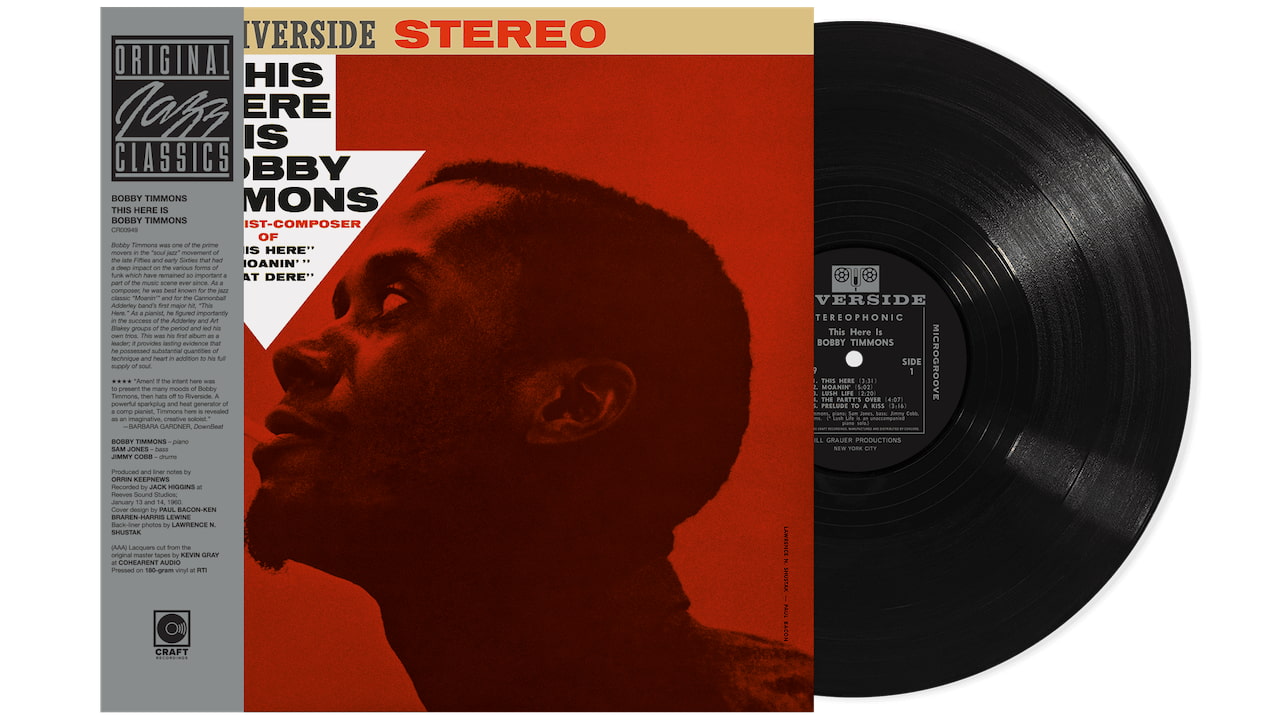
Craft Recordings’ revived Original Jazz Classics series has become the Lionel Messi of jazz reissues: technically brilliant, relentlessly consistent, and apparently incapable of having an off season. Since returning in 2023, OJC has delivered one carefully selected release after another, combining audiophile-grade sound with proper packaging, and without treating jazz collectors like an unlimited source of disposable income.
That winning streak continues with Bobby Timmons’ This Here Is Bobby Timmons, the pianist’s 1960 Riverside debut as a leader and an early defining statement from one of the architects of soul jazz. This 180-gram edition features AAA lacquers cut directly from the original analog tapes by Kevin Gray at Cohearent Audio, is pressed at RTI, and arrives in a tip-on jacket that faithfully recreates the original artwork. Craft has used this formula repeatedly, but the consistently strong results have made OJC one of the safest bets in modern jazz vinyl, which is more than can be said for buying a “near mint” original pressing from a stranger on the internet.
Related Reviews:
- Miles Davis Miles ’56 Review: Craft’s Prestige Box Set Makes The First Great Quintet Essential Again
- McCoy Tyner Quartet’s 1991 “New York Reunion” Album Reemerges On 2LP Pink One Step Pressed 180-Gram Vinyl: Review
- Red Garland Quintet Soul Junction Review: Craft Recordings’ OJC Reissue Gets The Groove Exactly Right
The Soul of Hard Bop
When Bobby Timmons entered the studio in 1960 to record This Here Is Bobby Timmons, he was only 24 years old, but he had already helped change the direction of modern jazz. His first album as a leader was less an introduction than a declaration that the pianist behind “Moanin’,” “This Here” and “Dat Dere” possessed considerably more range than the “funky” label that would follow him throughout his career.
Born and raised in Philadelphia, Timmons grew up playing music in the church pastored by his grandfather. Gospel was not something he added later because record labels discovered that soulful jazz could sell; it was embedded in his phrasing, rhythmic attack and use of call and response. Philadelphia also produced McCoy Tyner, born three years after Timmons, whose powerful left hand and harmonic language would become essential to John Coltrane’s classic quartet.
They were very different players, but both reflected a Philadelphia piano tradition built on rhythmic authority, blues feeling and absolutely no interest in sounding timid, which still makes perfect sense in a city where a parking cone is considered private property and every sports season ends with either a parade or a public inquiry.
Timmons first made his mark with Art Blakey’s Jazz Messengers, writing “Moanin’” for the group’s landmark 1958 recording. The composition became so closely identified with the album that it eventually replaced the original self-titled name in common usage. After joining Cannonball Adderley in 1959, Timmons contributed “This Here” to The Cannonball Adderley Quintet in San Francisco, another defining hard bop recording and one of the releases that helped push soul jazz beyond the clubs and into the wider jazz audience.
This Here Is Bobby Timmons brought that musical language into the trio format with bassist Sam Jones and drummer Jimmy Cobb. The album revisits “Moanin’,” “This Here” and “Dat Dere,” but its standards and ballads reveal a more complete pianist; one influenced by Bud Powell and fully capable of subtlety, harmonic sophistication and restraint when the music required it. His solo reading of “Lush Life” should end any lingering argument that Timmons was merely a supplier of catchy church riffs.
The albums that followed reinforced the point. Soul Time, recorded with Blue Mitchell, Sam Jones and Art Blakey, placed his writing and improvisation inside a muscular quartet setting, while Blakey’s The Big Beat featured “Dat Dere” and captured one of the strongest Jazz Messengers lineups. Easy Does It reunited Timmons with Jones and Cobb, and Sweet and Soulful Sounds balanced blues-driven originals with solo performances that exposed the connection between Bud Powell’s bebop vocabulary and Timmons’ church-rooted foundation.
These records make the same case from different directions: Bobby Timmons did not merely help popularize soul jazz. He gave it some of its most enduring melodies, its rhythmic identity and a direct emotional connection that still works more than six decades later.
Swings Hard and Never Lets Up

The first thing that stands out is the pacing. This Here Is Bobby Timmons moves with purpose from the opening bars, driven by a trio that sounds completely locked together without ever becoming rigid. There is real momentum to the music, but it never feels rushed. The album simply leans forward and invites you to move with it.
I became so absorbed that I had to text my children and ask them to stop screaming at one another while playing Xbox, which produced exactly the level of cooperation you would expect: none. Timmons’ piano has that kind of pull. Perhaps it worked on his own children.There is an energy, flow and rhythmic certainty to his playing that makes it difficult to focus on much else. His fingers do not sound as though they were designed to do anything but play the piano.
“My Funny Valentine” was bloody distracting. Timmons plays it with such an easy sense of timing that I stopped whatever I was doing and just leaned into it. There is no grandstanding and no attempt to turn the tune into a technical exercise. It simply flows, and before long you are moving with it; even if, like me, you have never set foot inside Minton’s Playhouse.
Sonically, the OJC pressing is exceptionally clean. The piano has real weight and physical presence, with Timmons locked firmly in place within a solid, believable soundstage. Sam Jones and Jimmy Cobb remain clearly defined around him, and the recording preserves the sense that all three musicians are responding to one another in real time. “Joy Ride” just bops, with the trio perfectly in step and the rhythm section pushing the music forward without crowding the piano.
At roughly 37 minutes, This Here Is Bobby Timmons is not a particularly long album, but not every record needs to turn listening into an endurance event. There is no filler, the pacing never sags, and the final note arrives before the record has exhausted its welcome.
My copy was perfectly centered, extremely quiet and free of any visible pressing defects. Craft Recordings and RTI have delivered another excellent OJC reissue, and this is easily one of my favorite titles in the series so far in 2026.
Our Ratings
★★★★★★★★★★ Music
★★★★★★★★★★ Sound Quality
★★★★★★★★★★ Pressing Quality
Where to buy:
Related Reading:


























rl1856
July 29, 2026 at 6:19 pm
Riverside LPs were surprisingly well recorded but were often let down by the quality of vinyl used for pressings. Listeners are rewarded if they find a clean Riverside pressing. The recordings capture the air and space around the musicians and room, but deep bass and treble are rolled off. A lack of bass sometimes alters the timbre of a piano or upright bass, which take on new impact when a remaster uncovers the bass notes that were originally captured. However remasters, including Craft, frequently loose that last smidgeon of air/space/you are there feeling that is conveyed from an origional pressing. Given that it is difficult to find a Riverside title that is origional, in EX or better condition, and using clean vinyl, the Craft reissue is an easy recomendation.