Woody Shaw’s Song of Songs is not background jazz. It does not politely occupy the room while you settle into a chair with a Glenrothes in hand and the dog asleep at your feet.
There are moments when it sounds like everyone has decided to run in a slightly different direction, occasionally at considerable speed. The first listen can feel frantic, even somewhat disjointed. Then you play it again. And again. Eventually, the apparent disorder begins revealing its internal logic.
That is precisely why this 1973 album remains such an interesting recording more than five decades later.
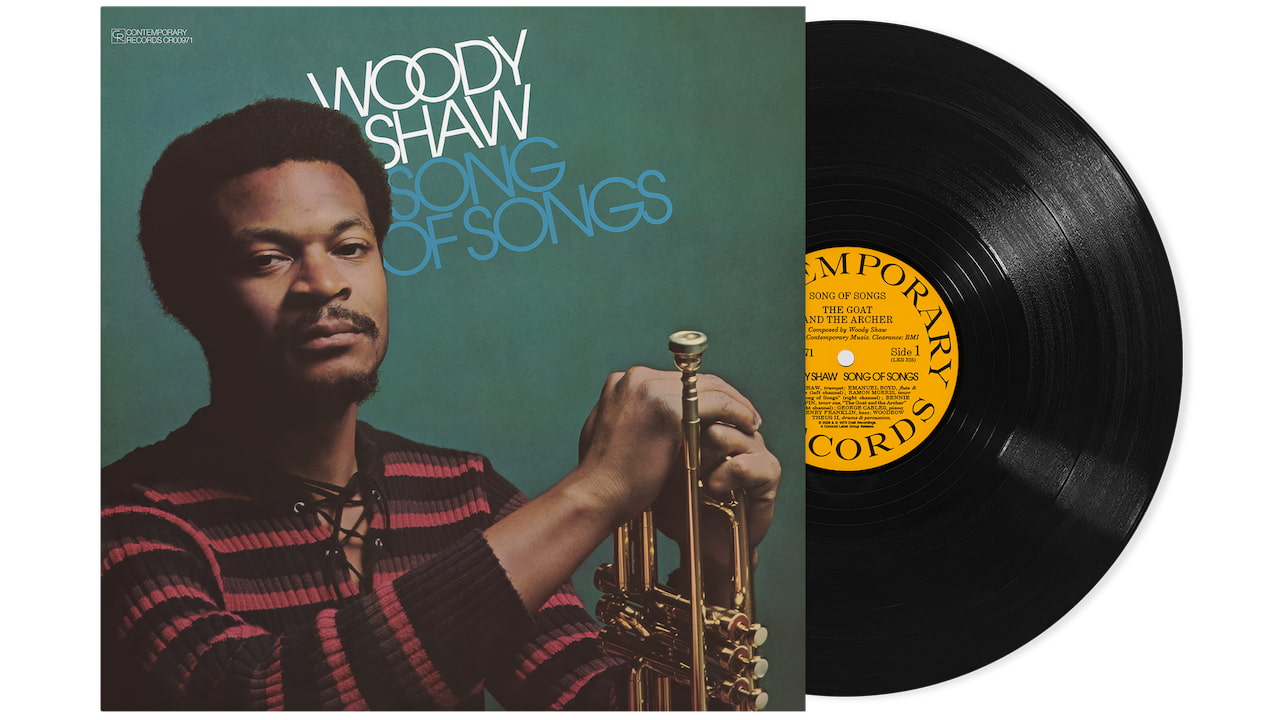
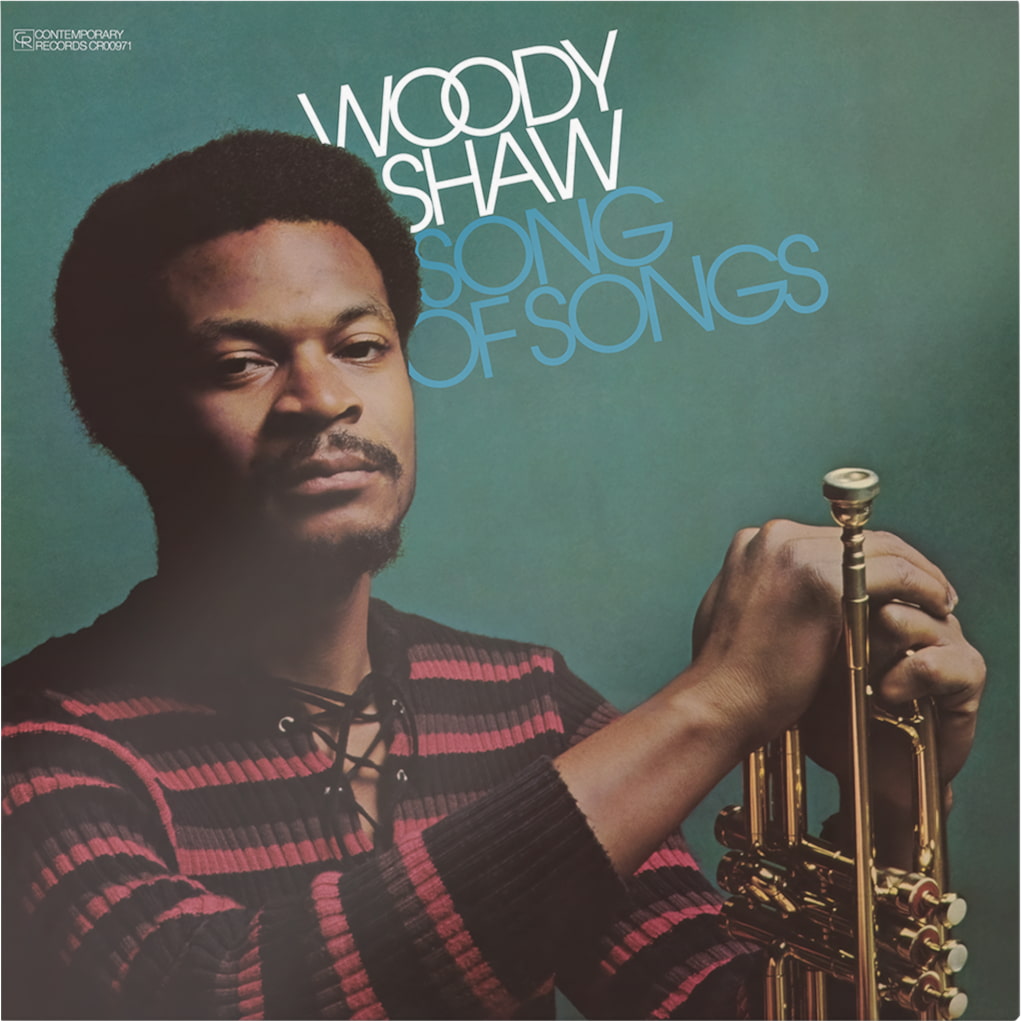
Jazz Dispensary’s Top Shelf edition returns Song of Songs to vinyl for the first time in more than 50 years. The release was cut AAA from the original analog master tapes, pressed on 180-gram vinyl at Fidelity Record Pressing, and packaged in a tip-on jacket reproducing the original Contemporary artwork.
My copy was extremely clean and well centered, with very little surface noise.
Who Was Woody Shaw?
Woody Shaw was born in North Carolina in 1944 but grew up in Newark, New Jersey, where he began studying trumpet at age 11. By his late teens and early twenties, he was already working in the orbit of musicians including Eric Dolphy, Larry Young and Horace Silver before later playing with Art Blakey, Dexter Gordon and others.
Calling Shaw merely a gifted post-bop trumpeter undersells him considerably.
He absorbed bebop and hard bop but pushed the trumpet into more harmonically complex territory influenced by John Coltrane, Eric Dolphy and McCoy Tyner. His phrasing could be angular, dense and rhythmically unpredictable without abandoning melody or swing. Shaw also became an important influence on later trumpeters, with his official archive citing musicians including Wynton Marsalis, Terence Blanchard, Randy Brecker, Tom Harrell and Dave Douglas among those affected by his work.
He died in 1989 at only 44.
Why Song of Songs Matters
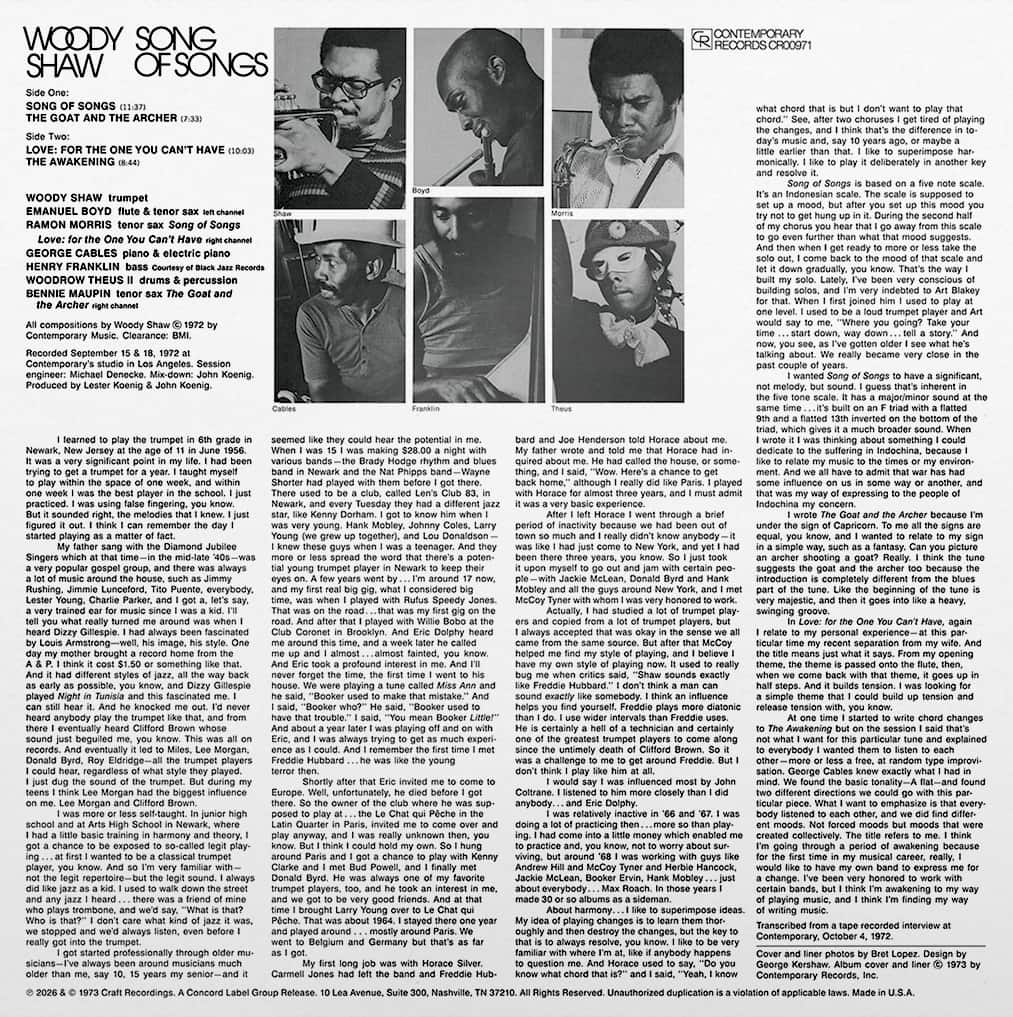
Recorded in Los Angeles in September 1972 and released by Contemporary Records the following year, Song of Songs was Shaw’s second album as a leader after Blackstone Legacy. All four compositions were his own.
The ensemble included George Cables on piano and electric piano, Henry Franklin on bass, Woodrow Theus II on drums and percussion, Emanuel Boyd on flute and tenor saxophone, Ramon Morris on tenor saxophone, and Bennie Maupin appearing on “The Goat and the Archer.”
What makes the record important is where Shaw was standing musically. Hard bop remained part of the foundation, but modal jazz, spiritual jazz and the avant-garde were pushing hard against its walls. Shaw was not abandoning structure so much as stretching it until the bolts started complaining.
The nearly 12-minute “Song of Songs” was constructed around a five-note Indonesian scale and reflected Shaw’s response to the Vietnam War, while “The Awakening” pointed toward the increasingly personal musical language that would define his later work.
This album swings back and forth between controlled ensemble playing and bursts of almost frantic energy. On the title track, Shaw remains largely front and center, his trumpet possessing real bite without becoming brittle. There is plenty happening around him, but the presentation does not behave like the kind of audiophile recording where you spend 20 minutes admiring how neatly the tenor saxophone has been nailed to a spot three feet behind the left loudspeaker.
Things move. They collide. Musicians enter the picture and then seem to retreat. The soundstage feels active rather than diagrammed.
And that works.
“The Goat and the Archer” has more obvious swing underneath it, but even here Shaw and Maupin refuse to make things particularly comfortable. “Love: For the One You Can’t Have” offers some breathing room, although calling it relaxing would still be generous.
“The Awakening” is where the entire record begins to make sense. What initially feels chaotic across Song of Songs reveals itself as musicians listening, reacting and pushing one another rather than merely waiting for the next prescribed solo.
This is energetic, restless jazz. It is probably not what I would put on at midnight with a drink and the lights turned down—unless I were home alone, annoyed at the world and possibly under the influence of something stronger than Rooibos.
But after several plays, I found myself appreciating the record considerably more than I did on the first pass. Its lack of immediate cohesion is part of the point. You have to meet it halfway.
Shaw’s trumpet is clear, immediate and predominantly forward in the presentation, with enough bite to preserve the character of his playing. The recording never feels overly polished, nor should it. Bass has sufficient weight, percussion remains easy to follow during busier sections, and the horns maintain separation without stripping the ensemble of its inherent volatility.
Woody Shaw was searching for something beyond conventional hard bop, and you can hear that struggle throughout these four compositions. The music can sound frenetic, confrontational and almost disconnected at first, but repeated listening reveals how deliberately these musicians are interacting.
If your idea of jazz involves dim lights, a comfortable chair and something expensive from Speyside, perhaps save this one for another evening.
But if you want to hear one of the most important trumpet voices of the post-bop era figuring out where jazz could go next, Song of Songs deserves the effort. At $33, this beautifully produced AAA reissue makes that effort rather inexpensive.
Our Ratings
★★★★★★★★★★ Album
★★★★★★★★★★ Sound
★★★★★★★★★★ Pressing
Where to Buy
Related Reading:
- Review: Coleman Hawkins’ The Hawk Relaxes Returns On Vinyl In Craft Recordings’ Acoustic Sounds Moodsville Series
- Cookin’ With The Miles Davis Quintet Review: This OJC Reissue Gets The Heat Right
- This Here Is Bobby Timmons 180 Gram Vinyl Review: Craft Recordings Revives A Soul Jazz Classic
- Jazz Dispensary At 10, Integrators In The Keys, Wireless Headphones On The Road, Catherine O’Hara, And Sinners Leading The Pack: Editor’s Round-Up