
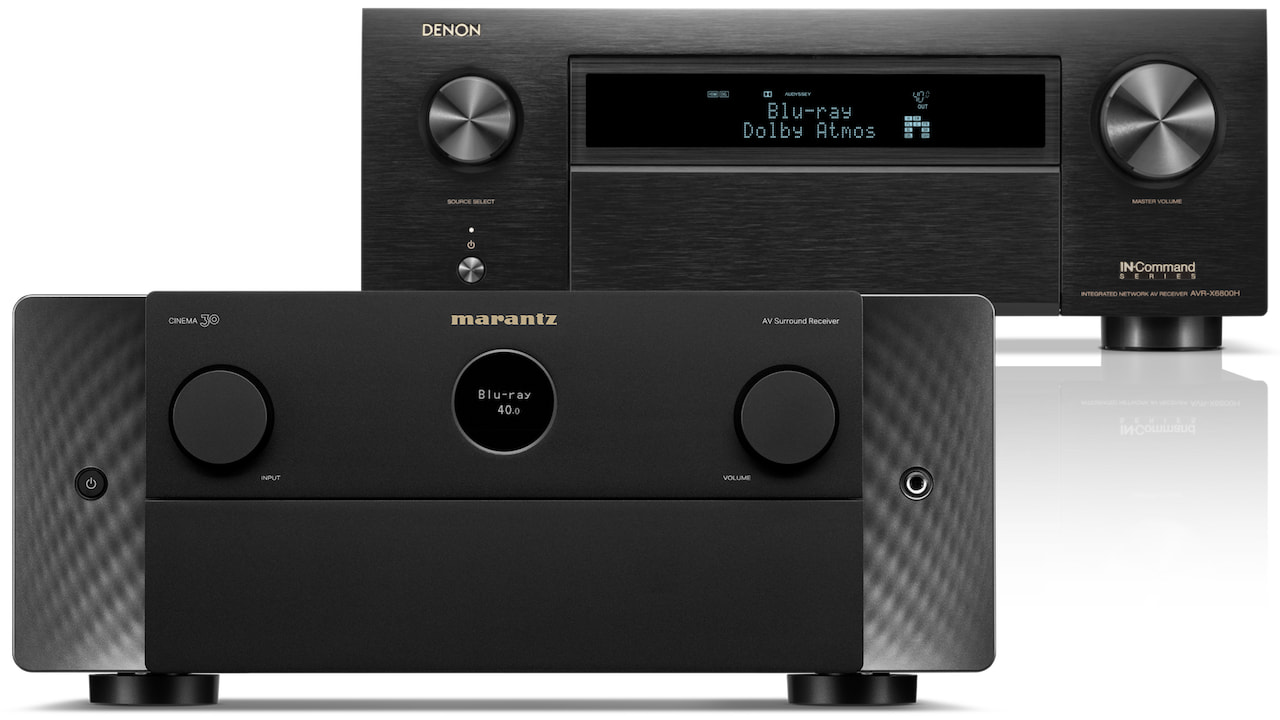
Should you buy a Denon or Marantz AVR, and why does it matter in 2025? As soundbars dominate living rooms with sleek convenience, traditional A/V receivers are fighting back with power, flexibility, and true cinematic immersion. Denon and Marantz, two of the most respected names in home theater, remain the go-to choices for anyone serious about multi-channel sound. This guide breaks down what sets them apart, who each brand is best for, and why an AVR might still be your smartest upgrade for big-screen entertainment.
Table of contents
- Understanding AVR Basics: What You Need to Know Before Buying
- The Denon Brand: Innovation and Performance in A/V Receivers
- The Marantz Brand: Legendary Sound Quality in Home Theater Receivers
- Why Choose a Denon or Marantz AVR for Your Home Theater System?
- Room Correction
- HEOS: Whole-Home Audio for Denon and Marantz AVRs
- Remote Controls
- Onscreen Setup Assistant
- Which Onscreen Interface and Menu is Better?
- Warranty Differences
- Denon & Marantz AVRs: Our Top Picks for Every Budget
- The Bottom Line
- Price & Availability
Understanding AVR Basics: What You Need to Know Before Buying
An A/V Receiver (AVR) combines three essential components in one device: a preamplifier, an AV processor, and a power amplifier. This all-in-one design makes an A/V Receiver the central hub of a home theater system, connecting speakers, source components, and a display—whether that’s a TV or a projector. Unlike a standard integrated amplifier, most AVRs include a built-in AM/FM tuner, a defining feature that separates them from stereo amps.
In addition, modern AVRs feature one or more subwoofer outputs to connect powered subwoofers, delivering deeper, more impactful bass for movies and music.

The Denon Brand: Innovation and Performance in A/V Receivers
Denon has been designing and manufacturing audio components for over 115 years, surviving more mergers and acquisitions than most Fortune 500 companies combined. The brand joined Marantz in 2002, later became part of DEI Holdings, transitioned under Sound United, and now operates within Harman, a subsidiary of Samsung. Despite all the corporate reshuffling, Denon has remained focused on producing reliable, feature-rich A/V receivers. Today, Denon AVRs range in price from $399 to $7,199 across three main series: the S-Series, X-Series, and flagship A-Series.

The Marantz Brand: Legendary Sound Quality in Home Theater Receivers
With a history spanning more than 70 years, Marantz is celebrated for its innovative engineering and high-end audio performance. The brand has undergone multiple ownership changes—from merging with Denon in 2002, to joining DEI Holdings, then Sound United, and most recently becoming part of Harman under Samsung in 2025—yet it has consistently maintained its reputation for quality. Today, Marantz remains a favorite among audiophiles and home theater enthusiasts, offering a broad range of AV receivers that suit a variety of needs and budgets, priced from $600 to $4,800.
Why Choose a Denon or Marantz AVR for Your Home Theater System?
Although Denon and Marantz AVRs share some common circuitry—mainly for HEOS integration, video switching, and audio processing—their amplifier design/circuity result in sonic differences. Interestingly, both brands utilize Class A/B amplification across their entire range. However, only Marantz includes HDAMs (Hyper Dynamic Amplifier Modules) in all models except the NR1510 and Cinema 70S, which deliver extended dynamic range, better detail and imaging. In addition, Marantz’s Current Feedback circuitry further enhances performance by providing faster response times and lower distortion compared to standard designs.

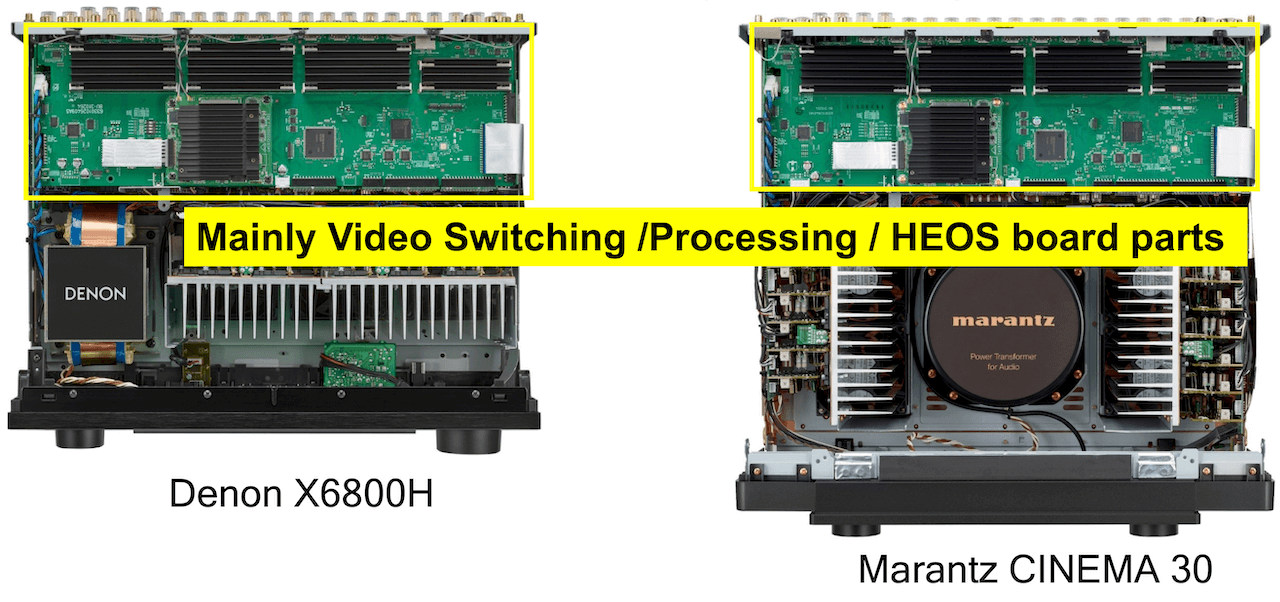
Marantz AVRs generally use more components and higher-cost parts than what might appear to be equivalently powered Denon models. Such parts include toroidal power supplies to reduce RF and EM interference, ELNA audiophile-grade capacitors, and copper-plated chassis for improved grounding and isolation
While both Denon and Marantz AVRs offer impressive features and audiophile-level performance, they don’t sound exactly the same. Denon’s sound signature is clean and dynamic, while Marantz is warm and musical. The sonic differences are audible, but preference is in the ear of the listener.
In addition, each brand has a respective Sound Master that ensures consistency and pursuit of company vision. Currently Denon’s Sound Master is Shinichi Yamauchi, while the Marantz Sound Master is Yoshinari Ogata.
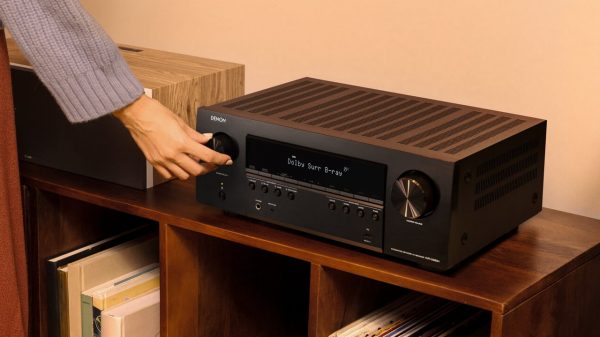
Lastly, from a design perspective, Denon AVRs typically feature a rectangular status display, with control and feature buttons either exposed or hidden behind a flip-down door depending on the model. Marantz AVRs, with the exception of the NR1510, use a distinctive “porthole” status display, with control and feature buttons similarly exposed or concealed behind a flip-down panel depending on the model.
Room Correction
To ensure precise system setup tailored to your room, both Denon and Marantz AVRs offer advanced room correction features. Many models include Audyssey MultEQ, Dynamic EQ, and Dynamic Volume, providing accurate calibration and consistent audio performance across a variety of listening environments.

Beyond Audyssey, select Denon A-Series and X-Series AVRs, along with certain Marantz models, also support Dirac Live, including Live Bass Control and Live Active Room Treatment (licenses required). Dirac Live offers advanced acoustic optimization, delivering clearer vocals, a wider sweet spot, tighter and more controlled low-end, and an overall more accurate and immersive listening experience.
HEOS: Whole-Home Audio for Denon and Marantz AVRs
With the exception of the Denon AVR-S270BT and AVR-S570BT, all Denon and Marantz AVRs feature the HEOS wireless multi-room audio platform, enabling seamless streaming throughout your home. Every Denon and Marantz AVR, including the AVR-S270BT and AVR-S570BT, also includes Bluetooth connectivity for direct streaming from mobile devices.
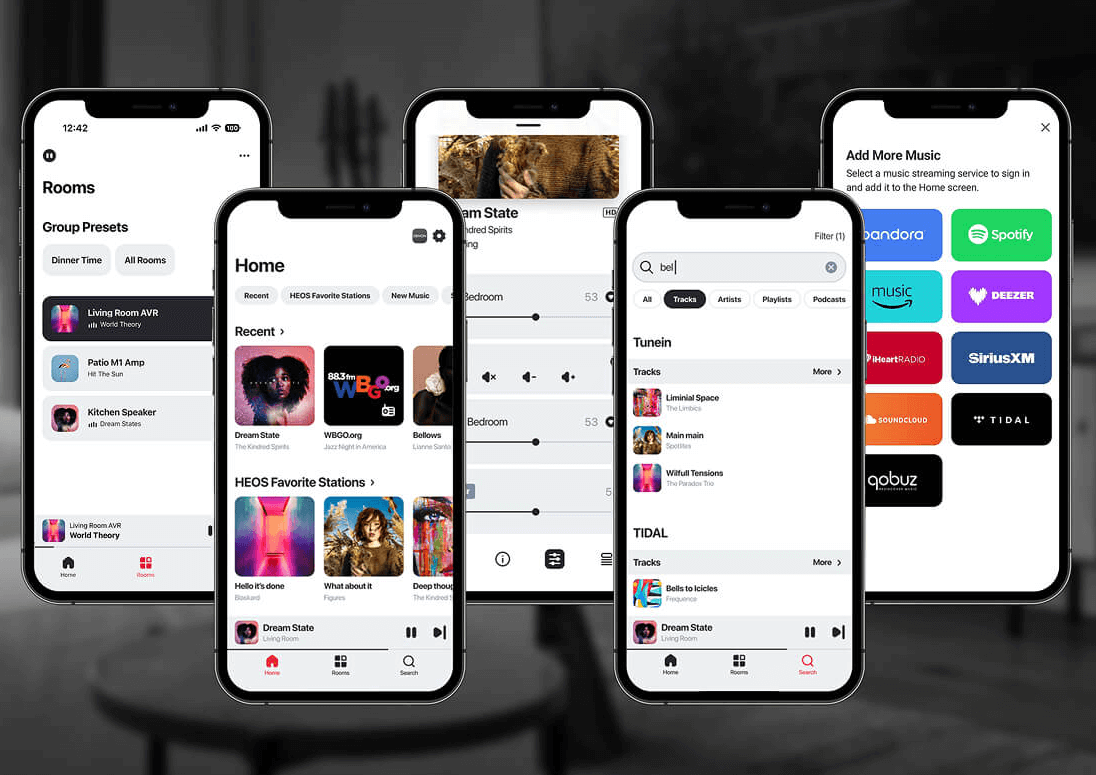
Launched back in 2014, HEOS has been through a couple of major overhauls—in 2016, again in 2021 with version 2.0, and most recently a significant update in 2023 with version 3.0. As of 2022, there were over 4 million HEOS-capable devices installed globally, and that number has continued to grow.
Like the other platforms, HEOS runs over your home network (ethernet or WiFi) but also supports Bluetooth, letting you stream to up to 64 devices across 32 zones, or group up to 16 devices to play in sync.
Remote Controls
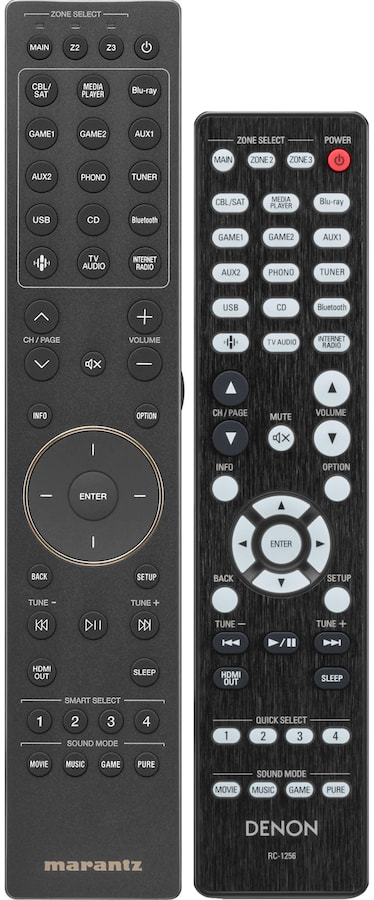
All Denon and Marantz AVRs include a wireless remote control. The remotes are similarly designed across both brands, with minor variations depending on the model or series to accommodate specific features. These remotes provide convenient access to all essential operational functions, allowing users to control their home theater systems with ease.
All Denon and Marantz AVRs also provide access to smartphone control apps. The Denon AVR-S270BT and AVR-S570BT are compatible with the Denon 500 Series Remote app (iOS, Android), while the remaining Denon (S, X, and A Series) AVRs are compatible with the Denon AVR Control app (iOS, Android). All Marantz AVRs are compatible with the Marantz AVR Remote app.(iOS, Android).
Onscreen Setup Assistant
Every Denon and Marantz AVR includes a built-in Setup Assistant to simplify the initial installation process. When the AVR is powered on for the first time with your TV on and the correct input selected, the guided setup menu appears automatically. If you choose to exit the Setup Assistant using the BACK button on the remote, it can be accessed again at any time through the main menu (GUI).
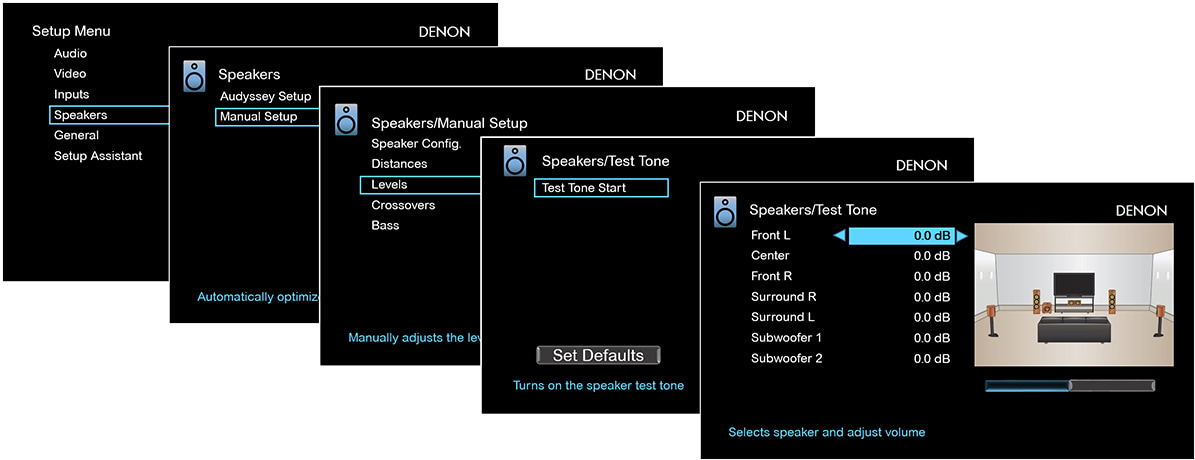
The Setup Assistant walks you through every essential step, including:
- Language selection
- Speaker setup and connection
- Speaker calibration using Audyssey
- Network connection setup
- ARC/eARC HDMI configuration
- Input assignment and labeling
- App download guidance for mobile control
The Setup Assistant makes getting started with your Denon or Marantz AVR both easy and intuitive—even for first-time users.
Which Onscreen Interface and Menu is Better?
While Denon and Marantz have a similar-looking Setup Assistant, overall Denon has a more user-friendly and intuitive interface that prioritizes ease of use, while Marantz offers a more complex but flexible interface with greater customization options (refer to your specific Denon and Marantz AVR’s user guide for more details).
Warranty Differences
All Denon and Marantz products provide a Limited Warranty for Parts and Labor when purchased through Authorized Denon dealers.
- Denon AVR-S Series AVRs: 2 years
- Denon AVR-X and AVR-A Series AVRs: 3 years
- Marantz NR1510 AVR: 3 years
- Marantz Cinema Series AVRs: 5 years
Denon & Marantz AVRs: Our Top Picks for Every Budget
Choosing the right AVR can be challenging, given the range of features and price points available. Here, we highlight select Denon and Marantz models across different budgets to help you find the best fit for your home theater setup.
Top Picks Under $500
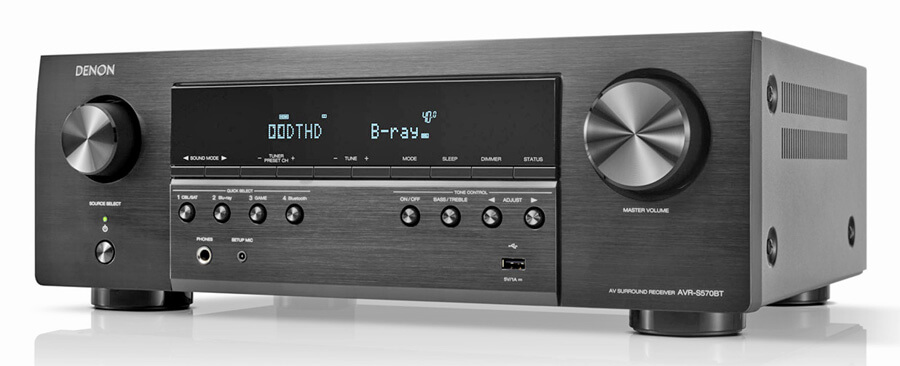
Denon AVR-S570BT ($449): Marantz doesn’t offer an AVR in this price category, so our pick here is the Denon AVR-S570BT, which provides basic 5.1 surround sound for those starting out. Although it’s limited in expandability, the AVR-S570BT can get the job done in smaller rooms with an overall better listening experience than a soundbar, even when factoring the cost of speakers.
Top Picks from $500 to $749
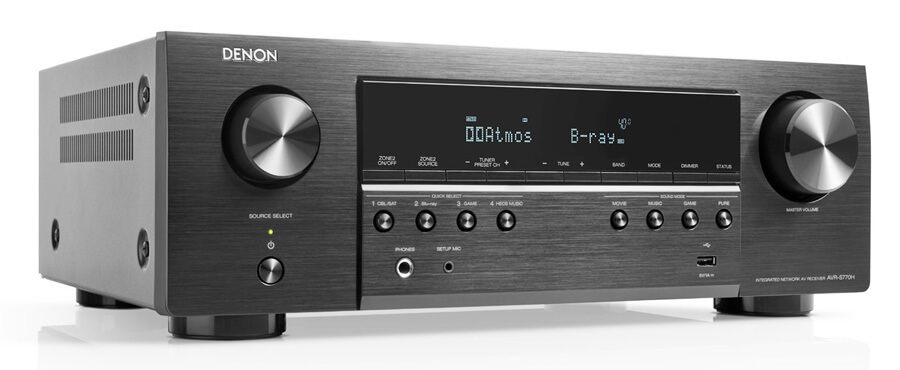
Denon AVR-S770H (749): The Denon AVR-S770H features a 7.2-channel configuration rated at 75 watts per channel (8 ohms, 2 channels driven). Audio support includes Dolby Atmos and DTS:X, delivering cinematic and immersive sound across a variety of setups, including 7.2 and 5.2.2 channel configurations. For video connectivity, the AVR-S770H has six HDMI inputs and one HDMI output, with three inputs supporting 4K resolution and three supporting 8K, making it a strong choice for those seeking high performance at a more accessible price point.
Marantz NR1510 ($700): The Marantz NR1510 is the brand’s most compact and budget-friendly AVR, featuring a slim profile ideal for tight spaces or smaller entertainment setups. It offers a 5.2-channel configuration with 50 watts per channel (8 ohms, 2 channels driven) and includes dual subwoofer outputs, making it a solid choice for users seeking a simple surround sound system without advanced immersive audio formats.

While the NR1510 does not support Dolby Atmos or DTS:X, it still delivers a satisfying home theater experience for users who prioritize simplicity and compact design. Additional features include a dedicated phono input, HEOS multi-room streaming compatibility, and six HDMI inputs that support 4K UHD video with HDR10, HLG, and Dolby Vision passthrough. This makes it an excellent choice for vinyl enthusiasts, casual streamers, and anyone looking to build a space-efficient AV setup.
Top Picks from $750 to $999
Denon AVR-X1800H ($999): There is no Marantz AVR in this price range, which makes the Denon AVR-X1800H an excellent choice for modest home theater setups, supporting a 7.2-channel configuration with 80 watts per channel (8 ohms, 2 channels driven), providing ample power for medium-sized rooms.
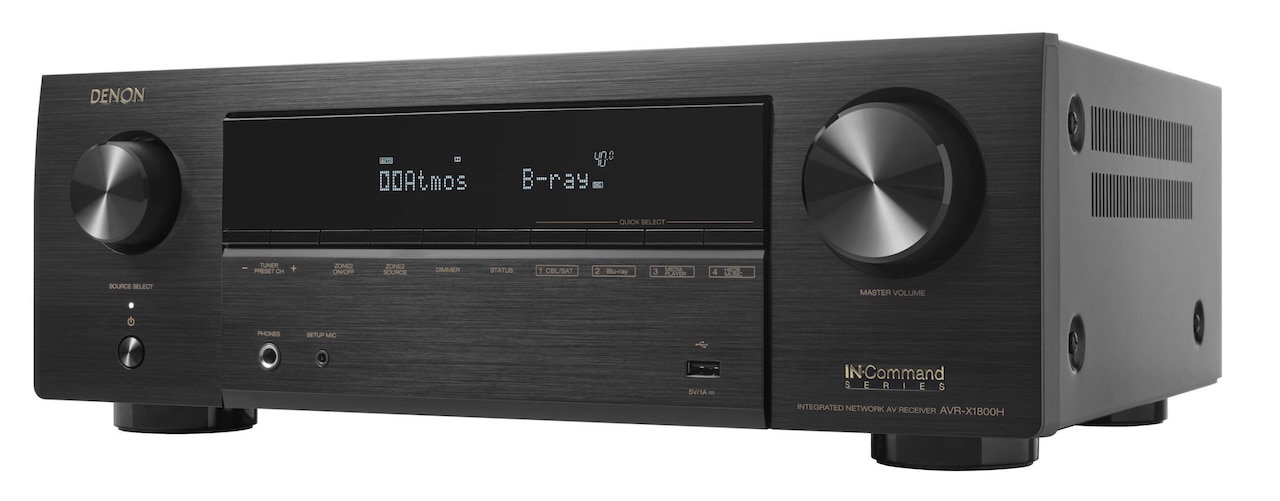
It accommodates standard 7.2 setups, 5.1.2 or 5.2.2 Dolby Atmos/DTS:X configurations, and also supports a 5.1 main room setup with a separate 2-channel zone for simultaneous multi-room audio.
Connectivity includes six HDMI inputs—three of which support 8K/60Hz and 4K/120Hz passthrough for next-generation gaming and video—plus one HDMI output. The AVR-X1800H delivers a robust, budget-friendly solution for home theater enthusiasts.
Top Picks from $1,000 to $1,499
Denon AVR-X2800H ($1,249): The Denon AVR-X2800H offers seven amplified channels rated at 95 watts per channel (8 ohms, 2 channels driven) and includes two subwoofer outputs, making it well-suited for medium-sized home theater setups.
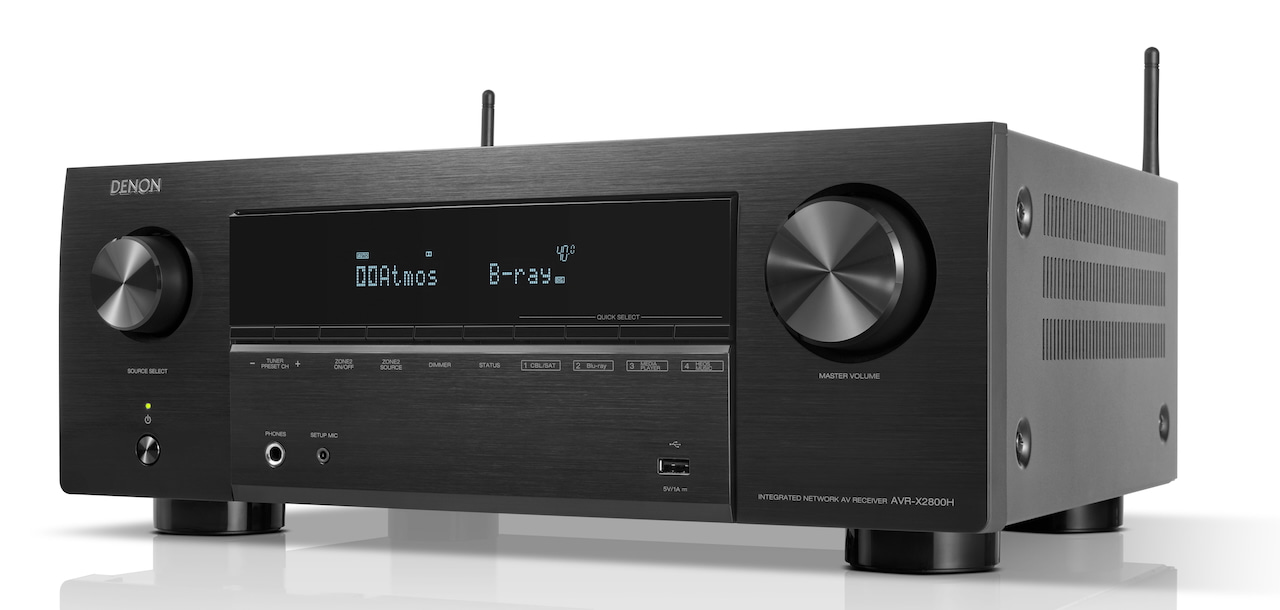
While it omits some premium features found in higher-end models, it still delivers strong performance with Dolby Atmos and DTS:X support in 5.1.2- or 5.2.2-channel configurations.
Connectivity features six HDMI inputs and two HDMI outputs, with three inputs supporting 8K resolution, ensuring seamless compatibility with modern video sources and displays.
Marantz Cinema 70S ($1,300): The Marantz Cinema 70S features a space-saving slimline chassis, making it ideal for smaller rooms or minimalist setups. It offers a 7.2-channel configuration with 50 watts per channel (8 ohms, 2 channels driven), a necessary compromise for its compact design.

Despite the lower power output, the Cinema 70S provides versatile options: it can handle a standard 7.2 setup, 5.1.2 or 5.2.2 Dolby Atmos or DTS:X configurations, or a 5.1 main room setup with a separate 2-channel zone for multi-room audio.
Connectivity includes six HDMI inputs—three supporting 8K/60Hz and 4K/120Hz passthrough for next-generation gaming and video—and one HDMI output. The Cinema 70S is a strong choice for users seeking a streamlined yet immersive home theater experience.
Top Picks from $1,500 to $1,999
Denon AVR-X3800H ($1,699): For those seeking versatility without a premium price, the Denon AVR-X3800H features a 9.4-channel configuration with nine discrete amplifier channels, each rated at 105 watts per channel (8 ohms, 2 channels driven). Like higher-end models, it includes four independent subwoofer outputs and two additional preamp outputs, enabling expansion to 11 channels when paired with external amplification.

Audio support covers Dolby Atmos, DTS:X, AURO-3D, IMAX Enhanced, and Sony 360 Reality Audio, providing cinematic and spatial audio realism across a variety of setups.
For video connectivity, the Denon AVR-X3800H offers six HDMI inputs and three HDMI outputs, all fully 8K-capable. This makes it an excellent choice for home theater enthusiasts seeking near-flagship performance at a more accessible price point.
Marantz Cinema 60 ($1,899): The Marantz Cinema 60 offers seven channels of amplification rated at 100 watts per channel (8 ohms, 2 channels driven) and includes two subwoofer outputs, making it ideal for medium-sized home theater setups. While it omits some premium features, the Cinema 60 still delivers strong performance with support for Dolby Atmos and DTS:X in 5.1.2- or 5.2.2-channel configurations.

It does not support Auro-3D, IMAX Enhanced, or Sony 360 Reality Audio, but for users focused on Dolby Atmos and DTS:X, it provides a reliable and immersive experience.
Connectivity includes six HDMI inputs and two HDMI outputs, with three inputs supporting 8K, ensuring compatibility with the latest video sources and flexibility for multi-device setups.
Top Picks from $2,000 to $2,999
Denon AVR-X4800H ($2,699): The Denon AVR-X4800H delivers high-performance features for advanced home theater setups. Like the AVR-X3800H, it offers nine discrete assignable amplifier channels, but with up to 125 watts per channel (8 ohms, 2 channels driven) and four independent subwoofer outputs. This supports flexible configurations such as 7.4.2, 5.4.4, or other immersive setups using Dolby Atmos, DTS:X, or Auro-3D, while also allowing bi-amping of front channels or creating a dual-zone system with independent audio playback.
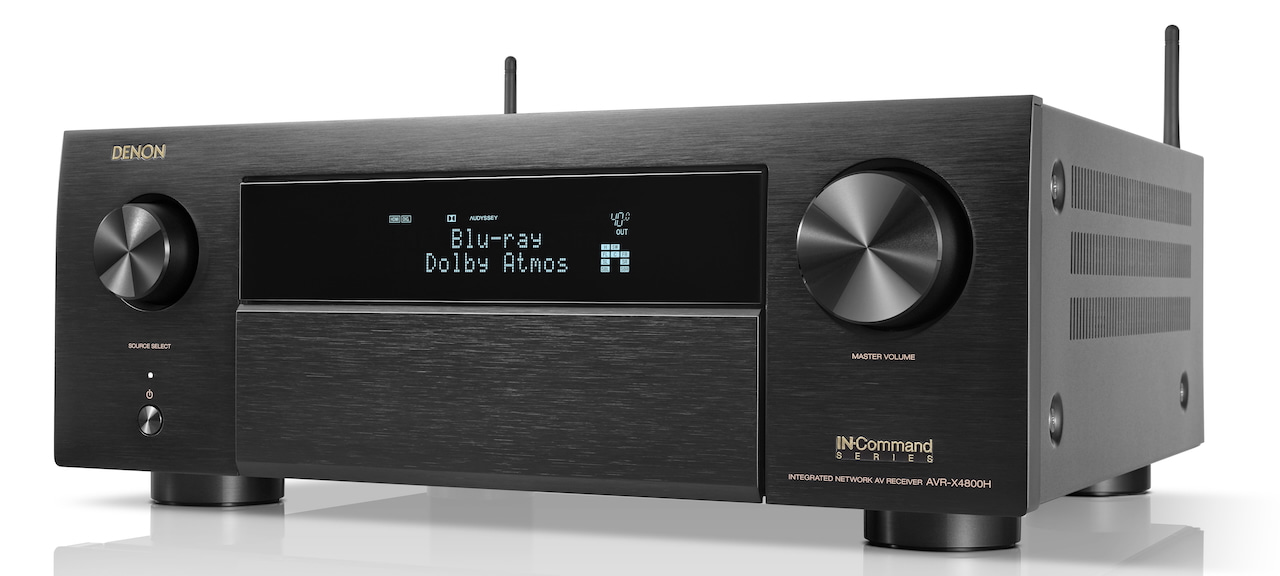
For setups requiring more than nine channels, the AVR-X4800H includes two additional preamp outputs, enabling expansion to 11 channels with external amplification, fully controllable via the receiver’s interface and volume settings.
Additional audio support includes IMAX Enhanced and Sony 360 Reality Audio, ensuring high-quality playback for both movies and music. Video connectivity features seven HDMI inputs and three HDMI outputs, all 8K-capable, matching the flagship X6800H in modern video compatibility and making the X4800H a versatile option for high-end home theater systems.
Marantz Cinema 50 ($2,800): The Marantz Cinema 50 features a 9.4-channel configuration with nine discrete amplifier channels rated at 110 watts per channel (8 ohms, 2 channels driven). It includes four independent subwoofer outputs for enhanced low-frequency performance and two additional preamp outputs, allowing expansion to an 11-channel system with external amplification.

The Cinema 50 supports Dolby Atmos, DTS:X, and Auro-3D, providing flexible immersive audio configurations for a variety of room sizes. It also includes IMAX Enhanced and Sony 360 Reality Audio support, delivering cinematic and spatial audio realism.
Connectivity consists of six HDMI inputs and three HDMI outputs, all fully 8K-compatible, making the Cinema 50 an attractive option for home theater enthusiasts seeking near-flagship performance at a more accessible price point.
Top Picks from $3,000 to $4,999
Denon AVR-X6800H ($3,699): The Denon AVR-X6800H is the flagship model in Denon’s AVR-X Series, offering reference-level performance and advanced processing for serious home theater systems. It features 11 amplified channels rated at 140 watts per channel (8 ohms, 2 channels driven), along with four subwoofer outputs and two additional preamp outputs, allowing configurations up to 13.4 channels when paired with an external 2-channel amplifier—ideal for large, fully immersive surround setups.

Internally, the AVR-X6800H employs AL32 Processing for exceptional audio fidelity, especially with digital sources. It supports all major immersive audio formats, including Dolby Atmos, DTS:X, IMAX Enhanced, Sony 360 Reality Audio, and Auro-3D, ensuring strong future-proofing for evolving content standards.
For video, the AVR-X6800H offers 8K-capable HDMI 2.1 connectivity across multiple inputs, providing full compatibility with next-generation video formats, high-bandwidth gaming consoles, and premium streaming devices. This makes it one of the most capable and versatile AV receivers available for high-end home theater systems.
Marantz Cinema 30 ($4,899): The Marantz Cinema 30 sits at the top of Marantz’s AVR lineup, delivering powerful performance and advanced processing for high-end home theater systems. It offers 11 channels of amplification at 140 watts per channel (8 ohms, 2 channels driven), along with four subwoofer outputs and two additional preamp outputs, supporting up to a 13.4-channel configuration for immersive surround sound in large home theaters or listening rooms when paired with an external 2-channel power amplifier.

Inside, the Cinema 30 features a toroidal transformer, Sharc Dual DSP, and a 32-bit DAC, providing precise processing and superior audio fidelity, particularly with digital sources. It supports all major immersive audio formats, including Dolby Atmos, DTS:X Pro, IMAX Enhanced, Sony 360 Reality Audio, and Auro-3D, making it a future-proof option for serious home theater enthusiasts.
For video, the Cinema 30 includes 8K-capable HDMI connectivity, ensuring compatibility with the latest video standards and high-bandwidth sources.
Top Picks $5,000 and Up
While Marantz is known for its high-end AVRs, the brand does not offer models in the $5,000+ price range. Instead, they provide two AV preamp and power amp separates: the AV10/AMP10 ($16,000) and AV20/AMP20 series ($12,000).

This positions the Denon AVR-A10H as one of Denon’s best offerings in the $5,000+ AVR category, priced at $5,199. It delivers an extensive feature set and additional channels, making it a compelling choice for users who need top-tier performance and flexibility in a high-end home theater system.
The Denon AVR-A10H features 13 amplified channels and four subwoofer pre-outs, providing the flexibility to fully utilize immersive audio formats such as Dolby Atmos, DTS:X (including DTS:X Pro), Auro-3D, IMAX Enhanced, and Sony 360 Reality Audio.
Supported Dolby Atmos speaker configurations include 7.4.6 and 9.4.4 setups. Room correction and tuning are managed with Audyssey XT32, with optional support for Dirac Live Room Correction and Live Bass Control (license required).

On the preamp side, the Denon AVR-A10H offers 15-channel pre-outs for external amplification, along with full equipment switching via seven 8K HDMI inputs and three HDMI outputs. It also includes multiple digital and analog connections, plus a dedicated MM phono input for vinyl enthusiasts.
Audiophile-grade ESS DACs ensure that all physical and wireless sources deliver high-resolution audio with exceptional clarity, detail, and accuracy.
Tip: Denon’s cost-no-object flagship AVR is the AVR-A1H for $7,199.
The Bottom Line
Denon and Marantz remain two of the most respected names in home theater AVRs, offering reliable performance, flexible features, and broad compatibility with immersive audio formats. While they share similarities in video processing and HEOS multi-room streaming, their core preamp and power amp designs set them apart—Denon leans toward power, versatility, and home theater performance, while Marantz emphasizes refinement and a warmer, music-focused sound.
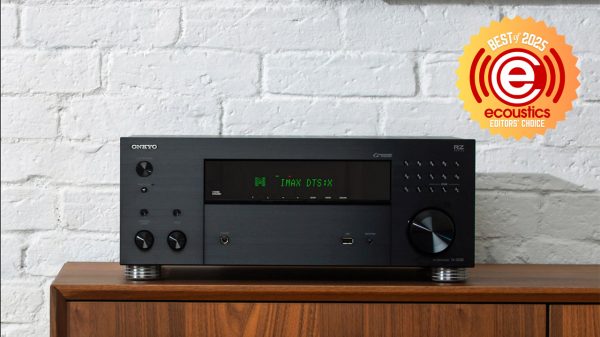
That said, both brands face growing competition from other established AVR makers, including Anthem, Yamaha, Onkyo, Integra, Pioneer, and JBL which offer strong alternatives across a wide range of price points. Choosing between Denon and Marantz ultimately comes down to whether you prioritize straightforward home theater power and versatility or a more premium, music-oriented experience.
Price & Availability
Denon AVRs
- AVR-S570BT: $449 at Amazon | Crutchfield | Denon
- AVR-S770H: $749 at Amazon | Crutchfield | Denon
- AVR-X1800H: $799 at Amazon I Crutchfield I Denon
- AVR-X2800H: $1,249 at Amazon I Crutchfield I Denon
- AVR-X3800H: $1,699 at Amazon I Crutchfield I Denon
- AVR-X4800H: $2,699 at Amazon I Crutchfield I Denon
- AVR-X6800H: $3,699 at Amazon I Crutchfield I Denon
- AVR-A10H: $5,199 at Amazon | Crutchfield | Denon
- AVR-A1H: $7,199 at Amazon | Crutchfield
Marantz AVRs
- NR1510: $700 at Crutchfield | Amazon
- Cinema 70s: $1,300 at Crutchfield | Amazon
- Cinema 60: $1,800 at Crutchfield | Amazon
- Cinema 50: $2,800 at Crutchfield | Amazon
- Cinema 40: $3,800 at Crutchfield | Amazon
- Cinema 30: $4,800 at Crutchfield | Amazon
Related Reading:
Pro Tip: Before making your final decision, explore the full range of AVRs from both Denon and Marantz. Check out the detailed guides below for a complete overview
- Which Marantz AVR Should You Buy? Our Guide to the Best Marantz A/V Receivers in 2025
- Denon A-Series A/V Receiver Buying Guide: Which Flagship AVR Is Right for You in 2025?
- Which Denon AVR Should You Buy? Our Guide to the Best Denon X-Series A/V Receivers in 2025
- Denon S-Series AVRs Explained: Which Budget Home Theater Receiver Is Right for You in 2025?
























Bob Rothman
October 23, 2025 at 12:45 pm
On the bottom list of available AVRs, why was the Cinema 40 omitted? Thanks