
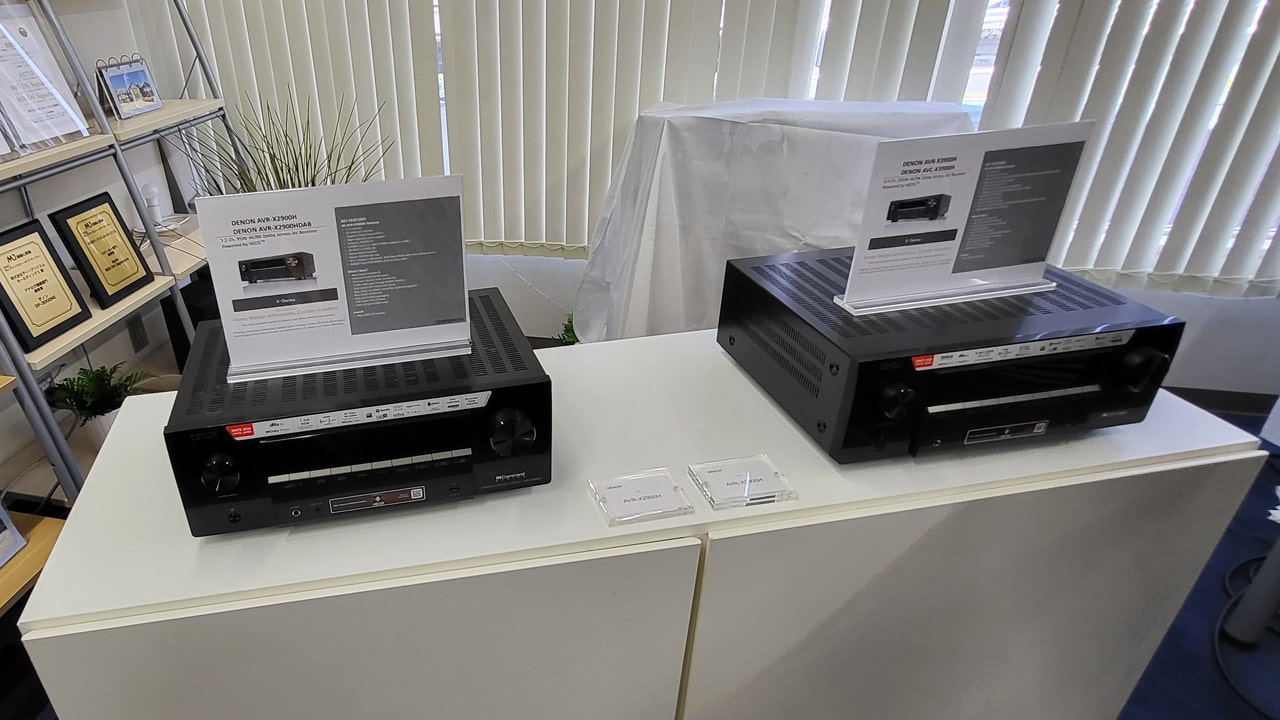
Last month, Denon unveiled its first new A/V receiver (AVR) since 2023, the AV-S980H, the most powerful in their budget-priced “S” series lineup. But it turns out, this was just the beginning. Today, Denon unveiled two more new AVR models, this time in their upgraded “X Series,” which is known for its higher performance, broad feature set and punchy dynamic sound. The AVR-X2900H ($1,349) replaces the AVR-X2800H and the AVR-X3900H ($1,849) replaces the venerable AVR-X3800H, an eCoustics Editors’ Choice Award winner.
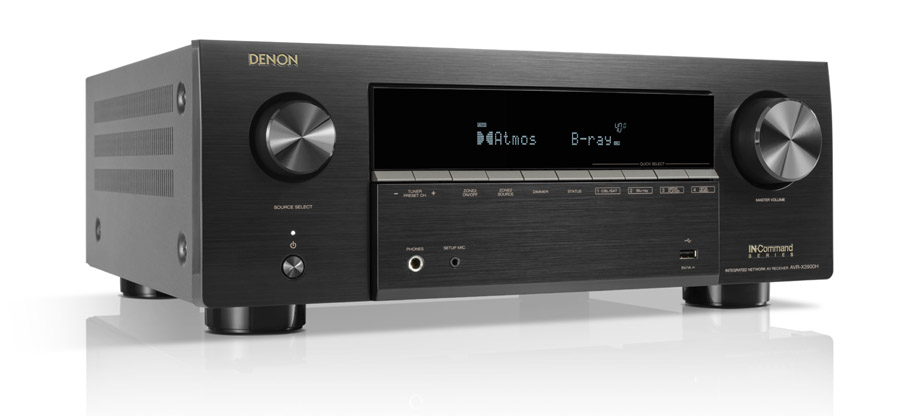
Stylistically, the new models bear a strong resemblance to their predecessors, though Denon reps tell us they have been tweaked internally for higher performance as well as adding some interesting new features like the ability to add wireless rear speakers.
We got a chance to check out these new receivers at Denon’s headquarters in Japan last month, and were impressed by what we saw and heard. In a series of movie clips, the AVR-X3900H filled a large listening room with immersive Dolby Atmos sound, powering a 7.2.2-channel Bowers & Wilkins speaker system featuring the company’s 800 series flagship speakers. The system was able to reach near cinematic reference output levels with no audible strain.
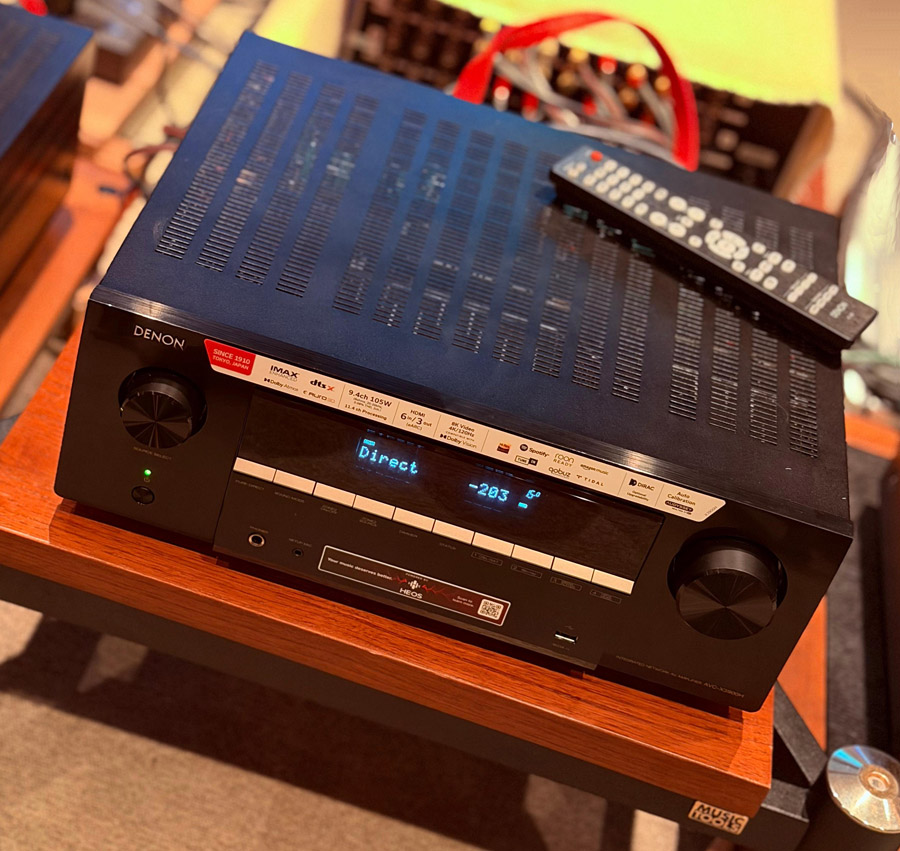
Powered by Heos
Both the AVR-X2900H and AVR-X3900H feature the latest HEOS module for whole home wireless music streaming, with support for lossless and high resolution audio from compatible streaming services such as TIDAL, Spotify, Amazon Music, Qobuz and Apple Music (via Air Play 2). Also, both receivers will support the use of Denon’s new Home 200, Home 400 and Home 600 speakers as wireless rear channels, via a future free over-the-air software upgrade. This gives home theater fans and A/V hobbyists the ability to do real discrete immersive surround sound without having to run speaker wires to the back of their rooms.
Both new models feature updated internal components and a high performance 32-bit multi channel DAC (Digital Analog Conversion) architecture to deliver improved imaging, clearer high frequency detail and more authoritative low frequency energy to every speaker. Both models include Audyssey calibration on-board with the option to upgrade to DIRAC Live room correction for an additional fee.
“Denon’s X-Series has always been about uncompromised performance,” said Lyle Smith, President of Sound United at Denon’s parent company, HARMAN. “With our newest additions to the series, we’ve gone further by combining expanded room calibration capabilities with adaptable system designs to deliver enhanced audio quality and greater flexibility for people who take their sound seriously.”

We also had a chat with Denon’s Sound Master, Shinichi Yamauchi. His job is to listen to Denon’s new product designs throughout their development cycle at Shirakawa Audio Works in Japan. With a trained ear and a background in engineering, Yamauchi-San makes suggestions to the development and engineering team, based on his extensive listening sessions with each new product. A new Denon product only makes it into production once Yamauchi-San signs off on it. And both the X2900H and X3900H got his seal of approval earlier this year.

Denon AVR-X2900H
The Denon AVR-X2900H offers seven channels of amplification and dual subwoofer outputs. It’s rated at 95 watts/channel into 8 ohms (2 channels driven). It can decode Dolby Atmos and DTS-X immersive sound formats with discrete height and surround speaker outputs for a 5.2.2-channel implementation. While Audyssey MultEQ XT calibration software is included, the X2900H is Denon’s most affordable AVR that also offers an optional upgrade to DIRAC Live room correction and calibration software. The license for DIRAC Live currently costs $259 for the limited bandwidth version or $299 for the full bandwidth version.
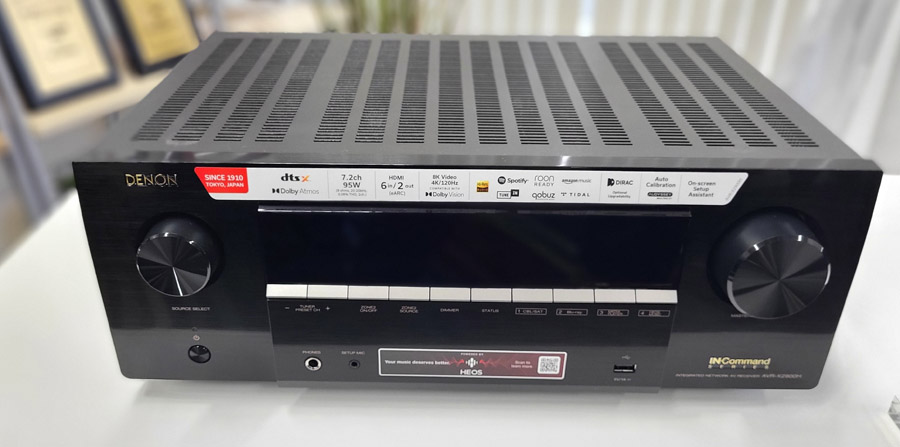
The receiver offers six HDMI inputs with support for VRR, ALLM, AMD FreeSync, 8K/60 Hz or 4K/120 Hz and dual HDMI outputs, including one with ARC/eARC audio return channel. It also offers multiple analog and digital inputs for legacy gear, including a turntable input with built-in moving magnet phono preamp.
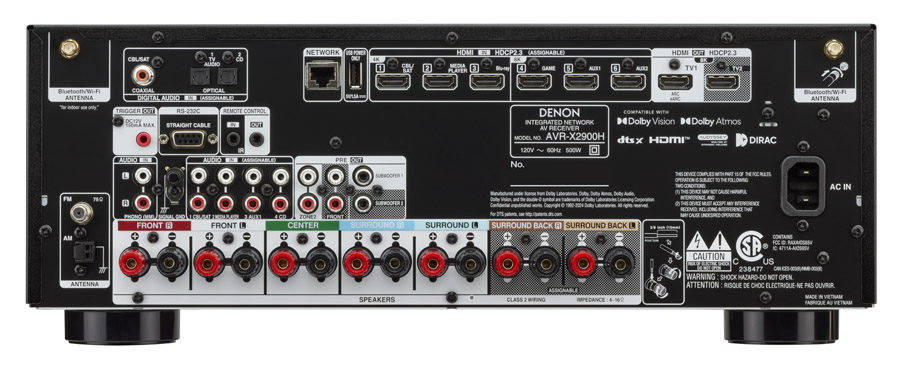
In addition to a fully wired speaker set-up, the AVR-X2900H will support wireless rear channels using the Denon Home 200, Home 400 or Home 600 speakers (this will be delivered in a future software update). While the 95-watt power rating is measured with two channels driven, Denon guarantees that the AVR-X2900H will deliver at least 70% of that power rating when five channels are driven. It supports Bluetooth, Wi-Fi and hard-wired network connectivity with HEOS built-in for whole home music streaming from a wide selection of compatible streaming apps.
Denon AVR-X3900H
The Denon AVR-X3900H includes nine channels of amplification and four independently controlled subwoofer outputs for precise in-room bass optimization. It is rated at 105 watts/channel with two channels driven with a guarantee of at least 70% of that rated output when driving five channels. Out of the box, the X3900H supports 5.4.4 or 7.4.2-channel immersive sound applications.
With eleven channels of processing, the X3900H can be upgraded to support a 7.4.4 channel surround system by adding a 2-channel power amplifier. If you only need a five or seven channel surround system, you can use the additional on-board amps to drive speakers in another room. And if you need more power, the AVR-X3900H has a full set of eleven preamp outputs which can be connected to outboard power amplifiers.
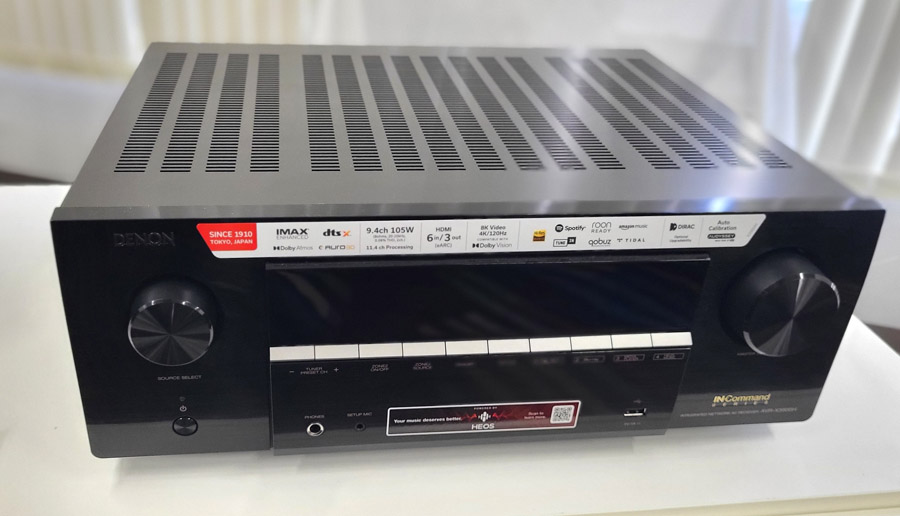
In addition to Dolby Atmos and DTS:X, the AVR-X3900H can decode Sony 360 Reality Audio, MPEG-H and AURO-3D immersive surround formats, for maximum compatibility and flexibility. It is also IMAX Enhanced certified so it can apply IMAX EQ to DTS-X soundtracks that are IMAX Enhanced.
The X3900H includes Audyssey MultEQ XT32 calibration software on-board, and can be upgraded to DIRAC Live – all the way up to DIRAC Live ART – via an additional license purchase (currently priced at $259 to $799, depending on options).
Like the X2900H, the X3900H includes six HDMI inputs with support for VRR, ALLM, AMD FreeSync, and resolution up to 8K @ 60 Hz or 4K @ 120 Hz. But the X3900H adds a third HDMI output for a projector, monitor or TV. The X3900H also supports HDMI ARC/eARC for single cable connection to your display of choice. It also offers multiple analog and digital audio inputs for legacy gear, including a turntable input with built-in moving magnet phono preamp.
Interestingly enough, unlike some competitive models, like the Onkyo TX-RZ30, neither of these new Denon receivers offers any analog video inputs (composite, component or S-Video). So if you’re still rocking a VCR or LaserDisc player, you’ll need to plug these directly into your TV or get an analog to digital video converter. I should note that this is nothing new as the predecessor models also lacked analog video inputs. It’s also not particularly critical to most potential buyers. The current AVR-X4800H model does include analog video inputs so we’d imagine any future replacement step-up model may continue that tradition.
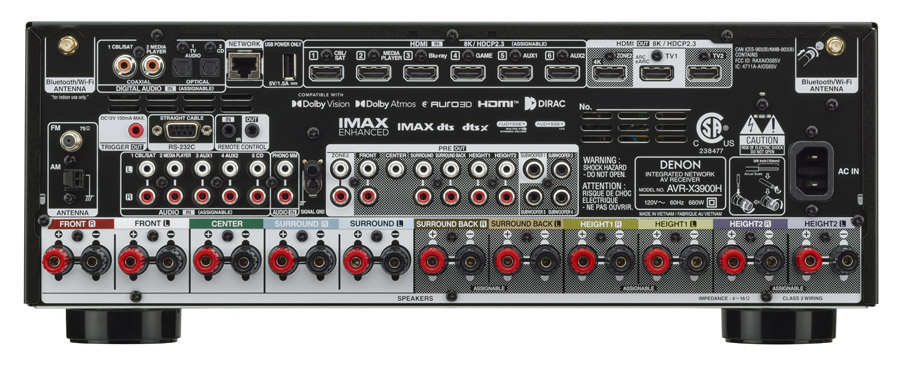
Like the X2900H, the AVR-X3900H will get an update later this year to support wireless rear surround channels by adding a pair of Home 200, Home 400 or Home 600 speakers. Also, like the X2900H, the X3900H supports Bluetooth, WiFi and hard-wired networking with an RJ45 network port.
Two things I had hoped to see on the new receivers (but didn’t) were support for Dolby Atmos music within the HEOS streaming platform and on-board decoding for Eclipsa Audio (IAMF) immersive surround. For now, Denon recommends connecting an outboard source device like an Apple TV 4K or FireTV stick to one of the receiver’s HDMI ports if you want to listen to Dolby Atmos music from streaming sources like Amazon Music Unlimited, TIDAL or Apple Music. I listen to Dolby Atmos and 360RA music this way on my current AVR-X3800H and it works reliably (which is nice).
With the company’s recent acquisition by Harman (which in turn is owned by Samsung), we believe it would be a natural fit for Denon receivers to support the new open IAMF/Eclipsa Audio immersive sound format, which was developed by Samsung, Google and others. Although it isn’t widely used yet, Eclipsa Audio is the only immersive surround format supported on YouTube so over time it could become more popular.
Comparison
| Model | AVR-X2900H | AVR-X3900H |
| MSRP | $1,349 | $1,849 |
| Number of Processing Channels | 7.1 | 11.4 |
| Subwoofer Out | 2 | 4 (Independent) |
| Number of Power Amps | 7 | 9 |
| Power Output | 95 W (8 ohm, 20 Hz – 20 kHz, 0.08% 2ch Drive) 125 W (6 ohm, 1 kHz, 0.7% 2ch Drive) | 105 W (8 ohm, 20 Hz – 20 kHz, 0.08% 2ch Drive) 135 W (6 ohm, 1 kHz, 0.7% 2ch Drive) |
| Multi-Source/Multi-Zone | 2 | 2 |
| GUI Languages | 3 (English/ Français/ Español) | 3 (English/ Français/ Español) |
| HDMI In/Out | 6/2 | 6/3 |
| Analog In/Out | 4/- | 5/- |
| Phono (MM) In | Yes | Yes |
| Digital In: Optical, Coaxial | 2, 1 | 2, 2 |
| Multi-Zone Analog Preouts | 1 | 1 |
| Multi-channel Pre-Out | Yes (2.2) | Yes (11.4) |
| Number of Speaker Terminals | 7 | 11 |
| Speaker A/B | Assignable | Assignable |
| Bi-amp Drive | Assignable | Assignable |
| Multi-Zone Speaker Terminal | Assignable | Assignable |
| System Remote Control | RC-1262 | RC-1262 |
| Power Consumption | 500W | 660W |
| Power Consumption No-Sound (ECO on/off) | 35W / 75W | 60W / 100W |
| Dimensions (W x D x H) | 17.1 x 13.0 x 6.6 inches | 17.1 x 14.9 x 6.6 inches |
| Weight | 21.4 lbs | 27.6 lbs |
The Bottom Line
They say, “If it ain’t broke, don’t fix it” and this saying holds true for Denon’s latest X series receivers. The models they replaced were highly rated and were popular sellers in the category and these new models look and feel quite similar, offering everything from their predecessors and more. The AVR-X2900H brings DIRAC Live room correction to Denon’s most affordable price point yet, though it does require an additional license purchase to use. Also, both models will get the option for wireless rear speakers in a future software update.
While we were disappointed to find out that the receivers don’t support Dolby Atmos music in HEOS yet or Eclipsa Audio decoding, it’s possible that either or both of these features could be added at some time in the future via a software upgrade. In the meantime, the otherwise comprehensive immersive format support of the AVR-X3900H is unmatched in the industry at this price point and we’d highly recommend it to anyone in search of a robust and future-proofed A/V receiver.
Pricing & Availability:
Both new 2026 Denon X-Series AVRs will be available to order on May 14, 2026 at the following prices:
- Denon AVR-X2900H (7.2-channel)
- $1,349 USD at Amazon | Best Buy | Crutchfield | Audio Advice
- $1,799 CAD at Amazon.ca
- Denon AVR-X3900H (9.4-channel)
- $1,849 USD at Amazon | Best Buy | Crutchfield | Audio Advice
- $2,499 CAD at Amazon.ca
Related Reading:
- Best A/V Receivers: Editors’ Choice
- Denon Vs Marantz AVRs: Which Home Theater Receiver Is Right For You In 2025?
- Podcast: Denon Vs. Marantz AVRs With Phil Jones














Bill H
May 15, 2026 at 10:43 pm
The HEOS upgrade to spatial will be a category killer. You have to believe that the engineers are quietly working on it.
Clearly it’s not that hard to do. I have a Sennheiser soundbar in my living room. All I have to do is press the cast button on my Amazon Music HD app. Dolby Atmos and Sony 360 Reality Audio work flawlessly. If they can do it while foundering on the financial rocks, then Samsung and their fleet of av solutions already know how.
It’s probably more of a strategic plan issue than a tech one.
Chris Boylan
May 16, 2026 at 5:43 pm
I agree. HEOS can already do Dolby Atmos in the Home 200, 400 and 600 speakers, so putting it into these new receivers, with the latest HEOS module, should definitely be possible to do. Conversations I had with the product folks in Japan suggested it was possible, but not easy. So we’ll have to wait and see. As for Eclipsa Audio decoding, that should also be something they could deliver via a software update. It doesn’t require specific hardware. Let’s hope the parent company and divisions (Samsung, Harman, Denon, Marantz, etc.) all start talking and planning things together. The Harman acquisition of Sound United went through too recently for it to have any impact on this development cycle, which had been in the works for a few years.