
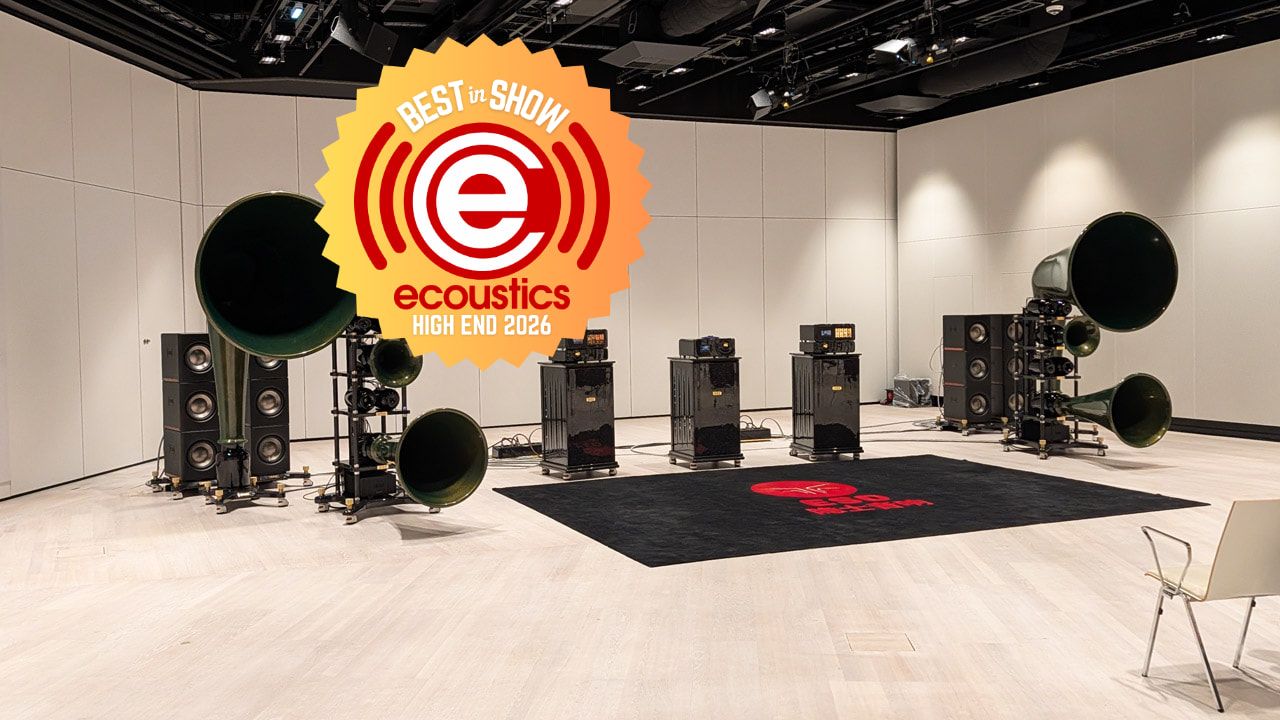
High End Vienna 2026 had no shortage of ambitious loudspeakers, six-figure electronics, and systems designed to remind everyone that “affordable high-end” is still a phrase the industry says with a straight face, but is sometimes subject to interpretation. But the ESD Acoustic Super Dragon was operating in its own category. This was not a large horn system. This was a room-dominating, field-coil sporting, Class A powered, carbon fiber, multi-way monument to what happens when subtlety is escorted from the building, dumped on Bruno-Kreisky-Platz, and told to take the U-Bahn home. “Fahrscheine, bitte!”
We had a chance to experience the Super Dragon system for our first time at the show, where ESD Acoustic staged one of the most technically extreme demonstrations at High End Vienna. The company also held an official “Super Dragon Technical Exchange + Deep Dive” press event during the show, which was appropriate, because this was not the kind of system one explains with a brochure. You need measurements, diagrams, floor reinforcement, and possibly a municipal permit.
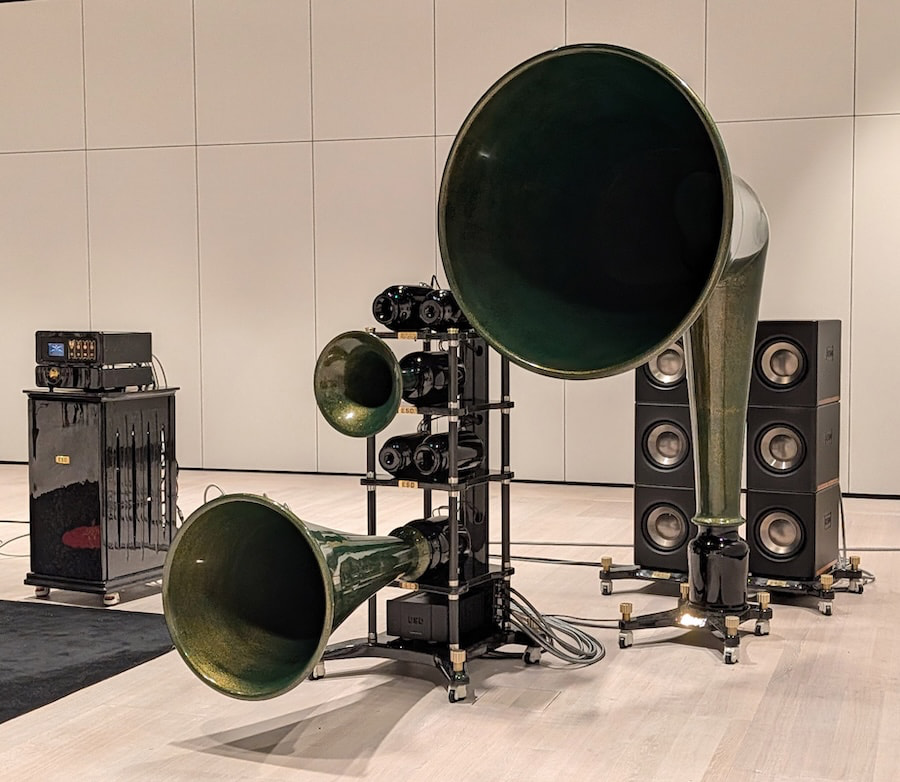
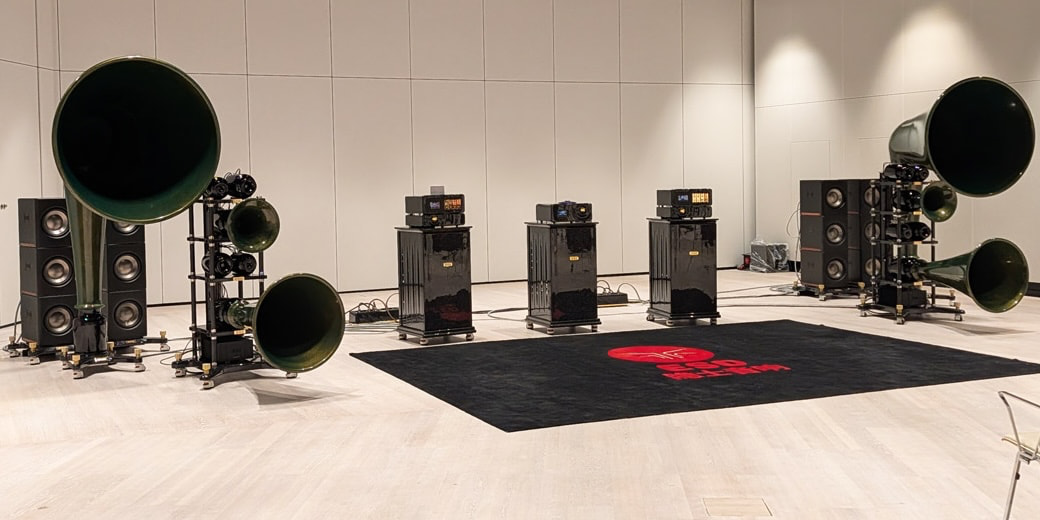
The Super Dragon is built around a field-coil horn architecture using ten field-coil driver units, large carbon-fiber horns, Truextent beryllium diaphragms for the midrange, tweeter, and super tweeter sections, and titanium sandwich diaphragms for bass, sub-bass, and subwoofer duties. It is not a conventional passive loudspeaker blown up to absurd scale. It is a five-plus-one-way active horn system using an analog active crossover, allowing dedicated Class A amplifiers to drive individual sections directly (amps are included with purchase).
That design choice matters. The Super Dragon’s drama is not only visual, although ignoring the visual part would require a better pair of glasses. The system’s frequency response range is specified from 18 Hz to 52 kHz, with 112 dB sensitivity and crossover points at 100 Hz, 500 Hz, 2 kHz, and 8 kHz. In terms of weight, the main speaker enclosure alone is listed at 1,190 kg (2,623.5 pounds), with the subwoofer section at 442 kg (974 pounds) and the sub-bass section at 990 kg (2182.6 pounds). So yeah, that’s over 5,700 pounds of speaker gear. Apartment dwellers need not apply.
You may need to ask a few friends and the dealer to spend the day setting this up at home. You know… In your auditorium.
The Super Dragon’s driver layout includes a massive subwoofer horn covering the lowest frequencies, a low-range carbon-fiber horn, midrange and high-frequency horn sections, and a dedicated tweeter/super tweeter array. ESD uses carbon fiber extensively in the horn assemblies to reduce resonance and control mass, while the powered field-coil motor system gives the company greater control over magnetic behavior than conventional permanent-magnet designs. If “field coil” rings a bell, it may be because that’s the magnet design recently chosen by speaker designer extraordinaire Mr. Andrew Jones himself, in his recently introduced Troubadour speakers. But let’s get back to these horns.
The supporting equipment stack was also ESD’s own, rather than a random pile of trophy electronics dragged into the room for branding purposes. The published system configuration includes the CDT-1B CD transport, DA-1B DAC, DPA-1B preamplifier, DX-1B active analog crossover, D100W-1B monoblock amplifiers, DPC-1 center power supply, Kunlun equipment supports, and ESD’s Lion-series AES, balanced, speaker, and power cables.
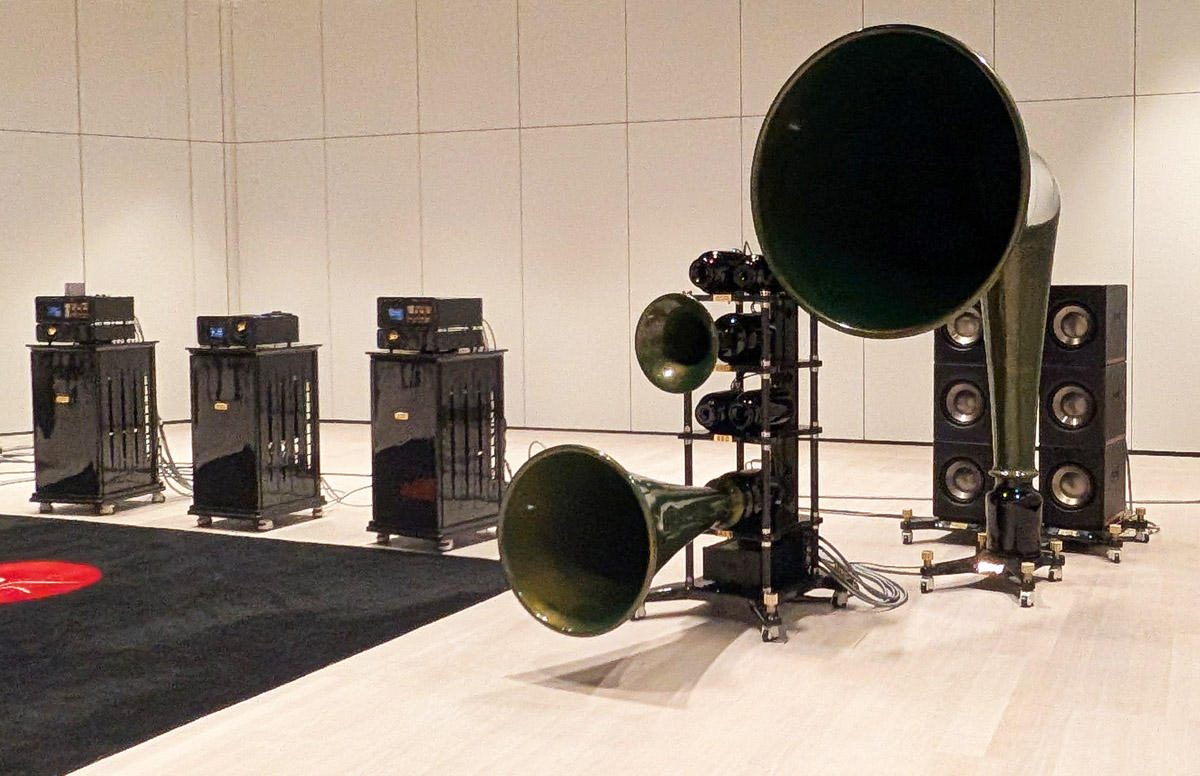
The electronics are not afterthoughts. The CDT-1B transport uses a Philips CD-Pro2M mechanism and a separate power supply. The DA-1B DAC supports PCM up to 768 kHz/32-bit and DSD512. The DPA-1B preamp is fully balanced with a separate power supply, while the DX-1B active crossover uses interchangeable crossover cards and provides six balanced outputs per channel. The D100W-1B monoblock is a single-ended pure Class A amplifier rated at 20 watts peak (10 watts nominal) into 8 ohms. You get one amps of these per horn, so you won’t need to go amplifier shopping too.
Pricing is where things get both fascinating, if not slightly unhinged. ESD’s standard Dragon speaker package has been listed at roughly $1.05 million, with the full Dragon System listed as starting at around $1.53 million. The special Super Dragon configuration shown at High End Vienna 2026 with its custom lacquer finish was reported to cost more than $3.6 million. That’s quite a paint job.
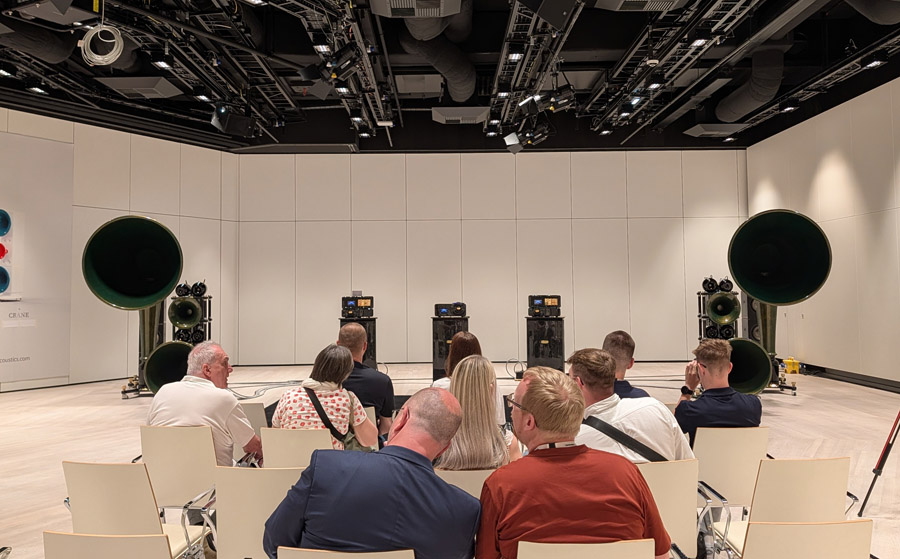
But how did it sound? In a word: breathtaking. According to our Editor at Large, Chris Boylan, who was on the ground in Vienna, the system had no trouble filling the huge ballroom with powerful dynamic sound. The demo clips he heard were mostly orchestral pieces, and the system really did capture the dynamics of a live orchestra performance, from delicate oboe soloes to powerful strikes of the bass drum and tympanis. Soundstage was huge and dynamics were without parallel. These horns were made for playing music. And that’s just what they did.
Start rubbing that Powerball ticket on your friendly neighborhood leprechaun. And in the meantime, make sure there are no cracks in your foundation.
The Bottom Line
The ESD Acoustic Super Dragon was one of the most outrageous rooms at High End Vienna 2026, but not because it was merely expensive. Expensive is easy in high-end audio. The Super Dragon was outrageous because it was unapologetically engineered as a complete ecosystem, from source to crossover to amplification to horn-loaded transducers. It was massive, excessive, impractical, and impossible to ignore.
So yes, the price is ridiculous. The size is ridiculous. The logistics are ridiculous. But the system itself was no joke. It was ESD Acoustic making a very loud argument that extreme horn loudspeaker design still has room to evolve and they’re the ones who will push it forward.
Just make sure your listening room has its own zip code.
Related Reading:
- Read more High End Vienna 2026 Coverage
- Watch more High Vienna 2026 Coverage on YouTube
- 11 New High End Vienna 2026 Products I Want To Review Most
- Ruark Talisman-R Makes Its European Debut At High End Vienna 2026 And Brings The R710 With It









Asa
June 11, 2026 at 8:54 pm
Thanks, Ian, for showing us ‘expansio ad absurdum’!
It reminds me of a private yacht that is available for charter with it’s own crew, chef, etc. I figured I might as well look it up…starting at $500K/wk. Yes, five-hundred-thousand clams. I’m unsure if it’s the owner or those chartering it that would buy a system like the above. I’m not too proud to want to take a listen to it.
When I was at university, I took a physics class, “Physics of Hi-Fi”. It was was one of the best classes I enrolled in during my tenure there. Upon walking in the auditorium the first day, classical music was playing through some very large (by those days standards) speakers and well-powered. It filled the space with ease and the professor came out, and said, “these were built by a student who took this class”.
I was hooked ever since!
Ian White
June 11, 2026 at 9:54 pm
Asa,
Absurdity is correct. I remember walking into Bay Bloor Radio when I was 9 and listening to a pair of panel speakers driven by McIntosh amps and just feeling like this was going to be my thing.
We’re going to review a lot of these new products — just not these. My family has spoken.
What day is it?
IW
Michael Little
June 12, 2026 at 12:38 am
Now did they offer to play “Big Bad John” to really demonstrate the system’s capabilities?
Ian White
June 12, 2026 at 12:47 am
Michael,
Hilarious.
The most bizarre thing is that one of my son’s female friends asked me last week while examining the ATCs under review if I knew what that was. I burst out laughing. My 19 year-old son had no clue.
IW
Chris Boylan
June 12, 2026 at 4:32 am
You joke, but that song was still featured in many of the demo rooms. I guess it can only go viral once, though.
LarryRS
June 20, 2026 at 5:18 pm
Ecosystem? So the room is included?
Chris Boylan
June 22, 2026 at 8:38 pm
At this price, they build the room for you. And the house around it. So yes!
Ian White
June 22, 2026 at 11:01 pm
It’s the least they can do.
IW