When eCoustics first encountered the Dynaudio Symphony Opus One at CES 2025, Chris Boylan named it our Best Concept Soundbar because it clearly was not another skinny TV speaker pretending to deliver real home theater. Opus One was something very different: a full-scale, ultra-premium all-in-one system from a serious loudspeaker company, aimed as much at music-first listeners as design-conscious home theater buyers.
Early pricing chatter suggested it could land near $20,000 USD, which made the concept feel even more audacious. Now that Dynaudio has moved Opus One closer to reality, the details are starting to look a lot more concrete.
At HIGH END Vienna 2026, Dynaudio brought Opus One back for its European debut, giving the ultra-premium all-in-one system a much larger hi-fi stage. A few days later, Dynaudio made it official with a launch event at its new Copenhagen concept showroom during 3daysofdesign, moving Opus One from impressive showpiece to actual product.
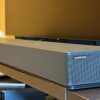
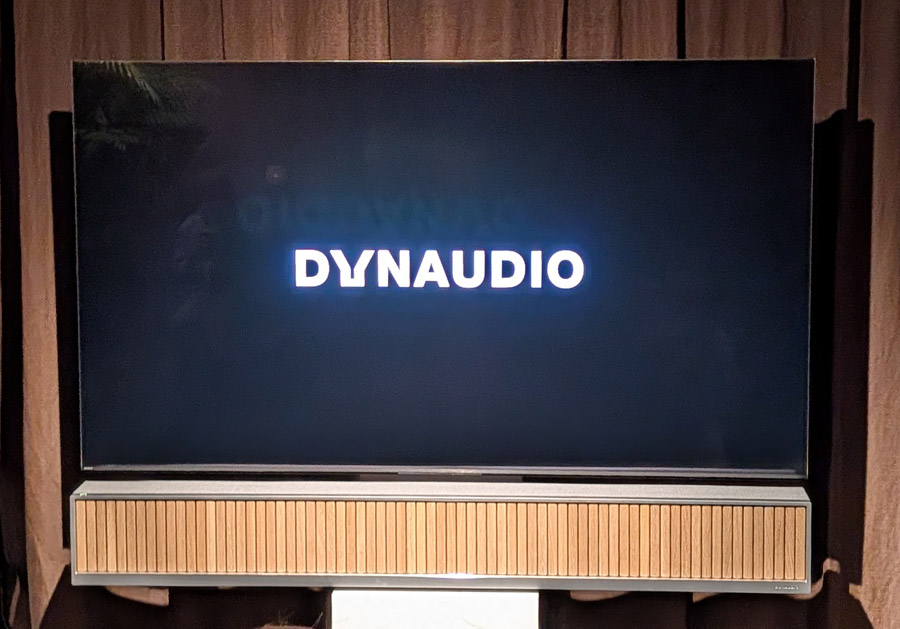
The latest confirmed hardware is substantial: 24 distinct drivers, including six soft-dome tweeters, 14 mid/bass drivers, and four dual-diaphragm force-cancelling subwoofers, powered by 1,500 watts of digital amplification and managed by Dynaudio’s proprietary spatial-audio processing. The 186.4 cm-wide chassis is built around a precision-machined aluminum-alloy frame, 72 motorized Karimoku wooden fins, and a footprint optimized for 83 to 85 inch TVs.
Dynaudio now lists Opus One at 1864 x 236 x 207 mm or 73.4 x 9.3 x 8.1 inches, with a weight of 45 kg / 99 pounds. In other words, this is not something you casually slide under the TV after dinner.
Dynaudio has also confirmed pricing and initial availability. The base model is listed at €13,000 RRP, with stands and mounting accessories priced between €500 and €5,000. Opus One will launch first in Denmark and China before rolling out to other markets. US pricing, US availability, and a firm global shipping timeline have not been confirmed but we believe that the $20,000 USD price will be accurate.
Some important AV details remain unresolved. Dynaudio has not yet published the final HDMI/eARC input configuration, HDMI passthrough support, streaming platform compatibility, Wi-Fi or Bluetooth specifications, full codec support, or the complete input/output package.
The company has confirmed that setup uses a microphone built into the remote to help the system identify whether it has been placed on a stand, mounted on a wall, or positioned in free space, then optimize its performance for that location. That is useful, but it is not the same thing as a fully disclosed room correction platform.
Dynaudio also says it intends to add support for wireless subwoofers and rear surround speakers in the future, integrated into the same system. That is worth mentioning, but it should still be treated as roadmap language rather than part of the launch package. At this level, “future support” and “included in the box” are separated by a very expensive Danish fjord.
That matters because this is not chasing Sonos, Samsung, or Bose. Dynaudio is aiming at a far more rarefied slice of the market already occupied by Canvas HiFi, Bang & Olufsen, and Steinway & Sons Lyngdorf. Interesting wrinkle? All of them have deep Danish roots or Danish manufacturing ties, making this emerging luxury soundbar category feel less like a global arms race and more like Denmark quietly deciding that big TVs deserve better sound.
eCoustics Editor-at-large Chris Boylan was on-site in Vienna for a hands-on preview of the Dynaudio Symphony Opus One. How did it sound? In a word? “Impressive.”
According to Chris, “Rather than simply throwing a wide wall of sound, the all-in-one Dynaudio system produced an enveloping bubble of richly layered sound that held together across multiple seating locations without rear surrounds, ceiling speakers or external subwoofers. When switching between movie and music sound, the system used its motorized fins to direct sound to specific areas of the room in order to best represent Dolby Atmos content vs. standard stereo music. And its size made it a perfect visual and audible match to the 85-inch TV it was paired with.”
Dynaudio has not yet published a frequency-response figure for the Opus One, which is an unusual omission for a €13,000 system. At 73 inches wide and designed to partner with 83-inch to 85-inch televisions, it is clearly aimed at large living rooms and media spaces; in a smaller room, its sheer physical presence could be harder to justify than the price tag. The current system should deliver an unusually ambitious all-in-one experience, but a true dedicated-theater role will depend on Dynaudio following through with the wireless subwoofer and surround speakers it has previously said were planned.
Related Reading:
- Read more High End Vienna 2026 Coverage
- Watch more High End Vienna Coverage
- WiiM Bar Debuts At High End Vienna 2026 With Dolby Atmos And DTS:X: Affordable Soundbar Takes Aim At Sonos
- Bose Lifestyle Ultra Soundbar Review: Dolby Atmos, AirPlay, And Google Cast Aim Straight At Sonos
- Best Soundbars: Editors’ Choice 2025
- More soundbar reviews