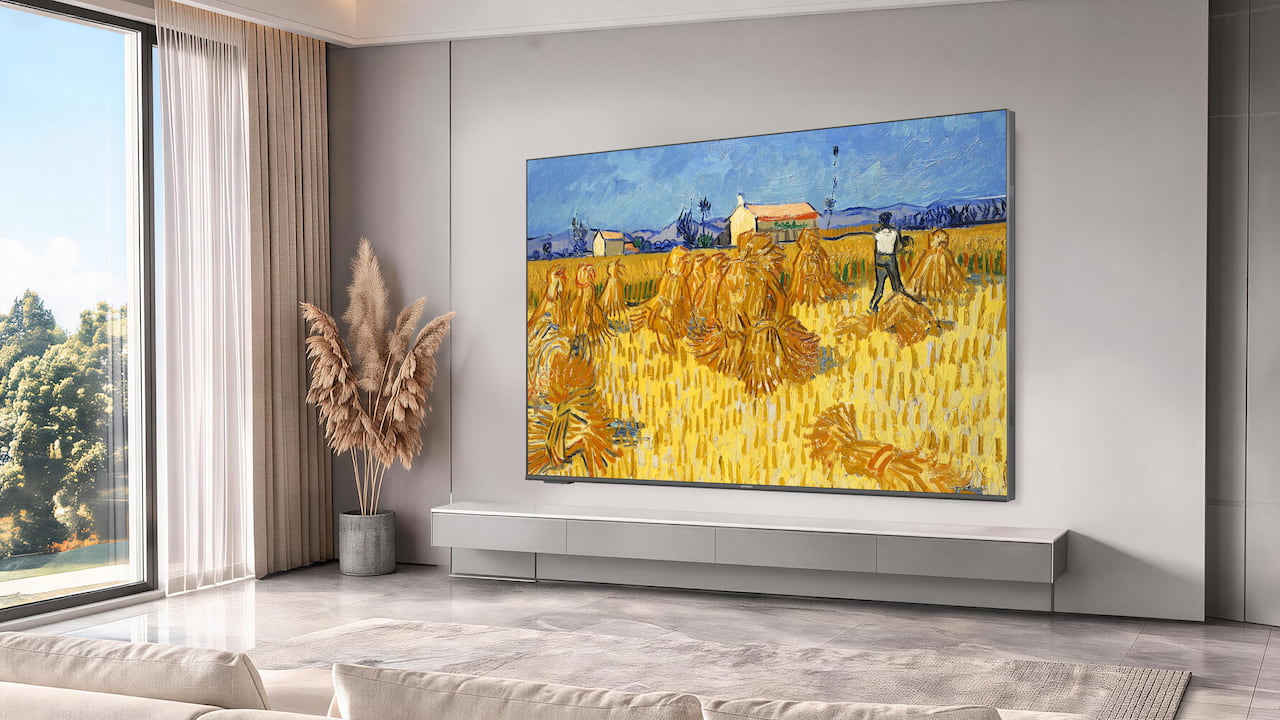
Art TVs have spent years asking buyers to accept a peculiar bargain: your television can look like framed artwork when nobody is watching it, provided you are willing to surrender some picture quality when everyone sits down for movie night.
Skyworth thinks that compromise has gone on long enough.
The new Skyworth C2 Canvas Art TV, which made its official debut at CEDIA Expo 2026, moves several of the display technologies used in the company’s considerably more expensive CE1 Canvas Elite into more conventional 55, 65 and 75-inch screen sizes.
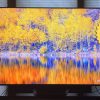
The headline upgrade is QD Mini LED with full-array local dimming and more than 400 zones, combined with 1,000 nits of claimed peak brightness, a native 144Hz refresh rate and Skyworth’s OmniView Matte Screen. HDR support includes both Dolby Vision and HDR10+.
That makes the C2 considerably more interesting than another television wearing a decorative wooden frame.
Related: Best TVs Of 2026: Editors’ Choice Podcast
This Is a Huge Upgrade Over the Skyworth C1
The difference between the existing C1 Canvas Art TV and the new C2 is substantial.
Skyworth’s current C1 uses a conventional LED backlight, operates at 60Hz and is rated at just 300 nits of brightness. It already offers a matte anti-glare screen, flush mounting, Art Mode and an included wood-grain frame, but its specifications clearly place aesthetics ahead of serious HDR performance.
The C2 changes that equation with 1,000 nits of claimed peak brightness, a 144Hz refresh rate and full-array local dimming with more than 400 zones. In other words, this is not Skyworth changing the frame, adding three new Van Goghs and calling it a product cycle.
The additional brightness should provide considerably more headroom for HDR content, while full-array local dimming gives the television much greater control over dark and bright portions of an image than the C1’s conventional LED backlight can provide. How effectively those 400-plus zones control blooming and black levels will require testing, but the underlying hardware represents a major step forward.
The 144Hz refresh rate also makes the C2 considerably more promising for gaming and fast-moving content than its 60Hz predecessor. Skyworth has now confirmed three HDMI 2.1 inputs, including one with eARC, along with optical audio, USB-A and USB-C connectivity, Ethernet and Wi-Fi.
What Skyworth has not yet detailed are gaming features such as VRR or ALLM, so we are not going to award the C2 capabilities that do not currently appear on its specification sheet. Three HDMI 2.1 inputs are useful. Inventing the rest would be less so.

How Close Is It to the Canvas Elite CE1?
Skyworth introduced the CE1 Canvas Elite at CEDIA Expo 2025 in 86 and 100-inch sizes, and eCoustics subsequently named the 100-inch model our Best Art TV at CEDIA 2025.
The CE1 remains the superior display on paper in terms of brightness and local dimming. It uses QD Mini LED technology with more than 1,000 local dimming zones, reaches a claimed 2,000 nits, offers a 144Hz refresh rate and uses the same OmniView Matte Screen technology. The 86-inch model is currently priced at $3,999, while the 100-inch version sells for $5,999.
The C2 therefore does not duplicate CE1 performance. It effectively moves some of the flagship’s display architecture further down the Canvas range, with half the claimed peak brightness and considerably fewer local dimming zones.
That is actually the more important story.
A 100-inch $5,999 lifestyle television is impressive, but it is not going into most living rooms. A 55, 65 or 75-inch Art TV using full-array QD Mini LED technology has the potential to compete for considerably more wall space.
With C2 pricing running from $1,399 to $2,499, Skyworth has also removed one of the biggest obstacles to that happening. You are giving up brightness, screen size and a substantial number of local dimming zones compared with the CE1, but you are also spending thousands less for the same basic idea in sizes that do not require restructuring the living room around the television.
Is the Skyworth C2 Really Unique?
Not entirely, and this is where the marketing department needs to put the champagne back in the refrigerator.
Mini LED is no longer exclusive to Skyworth among televisions designed to double as artwork. Samsung’s 2026 The Frame Pro uses its Neo QLED Mini LED platform and supports 144Hz operation, while TCL has also introduced QD Mini LED technology in its premium NXTVISION Art TV lineup.
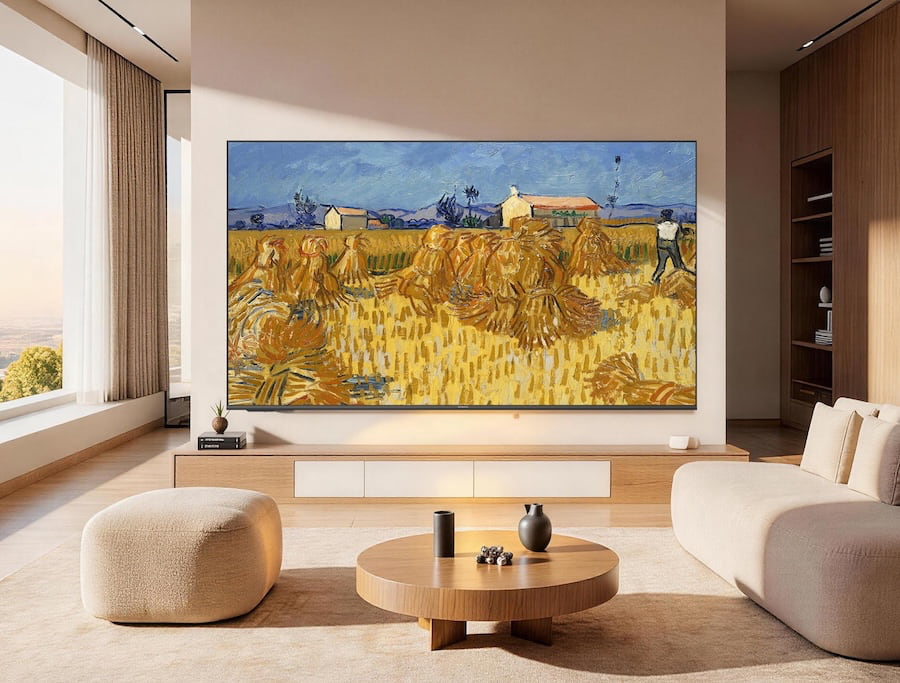
What makes the C2 Canvas Art TV noteworthy is the combination Skyworth is bringing into its standard Canvas range: full-array QD Mini LED backlighting, 400-plus local dimming zones, 1,000-nit claimed brightness, 144Hz operation, Dolby Vision, HDR10+ and a matte display.
There is another important distinction. Skyworth supports Dolby Vision, which Samsung still does not offer on its televisions.
The company has also integrated a subwoofer and Dolby Atmos audio into the C2. Skyworth goes so far as to suggest an external soundbar is unnecessary. We will reserve judgment on that one until somebody actually listens to it; physics has not yet received notice that it has been cancelled.
CEDIA Is Also Part of the Story
The C2 is not being positioned solely as another television destined for a pallet at Costco.
Skyworth says the new models will be distributed through its authorized custom integration dealer network, which helps explain the CEDIA Expo debut. The company supports integration with control platforms including Control4 and Crestron, while installers can order customizable frames through Skyworth’s partnership with Hydro Frames.
Standard frame finishes include black, silver, gold, white and walnut, with additional custom patterns and colors available.
That flexibility matters in a category where the television is supposed to disappear into the room rather than announce that somebody bought another 75-inch black rectangle.
Skyworth Is Becoming Harder to Ignore
The C2 also arrives during a much more consequential year for Skyworth in North America.
Earlier in 2026, Panasonic announced a strategic partnership with Skyworth for its U.S. television business, with Skyworth USA assuming a major operational role covering sales, marketing and logistics while the relationship also leverages Skyworth’s manufacturing scale. That development followed Skyworth’s growing push into premium Art TVs and outdoor displays in the American market.
That makes products like the C2 worth watching beyond their individual specifications. Skyworth is no longer merely another enormous Chinese television manufacturer trying to establish name recognition with American consumers. Its role in the North American television business is expanding rather quickly.
The Bottom Line
The Skyworth C2 Canvas Art TV looks like a far more consequential product than the C1 it follows.
Moving from a 300-nit, 60Hz conventional LED platform to 1,000 nits, 144Hz and more than 400 full-array local dimming zones changes the conversation from “television that looks attractive on the wall” to something that could potentially deliver credible home theater performance as well.
It is not the first premium Art TV to embrace Mini LED, but Skyworth has given the C2 considerably more serious display hardware than its predecessor. It also includes three HDMI 2.1 inputs, including one with eARC, removing one of the larger question marks from the original announcement.
With pricing starting at $1,399, Samsung, Hisense and TCL now have another serious competitor hanging on the wall. And this one appears rather more interested in what happens after you stop looking at the Monet.
Price & Availability
The Skyworth USA website currently lists pricing at $1,399 to $2,499, but we haven’t received any information when it will become available yet.
Related Reading:
- Skyworth 100-Inch Canvas Elite Art TV Launches At CEDIA 2025 — Who Needs A Wall Anyway? – Price And Availability Update
- Amazon Ember Artline TV Takes Aim At Samsung The Frame With Free Art And Alexa Plus
- Samsung Unveils 2026 The Frame And Frame Pro 4K TVs: New Sizes, Art Mode Upgrades, And Design Focus
- Samsung S95H OLED TV Review: Top Notch Performance In An Artsy Frame
- Panasonic Exits TV Manufacturing, Hands Production To Skyworth As 2026 TV Shakeup Continues