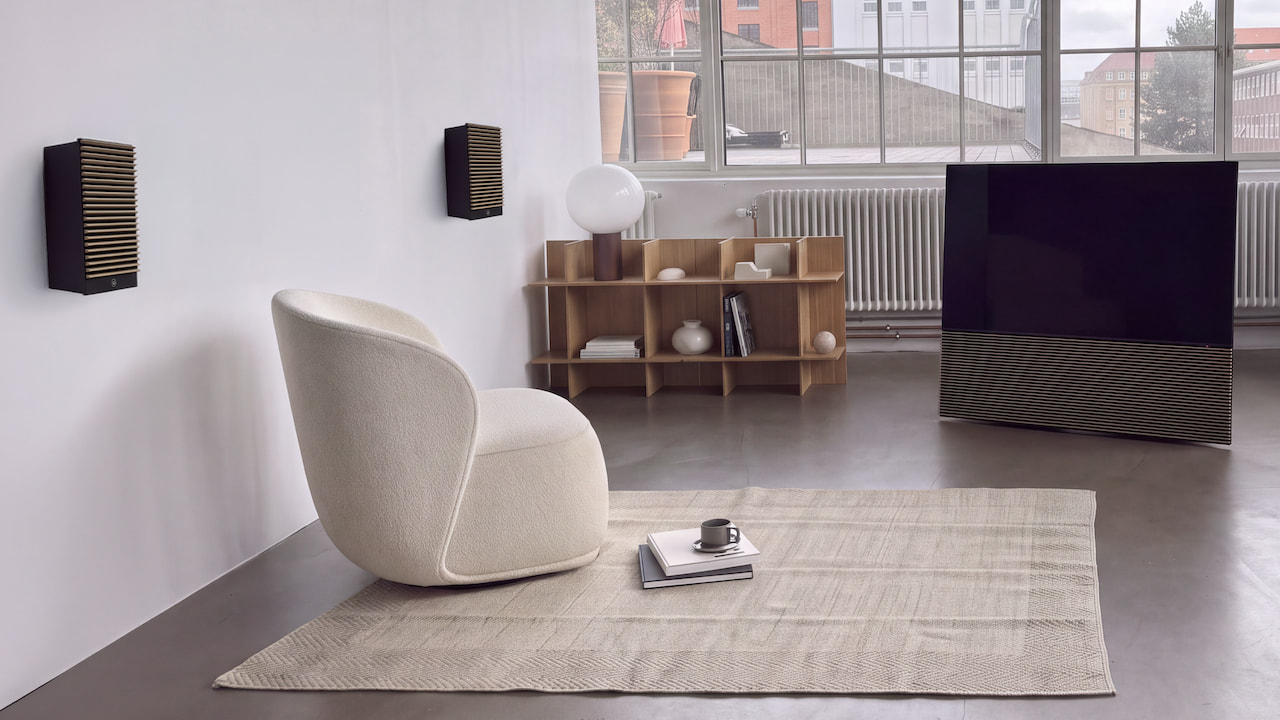
CANVAS HiFi built its reputation around doing something rather unconventional: using BACCH 3D processing and a single, furniture-friendly audio system to create a much larger front soundstage without surrounding the television with separate left, center, right and subwoofer cabinets. At IFA 2026, the Danish company is taking that concept considerably further by adding support for dedicated Dolby Surround and Dolby Atmos channels around and above the listener.
The big change is Almando InMedio, a new component developed with German electronics specialist Almando. It handles surround decoding and signal distribution while allowing CANVAS to remain responsible for the front soundstage. Surround, rear and height duties can then be assigned to compatible active loudspeakers, with both wired and wireless connectivity, including WiSA.
And there is an important distinction here: CANVAS is not introducing its own surround or height speakers. Instead, it is opening the platform so owners can build a multichannel home theater around CANVAS using active or passive speakers from other manufacturers. That makes this much more than CANVAS simply adding a Dolby Atmos badge to the box.
Related Reviews:
What Is CANVAS HiFi and How Does BACCH 3D Work?
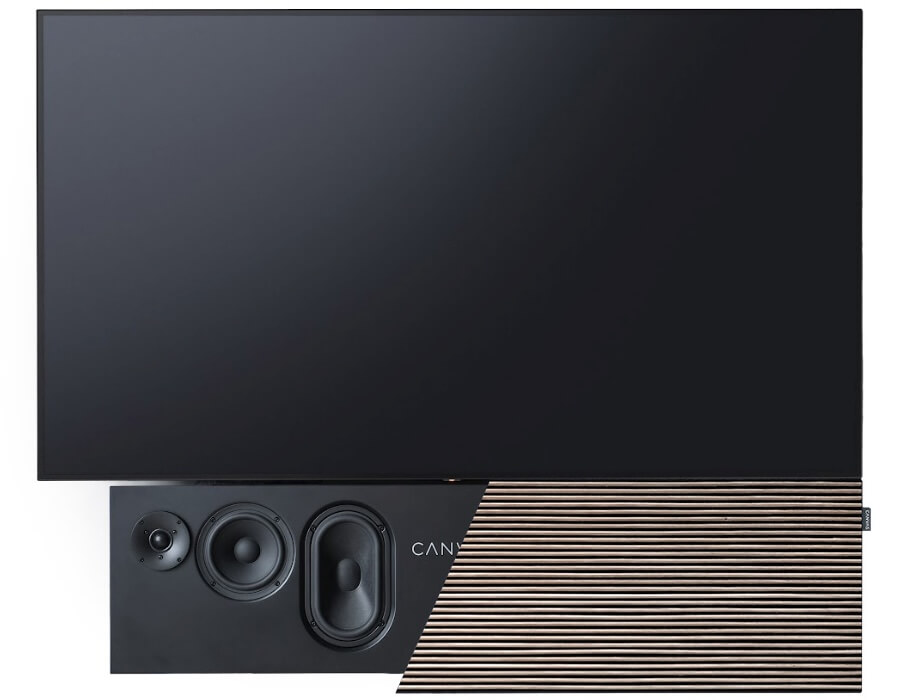
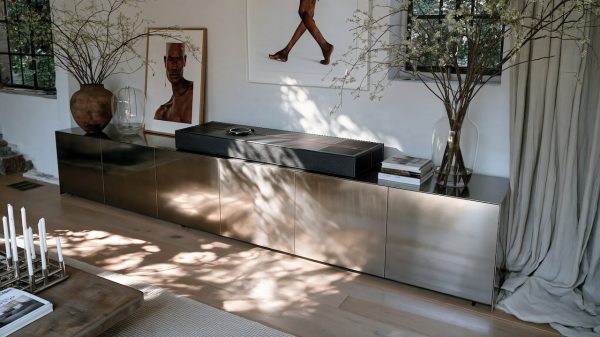
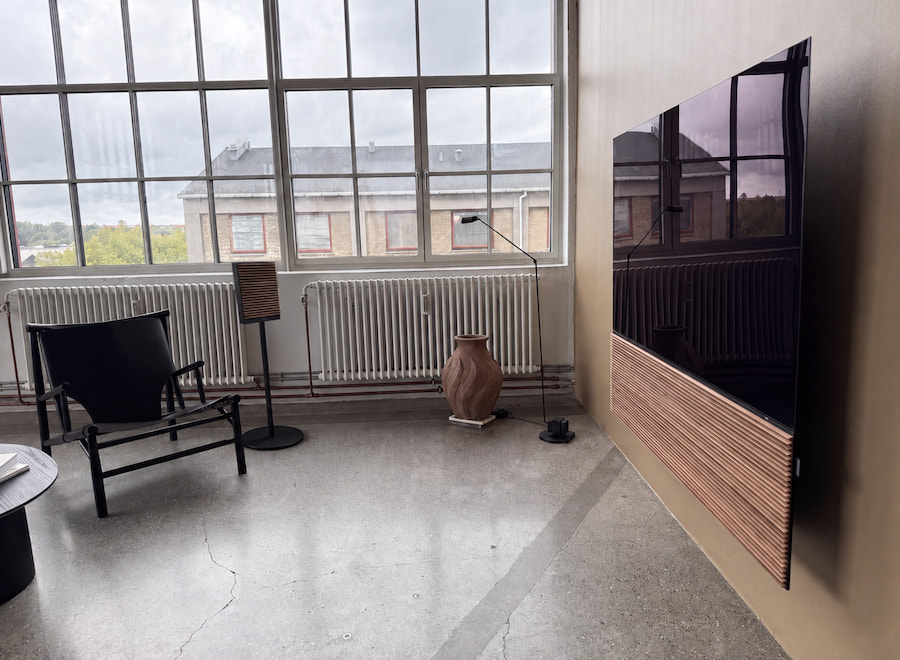
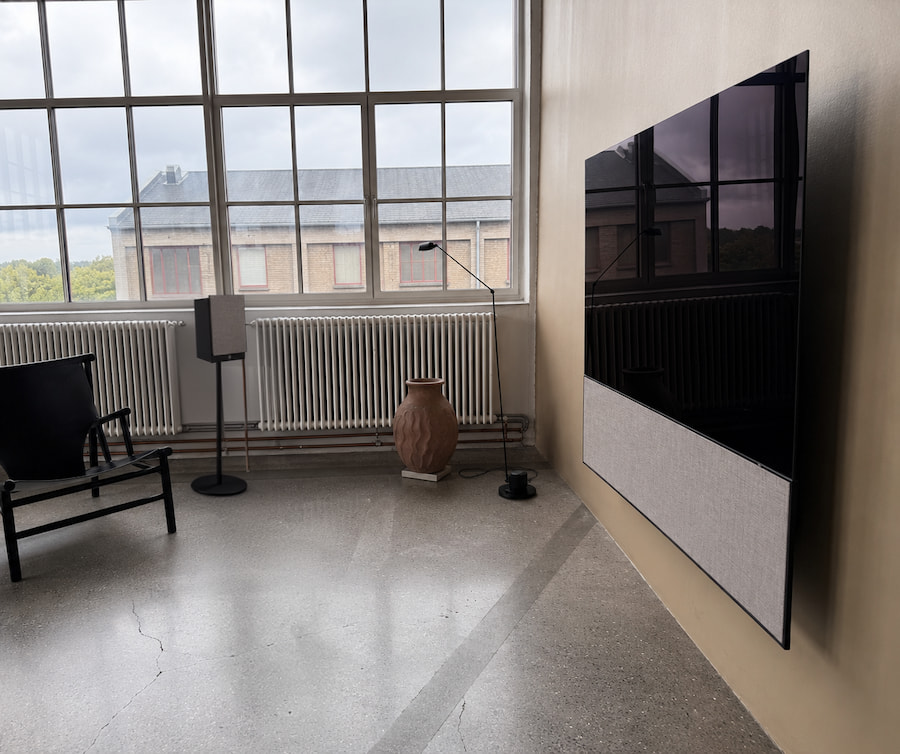
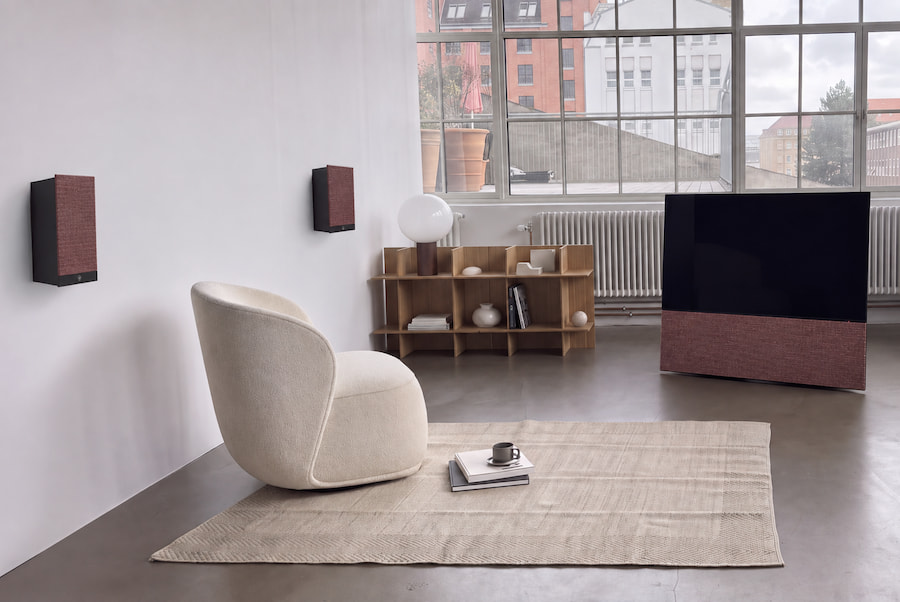
Calling CANVAS HiFi a soundbar has always been somewhat misleading. The Danish company’s original CANVAS is an active stereo loudspeaker system designed to integrate physically with a television, either mounted beneath the display or used as part of a freestanding installation. Its interchangeable fabric and wood fronts can be matched to common TV sizes, giving the television and speaker system the appearance of a single piece of furniture rather than a screen with another black box hanging underneath it.
CANVAS is also deliberately TV-brand agnostic. Its universal mounting system works with flat-panel televisions from multiple manufacturers, and CANVAS specifically lists Samsung, Sony, Panasonic and LG among the supported brands. Current versions are designed to visually match 55, 65, 75, 77, 83 and 85-inch screens, while CANVAS SOLO can be installed independently beneath televisions of other sizes.
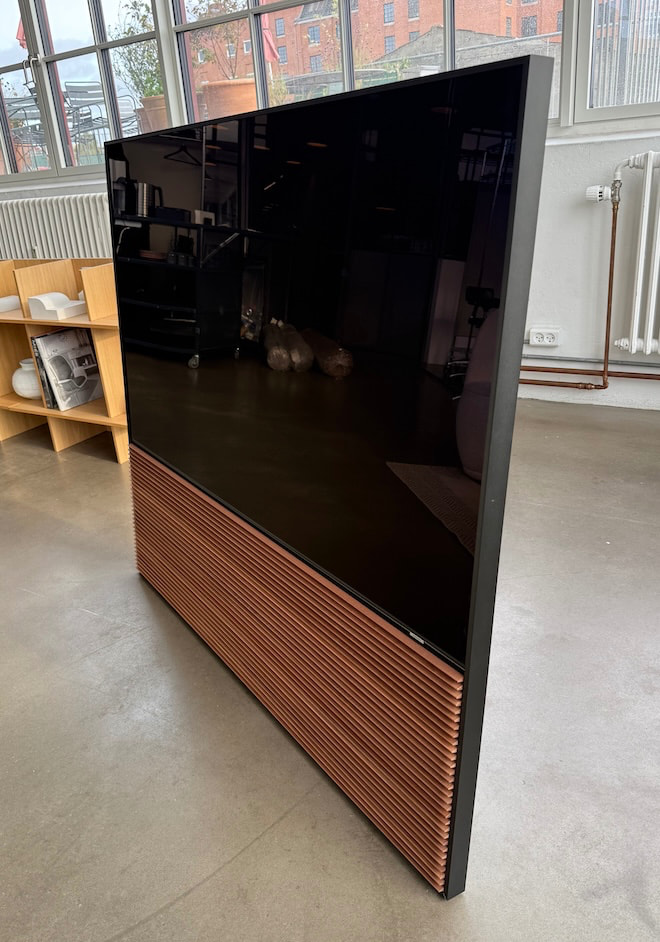
Samsung represents a deeper relationship. CANVAS and Samsung introduced The HiFi Frame at IFA 2025, initially pairing the audio system with Samsung’s The Frame and The Frame Pro televisions. CANVAS has since expanded that concept to other Samsung displays, giving buyers considerably more freedom over the television they put inside the integrated frame.
The other major piece of the CANVAS formula is BACCH 3D, technology developed from research led by Princeton University Professor Edgar Choueiri. BACCH stands for Band-Assembled Crosstalk-Cancellation Hierarchy, and its purpose is very different from conventional virtual surround processing.
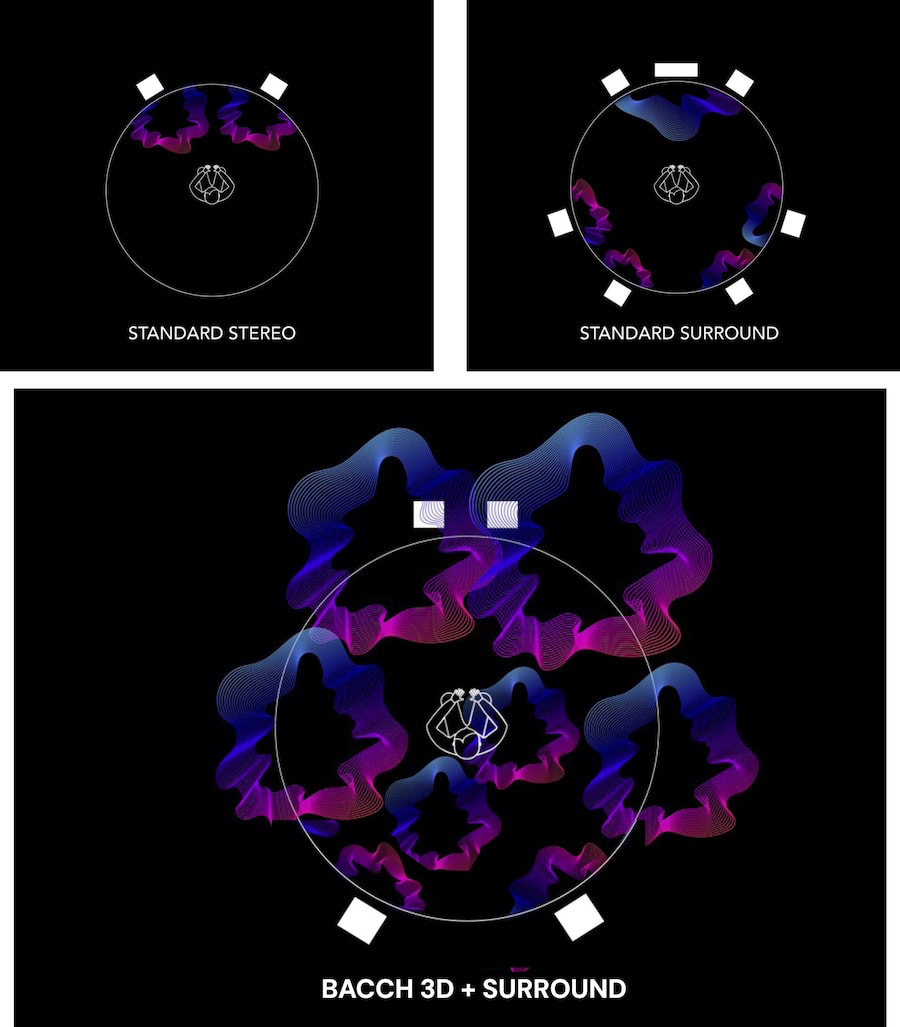
With normal stereo loudspeakers, sound from the left speaker reaches both ears, as does sound from the right speaker. BACCH processing reduces that acoustic crosstalk so the spatial information contained in the recording can reach the listener’s ears more accurately. The result can produce a soundstage that extends well beyond the physical position of the two speakers, including greater apparent width, depth and, with suitable material, a more convincing sense of three-dimensional space.
That is why CANVAS has previously been able to create such an expansive presentation from the front of the room without installing physical surround speakers behind the listener.
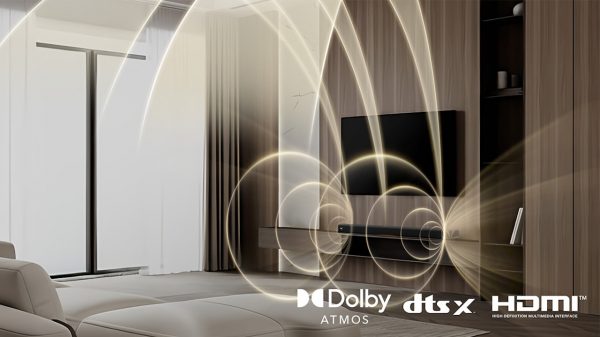
The new Dolby Surround and Dolby Atmos expansion changes that equation. BACCH 3D is still responsible for what happens across the front of the room, but CANVAS can now become the front end of a system with real surround, rear and height channels. And that is where the new Almando InMedio becomes important.
What Is Almando InMedio and How Does It Work?
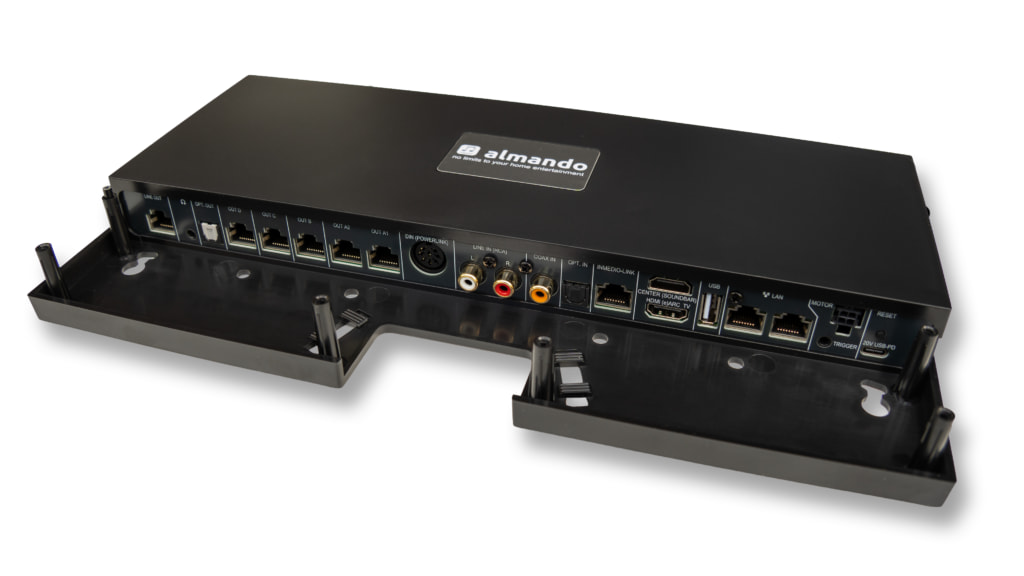
The component that makes CANVAS HiFi’s move into full multichannel home theater possible is the new Almando InMedio, developed in collaboration with German electronics specialist Almando. Rather than forcing CANVAS owners to add a conventional AV receiver or processor, InMedio handles surround decoding, channel distribution and connectivity while allowing CANVAS to remain responsible for the front soundstage.
The control box is compact enough to be hidden inside the CANVAS converter bracket, keeping another piece of electronics out of sight beneath the television. InMedio determines which channels are sent to CANVAS and which are routed to the active loudspeakers positioned around or above the listener.
In the configuration CANVAS considers the logical starting point, BACCH 3D continues to handle the front left, front right, center and subwoofer channels through CANVAS, while InMedio provides up to eight additional channels for surround, rear and height speakers. The complete system can therefore support configurations up to 7.1.4 channels, with those eight external channels connected either by wire or wirelessly using WiSA HT.
Owners can also mix the two connection methods rather than committing the entire system to one or the other. Almando lists an 8-channel analog output alongside 8-channel WiSA HT transmission on the WiSA-equipped version of InMedio, while CANVAS receives its signal from InMedio through the latter’s optical digital output. Almando says several versions of InMedio are planned for different system requirements, so not every model will necessarily include every connection option.
InMedio is also considerably more than a surround breakout box. Its current specification includes HDMI eARC/ARC, optical and coaxial digital inputs, RCA analog input, USB-A, UPnP networking and B&O PowerLink, along with an integrated Gigabit Ethernet switch. Almando also lists AirPlay, Spotify Connect, TIDAL Connect, Qobuz Connect, internet radio and podcast support, giving InMedio the potential to become the connectivity hub for a much larger CANVAS-based AV system.
The surround ambitions extend beyond Dolby as well. Almando currently lists Dolby Atmos up to 7.1.4, Auro-3D and MPEG-H 3D Audio, along with WiSA HT and B&O Wireless PowerLink compatibility. There are also separate 12V trigger outputs for audio and video equipment, which could make InMedio useful in more elaborate installations involving external amplifiers, projection screens and other components.
System configuration is divided between two apps. Surround setup, channel assignment and the external loudspeakers are controlled through the Almando Play app, while BACCH 3D continues to be configured through the CANVAS app. Outputs can also be assigned for subwoofer duty, allowing wired or wireless subwoofers to be incorporated into the system.
There is another way to configure the front of the room, but it comes with a significant tradeoff. Users can install separate front left and right speakers and have CANVAS operate primarily as the center channel. According to CANVAS CEO Laust Nielsen, doing so disables BACCH 3D because CANVAS is no longer handling the left and right front channels required for its crosstalk-cancellation processing.
That is why the more interesting configuration keeps CANVAS responsible for everything across the front. Owners retain the BACCH 3D presentation that distinguishes CANVAS from a conventional soundbar or center speaker, but gain physical surround, rear and overhead channels where they can provide a genuine benefit.
There is one important caveat before anyone starts measuring the ceiling for four Atmos speakers. The InMedio being shown at IFA 2026 is the first prototype, not a finished production unit. Almando says the hardware is ready, but software development and certification are still being finalized. The extensive feature list therefore represents the platform Almando is currently developing, and some details could change before commercial availability.
System Audio Is the First Partner, But Not the Only Option
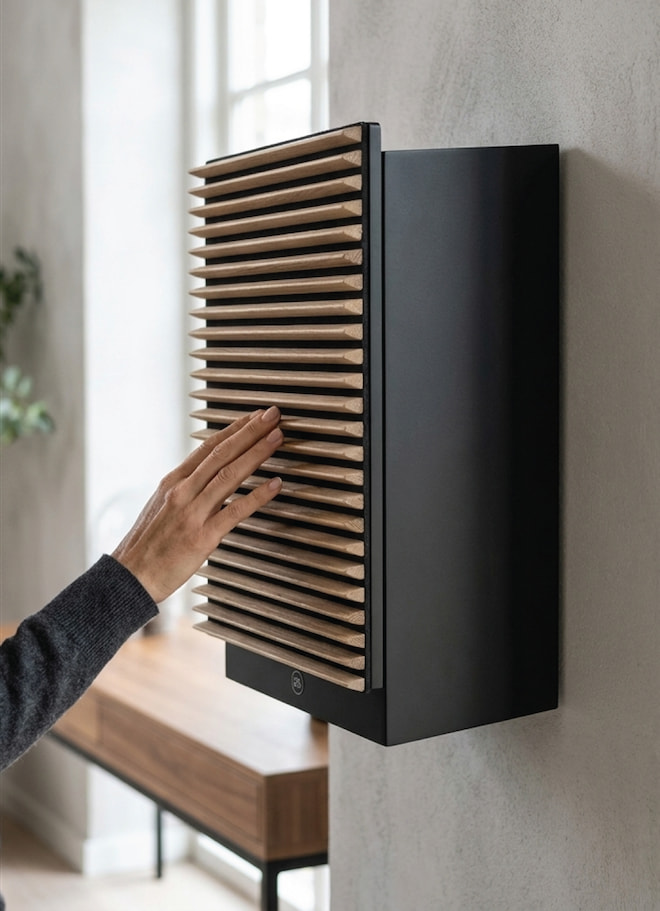
CANVAS HiFi is not developing its own surround, rear or height loudspeakers for this system. Instead, the company is taking a more open approach, and its first loudspeaker partner is fellow Danish manufacturer System Audio.
Selected models from System Audio’s Silverback range of active loudspeakers will be adapted to better match the CANVAS design language, including coordinated Kvadrat textiles, colors and wood finishes. The idea is to provide CANVAS owners with a surround solution that looks like it belongs in the same room rather than a collection of unrelated boxes assembled around the television.
System Audio is also a logical technical partner because its Silverback loudspeakers are already active and support WiSA HT. The compact Silverback 1, for example, incorporates 80 watts of amplification, WiSA HT connectivity and an analog line input, and can be mounted on a wall or placed on a shelf. System Audio already positions the Silverback platform for expandable home theater applications, so adapting selected models for the CANVAS ecosystem does not require reinventing the loudspeaker.
But buying System Audio speakers will not be mandatory.
Laust Nielsen explained to eCoustics that owners will be free to use other compatible active loudspeakers, either through InMedio’s wired outputs or wirelessly through WiSA HT. Conventional passive loudspeakers can also be used, although they will require separate amplification between the InMedio and the speakers. That opens the door to considerably more ambitious installations and means existing home theater owners may be able to incorporate loudspeakers and amplifiers they already own rather than starting again from scratch.
That flexibility is important because adding more speakers is not necessarily the starting point for everyone who buys CANVAS. One of the system’s greatest strengths is how effectively it can create an unusually large and immersive soundstage without any surround or height speakers at all.
The Bottom Line
We have experienced CANVAS extensively at audio shows and in a home environment, and BACCH 3D can make the presentation extend well beyond the physical dimensions of the system. With suitable movies and music, the sense of width, depth and spatial placement can be rather startling considering that all of the hardware is sitting beneath the television. CANVAS itself describes BACCH 3D as part of the combination of loudspeaker design, room correction and crosstalk cancellation that allows the system to produce a much larger presentation than its physical footprint would suggest.
That flexibility may ultimately be more important than the System Audio partnership itself. Some buyers will want the cleanest possible installation with matching Silverback speakers, while others may already own active loudspeakers, amplifiers, or passive speakers they want to integrate. InMedio gives both groups a path forward without turning CANVAS into a closed ecosystem.
Adding Dolby Atmos changes the conversation because CANVAS is no longer limited to competing with premium soundbars and all-in-one TV audio systems. It can now become the front end of a genuine 7.1.4 Dolby Atmos home theater while retaining BACCH 3D where it arguably makes the most sense.
With Playback Distribution now handling CANVAS HiFi in North America, the company also has a much stronger route into dealers, custom installers and demonstration rooms on this side of the Atlantic. The InMedio hardware and software still need to reach production, but if CANVAS and Almando deliver what they are showing at IFA 2026, this could turn one of the more interesting alternatives to a conventional soundbar into something considerably more ambitious.
For more information: canvashifi.com
Related Reading: