Bluetooth has spent more than two decades teaching consumers that wireless convenience sometimes means opening Settings and wondering why your headphones have connected themselves to a laptop in the next room.
Auracast has always promised something considerably more useful: one audio source broadcasting to many listeners without conventional one-to-one Bluetooth pairing. Vue Cinemas is now giving that idea a serious public test.
Vue has deployed the Auri assistive listening system across 20 cinemas and more than 200 screens in the UK and Ireland, representing more than 28% of admissions across its circuit. Auri was developed by Listen Technologies and Ampetronic around Bluetooth Auracast broadcast audio and can transmit cinema audio directly to compatible hearing aids, cochlear implants, earbuds and headphones.
For people without compatible hardware, Vue can still provide dedicated Auri receivers connected to headphones or earbuds. That may sound like a minor detail, but it is crucial because Auracast compatibility is not yet universal.
This is where Bluetooth audio starts becoming much more interesting than another wireless codec promising slightly better cymbals.
What Is Vue Actually Installing?
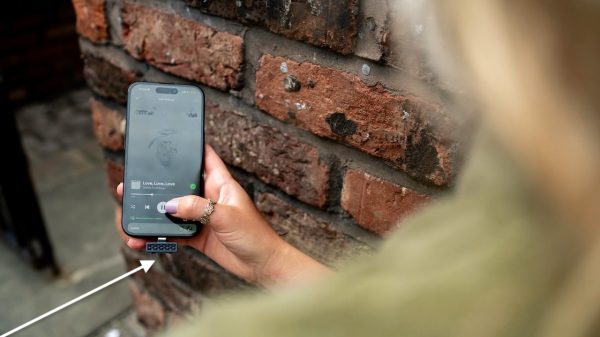
Traditional Bluetooth is generally built around a connection between individual devices. Auracast works more like a radio broadcast: one transmitter can send an audio stream to an effectively unlimited number of compatible receivers within its coverage area. Users select the available broadcast rather than individually pairing every listener with the source.
At Vue, that means somebody with an Auracast-compatible hearing aid or cochlear implant can receive the movie soundtrack directly through their own hearing device. Someone using compatible earbuds or headphones can do the same thing.
Auri transmitters can be mounted on walls or ceilings and integrated with existing audio infrastructure without ripping the auditorium apart. The system can also operate alongside existing assistive listening technology, which matters for venues that cannot simply abandon hearing loops or other installed systems overnight.
The platform is also capable of carrying audio description for blind or partially sighted patrons, while Vue and Auri have identified potential benefits for neurodivergent moviegoers who may prefer a more direct and controlled listening experience.
Why Does This Matter?
Because accessibility technology frequently fails at the point where somebody actually has to use it.
Going to the counter, requesting a proprietary receiver, finding out whether it has been charged, figuring out how to connect it to your hearing device, and returning it after the movie creates a lot more friction than simply selecting an available audio broadcast on equipment you already use every day.
Auracast does not eliminate the need for venue-supplied receivers yet, but it creates a path toward bring-your-own-device assistive listening.
For hearing-aid and cochlear-implant users, the benefit is obvious: clearer, direct audio without relying entirely on room acoustics or trying to extract dialogue from an enormous theatrical mix.
But the audience could be much larger.
People without diagnosed hearing loss can struggle with dialogue in acoustically difficult spaces. Someone who finds theatrical sound levels uncomfortable may prefer a personally controlled feed. Audio description can help visually impaired patrons. Multiple broadcasts can potentially support language interpretation. The same underlying technology can serve people with very different needs without forcing the venue to build a completely different system for each one.
That is the genuinely clever part.
What About AMC, Regal, Cinemark and Cineplex?
This is where North America has some catching up to do. To date, we’ve received no word of any Auracast rollout from AMC, Regal, Cinemark or Cineplex.
That does not mean those chains ignore accessibility. Quite the opposite.
AMC currently offers assistive-listening headsets and audio-description devices. Regal uses Sony Access systems built around wireless receivers that can connect to headphones or neck loops. Cinemark provides Ultra Stereo headsets and neck-loop devices for hearing aids and implants, while Cineplex uses systems including Doremi Fidelio for described narration and CaptiView for closed captioning.
Those systems work, but they generally depend more heavily on hardware supplied and maintained by the theater.
Auracast could eventually reduce that dependency by letting more patrons use their own compatible devices.
It would not, however, mean an American cinema could throw its loaner receivers into a dumpster and put up a sign saying “bring earbuds.”
The 2010 ADA Standards require assistive listening systems in assembly areas where amplified audible communication is integral to the space and specify minimum numbers of receivers based on seating capacity. Some of those receivers must also be hearing-aid compatible. Auracast can fit within an ADA-compliant system, but U.S. venues still need to satisfy those accessibility requirements for people who do not arrive carrying compatible hardware.
Auri already accounts for that with dedicated receivers.
Auracast Is Already in a U.S. Theater — Just Not a Movie Chain
There is already a useful American proof of concept.
The WYO Performing Arts & Education Center in Sheridan, Wyoming, installed Auri on its main stage in 2025. The system supplements the theater’s existing hearing loop and allows visitors to listen through compatible personal devices or borrow Auri receivers. WYO can also use the system for audio description and language interpretation.
That is significant because it demonstrates that there is nothing inherently European about this technology.
The larger question is when a North American cinema operator decides to try it across hundreds or thousands of screens. Vue may have just provided them with a rather useful case study.

Where Could Auracast Go Next?
Movie theaters might ultimately be one of the less important applications.
Think about an airport gate where a traveler with hearing loss can receive boarding announcements directly through a hearing aid instead of trying to understand a PA system bouncing around a glass terminal. Or a railway station where platform announcements arrive clearly through earbuds.
Universities could broadcast a lecturer directly to students across a large auditorium. Houses of worship could offer clearer speech without requiring everyone to use the same proprietary receiver. Museums could provide tours and multiple languages. Convention centers could offer simultaneous interpretation. Sports stadiums could broadcast commentary or announcements. Hospitals and waiting rooms could finally make those silent television screens useful without subjecting everyone else to daytime television at full volume.
The Bluetooth SIG specifically identifies airports, conference centers, gyms, cinemas, houses of worship, museums, lecture halls and transportation facilities as potential Auracast environments, including applications for assistive listening, silent screens, tours and multilingual audio.
This is already moving beyond theory. Auri has been installed in performing arts venues, universities and Stadium Taranaki in New Zealand, where multiple transmitters cover different parts of the facility without the under-floor cabling required by a conventional induction-loop installation.
There Is Still One Big Catch
Your headphones actually have to support it.
Auracast relies on features introduced with Bluetooth 5.2 and the LE Audio specifications, but having Bluetooth 5.2, 5.3, 5.4 or something newer printed on the box does not automatically mean a product supports Auracast. The transmitting and receiving devices need the appropriate LE Audio and Public Broadcast Profile capabilities, and some existing products may require hardware rather than merely a firmware update.
That is why Vue keeping dedicated receivers available is not some legacy concession. It is essential during the transition.
The good news is that Auracast support is appearing in more consumer products. eCoustics has already covered Auracast implementations in the Technics EAH-AZ100, Sennheiser’s RS 275 television listening system and numerous Bluetooth transmitters and dongles. What has been missing is somewhere genuinely useful to connect them outside the house.
Vue is beginning to answer that question.
The Bottom Line
Auracast has spent several years sounding like one of those Bluetooth technologies that would be transformative just as soon as somebody gave consumers somewhere meaningful to use it. Vue putting Auri into more than 200 cinema screens changes that conversation because this is no longer a trade-show demonstration or another logo on an earbud box.
People with hearing loss stand to benefit first, particularly users of compatible hearing aids and cochlear implants, but the potential extends to audio description, language interpretation, neurodivergent listeners and anyone who needs clearer audio in a difficult public environment. The technology does not eliminate existing accessibility systems overnight, and compatibility remains inconsistent, but the ability to use your own listening device removes an important barrier.
The more interesting question is what happens if airports, universities, stadiums, museums, houses of worship and North American movie chains follow Vue’s lead. Bluetooth has spent years connecting our phones to increasingly ridiculous numbers of gadgets. Helping somebody actually hear the movie, boarding announcement or person standing on a stage might finally be the feature that matters.
Related Reading:
- Technics EAH-AZ100 Earbuds Add Auracast Support: A Practical Bluetooth LE Upgrade For 2025
- Sennheiser BTD 700: AptX Adaptive, Auracast, And No More Bluetooth Bottlenecks
- Sennheiser RS 275 TV Listening Bundle Brings Wireless Audio To The Living Room Without The Lip Sync Drama
- Podcast: Is Bluetooth About To Take A Major Leap Forward?