
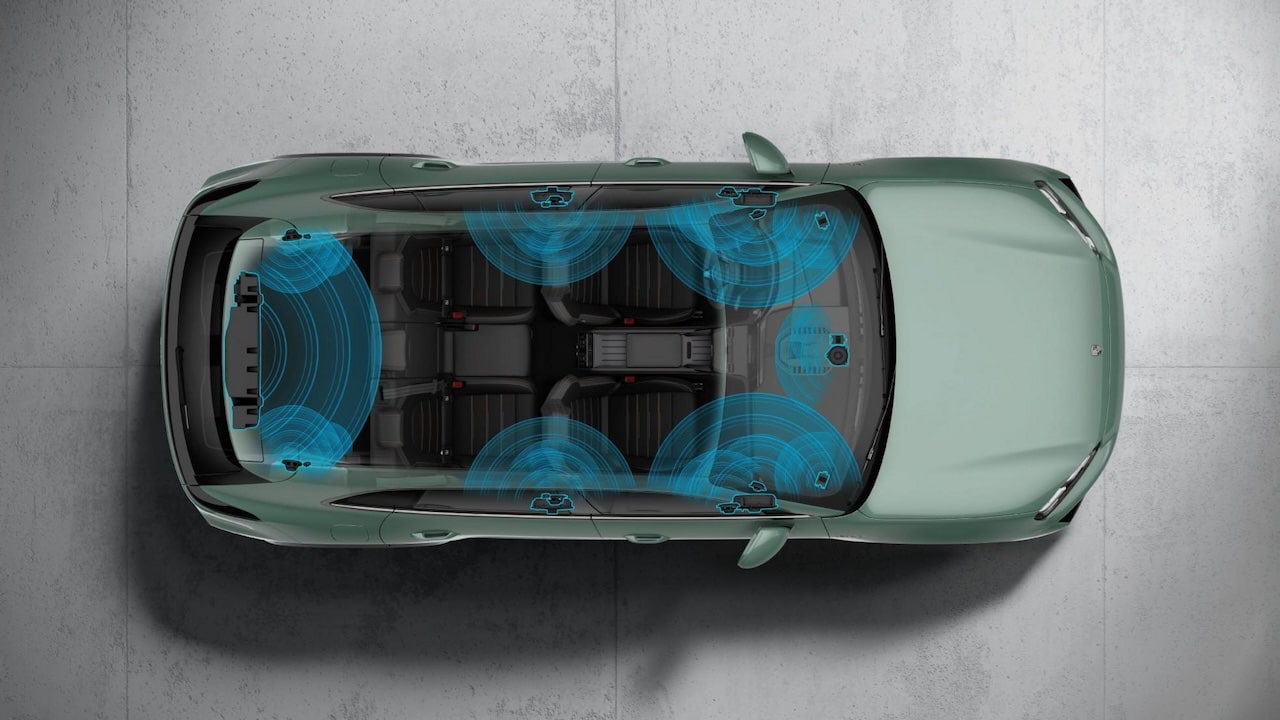
The premium car audio arms race has become wonderfully ridiculous.
Genesis just unveiled a 25-speaker Bang & Olufsen system with a discrete 7.1.4 Dolby Atmos layout for its flagship GV90. Cadillac has stuffed 38 AKG speakers into the Escalade IQ. BMW offers 36 Bowers & Wilkins speakers in the 7 Series, while Volvo continues expanding Dolby Atmos and Apple Music Spatial Audio across its latest Bowers & Wilkins-equipped EVs.
Porsche, apparently deciding that another dozen loudspeakers would be too obvious, has gone after the semiconductors instead.
The German automaker has developed what it describes as the world’s first production-ready high-end automotive audio system to incorporate gallium nitride (GaN) semiconductor technology, with the first application scheduled to reach a future Porsche vehicle in 2027. The technology is being integrated into Porsche’s Burmester 3D High-End Surround Sound System and was developed with the University of Stuttgart.
There is an important technical distinction here. Porsche has not announced that every amplifier stage in the Burmester system is becoming a GaN design.
A GaN-based high-performance chip is being used for the voltage conversion required to power the system’s 400-watt subwoofer amplifier. That may sound less dramatic than proclaiming that Porsche has invented a giant GaN-powered stereo on wheels, but it is also considerably more accurate.
Why Is Porsche Using GaN?

Gallium nitride is already familiar to anyone following modern Class D amplification and compact power supplies. Compared with conventional silicon semiconductors, GaN devices can switch at higher frequencies with lower losses, helping engineers reduce heat and shrink some of the supporting circuitry.
Those advantages are particularly useful inside a car, where packaging space and weight matter far more than they do in a listening room.
Porsche says the improved efficiency allows the Burmester amplifier’s heat sink to be approximately 20 percent lighter, while passive components including capacitors and inductors can also be made smaller.
That 20 percent figure applies specifically to the heat sink, not the complete amplifier or audio system.
From Stuttgart University to a Production Porsche
The project began in mid-2023, when Porsche engineers started investigating whether GaN could meet the thermal, durability and packaging demands of an automotive environment.
Beginning in spring 2024, Porsche audio, semiconductor and sustainability specialists worked with the Institute for Robust Power Semiconductor Systems at the University of Stuttgart to develop a prototype GaN-based subwoofer amplifier.
Porsche subsequently worked with an unnamed international semiconductor manufacturer and an audio development partner to turn the concept into a production-ready design. The company says several patent applications have resulted from the project.
The first production application is scheduled for 2027, although Porsche has not disclosed which model will receive it first.
We also don’t know the complete speaker configuration, total amplifier output, option price or whether the first GaN-equipped system will otherwise mirror one of Porsche’s existing Burmester installations.
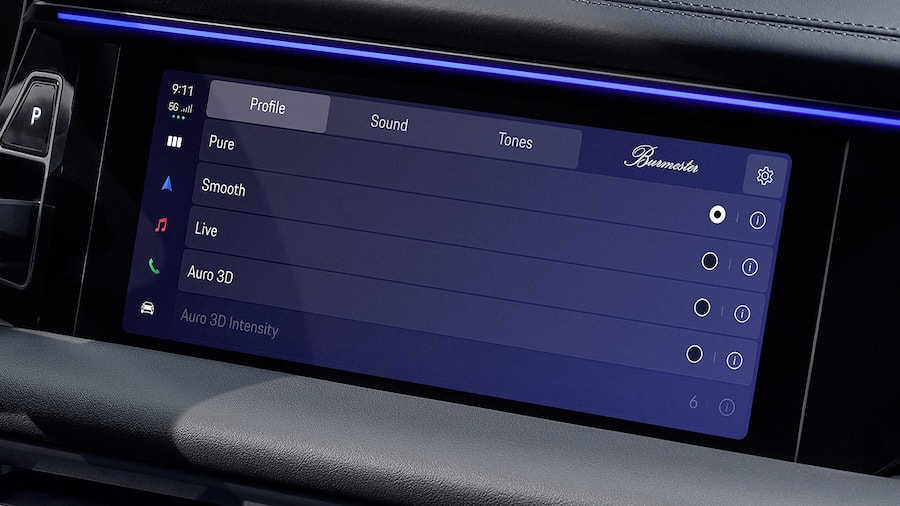
What Does Burmester Already Offer in Porsche Vehicles?
The current electric Porsche Macan provides useful context.
Its $6,010 optional Burmester 3D High-End Surround Sound System uses 21 speakers, 21 amplifier channels and 1,470 watts of total system output, including a 400-watt active subwoofer.
Porsche has also been expanding its immersive audio capabilities. For model year 2026, compatible vehicles equipped with premium Bose or Burmester systems gained support for Dolby Atmos through the latest Porsche Communication Management platform.
The GaN project therefore isn’t replacing Porsche’s broader push toward immersive audio and advanced DSP. It is addressing the electrical hardware underneath those systems.
Automotive Audio Is Getting Serious
We have been watching this transformation accelerate throughout 2026.
The Genesis GV90 arrives with a 25-speaker Bang & Olufsen Premier 3D system configured as a 7.1.4 Dolby Atmos layout, including four overhead speakers. Acoustic Lens Technology, cabin isolation and B&O’s Virtual Venue processing make it one of the more ambitious factory systems announced this year.
The Cadillac Escalade IQ’s 38-speaker AKG Dolby Atmos system was also one of the best automotive immersive audio demonstrations we heard at NAMM 2026. Its success wasn’t simply about the speaker count; the system worked because the drivers, processing, bass reproduction and cabin were engineered together.
BMW’s current 7 Series offers a 36-speaker Bowers & Wilkins Diamond Surround Sound System with Dolby Atmos, while Volvo continues pursuing the same immersive direction with Bowers & Wilkins systems in vehicles including the EX60, EX90 and ES90.
Premium automotive audio is no longer defined by attaching a famous hi-fi badge to a door grille and hoping somebody notices before signing the lease. Cabin acoustics, streaming platforms, DSP, amplification and immersive formats are increasingly being developed as parts of the same system.
Porsche’s GaN project adds semiconductor efficiency to that equation.
What Makes Porsche’s GaN System Unique?
What separates Porsche’s announcement from most recent high-end car audio launches is its focus.
Genesis, Cadillac, BMW and Volvo are primarily pushing immersive playback, additional channels and more sophisticated cabin processing. Porsche is working deeper inside the electronics, attempting to reduce the size, weight and thermal demands of the hardware supplying that performance.
In a sports car or EV, those gains matter.
Nobody should expect this single audio component to produce a meaningful increase in driving range, and Porsche has made no such claim. The significance is more about what could follow.
The company says it is already examining additional GaN applications elsewhere in the vehicle, including power conversion in high-voltage systems used by electric sports cars, while also evaluating broader uses within automotive audio.
The subwoofer amplifier may therefore be the first production application rather than the final objective.
Price & Availability
Porsche says the first production implementation of its GaN technology will appear in a future Porsche vehicle in 2027.
The company has not announced the vehicle, U.S. availability, pricing, complete Burmester system specifications or whether the technology will initially be standard equipment or part of an optional audio package.
The Bottom Line
The Porsche and Burmester GaN project matters because it approaches premium automotive audio from a different direction. While much of the industry is concentrating on Dolby Atmos, DSP and ever-more-elaborate speaker arrays, Porsche is trying to make the electronics behind those systems smaller, lighter and easier to cool.
For now, the application is relatively focused: GaN-based voltage conversion for a 400-watt Burmester subwoofer amplifier arriving in an unnamed Porsche model in 2027.
But if Porsche can expand the technology across more of the audio system and eventually into other areas of the vehicle, this could prove considerably more important than adding another row of speakers to the headliner.
For more information: newsroom.porsche.com
Related Reading:
- Genesis GV90 Packs A 25 Speaker Bang & Olufsen 7.1.4 Dolby Atmos System Into Its Flagship EV
- Dirac Spaces Brings Immersive Car Audio And Spatial Sound To Vehicles
- Dolby Atmos Car Audio System Coming To Mercedes-Benz/Maybach
- Dolby Atmos Comes To The BMW 7 Series: Can It Turn Your Commute Into A Rolling Theater?
- IMAX And Dynaudio Parent Goer Dynamics Are Building A 4K HDR Cinema For Cars

























ORT
August 25, 2026 at 9:11 pm
It had better have at least 26 speakers, don’tcha know. Pretty soon Dolby will change the name to FATmo’s.
As my mother taught me decades ago. Sometimes less is more…Than enough.
ORTson Welles