I have always vacillated between loving country and western music and really hating it.
And yes, I mean country and western in the Bob’s Country Bunker sense. The Blues Brothers joke works because it is funny, but also because it captures the nightmare some of us have had with the genre: walking into a room where the menu promises two choices, and both of them come with chicken wire, warm beer, and someone asking if you know “Rawhide.”
That has never been entirely fair to country music, but it has sometimes been understandable.
At its worst, country can feel overly polished, predictable, and emotionally manipulative. At its best, it is one of the most direct forms of American songwriting we have. No clutter. No theory seminar. Just people trying to explain love, regret, money, work, faith, family, and bad decisions in a way that sounds true.
The country artists who have always worked for me tend to be the ones who make the genre feel larger, not smaller.
Johnny Cash made moral conflict sound lived-in. Dolly Parton’s quiver makes me quiver; that catch in her voice can make me want something I know I am never allowed to have again. Hank Williams still feels foundational because the songs do not need modern packaging to land. Jason Isbell has written songs that made me understand why someone might want to start drinking again; and that is not what landed me in a mental hospital, but I get it now. Tom Russell’s The Man from God Knows Where sits somewhere between country, folk, family history, and immigrant memory. Tyler Childers, assuming the country police have agreed to renew his permit, has carried the older Appalachian and bluegrass strains into the present with real conviction.
And Glen Campbell’s “Wichita Lineman” might still be the gold standard. That one line, “I need you more than want you,” does not land like a hook. It lands like a BNSF or Union Pacific freight train moving through north Wichita at 3 a.m., the kind of sound that tells you something heavy is passing through whether you are ready for it or not. It is one of those moments where country music stops being a genre and becomes weather.
Don Williams belongs in that conversation for me, although I will admit he spent years in a slightly embarrassing category: artists I really liked but did not bring up much.
That says more about my own bias than it does about Williams.
What Craft Recordings Found in the Cellar
Born in Floydada, Texas in 1939, Williams came to prominence after his time with the Pozo-Seco Singers and then built a solo career defined by calm authority rather than volume. The Country Music Hall of Fame, which inducted him in 2010, describes him as country music’s “Gentle Giant,” a nickname tied to his warm baritone and low-key presence. The numbers are not small: Williams placed at least one major hit every year from 1974 through 1991, with 56 chart records, 50 country Top 20 singles, 45 Top 10s, and 17 No. 1 hits.
Williams rarely sounded like he was trying to dominate a song. He let the melody and lyric do their jobs. That approach can be easy to underrate because it does not call attention to itself. But the more you listen, the clearer it becomes that the lack of strain was the point. He did not flatten songs with personality. He trusted them.
That is what makes Epilogue: The Cellar Tapes interesting, and also what makes it a risky release.
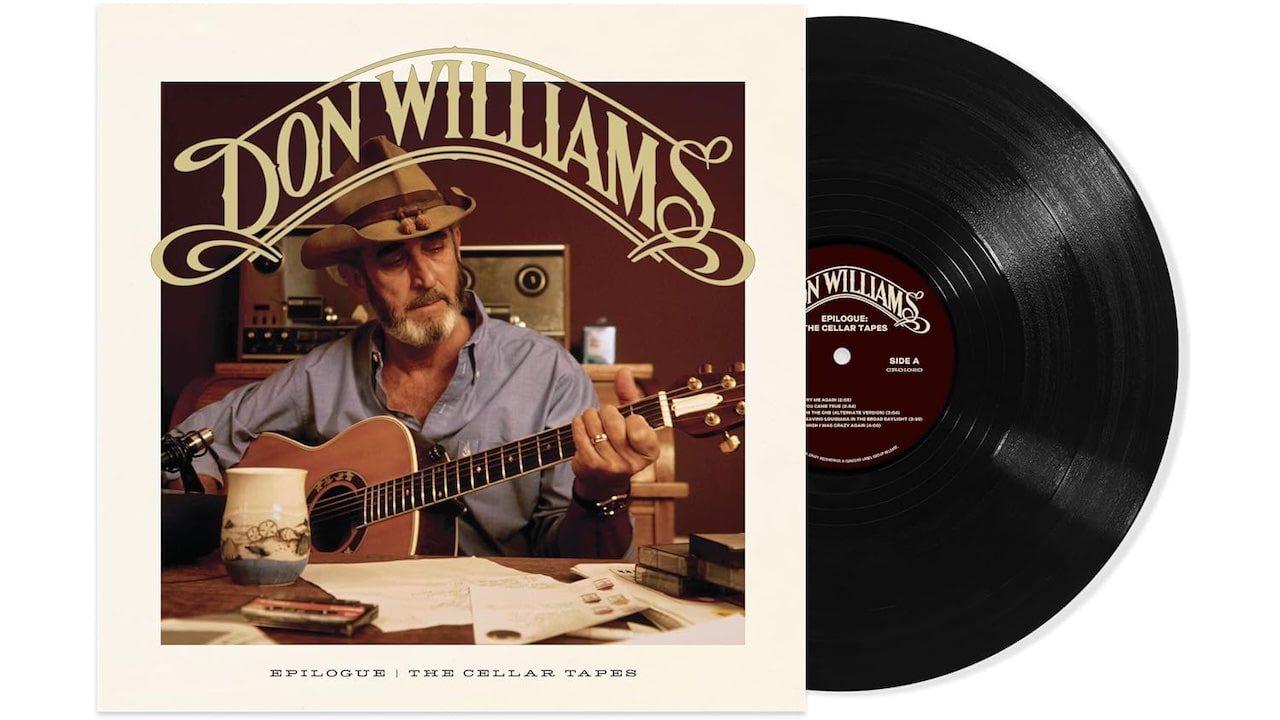
Craft Recordings is presenting the album as a collection of 12 previously unheard Don Williams recordings, tracked between 1979 and 1984 and released on May 29, 2026. Those years matter. This was not a marginal period in his career. It overlaps with the era that produced major Williams songs including “Good Ole Boys Like Me,” “I Believe in You,” “Lord, I Hope This Day Is Good,” and “Love Is on a Roll.”
The recordings were found in the cellar of the Williams family home in Tennessee, and the project was completed with involvement from longtime producer Garth Fundis and Williams’ son, Tim Williams. According to Craft, the original vocals remained the center of the project, while missing or damaged instrumental elements were rebuilt with musicians connected to Williams’ original recording world.
Posthumous albums always deserve some skepticism. Too often, the selling point is not the music but the fact that the artist is no longer here to object. Epilogue: The Cellar Tapes mostly avoids that problem because it does not try to turn Williams into something else. The arrangements are tasteful, the playing is understated, and the production does not push him into a contemporary country space where he would not belong.
The first thing that registers is still the voice. Williams’ baritone has that familiar ease: close to the microphone, relaxed, and clear without sounding overly polished. He was never a dramatic singer in the obvious sense. His strength was in how little he needed to do.

“Leaving Louisiana in the Broad Daylight,” the album’s first single, is a smart entry point because the song already has history, including versions by Emmylou Harris and The Oak Ridge Boys. Williams does not try to remake it into a showcase. His version feels settled, which is usually where he was most persuasive.
The same is true of the quieter material. Songs like “How Can I Miss What I Never Had” and “I’m The One” work because Williams keeps them conversational. The titles may look like standard country architecture on paper, but his delivery gives them more weight than the wording alone would suggest. He had a way of making plain language feel unforced.
That may be the real value of this release. Epilogue is not a lost masterpiece, and it does not need to be sold as one. The stronger argument is that it offers another look at Williams during a productive stretch, singing material that fits comfortably within his established strengths.
Sonically, the album sounds warm, clean, and appropriately modest. Craft Recordings restored these 12 previously unheard recordings from the original multi-track tapes, with Williams’ original vocal performances intact, and completed the missing pieces with musicians connected to his touring and recording history. The vinyl pressing itself is quiet and well centered, which matters here; surface noise or pitch instability would have pulled attention away from the one thing this release cannot afford to damage: that voice.
The restoration work does not announce itself, which is probably the highest compliment in this case. You hear Williams first, then the band around him: steel guitar, bass, drums, strings, piano, organ, and acoustic textures all kept in proper proportion.
That restraint is why Epilogue: The Cellar Tapes succeeds. It does not inflate Don Williams’ legacy. It simply adds to it.
For someone like me, who has spent decades moving between affection and suspicion when it comes to country music, Williams remains one of the artists who makes the case for the genre without needing to argue. No outlaw costume. No forced grit. No arena-sized self-importance. Just a singer with excellent control, good songs, and enough taste to know when not to oversell the moment.
That may not sound revolutionary. It probably was not meant to.
Where to buy: $28.99 at Amazon
Related Reading:
- Carly Simon Anticipation Mobile Fidelity Review: Was The First-Ever 180g 45RPM 2LP Reissue Worth The Wait?
- Allen Toussaint’s Songbook Review: Craft Recordings’ Expanded 2-LP Vinyl Debut Honors An American Master
- Sonny Rollins Remembered, Peter Sellers Brings Beautiful Disaster To The Party, And Maybe Pedro Should Have Kept The Helmet On: Editor’s RoundUp
- Bobby Charles’ Lost 2004 Album Last Train To Memphis Arrives On First Ever 2LP Vinyl And Expanded 2CD Edition: Review