Immersive audio formats are not won in engineering labs or hotel suites at CES. They are won when people can press play, hear something better and never have to think about which codec, container or licensing agreement made it happen.
That has always been the challenge for Eclipsa Audio, the open immersive audio format developed by Samsung and Google as an alternative to Dolby Atmos and DTS. When eCoustics first heard Eclipsa at CES 2025, the technology worked, Samsung was putting it into its TVs and soundbars, and Google had given it an enormous potential distribution platform through YouTube. What it desperately needed was more actual content.
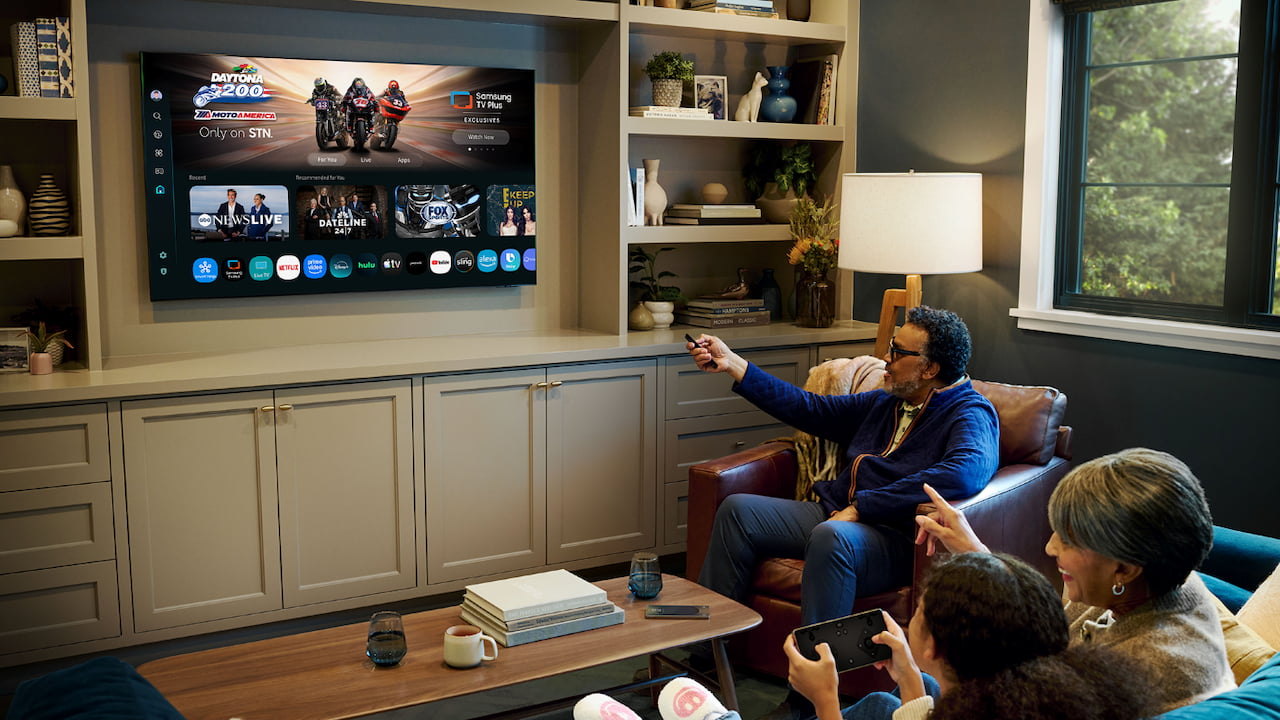
Samsung is now trying to solve that problem through Samsung TV Plus.
Related Reviews:
- Watch Out, Dolby Atmos: Google’s Eclipsa Audio Is Coming For You
- Samsung HW-QS90H Soundbar Review: Samsung’s Loaded New Standalone Atmos Bar Takes On Sonos
Eclipsa Audio Moves Beyond YouTube

Samsung says Eclipsa Audio is now being used with musicals and live performance content on Samsung TV Plus. The company has developed an IAMF-based system for encoding, delivering and playing the immersive audio streams on compatible televisions and soundbars, while unsupported devices automatically receive a conventional stereo version.
Samsung didn’t simply run a few test files through a television and call the press office. During development, the company captured a live performance in a 280-seat concert venue, converted the spatial recording to Eclipsa Audio, streamed it through a Samsung TV Plus channel and played it back through a Samsung television. Samsung says the system preserved the placement of vocals, instruments, audience reaction and the acoustics of the venue.
The more interesting part is what comes next. Samsung says it plans to expand Eclipsa Audio on TV Plus into K-pop concerts, classical performances, movies and sports, with longer-term possibilities including letting viewers emphasize vocals or individual instruments and selecting between commentary and stadium sound during sporting events.
Why Samsung TV Plus Matters
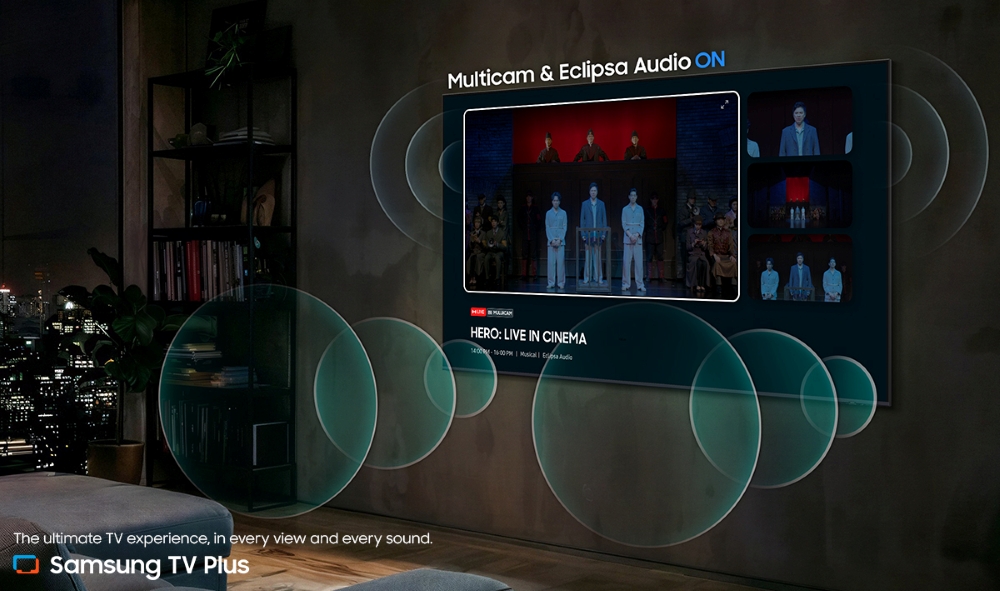
Samsung TV Plus isn’t some experimental streaming app hidden six menus deep beside the owner’s manual. Samsung reported in February that the free ad-supported service had surpassed 100 million monthly active users worldwide, with roughly 4,300 channels and 66,000 on-demand videos across 30 countries.
Obviously, 100 million Samsung TV Plus users are not suddenly listening to Eclipsa Audio. But the size of the platform gives Samsung something every new audio format needs: distribution without asking consumers to subscribe to another service or buy content separately.
YouTube already gave Eclipsa a potentially enormous creator platform. Samsung TV Plus gives it a more conventional television environment where concerts, movies and sports can demonstrate why immersive audio matters without the viewer first searching YouTube for an IAMF demonstration clip.

Does Eclipsa Audio Actually Have a Fighting Chance?
More than it did 18 months ago.
The biggest advantage remains the underlying IAMF (Immersive Audio Model and Formats) architecture. IAMF is an open, codec-agnostic specification designed to deliver immersive audio across everything from headphones and televisions to multi-speaker home theater systems. It does not lock creators and manufacturers into a proprietary audio codec or licensing model.
Google has also continued building the infrastructure around it. YouTube accepts Eclipsa Audio content, Google offers open-source Eclipsa production tools, and Android 16 QPR2 added software decoding for IAMF. Samsung, meanwhile, has incorporated Eclipsa support across its current television and soundbar ecosystem.
Those are not insignificant partners. Google controls YouTube and Android. Samsung sells an enormous number of televisions and soundbars and now operates a streaming platform with 100 million monthly users. If you’re going to pick two companies to push an alternative immersive audio standard, you could do considerably worse.
But Dolby is not packing its office furniture into boxes.
Dolby Atmos Still Has the Huge Advantage

Dolby Atmos has something Eclipsa cannot manufacture overnight: an enormous installed ecosystem of movies, television shows, music, streaming services, AV receivers, processors, soundbars, televisions and other devices.
That remains Eclipsa Audio’s biggest problem.
We have already encountered the hardware gap ourselves. Our recent coverage of the Denon AVR-X2900H and AVR-X3900H noted that Eclipsa decoding was still absent, even though Denon’s new corporate connection to Samsung through Harman makes future support seem like an obvious possibility. The Marantz AV 30 also did not support Eclipsa Audio when we reviewed it earlier this year.
Until Eclipsa appears routinely on mainstream AV receivers, more soundbars and non-Samsung hardware — and until major studios and streaming platforms start delivering meaningful libraries of movies and music in the format — Dolby Atmos remains miles ahead.
Samsung TV Plus doesn’t change that overnight.
It does, however, make Eclipsa Audio considerably harder to dismiss.
The Bottom Line
Eclipsa Audio does not need to kill Dolby Atmos to succeed. It needs enough content, hardware support and distribution that manufacturers and creators have a reason to support both.
YouTube gave Samsung and Google the creator side of that equation. Android is expanding the playback foundation. Samsung TVs and soundbars supplied the initial hardware. Samsung TV Plus now gives Eclipsa another real content platform where ordinary viewers can encounter it without going looking for it.
That is far more consequential than another impressive CES demonstration.
Dolby Atmos still owns the high ground, and Hollywood support remains the mountain Eclipsa Audio has to climb. But for the first time since its introduction, Samsung and Google’s immersive format is starting to resemble an ecosystem rather than an experiment.
And that gives it a fighting chance.
Related Reading: