For music and movie lovers who want the best musical and cinematic experiences at home, there have always been two camps: simplicity vs. performance. In the 80s, that meant buying a basic one-brand integrated component stereo system – cables and stand included – vs. buying the individual separate components, potentially from different brands, and hooking everything up yourself. In the 90’s and beyond, companies started building amplifiers and source connectivity into the speakers themselves. Powered soundbars became popular, particularly for those who just wanted a little better sound from their TVs or projectors with minimal set-up required.
Today, you can spend thousands of dollars on “simple” wireless speaker systems and soundbar-based systems with integrated streaming and networking. Some of these actually sound pretty good, but they tend to be a bit lacking in installation flexibility, features and ultimate sonic performance. For those who want something a bit more flexible and powerful, AVRs (Audio Video Receivers) are popular, as these offer a plethora of inputs, plenty of power and expandability for multi-channel and multi-room systems as well as relatively simple hookup.
But packing all these functions into a single box can lead to compromises in performance. In a receiver, all of the various components – DACs, processors, preamplification, switching, streaming receivers and radio tuners – share the same power supply as the amplifiers. And with receivers frequently including seven, nine or even eleven channels of amplification, power management and thermal management can get tricky and can lead to limited dynamic range, heat buildup, distortion and loss of detail.
The Case for A/V Separates
For those who find that A/V receivers aren’t flexible enough or require too large a compromise in performance, there is a step above known as A/V separates: separate components for pre-amplification and for power amplification. A/V separates typically include two types of components: a preamp/processor (pre/pro) which handles all of the low voltage/low current functions like audio decoding, processing, switching and volume adjustment/attenuation and power amplifiers which amplify the low level output of the preamp into high level output to drive the speakers. In theory, this reduces interference among components, simplifies thermal management and improves detail and dynamic range by giving the power amps “room to breathe.”
Marantz offers both A/V receivers and A/V separates, including preamp/processors and multi-channel power amplifiers. Their most recent product, the AV 30 preamplifier/processor ($4,000), is also their most affordable. And their AMP 30 ($4,000) is the company’s latest multi-channel power amplifier offering six channels of Class D amplification enhanced with Marantz HDAM modules for more refined sound. As we needed more than six channels for our test system, we paired the AV 30 with a Marantz AMP 20 ($6,000) 12-channel power amp, for the purposes of this review. We also checked out the AMP 30 and will cover that separately.
What Is It?
The Marantz AV 30 is an 11.4-channel A/V preamplifier/processor designed for high-end home theater and multi-channel surround sound systems. “11.4” means that it offers eleven channels of audio processing as well as four independently adjustable subwoofer outputs. The AV 30 supports all of the most popular immersive audio formats including Dolby Atmos, DTS:X, Auro-3D and MPEG-H/360 Reality Audio. It also is IMAX Enhanced Certified and can identify the IMAX DTS:X soundtracks on select UHD Blu-ray Discs and streaming services, applying IMAX processing and EQ for a more dynamic and theatrical sound. As of the publication of this review in May, 2026, the AV 30 doesn’t decode Eclipsa Audio (a.k.a. “IAMF”), the open source immersive audio format of choice on YouTube. But who knows what the future holds?
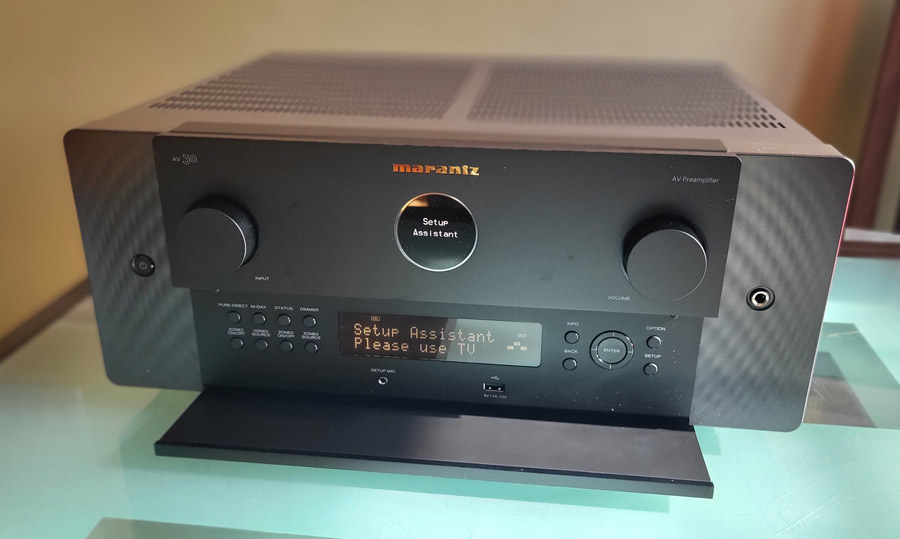
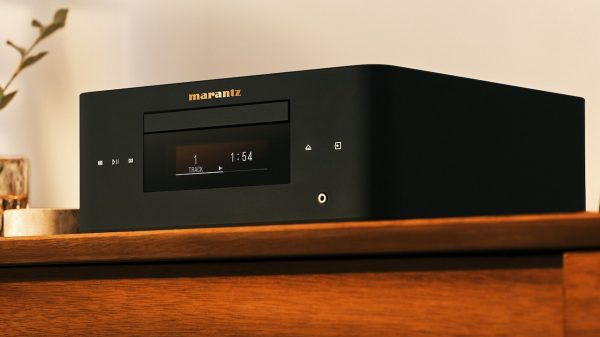
The chassis itself is elegantly styled in black aluminum with textured side pieces. The unit was designed in Shirakawa, Japan and features the hallmark Marantz porthole, carried over from some of the company’s earliest products, back when Saul Marantz himself (R.I.P.) was at the helm. An integrated hideaway panel at the bottom keeps the look simple and understated with only two controls visible on the main front panel: dials for volume and input selection. The power button can be found on the left textured side panel and a ¼-inch headphone jack appears on the right. Opening that lower panel reveals a larger rectangular digital display, as well as a few more buttons and a 5-way control to navigate through set-up and other screens.
Even though the preamp does include a fairly robust screen at the bottom, you do still need to connect it to a display of some kind (monitor, TV or projector) in order to complete the set-up.
The Power To Back it Up
As robust as the AV 30 it is, it wouldn’t be able to make much sound without a power amplifier. For the purposes of this review, I paired the AV 30 with a Marantz AMP 20 multi-channel power amp. This 12-channel amp features customized Class D power modules from ICEPower, enhanced by Marantz HDAM (Hyper Dynamic Amplifier Module) technology.
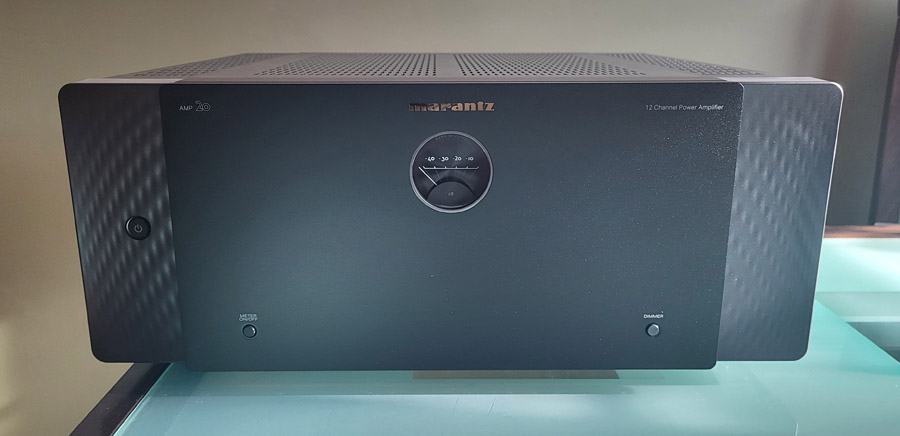
First developed by Marantz in 1992, HDAM modules replace traditional IC-based op-amp stages using hand-selected transistors, resistors and other components, mounted on a small board to minimize interference. This design increases slew rate, enhancing accuracy and reducing noise and distortion compared to traditional op-amp designs.
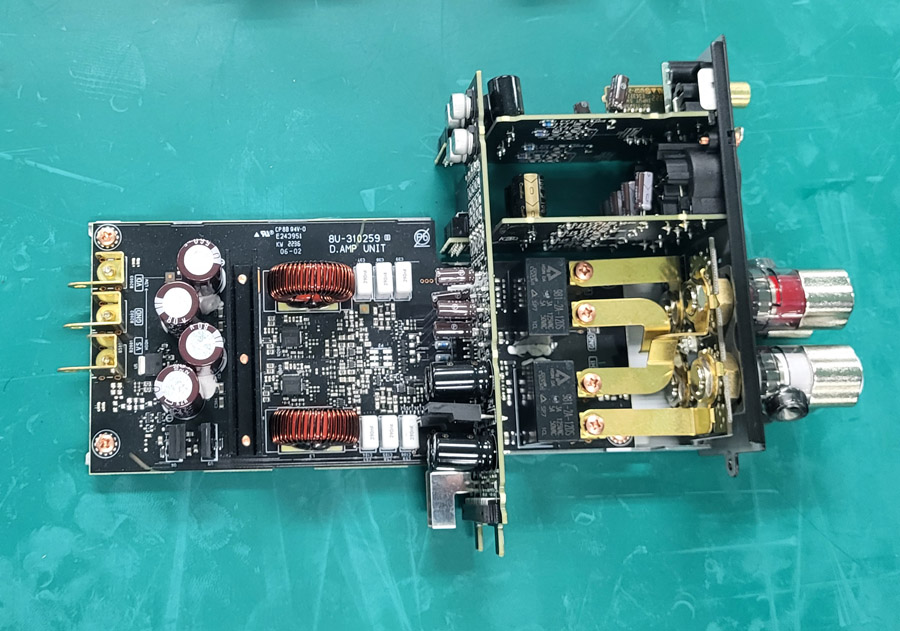
When I asked Ogata-san, the Marantz soundmaster, why Marantz has been moving away from Class A/B amplifiers to Class D, he said it is a combination of efficiency, thermal management and weight, which are particularly important on multi-channel amplifiers. And Ogata-san says with developments in Class D amplifiers, combined with Marantz HDAM, they are able to make smaller, lighter, more efficient, cooler running amplifiers without any sacrifice in that Marantz signature immersive, accurate sound quality.
Also, when asked why Marantz’ multi-channel power amplifiers are offered with even numbers of channels (6-channel, 12-channel, 16-channel), while most home theater systems are designed with odd channel numbers (7-channel, 11-channel, 15-channel), a Marantz rep explained that each amplifier module is manufactured as a stereo pair, with each stereo pair bridgeable to double the output. So the AMP 20 includes six individual stereo amplifier modules, while the AMP 30 has three stereo modules.
Connectivity
The AV 30 offers a generous seven HDMI 2.1-compatible inputs, all of which support video resolution up to 8K/60Hz or 4K/120 Hz and HDCP 2.3. It includes three HDMI outputs for connection to multiple TVs, monitors or projectors. One HDMI port includes support for HDMI ARC/eARC for single-cable connection (audio/video send and audio return) to an ARC/eARC compatible TV or projector. The AV 30 also features legacy analog and digital audio and video connections, including composite and component video, analog RCA audio, fiberoptic and coax digital audio. There’s even a built-in phono preamp with support for MM (moving magnet) phono cartridges.
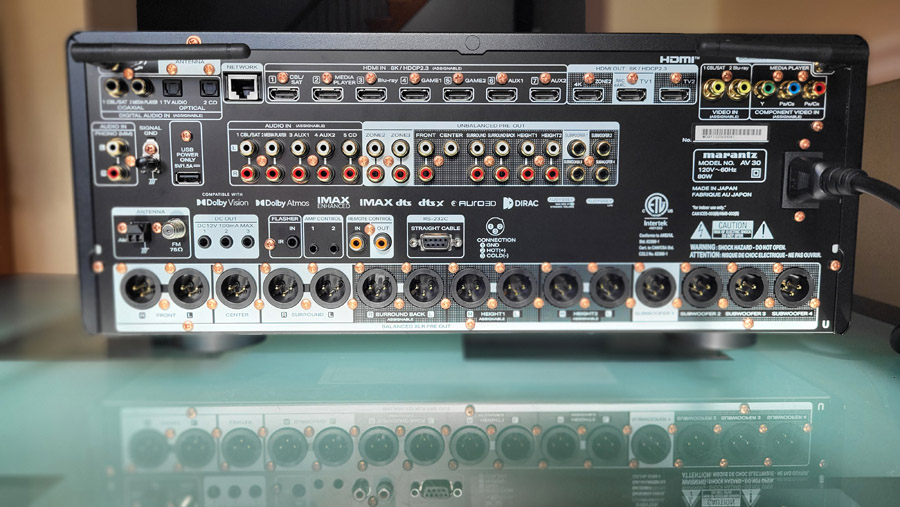
As for output to the power amplifier, the AV 30 supports both unbalanced RCA output as well as balanced XLR. Initially, I set up the system with nine meter-long RCA cables, but this led to a bit of a rats’ nest of wiring. I ordered a 10-pack of 12-inch XLR cables on Amazon and this cleaned things up a bit.
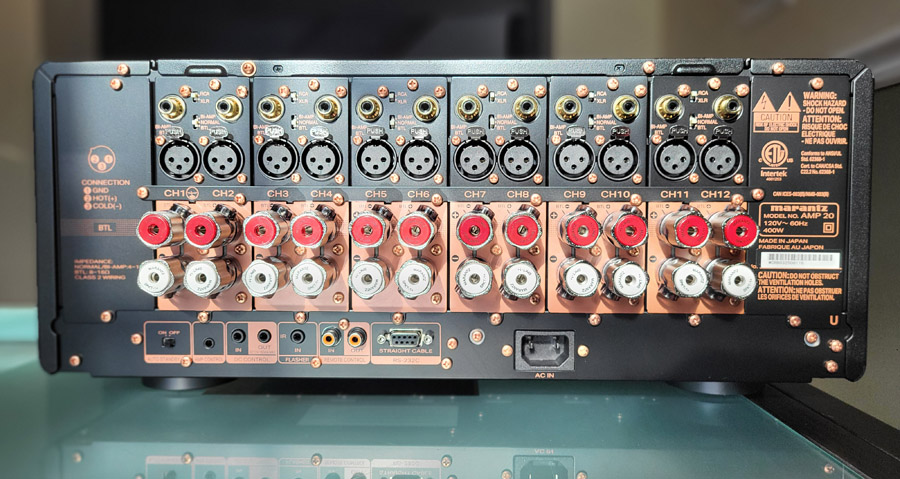
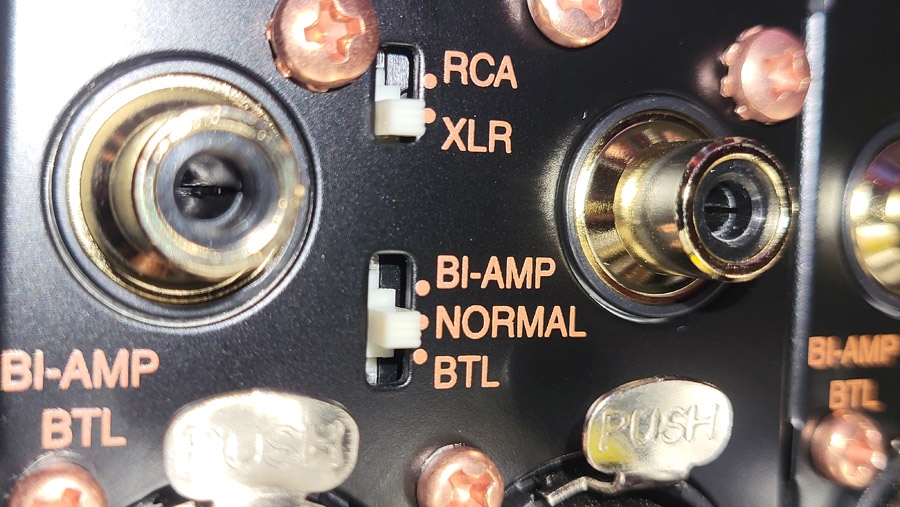
Balanced XLR connections can lead to cleaner sound with less interference and a lower noise floor. The Marantz AMP 20 and AMP 30 both have switches on each pair of amp channels to switch between XLR balanced and RCA unbalanced inputs. The amps also offer bi-amp output as well as a bridging option which combines two amp channels into one in order to deliver twice as much power to half as many channels. If the 12 channels of the AMP 20 are more than you need, you can bridge one or more amplifier pairs for more power to your center channel or main left and right channel speakers, or use the extra amps to power speakers in other rooms of your home.
HEOS FTW!
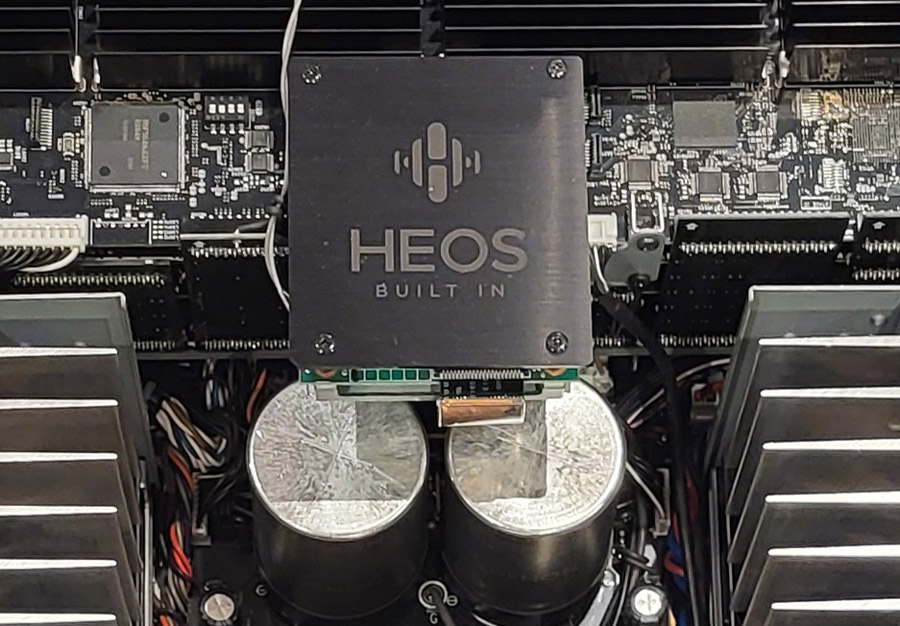
A highlight of the AV 30 is its HEOS integration. This network streaming music platform allows you to play music from the top streaming services like TIDAL, Spotify, Qobuz and Amazon Music anywhere in your home on compatible devices like receivers, streaming amplifiers, soundbars and wireless speakers. HEOS is included in most Denon and Marantz receivers and pre/pros made in the past decade as well as select products from Classe (all part of the “Sound United” family of products). Install the HEOS app, link your music accounts and you’ll see the AV 30 appear as a supported device. It’s that easy.
For internet radio stations, HEOS supports TuneIn and iHeart Radio. My Go-To Internet Radio station, the fabulous Radio Paradise is available in HEOS, through TuneIn. Sadly, TuneIn’s support for lossless or high resolution audio is non-existent. So while Radio Paradise is available in a lossless FLAC stream on BluOS, Sonos and WiiM, the best quality you can get for Radio Paradise on HEOS currently is a 320 KBPS AAC stream. That said, Radio Paradise does sound quite good through HEOS on the AV 30, whether in its pure stereo form or expanded into surround through one of the AV 30’s many immersive sound options.
But where we gain HEOS, we lose Google Cast. Unlike some competitive receivers and pre/pros, the Marantz AV 30 doesn’t offer Google Cast (formerly “Chromecast Built-in”) wireless connectivity. This means you won’t be able to cast Dolby Atmos multi-channel music from your music streaming app on your phone to the AV 30. Marantz tells us this is an intentional choice and they recommend using an external device like Apple TV 4K or Amazon FireTV stick if you want to listen to music encoded in Dolby Atmos (or Sony 360 Reality Audio, which the Marantz pre/pro also supports).
You can connect your audio streaming apps to the pre/pro via the HEOS app or Bluetooth, but these do not currently support Dolby Atmos music. Apple AirPlay 2 is available meaning you can connect an Apple device to the AV 30 wirelessly. The HEOS app also supports TIDAL Connect, Spotify Connect and Qobuz Connect, for wireless lossless (and even hi-res) music, but again, only for stereo 2-channel music tracks.
Correction and Calibration
The AV 30 comes with Audyssey MultEQ XT32 room correction and calibration on board. This includes SubEQ HT for managing up to four independent subwoofers. It also includes Audyssey Dynamic EQ and Dynamic Volume as options. For those who prefer DIRAC room correction, the AV 30 can be upgraded to support DIRAC Live, DIRAC Live Bass Control or DIRAC ART (Active Room Treatment) via the additional purchase of a DIRAC license (currently $259-$799, depending on the options). For the purposes of our review, we used the built-in Audyssey calibration system with the included microphone. We may do a follow-up story on DIRAC for those interested.
The Set-Up
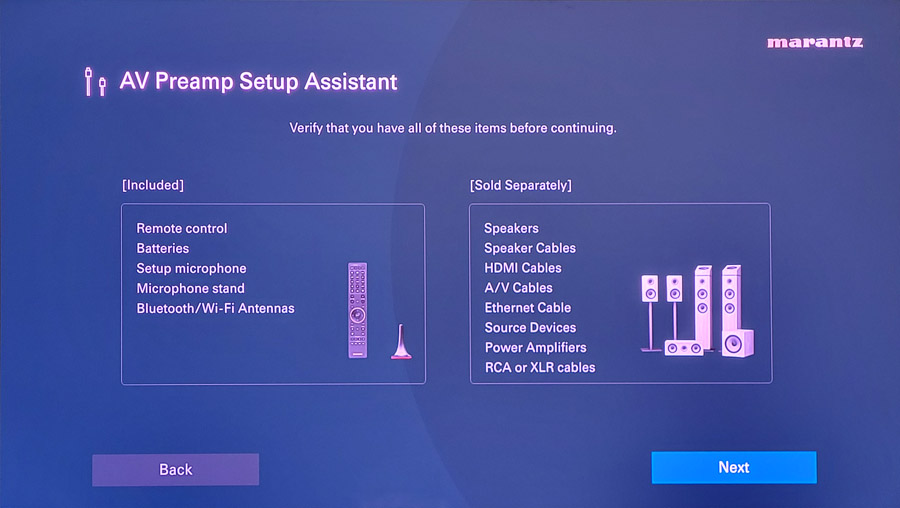
Initial set-up was fairly straightforward. As mentioned, you do need to connect the AV 30’s HDMI output to a TV or projector in order to see the set-up screens. You can exit the set-up wizard after selecting language, but if not, then the wizard takes you through connection of every single channel as well as connection of speakers to a connected power amp. It was a bit tedious to go through all these screens, but I’m sure it would be helpful to someone new to the process. And I will say that even this seasoned “A/V guru” swapped the positive and negative leads on one of my speaker connections. Thankfully this phase error was identified during the Audyssey set up process so it was easy enough to fix. (Oopsy).
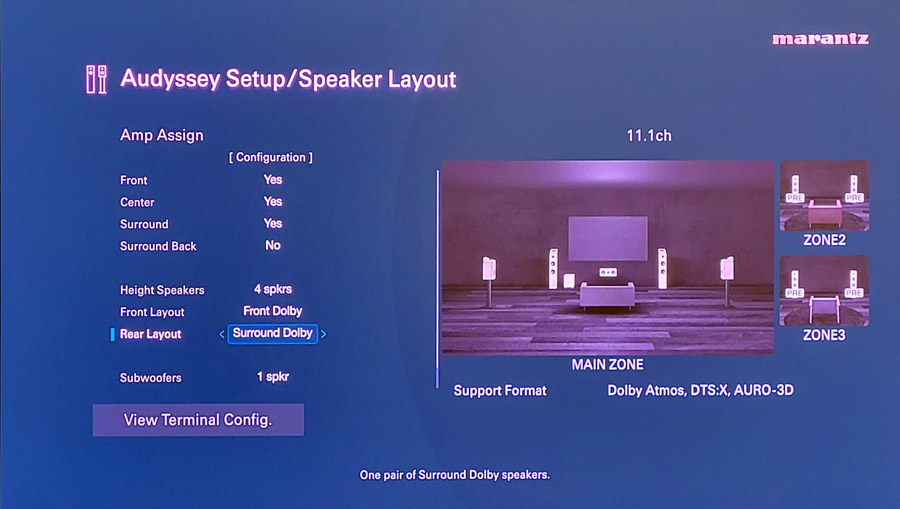
Audyssey calibration is pretty straightforward. Plug in the included mic to the front panel, and run through a series of test tones. Marantz recommends using eight distinct measuring points but for our small theater room, three measurement points were sufficient. Post calibration, the system sounded nicely balanced though we did manually boost the subwoofer level slightly as the sound was a bit thin in the lower octaves after Audyssey calibration.
The set-up wizard also requires you to set up HEOS, using the HEOS mobile app for iOS or Android. There is no “skip” option for this, though you can always manually exit the set-up wizard by backing all the way out or hitting the Setup button on the front panel or on the remote control. This proved slightly problematic as I had forgotten my HEOS account password and the link to reset it in the app failed repeatedly. Eventually I remembered the password and was able to complete the set-up. New HEOS users (or those who don’t forget their passwords) probably wouldn’t have an issue here. During the set-up, a firmware update was found and applied to the AV 30, which took a few extra minutes to complete.
“Control, Control. You Must Learn Control!” -Yoda
The AV 30 can be controlled by its fully backlit remote control, by the Marantz AVR Remote app, or by controls on the hideaway front panel. Navigation among menus is quick and intuitive. The remote feels solid and having a full backlight on all buttons is a nice touch when watching or listening in the dark. The remote offers direct input buttons for all inputs as well as dedicated buttons for different surround modes (Movie, Music, Game and Pure). These cycle through various sound processing modes like Dolby Surround, DTS Neural:X and Auro-3D.

Listening Notes
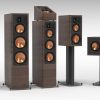
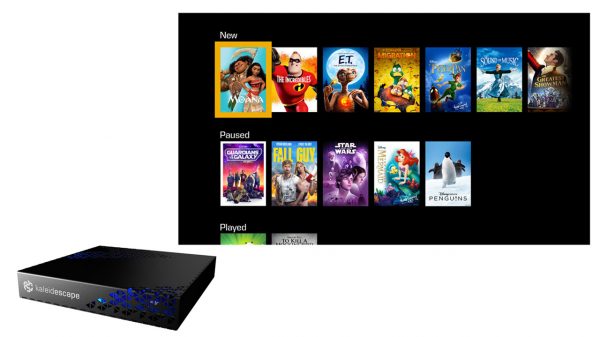
Speakers used for testing included a Klipsch Reference series home theater system as well as a pair of KEF LS50s. For source devices, I connected several components including an XBOX Series X, Fire TV 4K Max, Apple TV 4K, Samsung UHD Blu-ray Player, OPPO Blu-ray Player and a Kaleidescape Strato V 4K movie player all via HDMI cables. I also hooked up a vintage cassette deck for those classic 80s and 90s mix tapes using my grand-daddy’s analog RCA cables as well as a Systemdek turntable so I could spin some 70s vinyl.
Much of my music listening these days is to multi-channel immersive tracks encoded either in Dolby Atmos or Sony 360 Reality Audio. With no Google Cast option, I used the Amazon Music app on the FireTV 4K Max to load up my Dolby Atmos and 360RA playlists. Dolby Atmos favorites like KX5/Deadmau5 “Alive,” Ed Sheeran “Shape of You,” Elton John “Rocket Man” and A-Ha “Take On Me” had a wonderful sense of air and spaciousness through the Marantz preamp/amp combo, with deep tight bass and pinpoint imaging precision. 360RA tracks like Daft Punk “Get Lucky” and Pink’s “Trustfall” were equally enveloping, with instruments and voices filling the listening room with a cohesive dome of sound.
Moving onto movies, I hit the system with everything I had: Dolby Atmos, DTS:X, IMAX Enhanced and even AURO-3D. The system was able to decode all of these formats, routing the sound to the appropriate speakers for full immersion. It was at least as good if not better than the experience I’ve had in many premium movie theaters.
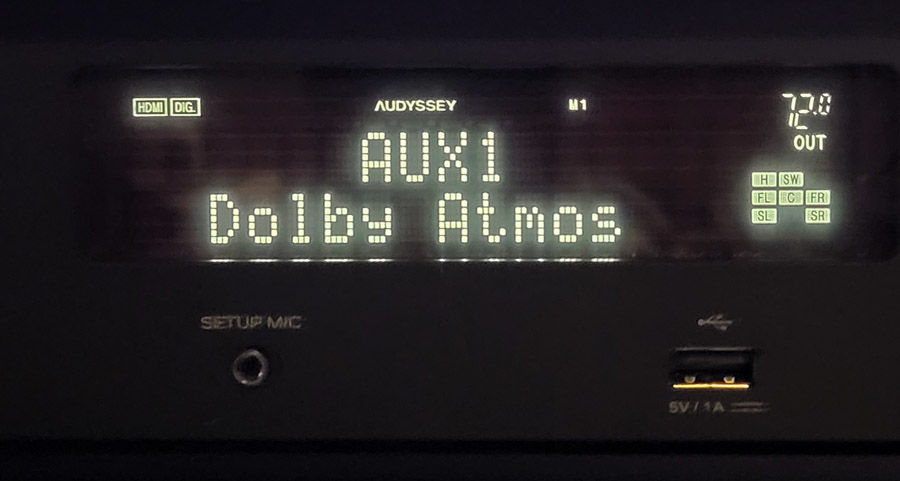
For Dolby Atmos, I started with Denis Villeneuve’s “Dune” on UHD Blu-ray. In the worm attack on the spice crawler about 1:05 into the film, the soundtrack includes a cacophony of different sounds that can challenge the finest surround system. As the spice-saturated sand encompasses Paul Atreides, the sound abruptly cuts out, music swells, sand swirls and the voices of the Bene Gesserit build in a spice-induced vision. The line “Qwizzatz Haderrach awakes,” which is difficult to make out on some systems, cuts cleanly through the sonic mayhem here.
Moving onto another Dolby Atmos soundtrack, I put on the first episode of “Andor” on Disney+. The rain falling from above in the opening scene permeated my listening room and as our antihero enters a nightclub, his conversation with the club worker is easy to make out over the pulsing background music. Complex soundscapes are handled effortlessly by the Marantz AV 30/AMP 20 combination.
For DTS:X, I put on “Ex Machina” to verify that the claustrophobic feeling inside the compound when the power fails was conveyed realistically and effectively (it was). The UHD Blu-ray 4K remaster of “Blues Brothers” also features a DTS:X soundtrack which was particularly lively during the mall chase scene as glass and debris exploded all around the room.
I also watched some of the IMAX Enhanced movies on Disney+ which offer DTS:X soundtracks enhanced with IMAX EQ. On “Guardians of the Galaxy 3,” the preamp identified the IMAX Enhanced flag in the content and decoded the DTS:X track with excellent dynamics and thunderous bass. Switching to the IMAX Enhanced “Queen Rock Montreal” concert film, “We Will Rock You” was recreated in all its grandeur, making me feel like I was there in the stadium enjoying the show.

For Auro-3D, there isn’t as much selection as far as software goes, but I put on a few clips from an AURO-3D test Blu-ray Disc and also the UHD Blu-ray Disc of “Shine” which is the first major film with an AURO-3D soundtrack available on physical media in the U.S. For some reason, the preamp didn’t identify the AURO-3D flag in the DTS-HD MA datastream, so it did not automatically engage AURO-3D surround. However, manually switching the AV 30 to AURO-3D did allow the preamp to decode the stream and process all the channels properly, including the overhead voice of god speaker that Auro-3D is known for (which was virtualized at the center point of my ceiling, using the four Dolby height channels currently in my system).
For stereo music, I listened to high res and lossless tracks on both Qobuz (using Qobuz Connect) and Amazon Music (through the HEOS app). The Marantz offers both “Direct” and “Pure Direct” stereo listening modes that present stereo music as God intended – in standard two-channel mode with minimal to no additional processing.
“Direct” modes bypasses DSP processing (including EQ and Audyssey calibration) for the purest signal, while “Pure Direct” mode does this and also shuts down the front display and video circuitry to eliminate any potential electrical noise. Depending how you’ve configured the speakers, these modes may also disable the subwoofer outputs, so they’re better suited for larger tower speakers. In these modes, the AV 30 offered outstanding clarity. Paired with the Marantz power amp, stereo music came through cleanly and transparently with excellent dynamics and a solid three dimensional soundstage. There’s also a standard stereo listening mode that does preserve DSP and subwoofer output.
Personally, I don’t mind listening to stereo tracks with some ambiance added, so I experimented with Dolby Surround, DTS Virtual X and Auro:3D upmixer. Of these, I felt that Dolby Surround offered the best sense of space and presence for stereo music. It didn’t sound artificial or gimmicky. It just sounded more substantial and full compared to the pure stereo reproduction. Vocals were still locked front and center on most cuts while subtle room reverberation emanated from the rear speakers, giving the music a more palpable presence.
All That and Black Vinyl, Too
While most of my listening was done with digital sources, I also fired up my Systemdek IIX turntable to spin a few classic LPs from the 70s and 80s. Using the AV 30’s built-in moving magnet phono stage, albums like Genesis “And Then There Were Three” and ZZ Top “Eliminator” were presented with nice detail, musicality and warmth, though having to get up to change sides and endure the clicks and pops of less-than-perfectly maintained vinyl reminded me of why I ultimately prefer high quality lossless and high res audio digital sources to analog.
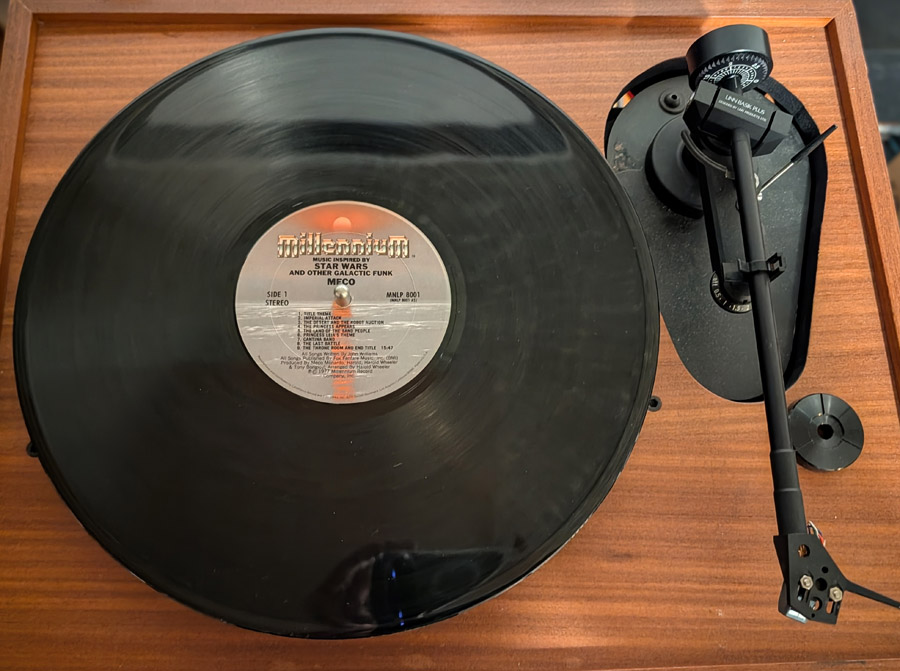
I admit I did get a bit emotional when listening to “Star Wars and Other Galactic Funk,” which includes a rock/disco version of the “Star Wars” soundtrack by Meco. Immersed in the thrumming sounds of drums, lightsabers, guitars and xylophone solos, I was transported to a galaxy far, far away, namely my parents basement where my friends and I would gather to listen to our latest records. But this record never sounded so good back then on my parent’s old console system. If you’ve got a penchant for black vinyl or two-channel music listening in general, the AV 30 won’t let you down.
Meanwhile, Back in Japan
I should note that on a recent trip to Denon and Marantz headquarters in Kawasaki, Japan, as well as the Shirakawa Audio Works, where many of the company’s high end audio products are manufactured (including the AV 30 and AMP 20), I experienced the attention to detail that goes into the construction of Marantz products. The manufacturing process includes equal parts high tech robotics and hand assembly by gifted craftsmen (and craftswomen).
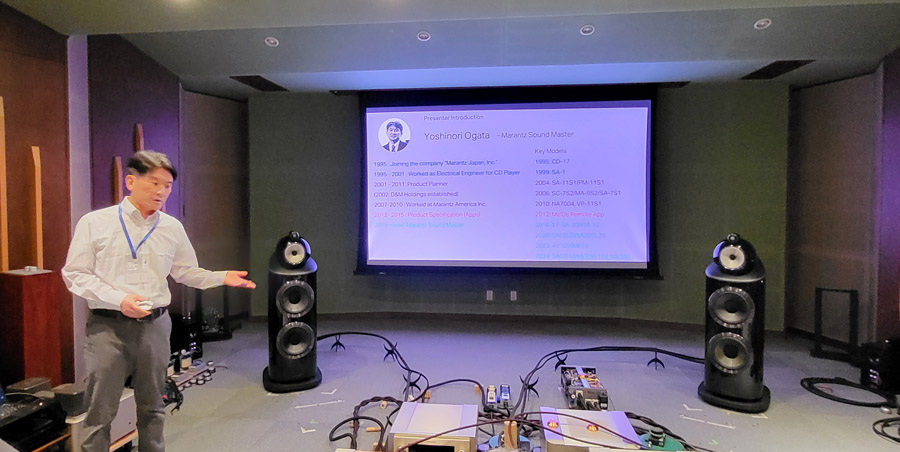
And this commitment to quality doesn’t only go into the physical assembly. New designs like the AV 30 and AMP 20 only make it into production after they have passed the careful ears of Marantz Soundmaster Yoshinori Ogata (Ogata-san). Only after Ogata-san signs off on the sound quality and build quality of each new product does that product make it into mass production and ultimately into a customer’s home.
The Bottom Line
With the AV 30, Marantz is bringing the cost of entry for A/V separates down to a fairly reasonable level. With 11 channels of processing, 4K and 8K video passthrough, and decoding for virtually all of the popular surround codecs, the Marantz AV 30 makes an excellent choice for those who are ready to graduate from A/V receiver to the next level of performance, flexibility and sonic clarity. And for those with a 7.1.2-channel or 5.1.4-channel speaker layout, the 12-channel AMP 20 power amplifier is truly a match made in heaven.
Pros:
- 11 channels plus 4 independent subwoofer outputs make this suitable for medium to large home theater installations
- Competitively priced for the category
- Built-in Audyssey MultEQ XT32 room correction/calibration is effective at reducing negative room interactions
- Option to add DIRAC room correction, including DIRAC ART (Active Room Treatment)
- Comes with HEOS whole-home multi-room wireless music platform
- Elegant design
- Supports unbalanced RCA and balanced XLR output for maximum flexibility and improved performance
- Includes all the popular immersive sound formats: Dolby Atmos, DTS:X, IMAX Enhanced, AURO-3D, MPEG-H and Sony 360 Reality Audio
- Top notch sound quality
Cons:
- Lacks Google Cast WiFi casting
- HEOS implementation does not natively support Dolby Atmos Music
- No decoding of IAMF (Eclipsa Audio)
- DIRAC requires additional purchase
Where to Buy:
Related Reading:
- Marantz M1 Streaming Amplifier Review
- Which Marantz AVR Should You Buy?
- What Exactly is HEOS?
- Marantz Unveils AV 30 Preamp/Processor and AMP 30 AMP for $4,000 (Each)