

July, 2025 Update: Added WiiM Amp Ultra
In This Article
What’s a Network Streamer?
Few products generate as much interest among our readers as network streamers. Whether you’re a lifelong audio hobbyist or a budding audiophile setting out to build your first HiFi system, the appeal of a device that can instantly play virtually any song by any artist over a nice pair of speakers or headphones is hard to resist. Network streamers vary in price from under $100 to over $35,000: if you’re in the market for a network streamer, there is no shortage of choices.
Any good streamer will give you access to your favorite digital music sources and streaming services such as TIDAL, Qobuz, Spotify, TuneIn, Internet Radio and Amazon Music. Most can also provide direct access to local digital music files, ripped from your CD collection or downloaded from a service like HD Tracks whether you store these on a USB thumb drive or on a network-attached storage drive. In most cases, you will need to install a DLNA or uPnP media server or add a service like Roon to a PC in your local network to access your local digital audio files.
One thing that can make or break a network streamer is the mobile app. While virtually all network streamers allow you to connect a phone via Bluetooth and play your music back over speakers, a good mobile app allows you to access music from multiple streaming services, internet radio stations, or even a local digital music collection from a single app, using a wired or WiFi connection from the network streaming box to the internet. This allows you to skip the unwanted interruptions and compression artifacts of a Bluetooth connection.

Just about every streamer maker has its own mobile app. Some, like SONOS, have been enhanced and refined over many years, while other apps from newer entries to the streaming market can show their immaturity in a lack of functionality, lack of third party integration options or just inconsistent operation. There are also third party apps like Roon which are designed to work with multiple third party streamers, local digital music libraries and music streaming services. But Roon is a subscription-based model so it may not be the best choice for those trying to stick to a budget.
Why WiiM?
Speaking of budgets, one company that stays toward the budget-friendly end of the price spectrum for network streamers is WiiM. Their most basic streamer, the WiiM Mini ($99) does the same kinds of things as the current flagship WiiM Ultra ($329) so why spend more? It comes down to a few factors: sound quality, build quality, aesthetic design, features and functionality. At eCoustics, we’ve had hands-on/ears-on time with nearly all of the WiiM streamers, including the newest models, the WiiM Ultra and WiiM Amp Ultra. With that said, here are our suggestions on what sets each WiiM apart so you can decide which WiiM will work well for you.
The WiiM Home App
All of WiiM’s network streamers use the same mobile app, called “WiiM Home.” WiiM Home gets high marks from users for its flexibility and reliability, though it can take some time to get used to just due to the sheer volume of features and options available. One thing that sets WiiM apart from many of its budget-priced competitors is that WiiM Home supports synced multi-room streaming. This allows you to play the same music in multiple rooms in your home, synchronized so there is no delay or echo. This is something that Sonos also does very well. Not all streaming apps support the feature.

As of the time of the article’s most recent update (July, 2025), the WiiM Home app supports most of the popular streaming music services, including Spotify, iHeartRadio, TuneIn Radio, TIDAL, Amazon Music Unlimited, Qobuz, Napster, Radio Paradise and Deezer. Apple Music can be played back via Apple AirPlay 2 on most WiiM streamers (except the newest models: WiiM Ultra, WiiM Amp Pro and WiiM Amp Ultra). Google Cast (formerly Chromecast) is also supported in all but the entry level WiiM Mini. Other third party apps are supported by connecting your phone to the WiiM streamer via Bluetooth.
The company seems to be committed to adding new music services based on owner feedback (as evidenced by this post on the company’s official user forum). When I wrote the first version of this article in 2024, Radio Paradise was not yet supported but now, in 2025, it is (and there was much rejoicing).
Powered vs. Unpowered Network Streamers. What’s the Difference?
WiiM makes two types of network streamers: powered and unpowered. A powered streamer (a.k.a. “Network Amplifier”), such as the WiiM Amp, WiiM Amp Pro and WiiM Amp Ultra, includes a built-in stereo amplifier. This means it can drive a traditional pair of passive bookshelf or tower speakers. This can both simplify your system and save you from having to purchase a separate integrated amp, receiver, power amp or pair of powered speakers. If you’re building your first HiFi system from scratch, or setting up a secondary system in a den or office or a vacation home, a powered streamer makes sense as it can save you money and system complexity.
A standard “unpowered” network streamer like the WiiM Mini, WiiM Pro, WiiM Pro Plus or WiiM Ultra is more like a traditional audio component such as a CD player or turntable in that it needs a separate piece of gear like a receiver, integrated amp or power amplifier to drive a pair of speakers. As an alternative option, you could pair an unpowered streamer with a pair of powered speakers, but this limits speaker choices a bit. If you’ve already got a nice HiFi system – modern or vintage – and you just want to add streaming functionality, a standard (unpowered) network streamer makes the most sense.

What’s in a WiiM?
All of WiiM’s streamers, including the entry-level WiiM Mini, support lossless and high resolution audio at a minimum of 192kHz/24-bit (depending on the source) with gapless playback for seamless track-to-track transitions. Enjoy that whole “Dark Side of the Moon” album without annoying blank spaces between tracks.
All WiiM streamers except the WiiM Ultra, WiiM Amp Ultra and WiiM Amp Pro support Apple AirPlay 2 and Siri voice assistants. All WiiM Streamers currently work with Alexa as well. All WiiM streamers offer both parametric and graphic EQ in the app. And all of WiiM’s streamers (except the WiiM Mini) support WiiM’s room correction option, either right out of the box or with a software update. This feature allows you to get the best performance from your speakers in your specific listening room.
“Works with Google” and Google Cast support are available in the WiiM Pro and above (basically, everything but the WiiM Mini). All WiiM streamers include built-in WiFi connectivity and all but the entry-level WiiM Mini include an ethernet port for an even more reliable network connection. For those users who favor Spotify, Qobuz or TIDAL, all WiiM streamers support Spotify Connect and TIDAL Connect, and all but the WiiM Mini support Qobuz Connect so you can eliminate the middleman and get your streamer connected directly to the internet, bypassing the phone entirely except as a control device.
All WiiM streamers currently feature two-way Bluetooth connectivity so you can stream from your phone or tablet to the WiiM or connect your favorite pair of Bluetooth headphones or wireless speakers to the streamer wirelessly.
Really there are more things in common among the WiiM streamer family than there are differences, but each step up the line does offer improvements in both feature set, aesthetic design and performance.
Guide to WiiM Network Streamers (Unpowered)
Even the most basic WiiM streamer offers solid performance and features, but you’ll get more of both as you move up the line. Here’s an overview of what you get as you move through the WiiM lineup.
Entry Level: WiiM Mini
The WiiM Mini streamer is a bare-bones streamer, lacking some of the more advanced features, but providing all the essentials for a music-lover on a limited budget. It uses the same WiiM Home app as WiiM’s more expensive models with the same rich functionality, but it lacks some niceties like a hard-wired ethernet port, Roon-ready certification and “Works with Google” support, or a digital input for use as a standalone DAC.

The WiiM Mini does include a fiberoptic digital output for connection to an outboard DAC, preamp or integrated amp with a built-in DAC. The Mini also includes a basic 3.5mm analog output so you can plug it into a receiver, preamp, amplifier or powered speakers using a 3.5mm to stereo RCA adapter cable. With a list price of $99, the WiiM Mini normally sells online for less making it a true bargain for an entry-level network streamer.
Where to buy WiiM Mini: $99.99 $89 at Amazon
Step Up to the WiiM Pro
The WiiM Pro offers all of the features of the WiiM Mini, including the same Texas Instruments PCM 5121 DAC (Digital Audio Converter), but adds a hard-wired ethernet port for rock solid network connectivity, a faster more powerful processor and increased internal RAM and Flash memory (from 128MB to 512MB). It also adds support for Google Cast, Works with Google and Roon-ready certification. In addition, the WiiM Pro offers a more refined design as well as a digital input so you can use it as a DAC for an older CD player or CD transport.

The WiiM Pro moves playback controls from the top to the front panel and adds high quality RCA jacks for both line inputs and line outputs. It also includes both fiberoptic and coax digital outputs for connection to a receiver, preamp, integrated amp or external DAC. The WiiM Pro does not come with a remote control, however you can bundle it with the WiiM Voice Remote for an additional $10 or just use the WiiM Home app to adjust volume and playback.
Where to buy WiiM Pro: $169 $149 at Amazon
WiiM Pro Plus: It’s What’s Inside that Counts
Looking nearly identical to the WiiM Pro, the upgrades in the WiiM Pro Plus are mostly invisible to the naked eye, but not to the naked ear. The WiiM Pro Plus offers upgraded DAC (Digital-to-Analog Conversion) and ADC (Analog-to-Digital Conversion) technology. It features an AKM 4493SEQ premium DAC with support for up to 32-bit/384kHz PCM and DSD512 high resolution audio, with PCM/DSD automatic switching. Meanwhile, its TI Burr-Brown Audio PCM1861 ADC supports up to 192kHz/24-bit from the digital outputs so connected analog sources will offer smoother overall sound. The CPU is also upgraded to a Quad Core Amlogic A113X chip which makes operation a bit smoother overall.

While the chassis of both the WiiM Pro and the Pro Plus are the same size (5.5″ square, 1.6″ high), the Pro Plus offers more premium parts and construction which leads to it weighing a bit more than the Pro: 400g (14.1 oz) for the Pro Plus compared to 330g (11.6 oz) for the Pro. The WiiM Pro Plus comes with WiiM’s voice remote. Read Ian White’s review for more details or find out why it earned out Editor’s Choice Award for 2023.
Where to buy WiiM Pro Plus: $219 at Amazon
WiiM Ultra – One with (Almost) Everything
When I’m listening to music on a network streamer, I like being able to glance over to see what artist is playing without having to refer back to my phone. Listening to Radio Paradise, not a day goes by when I don’t discover a cool new artist. In this case, a screen on the front of the streamer comes in handy. This is one of the things I liked so much about the Cambridge Audio CXN V2. The WiiM Ultra also offers a high-quality 3.5″ full-color touchscreen, but does so at about a third of the cost of the Cambridge Audio streamer.

The color screen isn’t all that’s added to the WiiM Ultra. Like the Zen master, it is truly “one with everything.” The WiiM Ultra includes an upgraded DAC and CPU. The DAC is the highly rated ESS Sabre ES9038Q2M DAC with decoding of up to 32-bit/384 kHz digital files or data streams. The CPU is a quad core Cortex A53 for super smooth operations. In addition to analog, fiberoptic and coax digital inputs, the WiiM Ultra includes an HDMI ARC input for connection to a TV (2-channel PCM, 2-channel Dolby Digital or 5.1-channel Dolby Digital).

At 8-1/8 inches wide and deep and 2-15/16 inches high, the WiiM Ultra is the largest of WiiM’s streamers to date, though it’s still only about half the width of a “standard” 17 inch component. Its elegant aluminum enclosure is accented by the glass-covered color display and a robust illuminated glass-covered volume and playback knob.
The WiiM Ultra is the first WiiM streamer to include a built-in headphone amp and jack (3.5mm). It even includes a built-in phono section which means you can plug your turntable in without a separate phono preamp. The USB-A port will allow you to connect a USB drive with your favorite digital music tracks (requires a firmware update). An RCA subwoofer output allows you to manage bass output and crossover as part of the WiiM’s integrated room correction functionality.
As with the WiiM Pro Plus, the WiiM Ultra includes two-way Bluetooth so you can stream wirelessly from your Bluetooth phone or tablet to the WiiM or stream from the WiiM to a pair of Bluetooth headphones or speakers. It also comes with the WiiM Voice remote in case you want to just put your damn phone down for a minute.
The one surprising omission from the WiiM Ultra is that it does not include support for Apple AirPlay. This is something we find in all of the other WiiM Streamers except the WiiM Amp Pro, and WiiM Amp Ultra, which are all newer models. AirPlay support is also available in most competitive products. WiiM Reps have told us that fewer than 11% of their customers ever use the AirPlay feature. Nevertheless, it is a checklist item and something that is important to some users who favor the Apple ecosystem. Other than AirPlay support, I’d be hard-pressed to find anything missing from the WiiM Ultra, particularly when compared to other streamers in its price range.
We have no idea how WiiM has managed to pack in so many features and so much performance into the WiiM Ultra and still reach a price point of $329. But suffice it to say, the most expensive of WiiM’s unpowered streamer offerings is still a bargain compared to the competition. The WiiM Ultra began shipping in July, 2024.
Where to Buy the WiiM Ultra:
WiiM Streamer Comparison Chart (Unpowered Streamers):
All prices listed are MSRP. Click the price to view current pricing online. Note: Scroll to lower section for comparison chart of WiiM’s powered streamers (WiiM Amp, WiiM Amp Pro, WiiM Amp Ultra).

| WiiM Mini | WiiM Pro | WiiM Pro Plus | WiiM Ultra | |
| MSRP | $99 | $149 | $219 | $329 |
| Ethernet | No | Yes | Yes | Yes |
| WiFi | 5 | 5 | 5 | 6E |
| Bluetooth | 5.2 | 5.1 | 5.1 | 5.3 |
| Google Cast Audio (formerly Chromecast) | No | Yes | Yes | Yes |
| Group with Nest Speakers and Display | No | Yes | Yes | Yes |
| Group with Echo Speakers and Display | Yes | Yes | Yes | Yes |
| Alexa Multiroom with UHD | No | Yes | Yes | Yes |
| Group with Homepods | Yes | Yes | Yes | Yes |
| Works with Alexa | Yes | Yes | Yes | Yes |
| Works with Google | No | Yes | Yes | Yes |
| Works with Siri | Yes | Yes | Yes | No |
| Group with WiiM or Linkplay Devices | Yes | Yes | Yes | Yes |
| Airplay 2 | Yes | Yes | Yes | No |
| DLNA | Yes | Yes | Yes | Yes |
| Spotify Connect | Yes | Yes | Yes | Yes |
| TIDAL Connect | Yes | Yes | Yes | Yes |
| Qobuz Connect | No | Yes | Yes | Yes |
| Gapless Playback | Yes | Yes | Yes | Yes |
| PEQ (Parametric EQ) | Yes | Yes | Yes (after firmware update) | Yes |
| 10 Band Graphic EQ | Yes | Yes | Yes | Yes |
| Linkplay Music Streaming Platform | Yes | Yes | Yes | Yes |
| Roon Ready | No | Yes | Yes (after firmware update) | Yes |
| CPU | Dual Core A7 | Dual Core A53 | Quad Core Amlogic A113X | Quadcore Cortex A53 |
| DRAM | 128 MB | 512 MB | 512 MB | 512 MB |
| Flash | 128 MB | 512 MB | 512 MB | 512 MB |
| Voice Remote Included? | Optional | Optional | Yes | Yes |
| Audio Input (wired) | Aux | Line-in Optical | Line-in Optical | Line-in Optical HDMI-ARC Phono (MM) USB |
| Audio Output (wired) | Aux, Optical | Line-out Optical Coax | Line-out Optical Coax | Line-out Optical Coax Subwoofer Headphone |
| DAC | TI PCM 5121 | TI PCM 5121 | AKM AK4493SEQ | ESS ES9038Q2M |
| Built-in Amplifier | No | No | No | No |
| Subwoofer Output | No | No | No | Yes |
| Front Panel Display | No | No | No | Yes |
Guide to WiiM Powered Streamers (a.k.a. “Network Amplifiers”)
WiiM’s powered streamers or “network amplifiers” combine the streaming features of WiiM’s network streamers with a robust 2-channel amplifier capable of driving a pair of passive bookshelf or tower speakers. They’re similar to what audiophiles would call an “integrated amp” but with all the streaming goodness built in. Here’s what each of WiiM’s powered streamers has to offer.
What’s In Common to WiiM’s Powered Streamers?
As with the company’s unpowered network streamers, WiiM Amp, Amp Pro and Amp Ultra users can control their streaming preferences, song playback and volume from within the easy-to-use WiiM Home app, from the unit’s front panel, from a native music streaming app or with their voice. WiiM Amp offers compatibility with the three major voice assistant platforms: Siri, Alexa and Google while the Amp Pro and Amp Ultra support Alexa and Google.
The included WiiM Voice Remote features a built-in microphone for wireless control on both the WiiM Amp and WiiM Amp Pro. The WiiM Amp Ultra includes an upgraded aluminum remote, the Voice Remote 2 (also available separately). For third party compatibility, all three of the “Amp” products support Google Cast, Alexa Cast, DLNA, Spotify Connect, Qobuz Connect and TIDAL Connect. The WiiM Amp also supports Apple AirPlay 2, but the WiiM Amp Pro and Amp Ultra do not. If you prefer, you can manage your content and devices within the WiiM Home App, with embedded support for Spotify, Amazon Music, Deezer, Qobuz, TIDAL, Pandora, iHeartRadio, TuneIn, SoundCloud, Radio Paradise and more. The WiiM Amp, Amp Pro and Amp Ultra are all “Roon ready” certified.
In addition to streaming, all three of the Amp products offer a stereo RCA line input, optical S/PDIF digital input, HDMI ARC and USB-A inputs so you can add additional sources like a turntable, TV or CD player. Note that there is no phono preamp on-board on any of these, so you’ll need a turntable with a line level output or an outboard phono stage. All units also offer bi-directional Bluetooth so you can connect your phone as a Bluetooth source or connect a pair of Bluetooth headphones or speakers – in addition to or instead of the wired speakers – for playback.
Because all of the WiiM Amp products have on-board amps, they all lack any sort of line level analog or traditional digital outputs. They do, however, include a USB port which can output digital audio over USB to a compatible DAC or pair of headphones.
WiiM Amp: Packing a Punch for Under $300
The WiiM Amp ($299) is the entry level powered streamer from the company. It offers roughly the same streaming and networking features, app control and multi-room functionality as the unpowered WiiM Pro Plus but with a power amplifier built in, so it can drive a pair of passive loudspeakers directly. The Class D amplifier in the WiiM amp is rated at 60 Watts/Channel into 8 ohm or 120 Watts/Channel into 4 ohms.
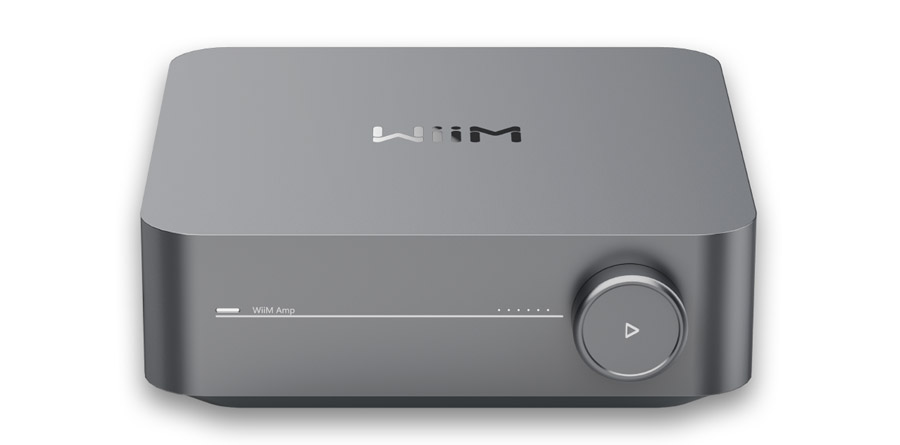
The WiiM Amp does include analog and fiberoptic digital inputs, a USB port that can connect to an external USB drive and an HDMI port with support for ARC (Audio Return Channel) to get sound from a compatible TV. In addition to supporting all the networking features and streaming apps of WiiM’s unpowered streamers, the WiiM Amp is the only powered streamer from WiiM that also supports Apple AirPlay 2.
Our Editor-in-Chief Ian White reviewed the OG WiiM Amp as part of his Audiophile System Builder column. In Ian’s words, “the power, multi-room audio support, and surprising build quality makes this the network amplifier to beat below $500.”
Where to Buy the WiiM Amp: $299 at Amazon
WiiM Amp Pro: For Those Who Want a Little More
The WiiM Amp Pro ($369) looks nearly identical to the WiiM Amp and offers similar features and specs but with a few subtle upgrades. It’s basically an upgraded version of the WiiM Amp, based on customer feedback. The main difference is that the Pro includes an upgraded ESS Sabre ES9038Q2M DAC with decoding up to 32-bit/384KHz digital files and data streams. The DAC is the same one used in WiiM’s flagship network streamer, the WiiM Ultra. The Amp Pro also adds a PFFB (post filter feedback loop) to the amp section in order to offer cleaner, more precise sound.
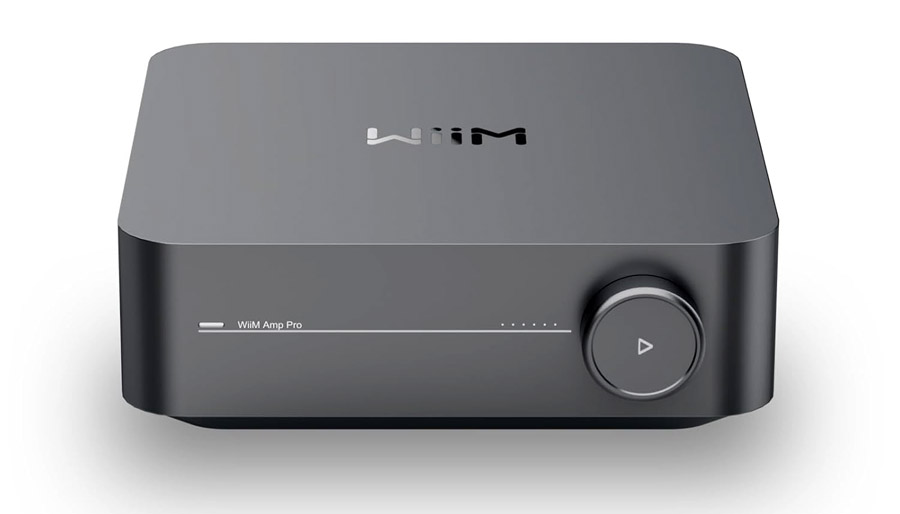
Like the WiiM Ultra, the WiiM Amp Pro lacks support for Apple AirPlay 2 or Apple Music. Apple users can always stream music from their phones, tablets or MacBooks directly to any WiiM streamer (including the WiiM Amp Pro) via Bluetooth or over WiFi via Google Cast on supported devices.
Upgraded Specs of the WiiM Amp Pro
- Support for the latest Wi-Fi 6E and BT 5.3 standard with two antennas for rock-solid Bluetooth or Wi-Fi audio streaming
- TI TPA3255 Class D amp module (60 Watts per channel at 8 ohms, or 120 Watts per channel at 4 ohms) now comes with additional post-filter feedback (PFFB) loop for enhanced sound quality.
- Premium 32-bit/384kHz ES9038 Q2M SABRE DAC
- Elegant aluminum case with subtle design tweaks over the regular version
- Superior sound quality with -105 dB THD+N (Total Harmonic Distortion plus Noise), 120 dB SNR (Signal to Noise Ratio) compared to -92dB THD+N and 102 dB SNR in the original WiiM Amp
Where to Buy the WiiM Amp Pro: $379 at Amazon
WiiM Amp Ultra: More Power, and a Color Touch Screen
Similar in appearance to the unpowered WiiM Ultra (with the addition of a built-in amplifier), the WiiM Amp Ultra provides the most powerful amp in WiiM’s lineup, and adds the color touch screen of the WiiM Ultra for enhanced aesthetics and functionality. With 100 Watts/Channel into 8 ohms and 200 Watts/Channel into 4 ohms, the WiiM Amp Ultra can power virtually any pair of bookshelf or floor standing speakers.
The WiiM Amp Ultra offers all the streaming features of the Amp and Amp Pro, but with the touchscreen, an upgraded DAC and more powerful amplifier.

I reviewed the WiiM Amp Ultra in July 2025. And while I bemoaned the lack of phono input and headphone output, I did find a lot to like in the Amp Ultra. In my own words, “When paired with a capable pair of speakers, the WiiM Amp Ultra provides virtually all a music fan could want in a budget HiFi stereo system: robust features, excellent sound quality, intuitive operation and access to nearly all of the popular music streaming services.”

Upgrades in the WiiM Amp Ultra vs. WiiM Amp Pro
- More powerful dual TI TPA3255 Class-D amplifiers with six TI OPA1612 op-amps (100 Watts/Channel into 8 ohms, 200 Watts/Channel into 4 ohms)
- ESS ES9039Q2M SABRE DAC with 24-bit/192KHz support
- Color Touchscreen
Comparison Chart for WiiM Powered Streamers

| WiiM Amp | WiiM Amp Pro | WiiM Amp Ultra | |
| MSRP | $299 | $379 | $529 |
| Type | Streamer + Amp | Streamer + Amp | Streamer + Amp |
| Audio Amplification | TI TPA3255 | TI TPA3255 with PFFB (Post-Filter Feedback) | Dual TI TPA3255 amps with 6 TI OPA1612 op-amps and PFFB (Post-Filter Feedback) |
| Power Rating | 60 Watts/Channel into 8 ohms, 120 Watts/Channel into 4 ohms | 60 Watts/Channel into 8 ohms, 120 Watts/Channel into 4 ohms | 100 Watts/Channel into 8 ohms, 120 Watts/Channel into 4 ohms |
| CPU | Quadcore A53 | Quadcore A53 | Quadcore A53 |
| DRAM | 512 MB | 512 MB | 512 MB |
| Flash | 512 MB | 512 MB | 512 MB |
| DAC IC | ESS ES9018K2M | ESS ES9038Q2M | ESS ES9039Q2M |
| Audio Input Port | Stereo RCA, Optical, HDMI ARC, USB-A | Stereo RCA, Optical, HDMI ARC, USB-A | Stereo RCA, Optical, HDMI ARC, USB-A |
| Audio Output Port | HP terminals (speaker outputs), Subwoofer out (RCA), USB-A digital output | HP terminals (speaker outputs), Subwoofer out (RCA), USB-A digital output | HP terminals (speaker outputs), Subwoofer out (RCA), USB-A digital output |
| Pair with a Sub | ✓ | ✓ | ✓ |
| USB Port (Storage/Audio Out) | ✓ | ✓ | ✓ |
| Wi-Fi | 5 | 6E | 6E |
| Ethernet | ✓ | ✓ | ✓ |
| Bluetooth | 5.0 | 5.3 | 5.3 |
| Analog Out SNR | 98 dB | 120 dB | ≥120dB |
| THD+ N (Analog Out) | -92 dB (0.002%) | -105 dB (0.0005%) | -106 dB (≤0.005%) |
| Analog Input (ADC) | Up to 192k, 24bit | Up to 192k, 24bit | Up to 192k, 24bit |
| Google Cast | ✓ | ✓ | ✓ |
| Group with Nest speakers and Display | ✓ | ✓ | ✓ |
| Group with Echo speakers and Display | ✓ | ✓ | ✓ |
| Alexa Multiroom with UHD | ✓ | ✓ | ✓ |
| Group with HomePods | ✓ | ||
| Works with Alexa | ✓ | ✓ | ✓ |
| Works with Google | ✓ | ✓ | ✓ |
| Works with Siri | ✓ | ||
| Group with WiiM or Linkplay devices | ✓ | ✓ | ✓ |
| AirPlay 2 | ✓ | ||
| Voice Remote Included? | Voice Remote | Voice Remote | Voice Remote 2 |
| 2-Way Bluetooth | ✓ | ✓ | ✓ |
| Roon Ready | ✓ | ✓ | ✓ |
| DNLA | ✓ | ✓ | ✓ |
| Spotify Connect, Qobuz Connect & TIDAL Connect | ✓ | ✓ | ✓ |
| Gapless Playback | ✓ | ✓ | ✓ |
| 10-band Graphic EQ | ✓ | ✓ | ✓ |
| 10-band Parametric EQ | ✓ | ✓ | ✓ |
| Linkplay Music Streaming Platform | ✓ | ✓ | ✓ |
| Room Correction | ✓ | ✓ | ✓ |
Pricing & Availability
All WiiM streamers and powered streamers covered in this guide are now available to order online on sites such as Amazon and Crutchfield (see links below).
The Bottom Line
Priced from $99 to $529, there’s a WiiM network streamer for everyone. Whether you want basic no-frills model, a fancy touch-screen with ultra high-end DAC or a powered streamer for simplified connection to any pair of speakers, there’s definitely a WiiM that will work well for you.
Those who are partial to the Apple ecosystem and Apple Music should note that all of WiiM’s streamers released in 2024 and later (WiiM Amp Pro, WiiM Ultra and WiiM Amp Ultra) lack support for Siri or Apple Airplay, so if this is important, you may want to consider the WiiM Mini, WiiM Pro, WiiM Pro Plus or WiiM Amp instead.
Where to Buy
- WiiM Mini –
$99.99$89 at Amazon - WiiM Pro – $149 at Amazon
- WiiM Pro Plus $219 at Amazon
- WiiM Ultra – $329 at Crutchfield; $329 at Amazon
- WiiM Amp (Powered Streamer) – $299 at Amazon
- WiiM Amp Pro (Powered Streamer) – $379 at Amazon
- WiiM Amp Ultra (Powered Streamer) – $529 at Amazon
*note: pricing is accurate as of July, 2025 but is subject to change
Related Reading:































Paul
June 14, 2024 at 1:24 am
I like my WIIM Pro Plus. What I don’t get is the Ethernet port speed. It’s the 21st century and they put 10/100 MB port in it. Why not a GB port? Pretty cheap ass if you ask me. Modern networks prefer a GB port.
Chris Boylan
June 16, 2024 at 6:43 pm
That is lame. I mean, 100MB should be more than enough for even lossless high res audio but how much could the part cost difference be? I wonder if the Ultra will have GB ethernet?
Ian White
June 17, 2024 at 2:11 pm
Chief,
It is lame, but I will say based on my experience with the Pro Plus and Amp, there have never been any issues so far using the hardwired ethernet connection.
Best,
Ian White
Chris Boylan
June 17, 2024 at 3:10 pm
Yeah, I think high res lossless two-channel audio maxes out at around 9 MBPS so it’s really a non-issue. Even when WiiM moves toward immersive streaming (one day), the 100MB wired connection would still be more than enough.
Stephen
June 14, 2024 at 1:42 pm
The WiiM Pro does two-way Bluetooth; you don’t need the Plus version for that. I’ve used it far more than expected to stream internet radio to my Bluetooth speaker and headphones.
Chris Boylan
June 15, 2024 at 7:51 pm
Thanks. It looks like the Mini does too so all the WiiM’s do two-way Bluetooth. I’ll update the article.
Liam
June 18, 2024 at 7:24 pm
Hi, the Ultra has an USB port as per the images but is missing from your streamer table. Also, AirPlay Cast is no longer a feature of any WiiM device. Good article btw 🙂
Chris Boylan
June 20, 2024 at 3:27 am
Thanks for your comment. USB is listed under the “wired inputs” section for the Ultra in the streamer table. It is also mentioned in the text description for the Ultra.
Also these charts came directly from WiiM. Are you saying WiiM has discontinued support for AirPlay Cast in the last month since they sent us these streamer feature tables? From what I understand, people are using this feature on WiiMs to deliver sound from the WiiM directly to Apple HomePod speakers.
Burnside
September 15, 2024 at 4:06 pm
Yes, AirPlay cast is no more, and AirPlay reception has been dropped from the Ultra too.
Chris Boylan
October 31, 2024 at 6:40 am
AirPlay Cast removed from charts. Thx for heads-up!