
Vinyl has many virtues. Remaining clean through decades of paper sleeves, fingerprints, dust, smoke, questionable storage, basement humidity, pets, precious bodily fluids, moves between houses, and whatever happened during college is not one of them.
If you own 50 new records and handle them properly, a carbon fiber brush, stylus cleaner, and some common sense might be enough for most of your day-to-day needs. Start buying used records, inherit somebody else’s collection, or find yourself staring at several thousand LPs accumulated over decades and the conversation changes rather quickly.
A brush removes loose material sitting on the surface. A proper wet cleaning system is designed to remove contamination that has become attached to the vinyl and lodged inside the groove.
And before anyone gets carried away, record cleaning has limits. No machine can repair groove damage, scratches, non-fill, an off-center pressing, or the consequences of somebody playing a record 700 times with a worn stylus and the tracking force set somewhere between “agricultural” and “road construction.”
What a good record cleaner can do is remove contaminants that interfere with playback, reduce the amount of debris your stylus has to drag through, and in many cases lower the number of ticks and pops caused by dirt rather than permanent damage.
Which raises the obvious question.
Do you really need to spend $3,599 to accomplish that?
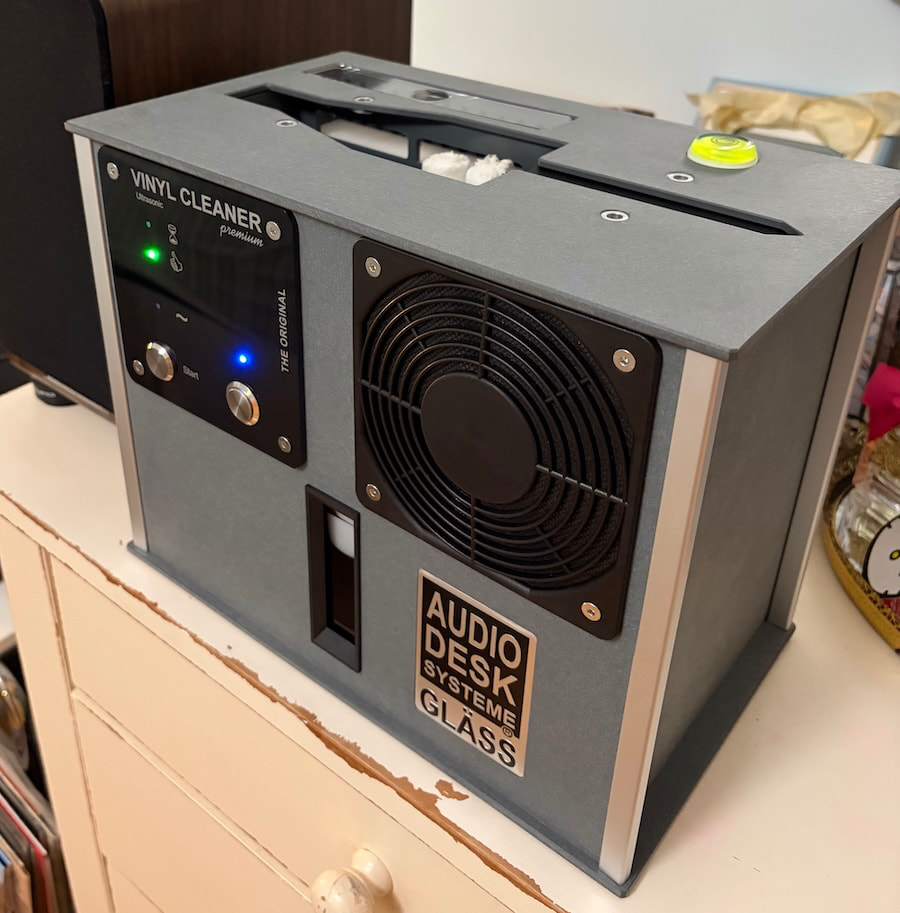
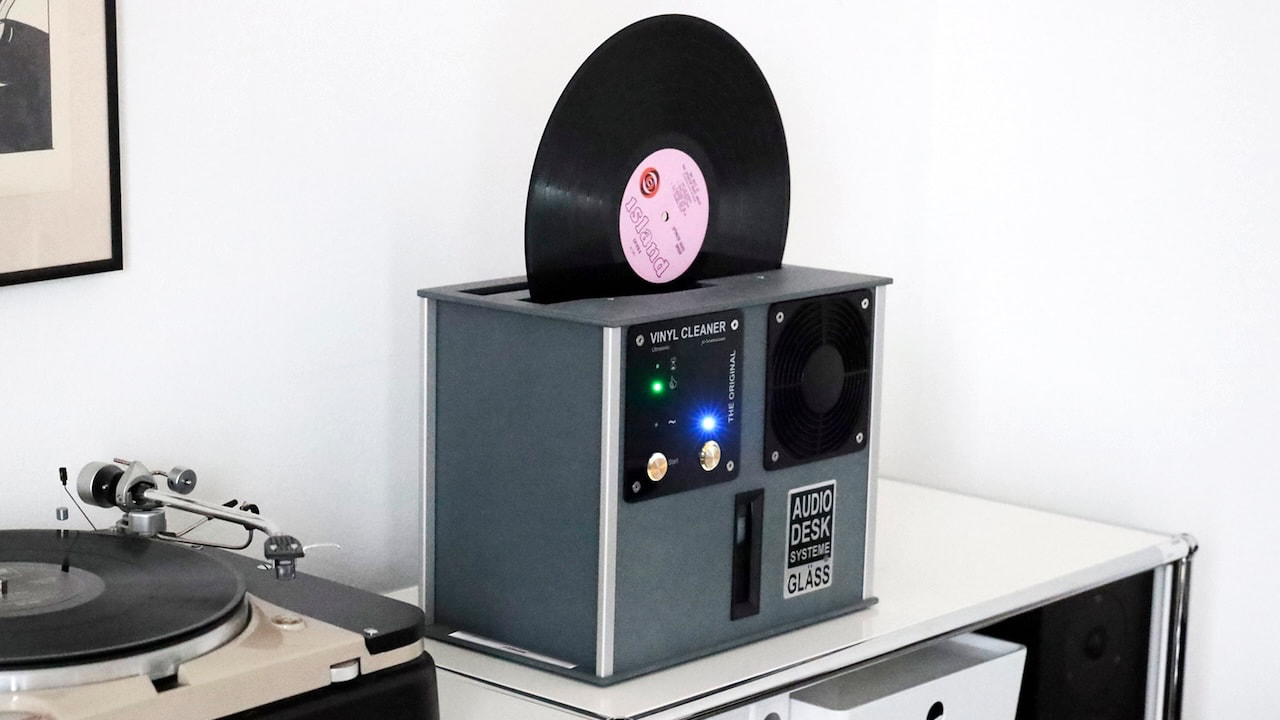
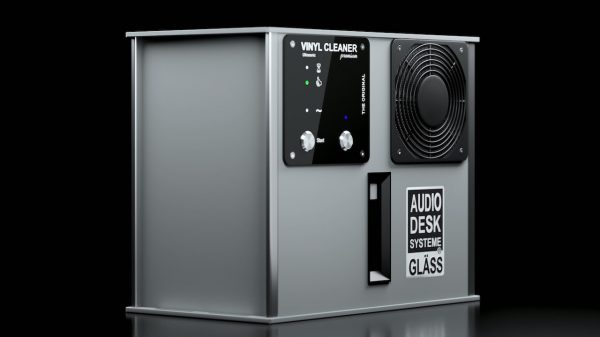
That is the current U.S. MSRP for the Audio Desk Systeme Gläss Vinyl Cleaner Premium with Silent Core One, and the price remains unchanged from when we first covered the new model in May 2026.
The honest answer is no.
You can clean records for considerably less. The more interesting question is what happens as you move from a $79.99 manual Spin-Clean, to a $1,200 VPI HW-16.5, to a much less expensive ultrasonic machine like the HumminGuru, and finally to a fully automatic German machine that costs more than a lot of very good turntables.
That is where this starts to become interesting. And where the Audio Desk Systeme Gläss Vinyl Cleaner Premium starts to make more sense.
Related Reading:
Why Clean Records at All?
A phono cartridge is trying to extract microscopic modulations from a groove while the stylus remains in physical contact with the record. Anything sitting between the stylus and groove wall is along for the ride.
Dust and fibers are obvious, but used records can also arrive with fingerprints, oils, dried cleaning products, smoke residue and assorted substances whose origin I would prefer not to investigate without gloves and a tetanus booster.
That expensive phono cartridge you spent hours installing? Clean records mean less abrasive debris attacking the stylus. At today’s cartridge prices, playing filthy vinyl is basically sanding money.
It can also make a meaningful audible difference, although this is another area where audiophile enthusiasm occasionally runs several exits past the available evidence. Cleaning a genuinely dirty record can reduce noise and reveal information that was being partially obscured by contamination. It does not remaster the album, expand the recording venue, change the frequency response of your cartridge, or summon Rudy Van Gelder from the afterlife to approve your system.
There is also a persistent claim that every new record needs to be cleaned because it arrives covered with mold-release compound from the pressing process. I would be careful with that one. New records can absolutely arrive with dust, paper fibers, fingerprints and other manufacturing or packaging debris, and I clean many new records before playing them. That does not require repeating a claim that is much harder to establish universally.
The case for record cleaning is strong enough without making the folks at your local pressing plant sound like they’re running a crime scene with hydraulic presses.
Why Not Buy a Spin-Clean?

For a lot of record collectors, that is exactly what I would do.
The Spin-Clean II Record Washer Complete Kit is currently $79.99 and requires no electricity. The record sits vertically between a pair of brushes in a bath of diluted cleaning solution, and you rotate it manually so both sides are cleaned at the same time. Remove the record, dry it with the supplied cloths, put it into a clean inner sleeve and move on with your life.
It is almost aggressively uncomplicated.
That is also why it works so well as an entry point. There is no pump, motor, ultrasonic transducer, vacuum system, software control board or German engineering degree hiding underneath the yellow plastic basin.
The trade-off is labor. You turn every record yourself. You remove it yourself. You dry it yourself. The cleaning fluid remains in the basin during a batch, and eventually you have to dump everything, rinse the unit and start again.
Clean five records and none of this matters.
Clean 50 every month and you might start to wonder if there is a better way.
The Spin-Clean remains one of the easiest products in this category to recommend because it is inexpensive and effective. What it does not offer is automation, active fluid filtration, ultrasonic cavitation, powered drying or anything resembling a drop-it-in-and-walk-away workflow.
If you own a modest collection and only occasionally buy used vinyl, you might never need more.
Seven Years With the VPI HW-16.5
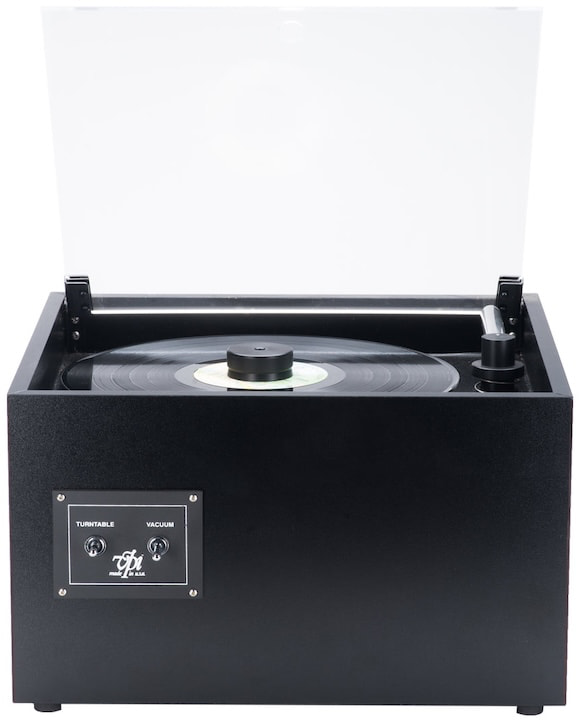
The VPI HW-16.5 is a different animal, and I owned one for seven years.
Mine was exceptionally reliable. It was also extremely effective, easy to understand, built like something designed to survive an evacuation, and never gave me a meaningful reason to question whether vacuum cleaning still had a place in a serious vinyl collection.
The current HW-16.5 costs $1,200 and uses an 18 RPM high-torque platter with a powerful vacuum system. VPI specifies a roughly 35-second cleaning cycle per side, and the machine includes a stainless steel internal waste-fluid collection system.
You apply cleaning solution to the record, work it across the surface with the brush, engage the vacuum and watch the fluid disappear through the pickup tube. Flip the LP and do it again.
Simple. Effective. Repeatable.
My first complaint was the size of the waste-fluid collection system. When you are cleaning records in volume, stopping to drain dirty fluid gets old rather quickly. This is not an issue if you clean three records after dinner. It becomes more noticeable when a stack of 30 LPs is staring at you from across the room.
My other complaint was rather harder to ignore.
The HW-16.5 is loud.
Not “I can hear it from the sofa” loud. Think old-school upright vacuum cleaner, the kind Alice pushed around the Brady house while wondering why six children apparently couldn’t clean anything themselves.
When I owned the HW-16.5, I measured almost 90 dB with a Radio Shack SPL meter from less than a foot away while standing over the machine, which helps explain why “vacuum cleaner loud” still feels a little polite.
I used to clean records in my dining room in the middle of the day and receive nasty text messages complaining about the noise.
From my neighbors.
They were sitting in their driveway roughly 18 feet away rolling something at the time, but I digress. The Jersey Shore isn’t for everyone.
None of that changes my opinion of the VPI. After seven years with one, I would still describe the HW-16.5 as a highly effective and impressively dependable record cleaning machine. Its manual nature also has an advantage when you encounter a truly filthy LP because you control how much fluid gets used, how aggressively you work the brush and whether the record receives another cleaning cycle.
What you do not get is silence or automation. You are part of the cleaning process from beginning to end, and everybody within shouting distance knows when the vacuum motor comes on.
Why Not Buy a HumminGuru?
This is the harder question for Audio Desk.
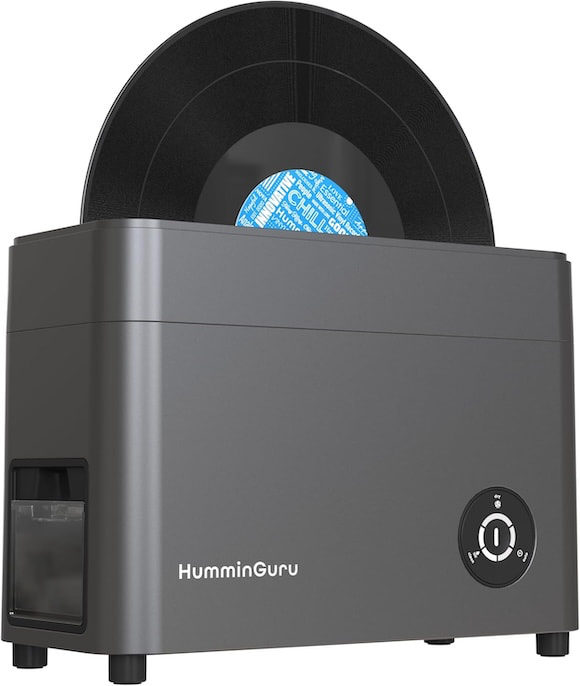
The HumminGuru HG01 ($599 at Amazon) offers legitimate ultrasonic record cleaning for hundreds of dollars rather than thousands. It uses two 40 kHz ultrasonic transducers, automatically drains the cleaning chamber before drying, and uses a dual-fan system to dry the record. HumminGuru offers shorter and longer cleaning programs, and the company recommends its longer cycle for new or heavily soiled records.
It is compact, relatively affordable and substantially more automated than a Spin-Clean or VPI.
The HG01 remains the least expensive way into HumminGuru’s ultrasonic ecosystem, but buyers willing to spend another $200 should also look at the newer HumminGuru NOVA HG05 ($799.99). The NOVA offers automatic cleaning and drying, 40kHz sweep-frequency operation, faster drying, built-in support for 7-, 10-, and 12-inch records, and integrated filtration.
It still lacks the Audio Desk’s heavier construction, roller-assisted cleaning system, larger fluid capacity, and luxury positioning, but at less than one-quarter the price it makes the value equation rather uncomfortable.
Ultrasonic cleaning is no longer exotic.
The Audio Desk takes a different approach.
Rather than treating ultrasound as the entire cleaning system, it combines cavitation with mechanical cleaning, fluid circulation and filtration, rinsing and automatic drying.
That combination is the real technology story here.
What Does the Audio Desk Actually Do?
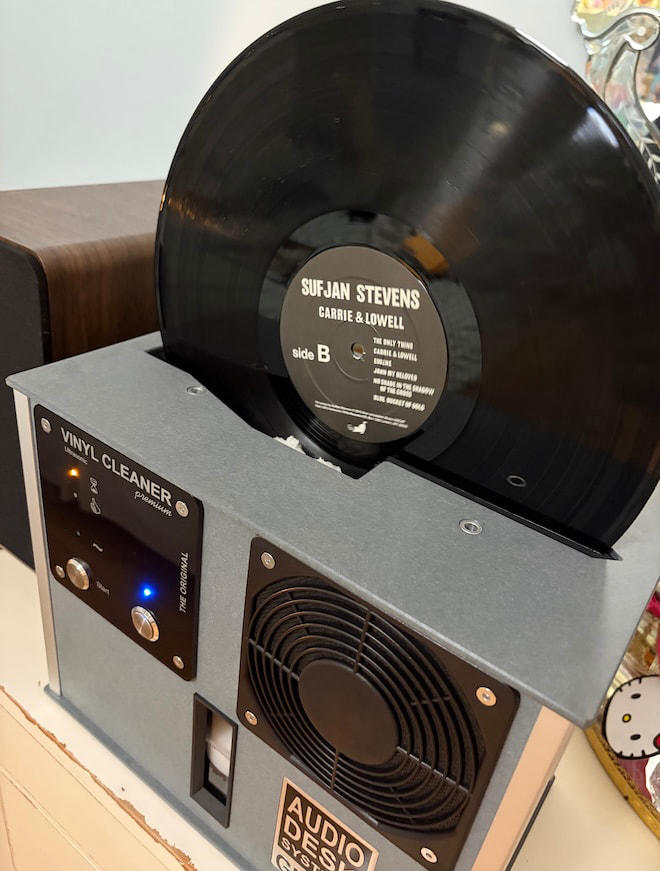
Insert a record vertically into the machine, press the button and the Audio Desk handles essentially everything from that point forward.
Cleaning fluid is pumped from its reservoir into the cleaning chamber while the record rotates. Ultrasonic energy creates acoustic cavitation in the liquid: rapidly changing pressure causes microscopic bubbles to form and collapse, producing localized fluid movement that helps dislodge contamination from areas inside the record groove that conventional surface brushing cannot easily reach. Audio Desk has used this approach since the original machine, which entered the market in 2009.
Audio Desk does not currently publish an ultrasonic operating frequency for the Premium, so I am not going to invent one. HumminGuru publishes 40 kHz for the HG01.
Where the Audio Desk departs from many competing ultrasonic designs is the addition of four rotating microfiber cleaning rollers, with two working against each side of the LP. The ultrasonic process helps loosen material from the grooves while the rollers provide mechanical contact with the record surface.
The cleaning fluid also circulates through a wet filter rather than simply remaining in the cleaning chamber. That matters because removing contamination from the record is only half the job. You would prefer not to loosen it and then give it another opportunity to settle back onto the vinyl.
After the wash stage, the Audio Desk drains the chamber and moves automatically into its drying process. The Premium uses a twin-fan air-drying system with filtration, and the latest version has reduced the drying portion of the cycle from approximately five minutes to three. The complete wash-and-dry process takes about five minutes.
There is no flipping the record, applying more fluid, moving a vacuum arm or wiping the LP with a cloth.
That is what the $3,599 is buying before we even discuss whether it cleans better.
For someone cleaning ten records a year, that convenience is absurdly expensive. For a collector working through thousands of LPs, a record dealer processing inventory, or somebody buying large quantities of used vinyl, the equation is rather different.
About Those Older Audio Desk Machines
This is where the review gets more complicated.
When I posted my first photographs of the Audio Desk review sample on social media, I received some interesting responses from people inside the audio universe.
“Good luck.”
“Have fun with that.”
And then there was the particularly comforting:
“My friend had to return his.”
The flowers arrived the following morning.
Those comments are anecdotes. They are not controlled reliability data, and it would be irresponsible to present them as proof that every earlier Audio Desk machine had problems.
It would be equally silly to pretend that the reputation did not exist.
Audio Desk has been refining this design for years, and what matters here is the machine sitting on my desktop in 2026. The new Premium with Silent Core One incorporates substantial changes to the motor, electronics, pump, filtration, rollers and drying system, with improved reliability, quieter operation and easier servicing among the stated goals. This is not simply the previous machine with a new badge.
What Changed With Silent Core One?
The most obvious change is the new Silent Core One motor, which Audio Desk developed in-house. The company says the new drive system is more powerful, quieter and designed to improve long-term reliability. The current model also uses revised drive components and more wear-resistant materials on its drive and output shafts.
Audio Desk also relocated and modified the water pump to improve cooling. According to the manufacturer, the revised pumps remain continuously cooled, addressing the possibility of overheating. A new software control system and circuit board add current management and short-circuit protection.
Those are not glamorous changes.
They are, however, exactly the kind of changes I want to hear about when people responding to photographs of a $3,599 review sample are wishing me “good luck.”
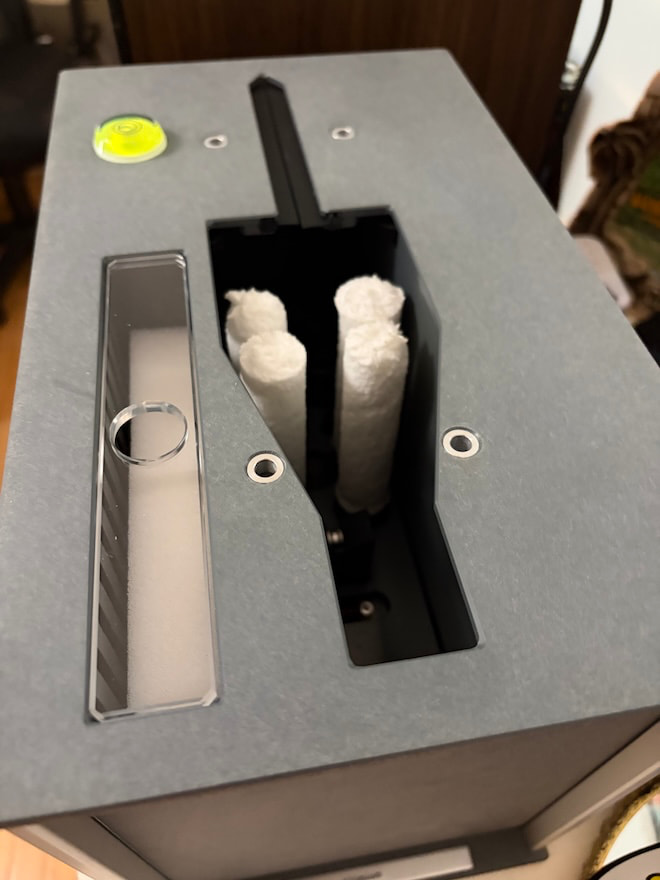
The four microfiber cleaning rollers have also been revised for improved concentricity. Audio Desk says the change provides more consistent contact with the record surface while lowering mechanical noise. The wet filtration system has been redesigned as well, and the disc-rinsing function now operates at higher pressure.
The drying system received considerable attention. Revised drying shafts have reduced drying time from five minutes to approximately three, while new drying wipers are designed to last longer, operate more quietly and eliminate the occasional squeaking associated with previous versions.
The three-year warranty is welcome, although at $3,599 I would consider that the minimum rather than a bonus. More important is the ability to have the machine serviced through authorized locations without automatically sending it back to Germany, which makes ownership of something this expensive considerably less complicated.
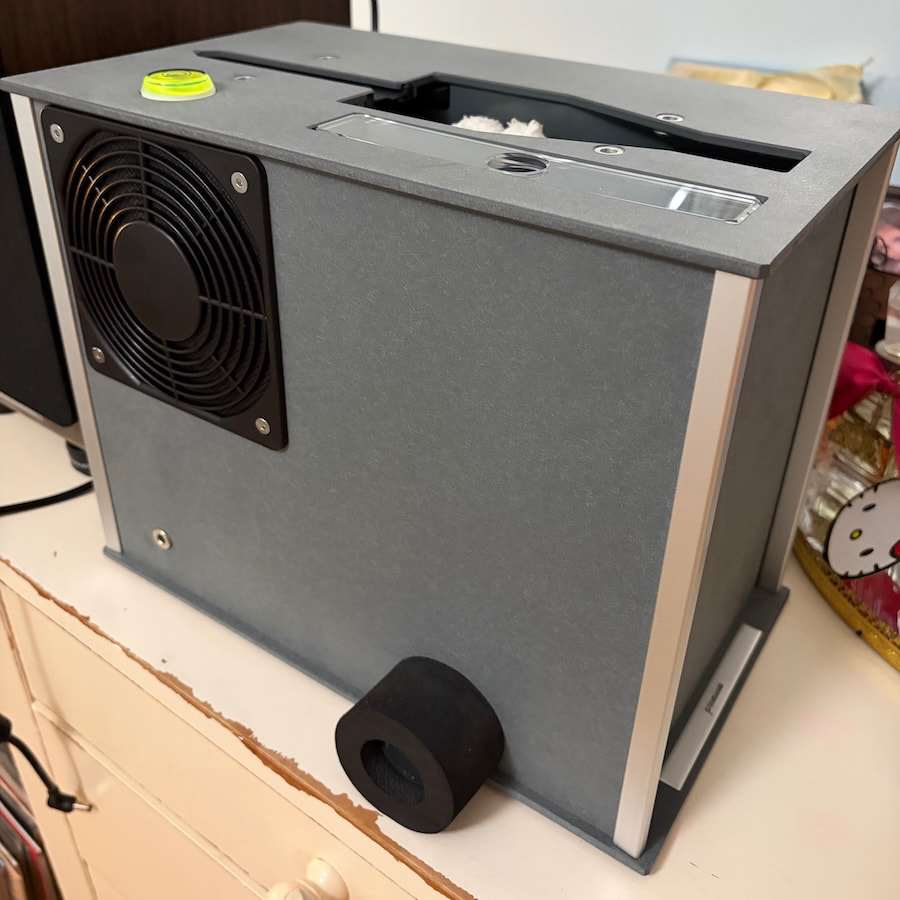
Audio Desk Systeme Gläss Vinyl Cleaner Premium Specifications
- Type: Fully automatic ultrasonic record cleaning machine
- Current U.S. MSRP: $3,599
- Drive system: Silent Core One
- Cleaning method: Ultrasonic cavitation plus four microfiber cleaning rollers
- Cleaning: Both sides simultaneously
- Fluid management: Circulating cleaning solution with wet filtration
- Reservoir capacity: 4.5 liters
- Cleaning solution: Distilled water plus approximately 20 ml of Audio Desk cleaning concentrate
- Rinsing: Powered rinsing system with increased pressure on the Premium
- Drying: Twin-fan filtered-air system
- Drying time: Approximately 3 minutes
- Complete cycle: Approximately 5 minutes
- Standard record compatibility: 12-inch LPs
- Optional compatibility: 7-inch and 10-inch records with accessory adapters
- Dimensions: 13 x 7.9 x 10.6 inches (330 x 200 x 270 mm)
- Weight: 12.1 pounds (5.5 kg), empty
- Available finishes: Black, red, white and gray
- Warranty: 3 years
- Country of manufacture: Germany
Five Minutes and Four Lights
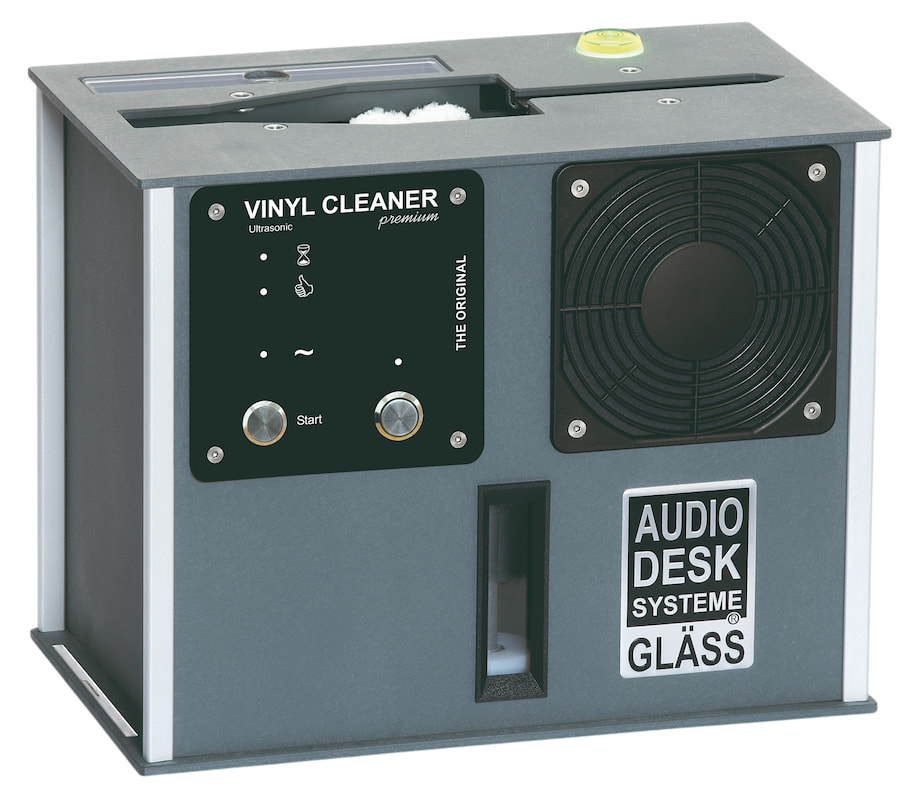
Getting the Audio Desk ready for its first cleaning cycle is refreshingly uncomplicated. The supplied concentrate is mixed with distilled water, and filling the machine proved easy enough that making a mess would require either genuine effort or deciding that pouring several liters of liquid into a $3,599 record cleaner was also the perfect time to answer a text.
Emptying it is equally straightforward. Make sure the machine is disconnected from its power supply, position it over a suitable container or sink, remove the drain plug, and let gravity handle the rest. Before using the machine, you also need to make sure the clear Plexiglas cover is properly installed over the filter section.
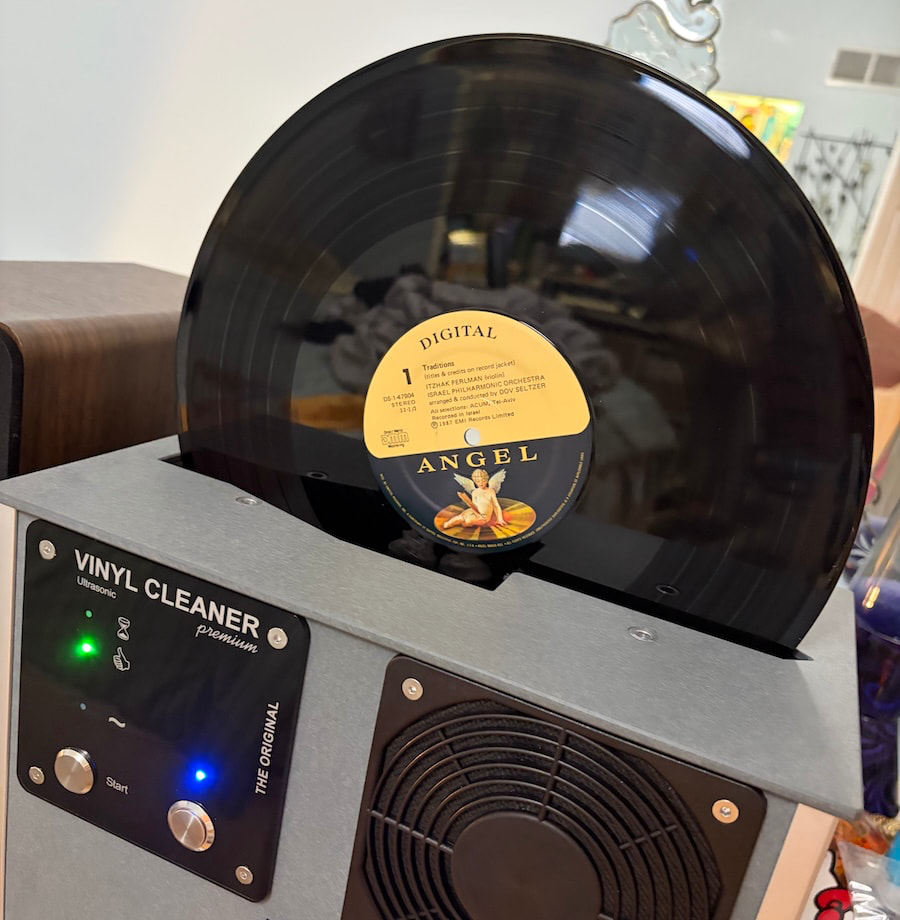
The front panel keeps things equally simple. Blue indicates power, green means the machine is ready or the cycle has finished, yellow indicates cleaning is underway, and red warns that the fluid level is too low. Insert the record, press Start, and let the Audio Desk handle the washing and drying automatically.
I did encounter one minor operational quirk. As the cleaning chamber filled, the internal rollers did not always secure the record firmly enough to start it rotating immediately. Out of 200 records cleaned during the review, I had to give roughly a dozen a small nudge to get them moving. It was hardly a crisis, but it happened often enough that I found myself watching the record for the first few seconds after pressing Start rather than immediately walking away.
There was also a much more important positive result from those 200 cleaning cycles: not one record label got wet. I inspected every single one. Considering how much fluid is moving around inside the machine and how many valuable or irreplaceable pressings passed through it, that consistency inspired considerably more confidence than anything printed in a brochure.
Audio Desk includes two bottles of cleaning concentrate, which got me through roughly the same number of records I cleaned for this review. At $3,599, however, two small bottles still feels a tad stingy. Toss in a few more. Nobody spending this much on a record cleaner should finish a serious first cleaning run and immediately have to start shopping for consumables.
The optional record-size adapters also raised an eyebrow. I can understand making the 10-inch adapter optional because most collections contain relatively few of them. Not including the 7-inch adapter at this price is harder to defend.
I inherited more than 300 45 RPM singles from the late Arnold Heft, who helped purchase the Baltimore Bullets in 1964 with Abe Pollin and Earl Foreman, later partnered with Pollin on the Capital Centre, and became deeply involved in the Washington sports world that included both the Bullets and Capitals. He was also the Zaida of my best friend from my years living in Washington, D.C., so these records mean considerably more to me than another box of used singles.
With the 7-inch adapter, I could easily see myself working through that collection every day. Without it, more than 300 very dirty little reasons are sitting on a shelf wondering why a $3,599 record cleaner did not come with one.
Quieter Really Does Mean Quieter
The name Silent Core One suggests monk-like behavior, which is not quite what happens when pumps, rollers, and drying fans are involved. What matters is whether the Premium is quiet enough to use without taking over the room.
I placed my iPhone on a 28-inch speaker stand positioned three feet in front of the machine. Ambient room noise measured 38.3 dB. During the cleaning cycle, the Premium reached 47.9 dB, while the drying cycle peaked at 62.4 dB across six separate measurements.
That tracks closely with what I heard over the course of 200 records. The cleaning portion is genuinely quiet and easy to live with. Drying is obviously louder, but it lasts only a few minutes and never approached the kind of noise that made my old VPI HW-16.5 such a neighborhood event.
As a reminder, when I owned the VPI, I measured almost 90 dB with a Radio Shack SPL meter from less than a foot away while standing over the machine. The measurement distance and equipment were different, so this is not an apples-to-apples laboratory comparison, but the practical difference was enormous.
The Audio Desk lets you clean records without announcing it to everyone within property-tax range.
The neighbors would probably still like an apology.
But Are They Actually Clean?
Did I randomly pick records for this review? Sort of. About 30 were new purchases or review samples, including Mobile Fidelity’s recent reissues of Rush and Fly By Night. The rest came from all over my collection, which was exactly the point. I wanted clean new pressings, recently purchased used records, and older LPs that had already been through another cleaning process.
That included a pile of records I bought during the pandemic at Cactus Music in Houston, where I somehow stumbled into a goldmine of Jewish and Israeli music that needed to come home with me. I schlepped them back to New Jersey and cleaned them on my Spin-Clean. They were already in decent shape, but another proper cleaning with the Audio Desk still proved worthwhile.
I also worked through used purchases from recent trips to Toronto, Pittsburgh, and Annapolis, along with records from Jack’s Music Shop in Red Bank and my regular haunt, the Princeton Record Exchange. In other words, this was not 200 copies of pristine audiophile vinyl being treated like laboratory samples. It was a pretty fair representation of what actually comes through my listening rooms.
My home office adds another variable: a four-year-old Westie who sheds like it is part of his employment contract. Dog hair routinely finds its way onto the table around my Andover SpinPlay, while the Thorens and Yamaha turntables downstairs live on taller furniture under substantial dust covers. Down there, dust is the primary enemy. Upstairs, Tyrion occasionally contributes raw materials.
After approximately 200 records in little more than a month, the Premium did a superb job. Records emerged noticeably cleaner and, when surface contamination had been contributing to playback noise, quieter as well. Not one record came out wet or even slightly damp.
Two hundred records in that period is probably closer to commercial use than anything remotely normal at home, but that was intentional. Audio Desk has redesigned a lot of this machine, and given the history surrounding earlier models, I wanted to know whether the Premium could tolerate sustained use rather than spending a month cleaning six carefully selected LPs and declaring victory.
It could. The machine proved robust, efficient, quiet enough to use while working, and remarkably easy to operate. More tellingly, it changed my behavior: I started buying more used records because cleaning them no longer felt like another project waiting for Saturday afternoon.
That might be the strongest argument for the Audio Desk Systeme Gläss Vinyl Cleaner Premium. At $3,599, it certainly does not make record cleaning inexpensive.
It makes you want to clean records.
Pros:
- Superb cleaning performance on new and used vinyl
- Fully automatic wash and drying cycle
- Quiet during cleaning and reasonable during drying
- Robust enough to handle heavy use without issue
- Redesigned motor, filtration, electronics and serviceability
Cons:
- $3,599 is a serious investment
- 7-inch and 10-inch adapters cost extra
- Only two bottles of cleaning solution are included
- Some records needed a slight nudge to start rotating
- Still louder during the drying cycle than during cleaning
Our Ratings:
★★★★★★★★★★ Build Quality
★★★★★★★★★★ Reliability
★★★★★★★★★★ Performance
★★★★★★★★★★ Value
Where to Buy:
Related Reading:















Randal P. Coltrane
September 29, 2026 at 12:46 am
I’m sure you will get torched online for this review but I applaud your honesty and for not turning this into a “this is the greatest thing ever” piece of audiofool slop.
I’m more inclined to buy this now.
Ian White
September 29, 2026 at 12:56 am
Randal,
It’s very hard to review a product like this without getting a lot of criticism but I wanted to be totally transparent and cut the naysayers off at the pass. It’s a very good product that does what they advertise. I’ve never tried the other machines that offer similar cleaning technology but all of them offer their own secret sauce. I will say that the noise difference is actually quite significant. This machine is rather quiet compared to anything else that I’ve tried or seen in stores. It is not cheap but if you have a big collection, it’s actually a solid investment.
IW
Abdo Abdala
September 29, 2026 at 8:29 pm
I think the article deserves a revision; I own an HG05 and it’s fantastic. I don’t understand why the HG01 was included—it’s a machine from four or five years ago… that could confuse a lot of people into spending 3,500 when they could get a good solution for 800.
Ian White
September 29, 2026 at 8:55 pm
Abdo,
Fair enough but the HG01 is still readily available at its asking price and very popular. I went from $79 to $599 to $3,500. I’ve added something about the HG05 (which I’ve yet to use personally) but also explained the differences between the Audio Desk and it. I’m not sure that it confuses people at all. I explained rather clearly who the Audio Desk is aimed at. I’ll see if I can get the HG05 in for review in a few months.
Appreciate the feedback.
IW