
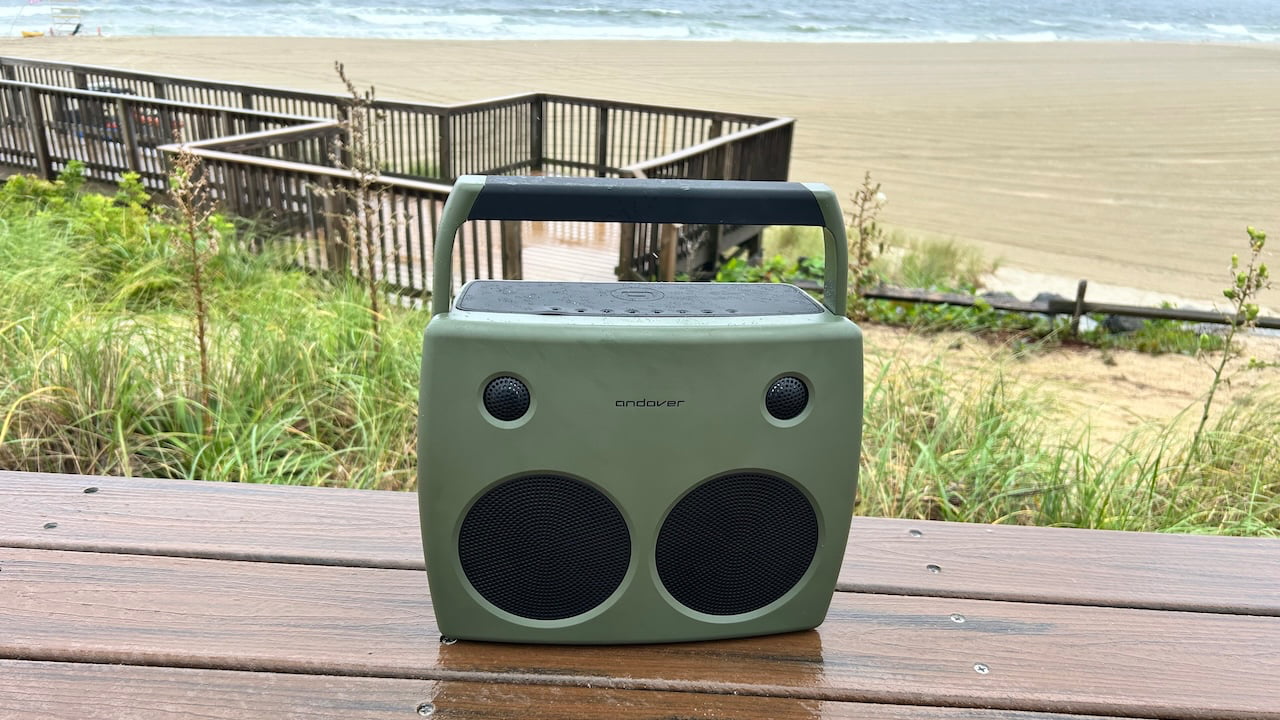
The $429 Andover Audio FreePlay is a portable Bluetooth speaker from a brand better known for all-in-one turntable systems, entry-level record players, network streamers, and phono stages than beach bags, pool decks, or backyard gatherings that become louder than originally approved. That puts Andover directly into a crowded category dominated by JBL, Sonos, and Soundcore, three brands that have spent years making portable speakers for people who believe every patio needs its own soundtrack and every beach requires a defensive weapon once the alcohol, blazing sun, and poor judgment begin to take hold.
So when the Andover Audio FreePlay arrived at my front door under embargo, before I had seen a single product image or received a press release, I was intrigued. Having just reviewed the excellent KEF Muo, I assumed FreePlay might be another compact cylindrical speaker to toss into a beach bag and hope for the best.
Wrong again.
The Jersey Shore had been baking under the kind of sun that would have sent Paulie Walnuts indoors to complain about the air conditioning. Temperatures were pushing past 100 degrees, the humidity was obscene, and sitting outside to listen to music felt like something an insurance company would strongly discourage. Naturally, I tested the FreePlay outdoors anyway, because apparently the question, “How bad can heatstroke be?” still needed answering.
The Andover Audio FreePlay went head to head with the KEF Muo, with Tivoli Audio making a late appearance for good measure. You can read that portable Bluetooth speaker shoot-out here.
So what exactly did Andover just deliver? A portable speaker with considerably more ambition than its small footprint suggests, and one that made our America 250 BBQ, held indoors because some of us had already suffered enough, considerably louder.
Related Reviews:
- KEF Muo Portable Bluetooth Speaker Review
- Andover Audio SpinPlay Review
- Tivoli Audio SongBook MAX Review
Andover Audio FreePlay: Design, Features, and Technology

More portable boombox than poolside bluetooth speaker?
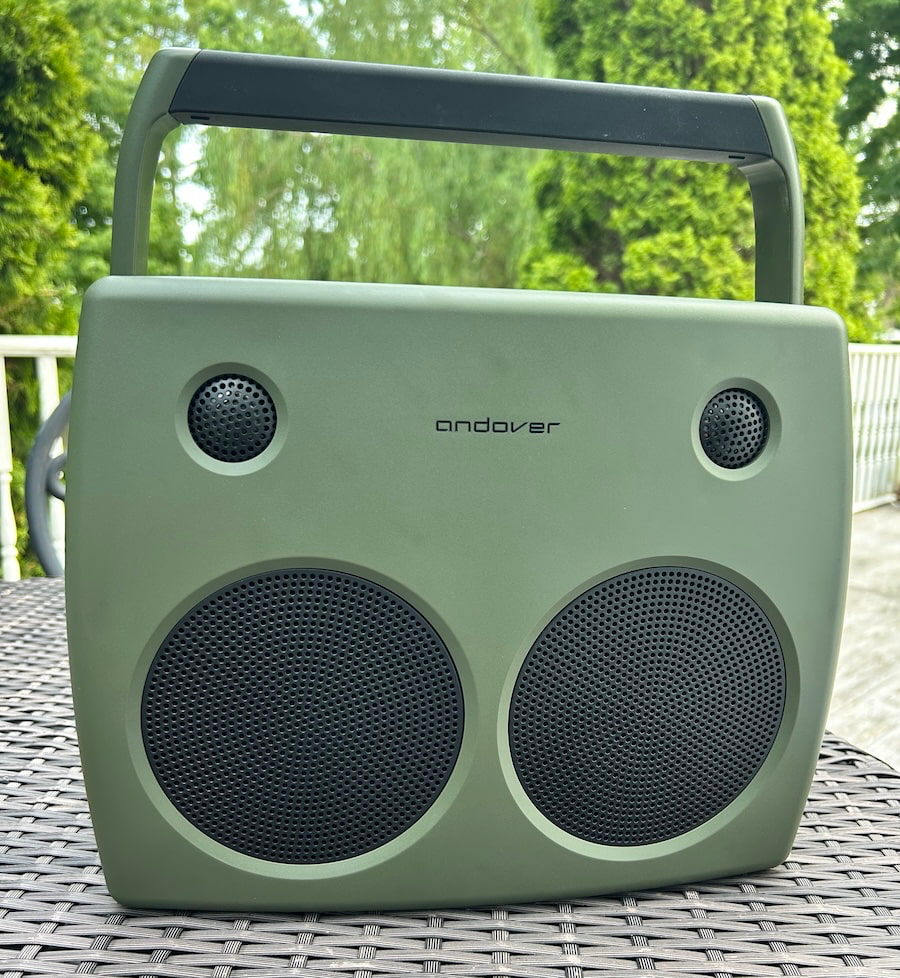
Andover does not publish an amplifier power rating for the FreePlay, which is a shame because it is the sort of figure people will inevitably ask about. The more revealing detail is the hardware inside: two 5.25-inch aluminum-cone woofers, a pair of 25mm dome tweeters, and a 160mm rear-mounted passive radiator.
That is a surprisingly serious driver complement for a 9-pound portable Bluetooth speaker. But who exactly is the FreePlay aimed at? Is it a back-deck, campsite, or “I am finishing a secret room in the garage and would prefer you not ask about the soundproofing” kind of portable speaker?
Or is it something you can actually schlep down to the beach beside an overpriced YETI cooler, where it will almost certainly annoy a Bennie Karen from Connecticut, a state that does in fact have beaches, who came all this way to work on her tan and overpay for a slice?
Andover rates the FreePlay from 55Hz to 20kHz, and my indoor listening suggested that claim may be a touch optimistic at the low end, but it is not fantasy. Anyone can build a speaker that plays loudly. The more important question is whether it actually sounds good, and more importantly, whether it sounds better than the rivals it is clearly trying to challenge.
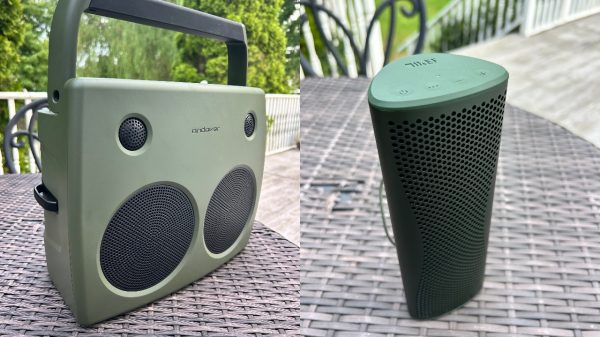
The FreePlay is a different animal: more portable boombox or modern ghetto blaster than typical poolside Bluetooth speaker, with separate left and right channels intended to preserve actual stereo separation from a single enclosure. I will get into what that means in practice in the listening section.
Portable Without Pretending to Be Pocketable
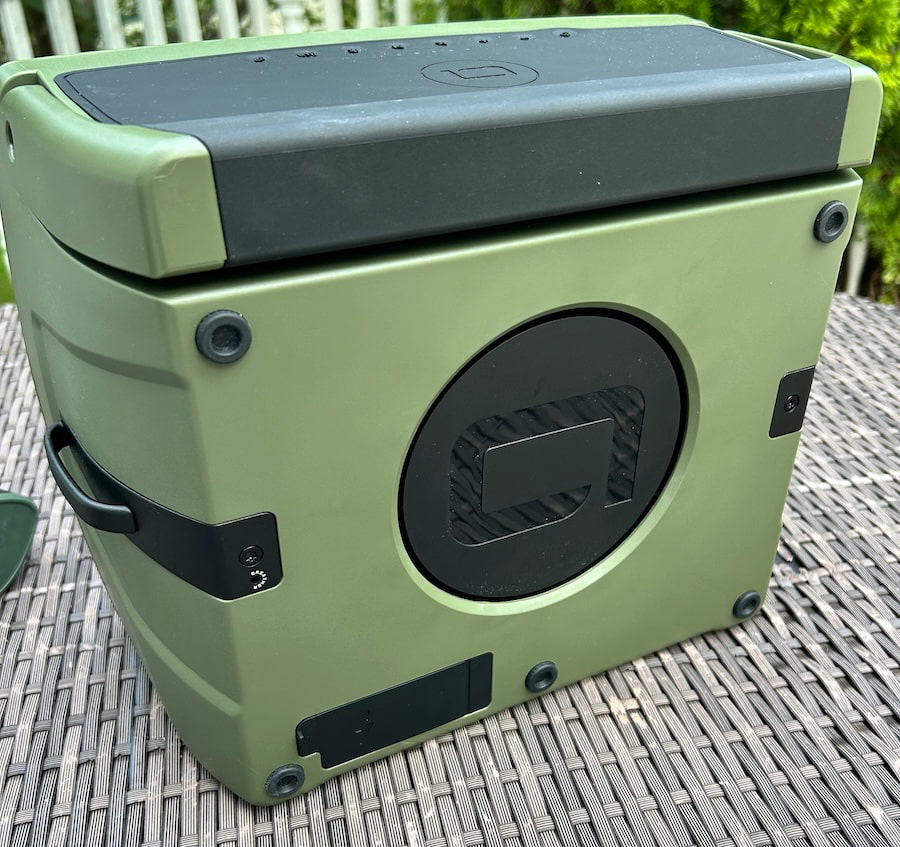
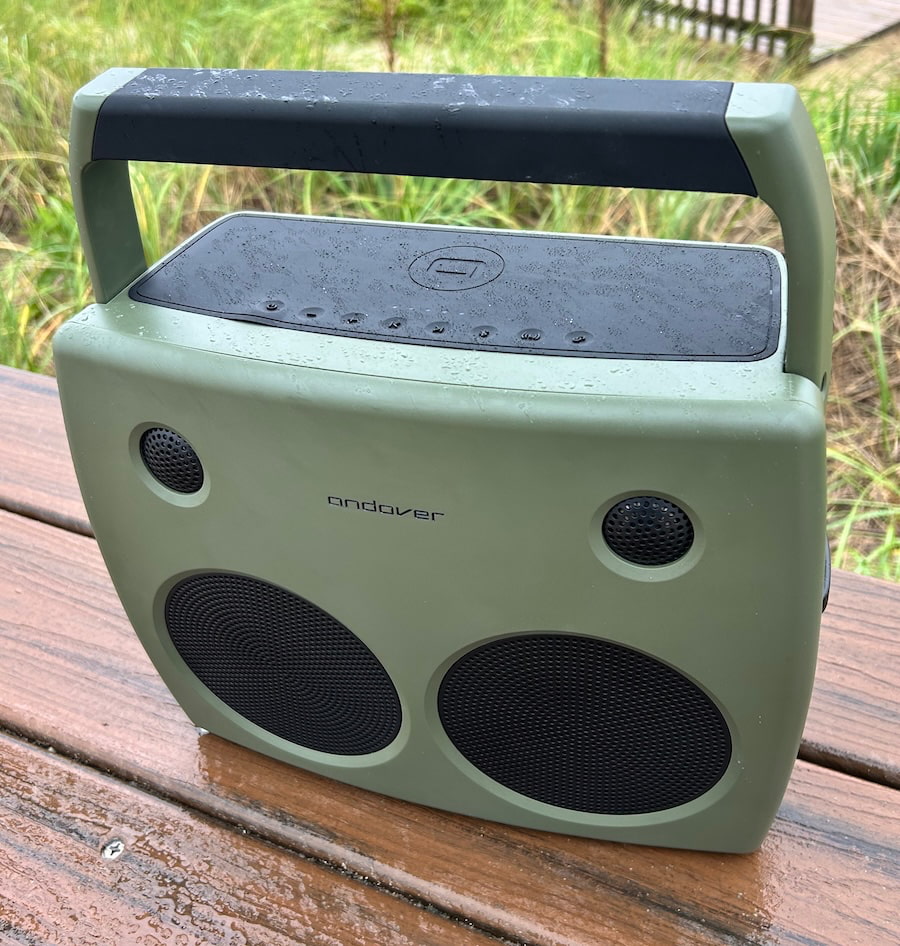
At 10 inches high, 13 inches wide, 6.5 inches deep, and 9 pounds, the FreePlay is portable in the original, more honest sense of the word. It has a handle, can be moved without requiring a second person, and fits neatly on top of the center console storage compartment of my Toyota SUV, alongside the unpaid parking tickets, an unopened at-home DNA test, and receipts from Dave’s Hot Chicken that I am absolutely not discussing with my rabbi.
A fold-down handle and side-mounted tie-down bars make it easier to carry or secure, while Andover includes a shoulder-strap carry bag for travel. The rear panel, which houses the 3.5mm auxiliary input, microphone input, and USB-C charging connection, is protected by a rubber cover.
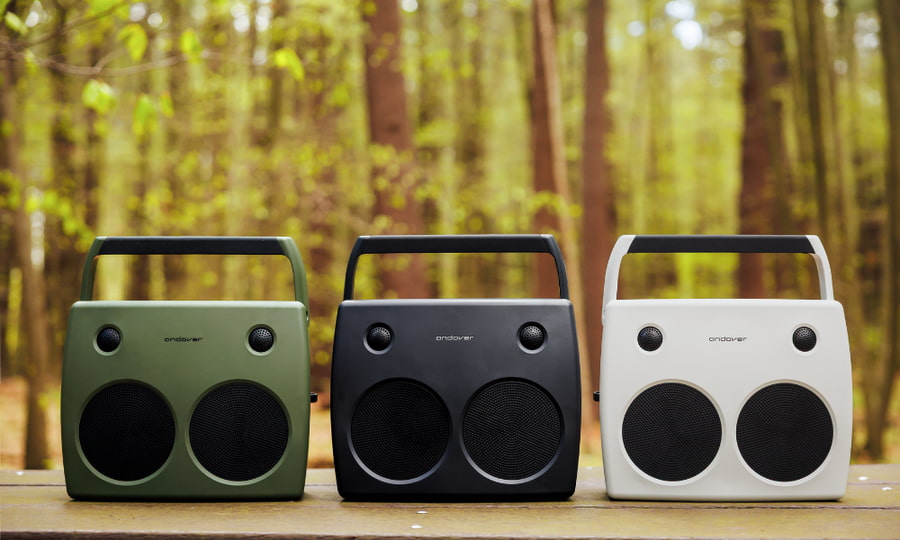
The FreePlay will be offered in Ivory, Olive, and Slate. Andover supplied the Olive version, which has a slightly military feel without looking like it was designed for a tactical cooler catalog. It is distinctive, practical-looking, and rather more interesting than the usual black-plastic Bluetooth-speaker blob that seems to reproduce by spores in big-box stores.
IP67 Protection
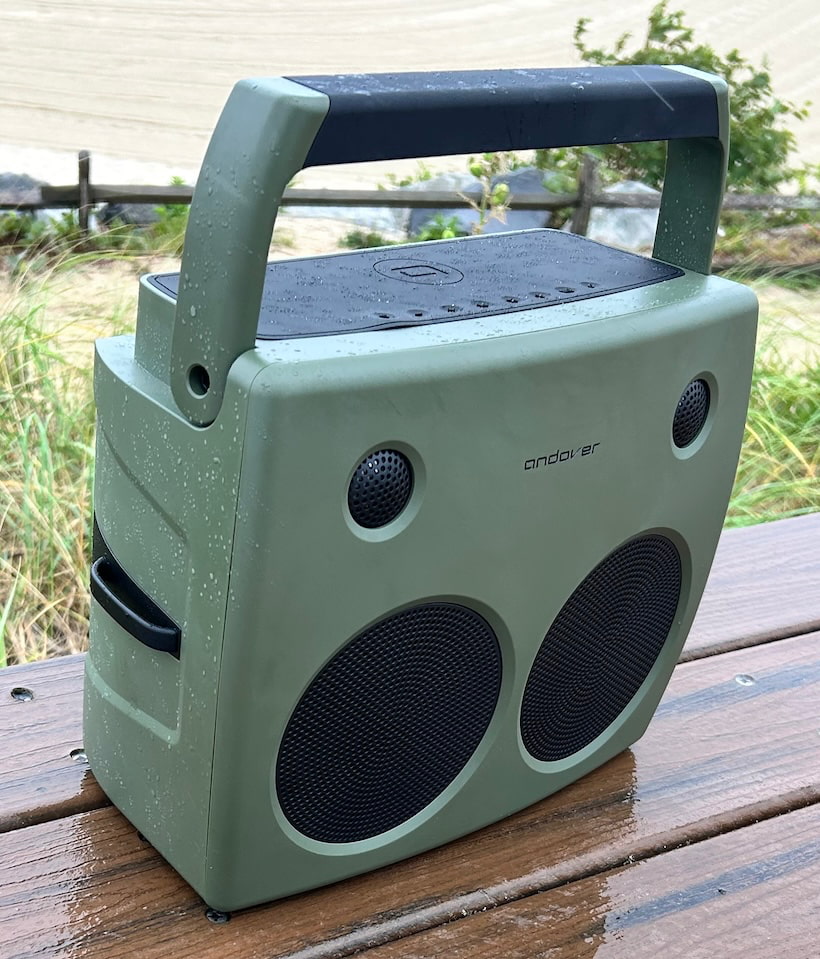
The FreePlay carries an IP67 rating for dust and water resistance. That means it is designed to keep dust and sand out and survive immersion in up to one meter of water for as long as 30 minutes, provided the rear-panel rubber cover is properly closed.
For testing purposes, I did not borrow one of my neighbors’ pools without permission. I have three possible targets, including one saltwater option, but the Long Branch Police already have enough going on during Fourth of July weekend.
Nobody wants to get picked up on Friday and spend the next two nights waiting to be processed, sleeping beside some guy who has been explaining frozen concentrated orange juice futures since Trading Places came out. I do not get paid enough for that. The cost of pizza is already too damn high.
I did take the FreePlay to the beach, left it in the sand, and let people run past it. Nobody stole it. Bennies. I threw sand at it, brought it home, and poured two glasses of water over the cabinet and controls. None of that had any impact on operation.
That is not the same as deliberately dropping it in the ocean or leaving it at the bottom of a pool while you go to the fridge for another Brio. But for sand, splashing, and the kind of weather-related stupidity a portable speaker is likely to encounter, the FreePlay handled itself without complaint.
Battery Life and Charging Are Better Than Expected
Andover claims up to 24 hours of playback at moderate listening levels, with a full recharge taking approximately three hours. Across three charge and listening cycles so far, I managed more than 23 hours each time, which is genuinely impressive for a speaker this size. I also recharged it from empty in about two hours and 45 minutes, slightly ahead of the company’s stated figure.
The top panel includes a 5W Qi-compatible wireless charging pad, while the USB-C port supports wired phone charging at up to 45W. The Qi pad worked with my mother-in-law’s Samsung phone and an older iPhone 14, although the usual caveat applies: the phone itself needs to support Qi wireless charging.
More importantly, Andover includes both a USB-C cable and an actual charger in the box. Not a sad little cable and a suggestion that you go rummage through a drawer full of obsolete power bricks. A real charger, and not one that feels like it came free with a gas-station flashlight.
One point buried in the manual is worth noting: Andover advises against listening to the FreePlay while it is charging. The company found that simultaneous charging and playback was not beneficial to the battery’s long-term performance, so its recommendation is to let the speaker recharge before putting it back into service.
That is mildly inconvenient when the party runs longer than expected, but it is a reasonable trade-off for a portable speaker capable of more than 23 hours of real-world playback per charge.
The bi-directional USB-C charging is more useful than it first appears. It lets the FreePlay function as a power source for a compatible phone, which could matter outside during an emergency, at the beach, or in a car. My Toyota does not have USB-C, and my recent iPhone upgrade has already created enough charging-related irritation. Being able to top up the phone from the FreePlay while driving is a legitimately useful feature.
Bluetooth 6.0, But No App Required
The FreePlay supports Bluetooth 6.0, including LE Audio, with LC3, AAC, and SBC codec support. LDAC and aptX HD codecs are not supported. There is also a 3.5mm auxiliary input and a microphone input for a dynamic microphone.
Andover has skipped the mandatory app route entirely. Playback, volume, track navigation, speaker linking, battery status, and Loud Mode are controlled from the top-mounted buttons. That may sound like a small thing, but it means the speaker can be handed to someone else without first making them download software, create an account, surrender their email address, and accept seventeen cookies.

Loud Mode?
The FreePlay defaults to Wide Range mode, but Andover also includes a selectable Loud Mode that adds up to 6dB of output.
There is a tradeoff: Loud Mode slightly reduces bass extension. That is a sensible approach for a portable speaker, where increased output can put greater demands on the woofers and amplifier. It gives users the option to prioritize fuller low-end response at moderate levels or greater output when competing with wind, crowds, water, or the person who insists on discussing global politics and World Cup probabilities while doing my best to not burn the kebabs and steaks on the braai.
Party Mode and the Pod People Problem
Party Mode lets you link up to 99 additional FreePlay speakers for synchronized playback. It is a useful feature, but Andover is not doing anything unique here. JBL, Klipsch, Sonos, and Brane all offer ways to expand beyond a single speaker, whether that means stereo pairing, grouped playback, or broader multi-speaker coverage.
Two FreePlays is probably sufficient for most people: one for the deck, one at the far end of the patio, or a proper stereo pair when a single cabinet is not enough.
Once you start thinking about six, twelve, or ninety-nine speakers, you are no longer planning a barbecue. You are recreating Invasion of the Body Snatchers, except the pods all have Bluetooth pairing buttons and somebody is still yelling that the Wi-Fi is too slow.
For serious outdoor coverage, Theory Audio Design and other custom-installation brands make much more sense. Their weather-resistant outdoor speakers, subwoofers, and distributed systems are designed for permanent coverage across a deck, pool area, or larger property. The obvious downside: you cannot toss them in the back of the SUV and take them to the beach.
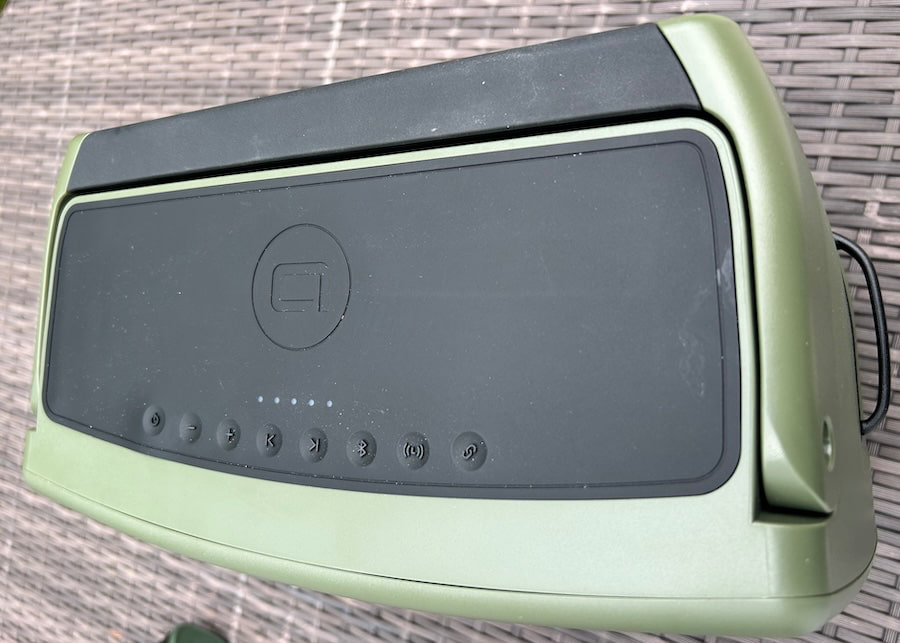
FreePlay Specifications:
- Type: Portable stereo Bluetooth speaker with passive radiator
- Drivers:
- 2 x 5.25-inch aluminum-cone woofers with neodymium magnets;
- 2 x 25mm dome tweeters with neodymium magnets
- Passive Radiator: 160mm rear-mounted passive radiator
- Frequency Response: 55Hz to 20kHz
- Bluetooth: Bluetooth 6.0 with LE Audio and Classic Bluetooth
- Supported Codecs: LC3, AAC, SBC
- Wireless Range: Up to 30 feet
- Inputs: 3.5mm auxiliary input; dynamic microphone input
- Listening Modes: Wide Range; Loud Mode adds up to 6dB, with some reduction in bass extension
- Multi-Speaker Capability: Party Mode links up to 99 additional FreePlay speakers
- Battery Life: Up to 24 hours at moderate volume
- Charge Time: Approximately 3 hours
- USB-C: Bi-directional USB-C port; up to 45W wired device charging
- Wireless Charging: Top-mounted Qi-compatible phone charging pad, 5W
- Weather Resistance: IP67 rated for dust, sand, and water; rated for immersion in up to 1 meter of water for 30 minutes
- Dimensions: 10 x 13 x 6.5 inches (H x W x D)
- Weight: 9 pounds / 4 kg
- Available Finishes: Ivory, Olive, Slate
- Included Accessories: Shoulder-strap carry bag, USB-C charging cable, and power adapter
- Warranty: One year standard; two years with online registration
Listening to the FreePlay: More Firecracker Than Backyard Sparkler
Because I am now at the age where I no longer care about offending the summer people, I began the FreePlay test in the driveway. If I have to listen to your twelve pairs of JBL outdoor speakers mounted on five-foot poles along the back of your property, you are going to have to tolerate my decidedly plebeian collection of portable outdoor speakers.
Do not feel too badly for me. A Klipsch Courtyard system with a subwoofer, or perhaps a Theory Audio Design outdoor setup, remains part of the long-term plan for our 120-by-100-foot backyard. There will be no pool. I am too cheap to pay the heating bill, and my childhood included enough near-drownings and a “clean the pool” assignment on the night of my senior prom to make that decision fairly permanent.
Driveway Fireworks, Electronic Music, and a Real Stereo Image
At 6:30 a.m., I paired my iPhone with the FreePlay, placed it on the roof of my Toyota with a towel underneath, and started the day with The Cure’s “A Forest” before heading to shul to daven. Its guitar-and-synth opening has enough drive and low-frequency pulse to expose whether a portable speaker can establish momentum without turning the entire track into a bright, compressed mess.
My driveway is roughly 15 feet wide and 70 feet long, with dense trees and hedges on the right side. The house and fencing create some reflective boundaries, although this was hardly a controlled acoustic environment. Standing beside the car, I could feel the FreePlay’s midbass and upper-bass energy, but what stood out more was the clarity and pacing. The opening retained its tension, the synth line did not blur into the guitar, and the speaker had enough control to make electronic music feel purposeful rather than merely loud.
Switching to Kraftwerk’s “Aéro Dynamik” from Tour de France and U2’s “Bad,” it became apparent that Andover has prioritized sound quality with the FreePlay over outright volume. Not that it lacks for output. It will play plenty loud before your neighbors begin checking Zillow listings.
Bass impact depended somewhat on placement, as it should with a speaker this size, but there was more than enough weight and punch when the FreePlay had a surface and boundary reinforcement working in its favor. What impressed me more was how clear, spacious, and tonally convincing the little Green Monster proved to be. Andover is based in Massachusetts, so somebody was going to make that joke eventually.
The Edge’s guitar work on “Bad” did not sound flat, gray, or needlessly sharp. There was actual body to the strings, real presence, and enough texture to keep the performance from collapsing into a bright wash of effects and echo. Kraftwerk did not suddenly acquire the wall-to-wall soundstage that my Q Acoustics 5040 speakers create in the den, because the FreePlay is still a portable speaker. But there was proper stereo separation, a legitimate sense of space, and an actual soundstage rather than the usual Bluetooth-speaker trick of throwing everything into the middle and hoping the bass distracts you.
Vocals, Piano, and Jazz Without the Usual Bluetooth Speaker Penalties
Vocals and piano were another strength. Nick Cave’s “Avalanche” and “Comancheria” from the Hell or High Watersoundtrack demonstrated genuine tonal weight through the piano. This was not high-end loudspeaker resolution, where you can follow the instrument’s full harmonic envelope and decay into the room, but it was better than any portable speaker I have tried so far.
Once the stares from the kitchen windows became somewhat obvious and Terry decided that the heat had become a personal insult, I moved indoors. Cave’s gravelly, heavy voice worked rather well with the FreePlay on the kitchen counter: clear, full of tone, and presented with enough scale to fill the room. The soundstage limitations became more apparent indoors, but the speaker never collapsed into a small, boxy presentation.
Placement mattered. Listen straight on from the counter and the FreePlay sounded full, weighty, and surprisingly impactful. Move it to the kitchen table and listen from my usual chair off to the side, however, and there was a noticeable drop in bass weight, clarity, and overall presence. The FreePlay can create a convincing stereo image from one cabinet, but it rewards sitting in front of it rather than treating it like a 360-degree party speaker.
Female and male vocals were delivered without too much compression, hardness, or that glassy upper-midrange edge that makes you reach for the volume control after two songs. Sia, Ofra Haza, Billie Holiday, and Tori Amos all benefited from decent top-end extension, with enough air and clarity to keep their voices from becoming thick or overly softened.
The FreePlay also did not attempt to rescue poor recordings by sanding off every rough edge. A hot-sounding top end remained hot. That is preferable to a speaker that tries to “fix” everything and ends up making every album sound like it was mixed under a wet blanket. More importantly, nothing sounded small. Even less-than-perfect recordings retained some scale and weight, which is a considerable plus with a portable speaker.
Sam Cooke, Johnny Cash, Jason Isbell, Dolly Parton, Glen Campbell, The Black Keys, and Gregg Allman all came across consistently well. The FreePlay did not flatter every recording into audiophile territory, but it gave vocals enough body, presence, and tonal color to make a wide range of music feel convincing rather than merely acceptable.
Finally, if the FreePlay had fallen apart with classical or jazz, it was losing a few points. We recently lost Abdullah Ibrahim, and the South African jazz legend was particularly well served here. “Barakat” and “Blue Bolero” highlighted just how clear, textured, and impactful this speaker can sound with a well-recorded piano.
I was more than a little impressed by this aspect of its performance. The FreePlay does not have the scale, resolution, or low-level delicacy of a proper pair of loudspeakers, but it did not turn Ibrahim’s piano into a thin, percussive blur either.
The Bottom Line
The Andover Audio FreePlay is not cheap at $429, but I do not think the price is out of line once you consider what is actually here: a substantial true-stereo driver array, IP67 protection, 23-plus hours of real-world battery life, phone charging, a proper auxiliary input, microphone support, a carry bag, and an actual charger in the box. Most brands throw in a USB-C cable and wish you luck.
What makes it different is not that Andover invented the portable Bluetooth speaker. It did not. The FreePlay’s appeal is that it approaches the category like a compact Hi-Fi product that happens to be portable, rather than a louder pool toy with a Bluetooth chip and an aggressive amount of silicone.
There are tradeoffs. It is not pocketable, it is not an all-purpose 360-degree party speaker, and the off-axis performance makes placement matter more than it does with some rivals. Andover also does not publish a power rating, and listeners looking for Wi-Fi streaming, an app-driven EQ suite, or a broad proprietary multiroom ecosystem will need to look elsewhere.
But for someone who wants one rugged portable speaker that can handle a kitchen counter, backyard barbecue, driveway test at 6:30 a.m., or a trip to the beach without sacrificing actual musicality, the FreePlay is a very compelling first effort. Save the shoot-out for the comparison, but the price is justified by the feature set and, more importantly, the performance.
Pros:
- True stereo presentation with unusually strong clarity, tonal weight, and bass for a portable speaker
- Excellent battery performance, with more than 23 hours achieved during testing
- IP67-rated cabinet, useful carry design, included bag, USB-C cable, and proper power adapter
- Useful extras including Qi phone charging, bi-directional USB-C charging, auxiliary input, and microphone support
Cons:
- $429 is a meaningful investment for a portable Bluetooth speaker
- Off-axis listening loses some bass weight, clarity, and overall impact
- No Wi-Fi streaming, app-based EQ, or broader multiroom ecosystem
- Andover advises against listening while charging to protect long-term battery health
Our Ratings
★★★★★★★★★★ Sound Quality
★★★★★★★★★★ Build Quality
★★★★★★★★★★ Features
★★★★★★★★★★ Durability
★★★★★★★★★★ Overall
Where to buy:
Related Reading:












John Oliver
July 10, 2026 at 4:46 am
Very excellent writing and a substantial review. I did notice in the included pictures, that the rubber seal next to the power button seemed to be either coming up or loose fitting. Can you comment on that at all? I do realize this was a preproduction model, but was concerned with consistent craftsmanship and build quality when I noticed that. Ordered mine today so we will see.
Ian White
July 10, 2026 at 10:24 am
John,
Let me take a look again at it. I was cleaning my garage all day and it was on the roof of my car in the rain and I abused it somewhat. Looks fine on mine now that I’ve inspected it.
IW