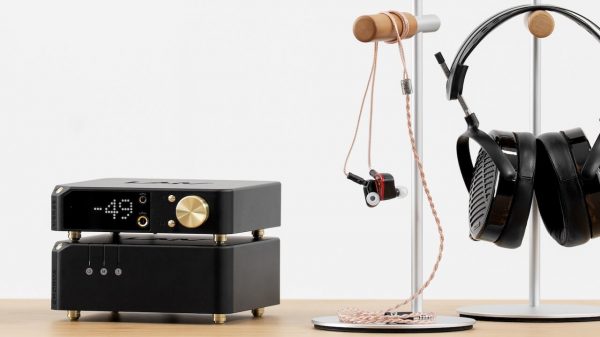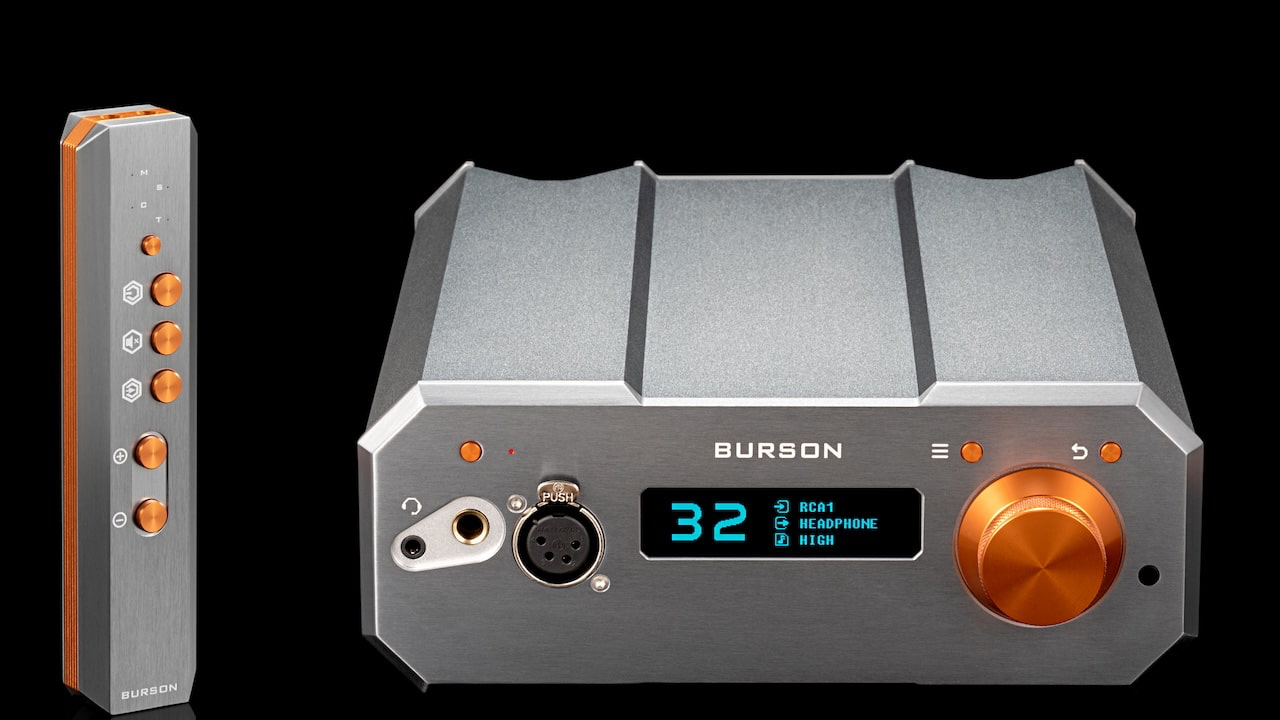
Burson Audio has spent nearly two decades building some of the most powerful and flexible desktop headphone amplifiers in the personal audio space. With the new Soloist Stellar, the Australian manufacturer is focusing on something that many desktop amplifiers still struggle to balance: delivering enough Class A power for demanding full size headphones while also providing the low noise precision required for modern wired in-ear monitors. And in case you might have missed it — wired IEMs are having a bit of a moment.
Priced at $1,500 for the Standard version, the Soloist Stellar is a pure headphone amplifier and preamplifier with no onboard DAC. That design choice is deliberate. Many headphone enthusiasts already own a DAC they prefer, and separating the amplification stage allows Burson to concentrate entirely on clean power delivery, ultra low noise operation, and flexible connectivity for a wide range of headphone and desktop systems.
The Soloist Stellar continues Burson’s long running approach of fully discrete Class A amplification, powered by the company’s Max Current power supply architecture and supported by Silent Power modules for lower electrical noise. The amplifier is rated at up to 8 watts of Class A output, which places it firmly in the category of desktop amplifiers capable of driving everything from efficient dynamic headphones to more demanding planar magnetic designs.
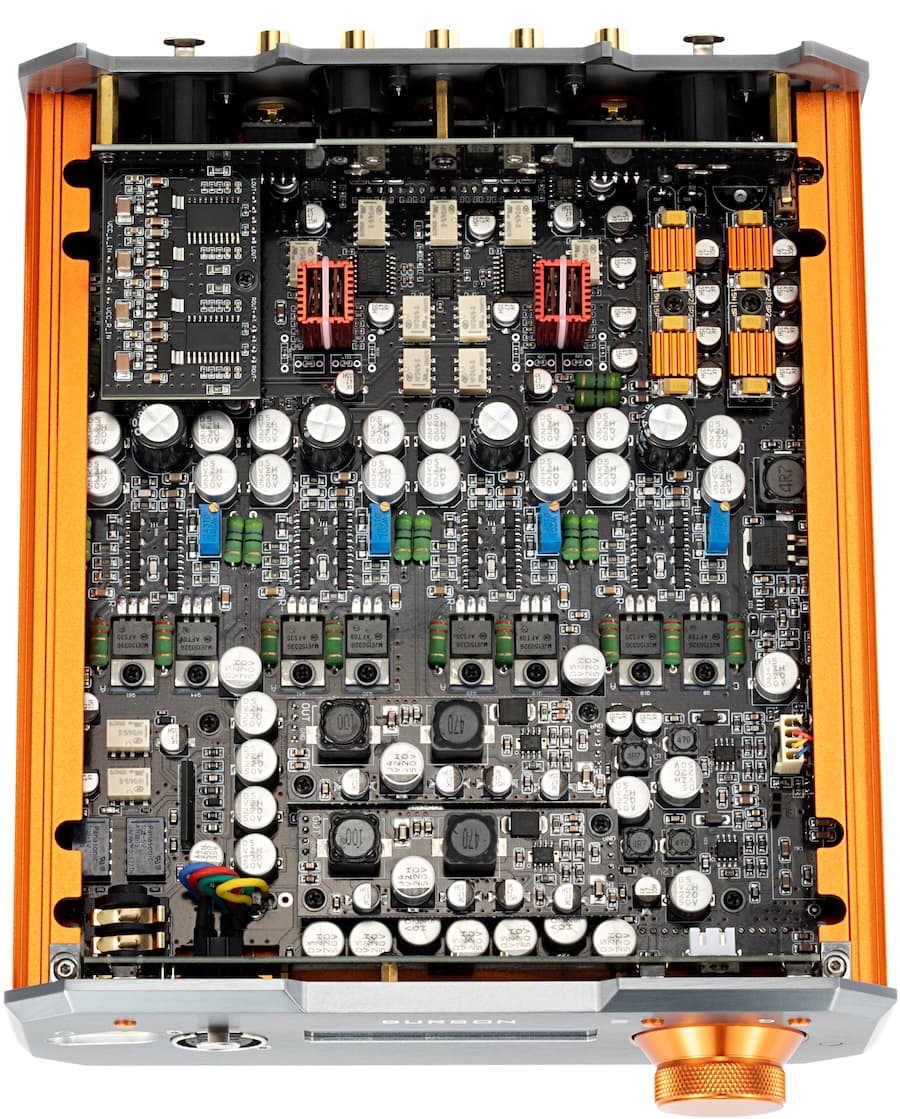
But the real story with the Soloist Stellar is how Burson is addressing the different requirements of wired IEM listeners. Sensitive in ear monitors often reveal noise and gain issues that remain hidden with full size headphones. To address this, Burson added a dedicated IEM amplification module built around dual TPA6120A2 amplifier chips. These chips are known for extremely low distortion—around 0.00014 percent THD+N—along with a very high 1300 V per microsecond slew rate and wide bandwidth. The goal is simple: maintain a pitch black background and precise micro detail even when using highly sensitive earphones.

Volume control is handled by a dual PGA2320 analog resistor ladder system, which allows for extremely accurate channel matching and low distortion. Unlike traditional potentiometers or digital attenuation systems, this approach maintains full signal resolution even at lower listening levels. That matters particularly for IEM listeners who often operate in the lower range of an amplifier’s volume control.
Burson also allows users to fine tune the amplifier through swappable dual op amp stages. Owners can experiment with Burson’s V7 Vivid or V7 Classic op amps, or even compatible third party options, depending on their preferred tonal balance. The Standard version is designed as the starting point for those who enjoy upgrading, while the Deluxe version includes V7 Vivid Pro op amps, Silent Power Level 2 modules, the Super Charger 5A power supply, and a remote control.
For users who want to push the amplifier even further, Burson also offers the Fusion Core upgrade, a GaN based power supply capable of delivering up to 360 watts of ultra low noise DC power to the amplifier stage.
What the Soloist Stellar Offers
From a system integration standpoint, the Burson Audio Soloist Stellar is designed to function as both a high performance headphone amplifier and a desktop preamplifier.
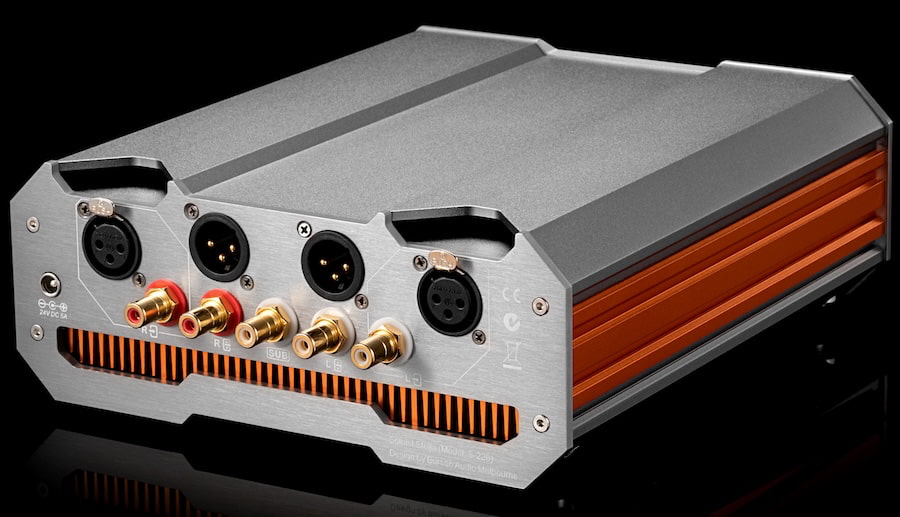
It accepts balanced XLR and single ended RCA inputs, along with a microphone bypass input designed for gaming headsets. Output connections include balanced XLR and single ended RCA preamp outputs, plus a dedicated mono subwoofer output for integration into desktop speaker systems.
For headphone users, Burson provides three connection options: balanced XLR, 6.35 mm single ended, and 3.5 mm outputs. The amplifier also separates its gain and output structure into high power, medium power, and dedicated IEM modes, giving users more flexibility when switching between different types of headphones.
This approach reflects the reality of modern personal audio systems. A listener might move between high impedance dynamic headphones, planar magnetics, and sensitive IEMs in the same setup, each of which places very different demands on the amplifier.
Unlimited Power?
Burson specifies the Soloist Stellar with an input impedance of 40 kΩ, making it compatible with a wide range of DACs and source components. Frequency response is listed at ±1 dB from 0 to 55 kHz, while total harmonic distortion is rated at below 0.0015%.
Channel separation is particularly strong, with 143 dB at 1 kHz and 138 dB at 20 kHz, and the amplifier’s THD+N is specified at 0.0005% at 1 kHz at full scale. Signal to noise ratio varies depending on output mode, reaching 120 dB in the dedicated IEM output stage, which is one of the key areas where the design aims to serve sensitive in ear monitors.
Output impedance is kept very low at 0.5 ohms for the headphone amplifier, helping maintain good damping and compatibility across different headphone loads. The preamp outputs are rated at 1 ohm and 20 ohms, depending on the output stage being used.
Power output scales depending on the headphone impedance and output mode. At 16 ohms, the amplifier can deliver up to 8 watts balanced or 4 watts single ended in its high output mode. At 32 ohms, output drops slightly to 5 watts balanced and 2.5 watts single ended. Even at 300 ohms, the Burson Audio Soloist Stellar can still produce 500 milliwatts balanced or 260 milliwatts single ended, which is enough to drive many high impedance headphones.
The medium and IEM modes reduce output accordingly to maintain lower noise and better control with sensitive earphones.
Physically, the Soloist Stellar measures 210 × 200 × 75 mm (8.3 × 7.9 × 2.9 inches) and weighs about 5 kilograms (11 pounds). That mass reflects the thermal and power demands of a compact Class A amplifier, which runs hotter by design than most desktop headphone amps. In our experience with Burson’s previous models, adequate ventilation is essential, as these amplifiers can run noticeably warm during extended listening sessions.
The Bottom Line
Unlike the Conductor Stellar, which combines a DAC, headphone amplifier, and preamp into a single desktop hub, the Burson Audio Soloist Stellar is focused entirely on pure amplification. There’s no DAC inside, which allows Burson to dedicate the design to delivering high current Class A power, extremely low noise performance, and greater flexibility for users who already own a DAC they like.
What makes the Soloist Stellar stand out is how it balances two very different needs. It offers up to 8 watts of Class A power for demanding full size headphones, while also including a dedicated low noise IEM amplification stagedesigned to avoid hiss and preserve fine detail with highly sensitive earphones. That combination is still surprisingly rare in desktop headphone amplifiers.
The Burson Audio Soloist Stellar is aimed at headphone enthusiasts who want a powerful standalone amplifier that can anchor a serious desktop system, especially those who rotate between full size headphones and wired IEMs. Add in the ability to swap op amps and upgrade the power supply, and it becomes a platform that can evolve over time rather than something that needs replacing when the rest of the system changes.
Where to buy:
For more information: bursonaudio.com
Related Reading:
- Burson Audio Conductor GT4 Review: Desktop DAC/Amp Muscle With Audiophile Finesse
- Best DAC/Amps For Headphones: Editors’ Choice 2025
- Best In Show At CanJam NYC 2026: The Headphones, DACs, Amps, And IEMs Everyone Was Fighting To Hear
- Are Wired IEMs Having A Moment? CanJam NYC 2026 Suggests The Answer Might Be Yes