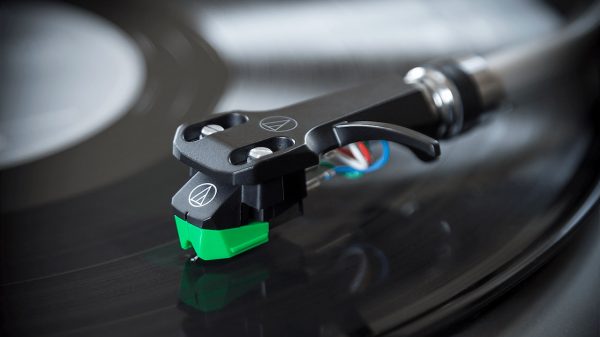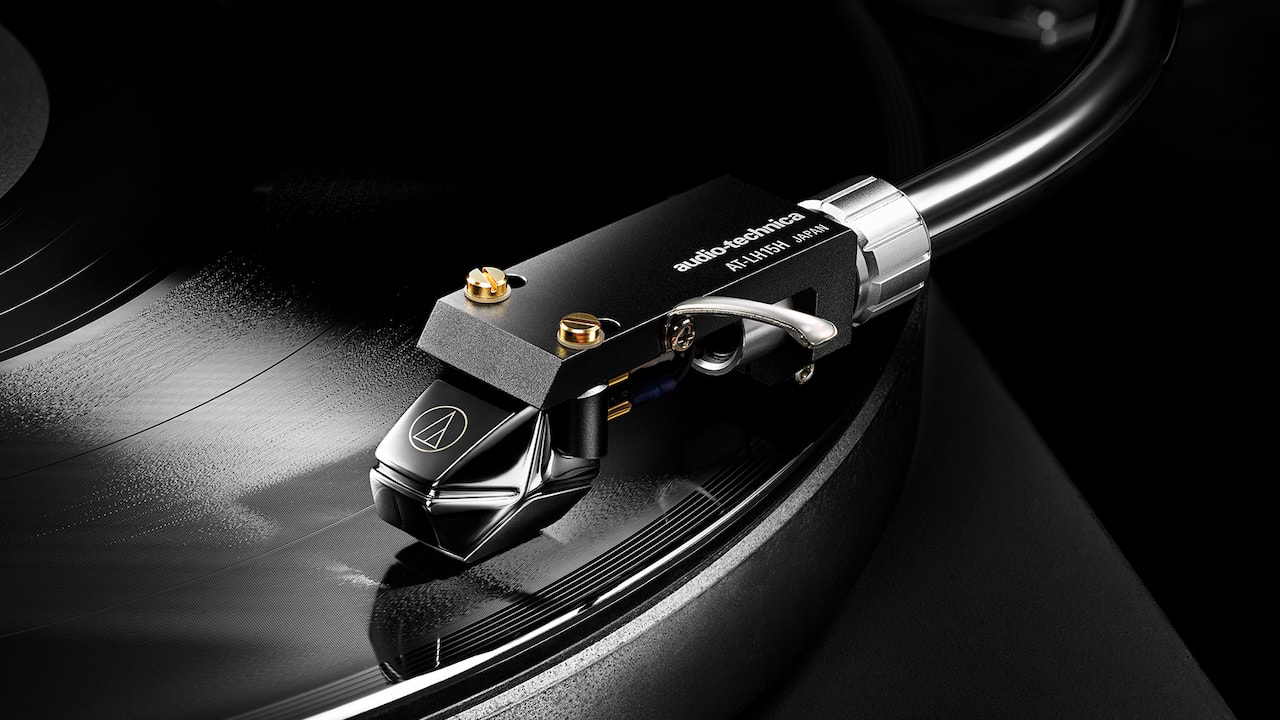
Audio-Technica has introduced the AT-MCD1 Dual Moving Coil Stereo Cartridge, a new flagship moving coil cartridge that the company is calling the finest phono cartridge it has ever produced. At $11,000, it should be. That kind of money buys a lot of records — even in 2026, when some Discogs sellers think a clean Blue Note reissue requires a notarized letter from your banker. Or your mother, depending on whether your weekly social calendar still consists of walking to the local record store, correcting strangers about deadwax, and pretending that $175 for a reissue with “light sleeve scuffing” is perfectly normal adult behavior.
The AT-MCD1 is not another affordable cartridge aimed at entry-level turntables, and that distinction matters. Audio-Technica may be one of the most important brands in affordable vinyl playback, but the Japanese manufacturer has never been only that. The company began in 1962 as a cartridge manufacturer, and its upper-tier analog products have been pushing well beyond the “starter table” aisle for years. The $2,900 AT-ART20 and the $9,999 Hotaru turntable already made that clear. The AT-MCD1 just removes any remaining doubt with a very sharp diamond chisel.
AT-MCD1: Audio-Technica’s Most Ambitious Moving Coil Cartridge Yet
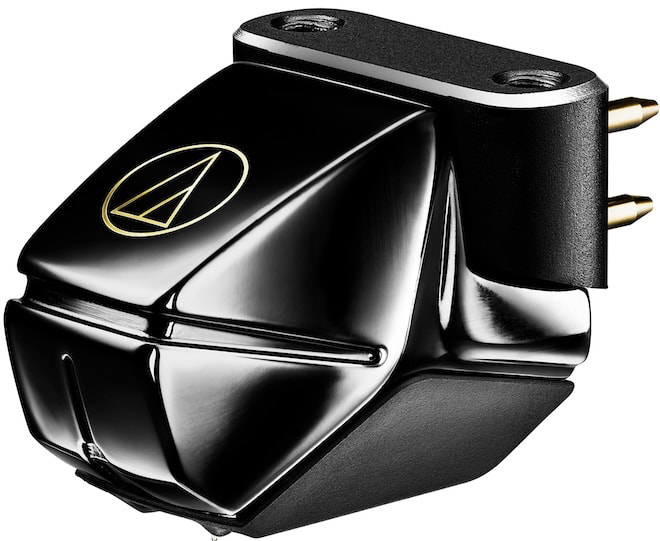
The headline feature is the AT-MCD1’s unified diamond stylus and cantilever. Rather than bonding a diamond tip to a separate cantilever, Audio-Technica forms both from a single lab-grown diamond. That matters because the stylus and cantilever are the first mechanical link in the playback chain. Any added joint, adhesive, mass, or material transition can affect how groove information is transmitted before it ever reaches the generator.
Audio-Technica says the AT-MCD1’s 0.22 mm-square cantilever is produced using a CVD, or chemical vapor deposition, process for precision and consistency. The cartridge also uses a newly developed Shibata stylus with a smaller minor radius than previous shapes, specified at r2.7 x R0.08. The goal is more accurate groove tracing and more direct transmission of extremely small mechanical vibrations.
That is the engineering story here. A cartridge lives or dies by how accurately it turns motion into signal, and Audio-Technica is betting that a seamless lab-grown diamond stylus/cantilever structure gives the AT-MCD1 a cleaner path from groove wall to coil.
The AT-MCD1 uses Audio-Technica’s dual moving coil architecture, a design long associated with the brand’s better MC cartridges. The company says the layout is intended to improve channel separation and preserve wide frequency response. PCOCC copper coils and a powerful magnetic circuit are used to increase signal transfer efficiency and output voltage.
The body construction is also far from basic. Audio-Technica uses a multilayer structure consisting of an aluminum base, titanium housing, and elastomer undercover. That combination is designed to control unwanted resonance without turning the cartridge into a dead little brick. Cartridge bodies are not decorative real estate; they shape how energy is managed after the stylus enters the groove. Get that wrong and your $11,000 cartridge becomes a very small, very expensive lie detector.
AT-MCD1 Specifications
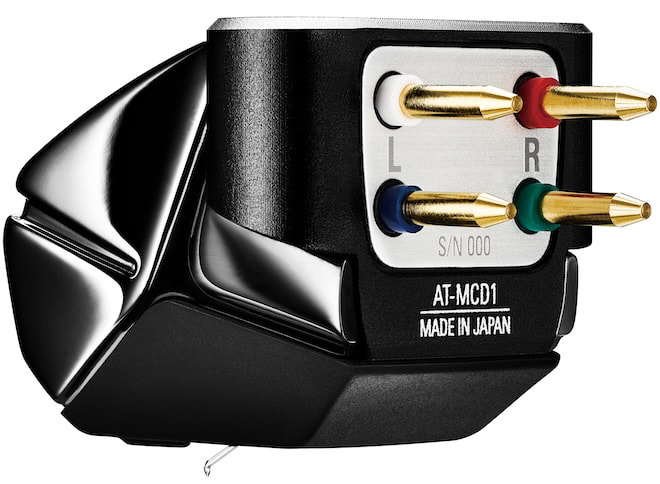
The AT-MCD1 is a low-output moving coil cartridge, but its 0.55 mV output is relatively healthy for the category and should make matching with high-quality MC phono stages less punishing than some ultra-low-output designs. Audio-Technica specifies a recommended load impedance of 100 ohms or higher, which gives users some flexibility depending on the phono stage, system balance, and desired tonal presentation.
The 20 Hz to 50,000 Hz frequency response is wider than any record collection actually needs on paper, but it does suggest that Audio-Technica is chasing bandwidth, speed, and low mechanical loss rather than a warm, syrupy presentation designed to flatter tired pressings. Channel separation is rated at 28 dB at 1 kHz, with output balance held to 0.5 dB, both of which point to careful generator alignment and channel consistency.
The stylus assembly is the real story. The AT-MCD1 uses an integrated Shibata stylus and 0.22 mm square diamond cantilever, formed as a unified structure rather than a separate stylus bonded to another cantilever material. That should reduce mechanical loss at the point where groove movement becomes signal — which is exactly where an $11,000 cartridge has to prove it is more than expensive jewelry for men with record clamps.
Tracking force is specified from 1.7 to 1.9 grams, with 1.8 grams as the standard setting. The vertical tracking angle is 20 degrees, and the 9.5-gram cartridge weight should make the AT-MCD1 compatible with a wide range of serious tonearms, though final matching will still depend on effective mass and the arm’s ability to handle the cartridge’s compliance and energy behavior.
The published dynamic compliance is 15 × 10⁻⁶ cm/dyne at 100 Hz, which is typical of Japanese cartridge specifications. Users comparing it with Western cartridge compliance figures should remember that 100 Hz compliance does not translate directly to the more commonly referenced 10 Hz figure. In plain English: do the tonearm math before bolting this thing onto whatever arm happens to be sitting on your plinth.
Key Specifications
- Type: Dual moving coil stereo cartridge
- Frequency response: 20 Hz to 50,000 Hz
- Output voltage: 0.55 mV at 1 kHz, 5 cm/sec
- Channel separation: 28 dB at 1 kHz
- Output balance: 0.5 dB at 1 kHz
- Recommended load impedance: 100 ohms or higher with head amplifier connected
- Coil impedance: 12 ohms at 1 kHz
- DC resistance: 12 ohms
- Coil inductance: 25 μH at 1 kHz
- Stylus shape: Shibata, integrated cantilever type
- Stylus curvature radius: 2.7 × 0.08 mil
- Cantilever: 0.22 mm square diamond
- Vertical tracking angle: 20 degrees
- Tracking force: 1.7 to 1.9 grams; 1.8 grams standard
- Static compliance: 21 × 10⁻⁶ cm/dyne
- Dynamic compliance: 15 × 10⁻⁶ cm/dyne at 100 Hz
- Threaded holes: M2.6 × 2
- Dimensions: 17.3 mm × 17.7 mm × 26.7 mm
- Weight: 9.5 grams
- Included accessories: Non-magnetic screwdriver, brush, washers, M2.6 cartridge installation screws, protector, and wooden case
Audio-Technica Is Not Just the Budget Cartridge Brand
A lot of listeners know Audio-Technica through affordable MM cartridges and turntables, and that is fair. The company has helped more people get into vinyl playback than most high-end brands would ever admit in public.
But that is not the whole story.
The AT-ART20, introduced at $2,900, already placed Audio-Technica in direct conversation with premium MC cartridge makers such as Lyra, Hana, and Koetsu. That cartridge used a titanium and aluminum body structure, an elastomer undercover, dual moving coils, and a nude special line-contact stylus with a solid boron cantilever. It was not a budget cartridge wearing a nicer suit.
Then came the Hotaru, a $9,999 floating turntable with a levitating platter, built-in lighting system, and limited production run. The Hotaru was strange, expensive, and very Audio-Technica in the sense that it mixed engineering ambition with a concept that felt like it wandered in from a Ridley Scott prop department.
The AT-MCD1 is different. It is more focused. No light show. No floating platter. No “look at me” industrial design circus. Just a flagship moving coil cartridge built around a unified diamond stylus/cantilever and a very high price.
The Bottom Line
The Audio-Technica AT-MCD1 Dual Moving Coil Stereo Cartridge will be available June 4, 2026, through selected specialist retailers for $11,000.
At that price, the AT-MCD1 is not competing with the company’s mainstream VM cartridges or even most of its ART Series lineup. It is aimed at owners of reference-level turntables, tonearms, phono stages, and record collections where the cartridge is expected to retrieve more information from the grooves and, ideally, make you see G-d. Or Elvis. Depends on the pressing, the system, and how much cocaine you had before cueing up side two.
The open question is whether the AT-MCD1 can justify the leap from Audio-Technica’s already strong high-end cartridges into true statement territory. The unified diamond stylus/cantilever is technically significant. The body construction looks purposeful. The dual moving coil architecture has deep Audio-Technica roots.
Now it has to play records better than anything the company has made before.
For $11,000, it had better.
Price & Availability
The Audio-Technica AT-MCD1 Dual Moving Coil Stereo Cartridge will be available June 4, 2026, through selected specialist retailers for $11,000.
For more information: audio-technica.com
Related Reading:
- Audio-Technica’s $108,000 Tube Headphone Amplifier Must Be Heard At CanJam NYC 2024
- Audio-Technica Fires Back At Ortofon With New AT33x Phono Cartridge Range — Handcrafted In Japan With Stereo And Mono Versions
- Audio-Technica’s 60th Anniversary AT-LP2022 Turntable Redefines “Transparency”
- Audio-Technica’s $9,999 Hotaru Turntable: A Floating, Glowing Sci-Fi Dream Straight Out Of Blade Runner