

Audio Note (UK) has never been the sort of high end audio brand that follows trends. While much of the industry chases new features, streaming platforms, or the latest amplifier topology, Audio Note has spent decades doing the opposite. The British manufacturer designs and builds a remarkable amount of its own parts in-house, from transformers and capacitors to cables, tonearms, cartridges, and even loudspeakers intended to sit in room corners rather than dominate the center of the floor. Their systems rarely rely on brute force volume or flashy demonstrations at trade shows. Instead, they pursue a very specific idea of musical realism and they have never shown much concern about whether the rest of the industry agrees.

That stubborn independence is part of why the Audio Note Oto has endured for more than three decades. First introduced in 1991 and conceived by founder Peter Qvortrup with engineering by Andy Grove, the Oto was the first amplifier fully developed and manufactured by Audio Note (UK). At the time, the company was already known for the legendary Ongaku integrated amplifier, but the Oto proved that the same philosophy of vacuum tube refinement and musical coherence could be delivered at a far more attainable level. Thirty five years later, the amplifier remains a cornerstone of the company’s lineup.

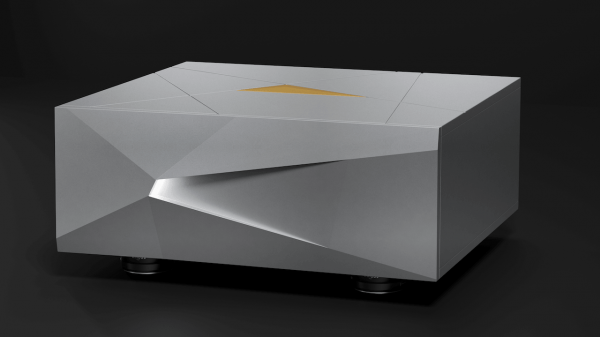
Now Audio Note (UK) has introduced the Oto SE 35 Integrated Amplifier, the first major technical revision of the design in decades. The anniversary model features a redesigned power supply and a number of bespoke in house components, continuing the company’s long standing belief that the path to better sound starts with controlling every part of the signal chain.
My own history with the brand goes back a long way. One of the strangest and most memorable listening sessions of my life happened in the basement of a Milan hotel during the Top Audio/Video Show in 1999. Late one night, Peter Qvortrup invited a small group of us down to hear one of their reference systems. Alongside me were SoundStage founder Doug Schneider, who I was writing for at the time, and Enjoy the Music’s Steven Rochlin, who somehow has remained my friend for nearly three decades and even attended my first wedding.
The room felt like something out of a Stanley Kubrick film, which became even more surreal when Qvortrup started playing music from the Eyes Wide Shut soundtrack. Kubrick probably would have appreciated the strange atmosphere. What I remember most, however, was the sound of the piano. It was uncannily real. The kind of moment that stays with you long after the show floor noise fades.
I ended up buying a pair of Audio Note entry level components not long after that trip and kept them for years. But like a lot of people who have spent time around the brand, there was always one amplifier I quietly coveted: the Oto.

Audio Note Oto SE 35: A Single Ended Tube Classic Reimagined
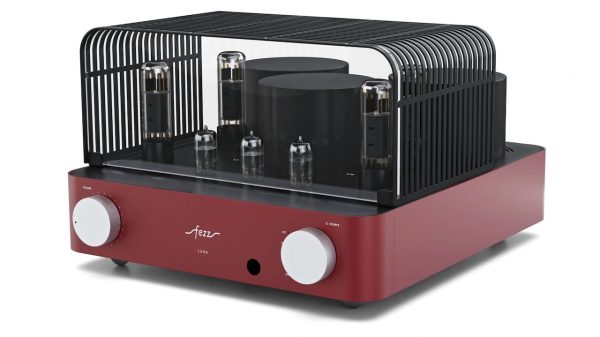
The Audio Note Oto SE 35 (starting at $5,950 USD) continues a design philosophy that has remained largely unchanged since the early 1990s, when single ended amplifiers were still considered something of an outlier in the broader hi fi landscape. The new anniversary model is a Class A, parallel single ended pentode design built around EL84 output valves, and it represents the first major technical refresh of the Oto SE platform in decades.
Introduced in February 2026, the Oto SE 35 sits within a wider family of Audio Note integrated amplifiers that includes multiple configurations and component levels, ranging from the P1 SE and P1 SE Signature to the OTO Line SE, OTO Line SE Signature, OTO Line SE Silver Signature, OTO Phono SE, OTO Phono SE Signature, and OTO Phono SE Silver Signature.

For Audio Note founder Peter Qvortrup, the amplifier represents a continuation of a design challenge first set more than three decades ago. “When I set Andy the challenge to design a single ended pentode version of the Oto in the early 90s, single ended amps were a big outlier,” Qvortrup explains. “The Oto and now the Oto SE 35 stand as a testament to our philosophy on timeless quality audio design. We still maintain and service our customers’ Oto’s, making sure they’re good for years to come. This is what true longevity looks like, and that will never change.”
Andy Grove Explains the Oto SE 35 Redesign
Design breakthroughs in hi-fi don’t always arrive after months of simulations and late night engineering marathons. Sometimes the circuit simply clicks into place. That was largely the case when Audio Note Chief Designer Andy Grove first developed the original single ended pentode version of the Oto in the early 1990s.

Grove recalls that the design process for the P1 SE and Oto SE power amplifier section came together surprisingly quickly. Instead of weeks of modeling or experimentation, the work relied mostly on careful calculations and a close reading of valve data sheets to establish the correct operating points and speaker damping characteristics. Like many creative disciplines—architecture, composition, or songwriting—there are moments when a design simply feels right.
He still remembers sketching out the concept in 1991 at the kitchen table in his parents’ home in Suffolk, where his workshop was located at the time. The prototype itself was later built with the help of engineer Claus Molgaard, who was working with Audio Note at the time. Despite limited time to assemble the first unit, the team managed to get the amplifier operational quickly and demo it in the listening room soon afterward. For Grove, it was a nerve wracking moment, but the results proved immediately encouraging.
Over the decades that followed, the Oto SE evolved gradually, with small refinements along the way. A recent special order request from a customer ultimately prompted Grove to revisit the design in a more comprehensive way. The result is the Oto SE 35, which receives a number of meaningful updates intended to bring the amplifier closer to the performance levels of more recent Audio Note designs such as the Meishu.
One of the most significant changes is a new output transformer designed specifically for the Oto SE and wound in house. While not as physically massive as the transformer used in the Meishu Tonmeister, it is engineered to deliver improved low frequency authority and overall control. The power supply has also been redesigned, now incorporating a choke that is likewise designed and manufactured internally by Audio Note. According to Grove, the updated power supply features optimized time constants and several additional tweaks to the power amplifier board itself.
Taken together, these changes are intended to give the amplifier a more convincing sense of weight and impact in the low end. Grove describes the goal as achieving a realistic “bass kick”—the kind of physical presence you feel when hearing a kick drum or bass guitar in a live performance—rather than the overly damped and flattened bass character sometimes associated with transistor designs.
The phono stage has also been redesigned, with increased sensitivity. Combined with the new power supply board, this allows Audio Note to eliminate the line stage that was previously required in earlier phono versions of the amplifier. The change improves phase integrity while also reducing noise.
Additional refinements include a revised internal wiring loom and improved shielding, along with a new in house designed mains transformer that contributes to improvements across the amplifier’s performance envelope. Grove notes that while the Oto SE 35 may not quite reach the performance ceiling of the company’s Meishu Tonmeister, it offers a level of authority and musical engagement that should surprise listeners accustomed to EL84 based designs.
In Grove’s words, the amplifier is not merely about delicate detail or midrange sweetness. It remains an all-round musical and easy to live with amplifier, but one that can deliver a serious sense of drive and attitude when the recording demands it.
From a technical standpoint, the Oto SE 35 delivers 8.2 watts per channel into 8 ohms at 5% THD measured at 1 kHz. Line input sensitivity is rated at 205 millivolts for 8 watts into 8 ohms, while the phono stage requires 2mV for the same output level. Phono hum and noise performance is specified at -100 dB A weighted referenced to 8 volts, indicating extremely low background noise for a valve based design.

The standard Oto SE 35 uses four EL84 output valves and two ECC83 driver valves, while the Signature and Silver Signature versions substitute two E83CC valves in the driver stage. Models equipped with the integrated phono section add ECC83/7025 and 6DJ8 valves to handle the phono amplification duties.
In terms of physical presence, the Oto SE 35 remains a relatively compact integrated amplifier by high end tube standards, though its build quality and transformer mass still give it substantial heft. The unit measures 140 mm (5.5 inches) high, 440 mm (17.3 inches) wide, and 410 mm (16.1 inches) deep, and weighs in at 17 kilograms (about 37.5 pounds), reflecting the heavy transformers and robust internal construction typical of Audio Note designs.
Connectivity is straightforward and very much in keeping with the company’s minimalist philosophy. The amplifier provides five inputs in total, including multiple line level connections and a dedicated Tape In, along with a Tape Outfor recording or integration with external devices. For loudspeaker connections, Audio Note includes separate binding posts for both 4 ohm and 8 ohm speaker loads, allowing the amplifier to be matched more effectively with a wide range of loudspeakers.
For Grove, the anniversary timing feels fitting. As he puts it, being 35 years old was a good age, and the Oto SE appears to be enjoying it just as much.

The Bottom Line
With just 8 watts per channel, the Audio Note Oto SE 35 isn’t about brute force. Pair it with the right high sensitivity loudspeakers, however, and that modest output can deliver a surprising level of intensity and presence. Audio Note has long excelled at getting tone, timing, and the natural flow of music right, which means the amplifier can feel alive even at lower listening levels.
If you’re heading to AXPONA 2026, the Oto SE 35 will be available to hear in person. I can’t speak for everyone else, but after spending time with Audio Note gear over the years, I’m damn excited to hear it again.
For more information: audionote.co.uk/oto-se
Related Reading:
- AXPONA 2026 Preview: New Hi-Fi Product Launches From Goldmund, SVS, Magico, Audio Note And More
- Audio Note Is Killing You Softly: T.H.E. Show 2023
- Best Integrated Amplifiers: Editors’ Choice




















Anton the Cheap
March 13, 2026 at 5:23 pm
I’ve only had limited experience with Audio Note and while their approach at the show didn’t feel as intimidating as other rooms, the prices were slightly bizarre.
Is there a big difference between the stock version for $6,000 and the more expensive ones with more exotic parts?
My gut tells me that the base model is 90% of the way there for a lot less.
8 watts is not a lot but I suppose their customers go for high sensitivity speakers and don’t blast it.
Ian White
March 13, 2026 at 9:19 pm
Anton,
So Audio Note has multiple tiers for their lines. The “upgrades” are because of the parts. They use different quality transformers, resistors, capacitors, and other components which Audio Note manufactures itself. The speakers were not their original design but something they licensed going back 30+ years ago. Same deal with the speakers in regard to the parts but the value once you get past the second tier is iffy in my experience.
Based on my ownership experience of two of their products over the years (1998 to 2003), they sounded great, always worked, and I sold them without losing a penny. I regret selling the DAC.
As to the Oto SE 35, my thought process would be that the stock unit is likely to sound really good and that the second tier will sound better but not worth dropping an additional $5,000 on if that’s the price. The power thing is misleading because I’ve heard Audio Note amps drive the living hell out of some 90dB speakers that never fell below 6 ohms and the experience was rather special. These are not detail monsters. They do inner detail well but it’s not a very analytical sounding system.
IW