

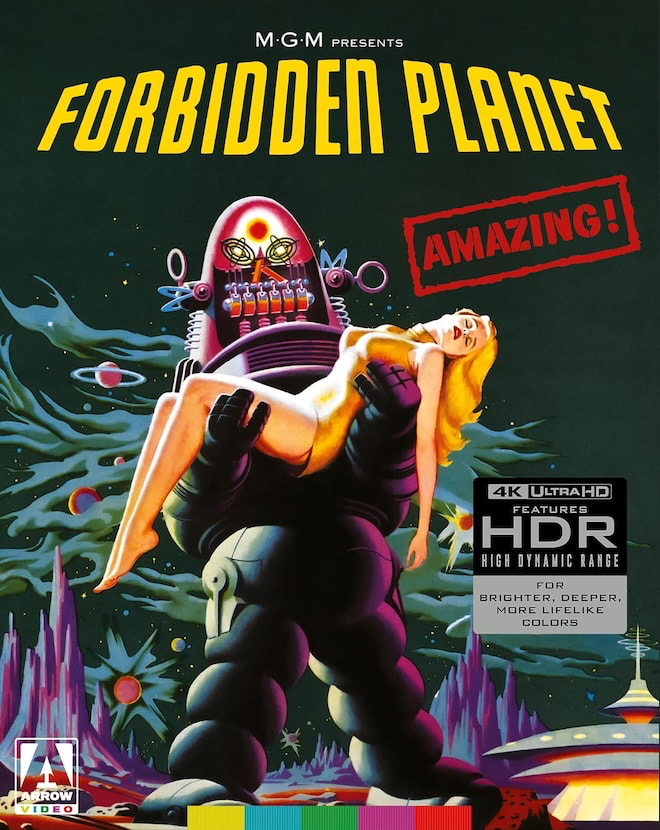
While not the first big-price-tag science fiction film to come out of Hollywood, 1956’s Forbidden Planet certainly shook up the world of fantasy filmmaking. Set on the alien planet of Altair IV, the story is based on William Shakespeare’s The Tempest, where a reclusive scientist, his naïve daughter, a mechanical servant, and a mysterious monster mirror the play’s core characters and dynamics. Upping the ante were the thrilling possibilities of the faster-than-light C-57D saucer, arriving to search for survivors of a mining crew dispatched some 20 years prior. What they find are the remnants of a long-lost native civilization, advanced beyond the dreams of mankind but wiped out for reasons no one yet understands. Their technology is still very much operational, however, unleashing a force that puts everyone in grave danger.
It’s hard not to view Forbidden Planet through a modern lens, largely because we’ve spent the past 70 years evolving past the tropes that this movie established so indelibly. There’s nothing “B-movie” about the concept or execution; it was made on a then astronomical budget (see what I did there?) of $2M, the first time a major studio poured prestige level dough into a space adventure. Robby the Robot alone cost a reported $125,000! The production values shine in the elaborate sets (it wasn’t shot on location on Altair IV) and the special effects, a dazzling combination of miniatures, matte paintings, animation, and practical trickery. The intense acting, unserious character interplay, and “romance” will no doubt play as corny to first timers, but we also explore some intelligent themes, including the darkness of the mind and the folly of so-called genius, and it’s all quite a bit of G-rated fun.
A new restoration was undertaken by Arrow Films from the original camera negative and is presented here at the full 2.55:1 aspect ratio, with Dolby Vision high dynamic range. That extra bit of width comes courtesy of early magnetic track CinemaScope, shortly before the industry switched to optical audio film prints, which would take a bite out of the frame’s real estate. This is, in fact, the first time that Forbidden Planet has ever been released on home media in its proper CinemaScope ratio. The enticing Eastman Color palette was no doubt intended to lure audiences off their sofas and into the theaters, rife with blue eyes and green skies. Shadows are natural and nuanced, and the grain is maintained but not distracting.
The restored lossless original mono is the default audio, followed by “Perspecta” stereo and a modern 5.1 channel option. Perspecta deserves a shoutout for its obscure and unusual approach, essentially moving the mono soundtrack between the left, center, and right front channels to enhance the experience in a crafty, if slightly disingenuous, manner. While the clarity and fidelity of the mono are excellent throughout, Perspecta is undeniably bigger, wider, and more engaging, whereas the restrained 5.1 remix offers a bit of appreciable separation and resonance. The events are set to Bebe and Louis Barron’s entirely electronic score, revolutionary (and controversial) at the time, and honestly, I found it difficult to distinguish between the “music” and the sound effects.
The sole bonus on the movie disc is a new historian commentary track, and the second platter is an extras only HD Blu-ray. The complex, fascinating Robby the Robot so captivated moviegoers that he returned for The Invisible Boy (1957), as well as an episode of the Thin Man TV series, both included here. There are also archival featurettes, promotional clips, more than ten minutes of deleted scenes, outtakes and test footage, a new appreciation of the Barrons’ contribution, plus a broad hour long TCM documentary from 2005 about the genre in the ’50s, much of this content in SD quality. The screenplay is also supplied as a series of still frames for us to flip through. The discs arrive in a slim, slipcased package with reversible cover art, a two sided poster, and a 40 page booklet.
A welcome addition to any science fiction movie library, Arrow’s limited edition restores MGM’s midcentury milestone to its widescreen glory, delivering video and audio that honor the film’s enduring legacy. Its influence extended well beyond Hollywood, even inspiring Dan D’Agostino to name one of America’s most iconic high end audio brands after the technologically advanced Krell civilization. Seventy years later, Forbidden Planet still has plenty of power left in the machine.
Forbidden Planet – Movie Details
- FORMAT: Ultra HD 4K Blu-ray (Available September 29, 2026)
- STUDIO: Arrow Video
- THEATRICAL RELEASE YEAR: 1956
- ASPECT RATIO: 2.55:1
- HDR FORMATS: Dolby Vision, HDR10
- AUDIO FORMAT: Linear PCM 1.0, DTS-HD Master Audio 3.0, 5.1
- LENGTH: 98 mins.
- MPAA RATING: G
- DIRECTOR: Fred M. Wilcox
- STARRING: Walter Pidgeon, Anne Francis, Leslie Nielsen, Warren Stevens, Jack Kelly, Richard Anderson, Earl Holliman
Our Ratings
★★★★★★★★★★ Movie
★★★★★★★★★★ Picture
★★★★★★★★★★ Sound
★★★★★★★★★★ Extras
Where to buy:
Related Reading:
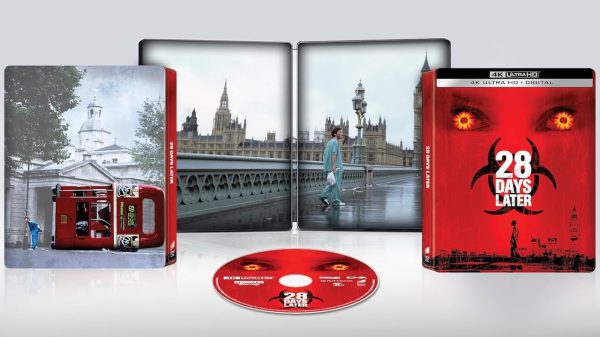
- 28 Days Later Was Shot On MiniDV. So Why Is Sony Releasing It On 4K UHD?
- Obsession 4K UHD Review: Hollywood’s $400 Million Lesson It Won’t Learn
- Criterion’s Complete Kubrick 4K Box Set Costs $599. Here’s Why Collectors Will Still Care
- Them! 4K UHD Review: Nuclear Testing Has An Ant Problem


















Ivor Shanix
September 6, 2026 at 12:09 am
The Arrow 4k/BD doesn’t add any extra picture information to make the 2.35:1 into 2.55:1, it actually crops the picture at the top, and to a lesser extent at the bottom. So you’re actually losing image compared to previous releases. It’s debatable as to if what Arrow have done is correct.
oldroadtoad@netscape.net
September 6, 2026 at 7:43 pm
I have never heard that it was originally in 2.35 and so did an admittedly cursory check of the interwebs. Per that check I present this factoid:
It was originally filmed in early CinemaScope using a anamorphic format, which yielded a wider native aspect ratio of 2.55:1. This extra wide layout was typical of early 1950s CinemaScope films that paired the wide image with a 4-track magnetic stereophonic soundtrack. Shortly after, the film industry transitioned to optical audio tracks on the film prints, which reduced the width of the projected image area down to 2.35:1 or 2.40:1.
Weird, huh?
Thankyew…Thankyewverumuch!
Elvis pORTsley
Chris Chiarella
September 9, 2026 at 7:31 pm
Ivor, you raise a valid question re: the proper framing of the movie, thanks for taking the time to comment. We reached out to Arrow Films for clarification and they had this to say:
“Forbidden Planet was produced in 1956 to be shown in the original Cinemascope 2.55:1 aspect ratio, later cropped on both left and right to be projected at 2.35:1. Prior DVD and Blu-ray presentations in a 2.35:1 aspect ratio show more picture information than was originally intended by the filmmakers; this was achieved by taking the uncropped 2.55:1 frame, stretching it vertically (partly to counteract the effect of ‘Cinemascope mumps’ inherent to the original image) and painting out splice marks from the top and bottom of the negative frame area that would be cropped out during theatrical projection. The 4K restoration by Arrow Video instead returns to the original 2.55:1 framing, with the top and bottom cropped correctly and no vertical stretching. We hope you enjoy this theatrically accurate presentation of Forbidden Planet, together with its original three-channel Perspecta soundtrack.”
Hope this addresses your concerns.
Ian White
September 9, 2026 at 11:04 pm
Cheech,
I knew it! Damn Krell.
😉
IW
Chris Chiarella
September 11, 2026 at 6:28 pm
🤖